
How to Get a Radio License in NZ: A Professional Guide (2026)
Operating a commercial radio network on the wrong frequency isn't just a technical glitch; it's a legal liability that can result in Radio Spectrum Management (RSM) fines of up to NZ$30,000 for a business. Understanding …
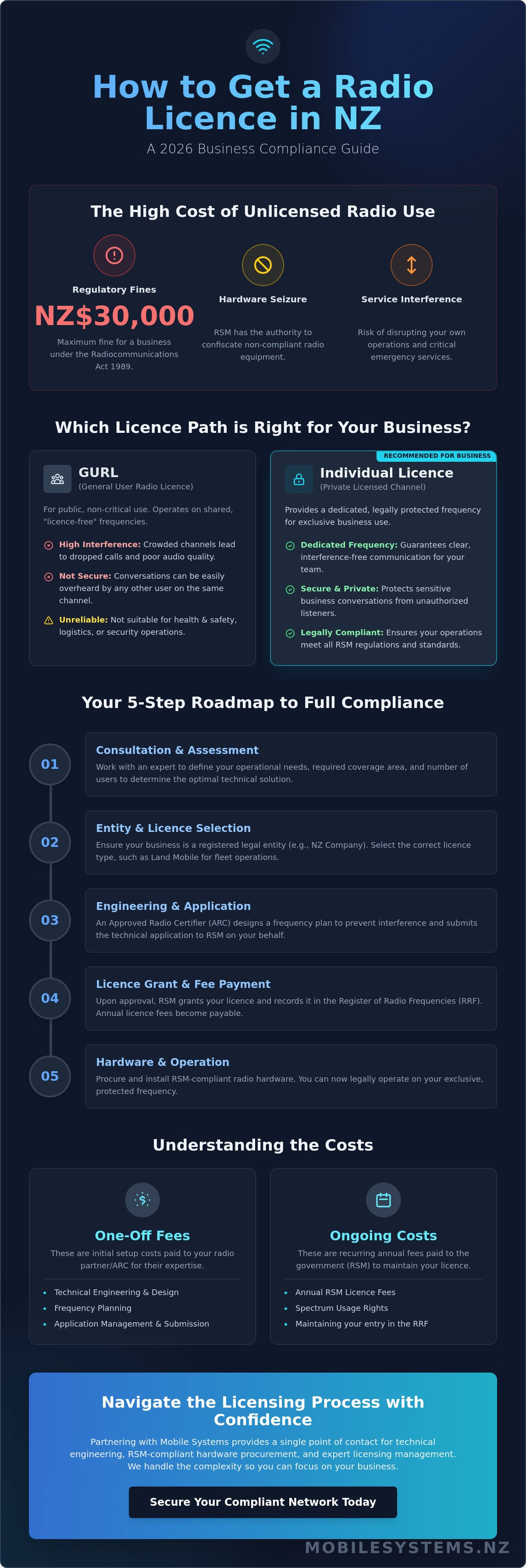
Operating a commercial radio network on the wrong frequency isn't just a technical glitch; it's a legal liability that can result in Radio Spectrum Management (RSM) fines of up to NZ$30,000 for a business. Understanding how to get a radio license nz is the only way to ensure your team stays connected without the risk of regulatory interference or hardware seizures.
You probably feel that reliable communication is the backbone of your daily operations, yet the technical distinction between General User Radio Licences (GURL) and individual spectrum allocations often creates unnecessary confusion for many New Zealand managers. This guide provides a clear, professional roadmap to help your business navigate the regulatory landscape and secure a fully compliant radio network.
We'll explain how to work with an Approved Radio Certifier (ARC) to eliminate interference and provide a transparent breakdown of the annual costs you should expect for 2026. By following these steps, you can focus on your core business while Mobile Systems Limited ensures your communication infrastructure meets every legal standard.
Key Takeaways
- Understand the regulatory role of Radio Spectrum Management (RSM) and how the Radiocommunications Act 1989 governs modern business radio use.
- Follow a structured, step-by-step roadmap on how to get a radio license nz for land mobile or maritime operations.
- Learn how to distinguish between one-off engineering fees and ongoing annual RSM licence costs to budget accurately for your fleet.
- Identify the importance of selecting RSM-compliant hardware to ensure seamless frequency allocation and long-term legal compliance.
- Discover how partnering with Mobile Systems provides a single point of contact for technical engineering, hardware procurement, and licensing expertise.
Understanding the NZ Radio Licensing Framework
The process of learning how to get a radio license nz starts with the Ministry of Business, Innovation and Employment (MBIE). Within this department, Radio Spectrum Management (RSM) acts as the national regulator. They manage the radio frequency spectrum to prevent interference and ensure critical services, such as emergency communications, remain operational without disruption.
Every transmitter in New Zealand operates under the authority of the Radiocommunications Act 1989. While this legislation is decades old, it remains the legal foundation for all 2026 wireless operations. Under this Act, it's illegal to transmit radio waves unless you hold a specific licence or operate under a general exemption. Understanding how to get a radio license nz involves recognizing that the law applies to everything from handheld portables to large-scale repeater networks.
To better understand this concept, watch this helpful video:
Many users confuse the physical radio hardware with the licence itself. In New Zealand, the Register of Radio Frequencies (RRF) is the online database where your rights to a frequency are recorded. Owning a radio doesn't grant you the right to use it; you must have an active entry in the RRF that matches your equipment's technical specifications and location. The hardware is simply the tool that utilizes the rights granted by the RRF entry.
General User Radio Licences (GURL) vs. Individual Licences
GURLs allow anyone to use specific frequencies without a person-specific licence. These are common for Citizen Band (CB) radio, maritime VHF, and low-power devices like garage door openers. Because these are "licence-free" for the end user, they're often crowded. In 2026, high-density industrial zones often suffer from significant congestion on these shared bands, leading to dropped calls or audio interference.
Businesses usually require an Individual Radio Licence to secure a private channel. This provides a dedicated frequency that isn't shared with the public. It's the only way to ensure reliable, secure communication for logistics, health and safety, or security operations. While GURLs are cost-effective for casual use, they lack the privacy and protection from interference that industrial operations demand.
The Importance of Being a Legal Entity
To hold an individual licence, you must be a "legal person" in the eyes of the RSM. This typically means a registered New Zealand company, an incorporated society, or a named individual. You cannot register a licence under a trading name that isn't a recognized legal entity. This requirement ensures there's a clear point of accountability for any interference or regulatory issues.
The registration process involves creating a client profile in the RRF. Your radio partner, such as Mobile Systems Limited, can facilitate this registration to ensure your technical data matches regulatory requirements precisely. A tailored assessment often prevents costly mistakes during this initial setup phase, ensuring your business remains compliant from day one.
Selecting the Correct Licence Type for Your Business
Choosing the right category is the first critical step when learning how to get a radio license nz. The NZ Radio Licensing Framework, managed by Radio Spectrum Management (RSM), categorizes users based on their equipment and operational goals. Selecting the wrong category doesn't just cause compliance issues; it often results in poor signal performance or interference with other local operators.
- Land Mobile Licences: This is the standard for most New Zealand businesses. It covers vehicle-mounted units and handheld teams, making it ideal for logistics, civil construction, and security firms.
- Maritime Coast Station Licences: If your business operates from a fixed shore location to communicate with vessels at sea, you'll require this specific licence. It ensures you're on the correct VHF channels monitored by emergency services.
- Fixed Radio Link Licences: These provide point-to-point solutions for connecting two specific locations. They're frequently used in rural regions where fibre infrastructure is limited or non-existent.
- Aeronautical and Satellite Licences: These are reserved for aviation needs or remote resource sectors where traditional terrestrial signals aren't viable.
Commercial vs. Amateur Licensing
One common mistake is attempting to use amateur (HAM) radio licences for business tasks. Amateur licences are strictly for non-commercial experimentation and personal hobby use. Using them for any form of business gain is a breach of the Radiocommunications Act 1989. Professional licences offer dedicated frequencies with higher power limits, ensuring your team isn't interrupted by hobbyist chatter. You can find more detail on hardware requirements in our Walkie Talkie NZ Professional Guide.
Professional licences also permit the use of repeaters to extend range, which is restricted in many amateur contexts. Businesses need the reliability of a clear, private channel that only a commercial licence provides.
Determining Your Coverage Requirements
Your geographic footprint dictates the licence engineering required. A local licence might cover a 10km radius around a single site, whereas regional or nationwide licences allow for broader movement across the country. Terrain plays a massive role in New Zealand. A business in the Waikato Basin faces different frequency challenges than one operating in the rugged terrain of the Southern Alps.
Hills and valleys influence frequency "overspill," which RSM monitors closely to prevent interference between users. Engineering a solution that accounts for your specific topography is essential to ensure your licence covers the areas where your team actually works. If you're unsure which category fits your fleet, contact our technical team for a site-specific assessment to prevent costly licensing errors.
Step-by-Step Guide: How to Get a Radio Licence in NZ
Securing a spectrum asset requires a methodical approach to meet Radio Spectrum Management (RSM) standards. The process begins with a clear audit of your operational footprint. A delivery fleet operating across the Auckland CBD requires different frequency engineering than a remote forestry site in the Bay of Plenty. Identifying your required coverage area prevents paying for spectrum you don't use.
Once your needs are defined, you must select RSM-compliant hardware. Using non-compliant equipment is a breach of the Radiocommunications Act 1989 and will result in application rejection. You can source approved hardware from the two-way radio inventory at Mobile Systems. Every device must be "type-approved" for use within New Zealand's specific frequency bands.
The core of the application involves five distinct stages:
- Step 1: Define your geographic coverage needs and the number of radios in your fleet.
- Step 2: Choose hardware that carries the R-NZ compliance mark.
- Step 3: Engage an Approved Radio Certifier (ARC) to manage the technical submission.
- Step 4: The ARC performs frequency engineering to ensure no interference with existing users.
- Step 5: Pay the RSM fees via the online portal to receive your commencement date.
Most commercial entities cannot apply for a licence independently because the technical requirements are highly specialized. For a detailed breakdown of the official government process, refer to the RSM guide on How to Get a Radio Licence in NZ. This resource outlines the legal framework that every applicant must follow.
The Critical Role of an Approved Radio Certifier (ARC)
An ARC acts as the technical gatekeeper for New Zealand's airwaves. They use specialized software to model signal propagation and terrain interference. This ensures your signal stays within your boundaries and doesn't bleed into other channels. Mobile Systems provides ARC-managed solutions, handling the engineering and RRF submissions on behalf of clients. This professional oversight prevents common errors, such as selecting a frequency already allocated to emergency services or local government infrastructure.
Navigating the Register of Radio Frequencies (RRF)
The RRF is the official public record for all radio rights in New Zealand. To manage your licence, you'll need a RealMe account to log in to the RRF portal. This system tracks your licence status, expiry dates, and technical parameters. It's vital to keep your contact details current. RSM sends renewal notices through this system. If your email address is outdated, you risk missing a payment deadline. This can lead to the immediate cancellation of your transmission rights, requiring a completely new application process.
Understanding how to get a radio license nz businesses can rely on involves recognizing these administrative requirements. Current RSM annual administration fees are typically billed in NZD and must be paid promptly to maintain your legal right to transmit. A tailored assessment by a professional often prevents the costly mistake of applying for the wrong licence type.
Compliance, Fees, and Avoiding Common Pitfalls
Understanding the financial and legal obligations of spectrum use is essential for any New Zealand business. When you look into how to get a radio license nz, you'll encounter two distinct types of costs. The first is the annual RSM administration fee, which covers the ongoing management of the Register of Radio Frequencies. The second is the one-off engineering fee paid to an Approved Radio Engineer (ARE) for the technical assessment and certification required to secure your frequency. Avoiding "grey market" hardware is a critical safety and compliance step. Radios purchased from international online marketplaces often lack the necessary AS/NZS 4768 certification. These devices can bleed into adjacent frequencies or interfere with emergency services. Using non-compliant hardware or transmitting before your license commencement date is a breach of the Radiocommunications Act 1989. For individuals, this can result in fines up to NZ$30,000, while corporate entities can face penalties of up to NZ$200,000.
Managing Interference and Enforcement
Licensed frequencies provide a level of protection, but they don't physically block others from using the airwaves. If your channel is being "stepped on" by unauthorized users, the Radio Spectrum Management (RSM) field officers have the authority to investigate and shut down illegal transmissions. Most interference issues are actually preventable through better planning. A tailored assessment from Mobile Systems identifies existing users in your area before you apply. This proactive approach ensures your equipment is configured to ignore distant traffic while maintaining clear local communication. If you're experiencing degraded signal quality, contact our technical team for a signal audit.
Licence Renewals and Equipment Updates
Radio licenses aren't a "set and forget" asset. Most licenses require annual renewal through the RSM online portal to remain valid. If you fail to pay the renewal fee, your frequency allocation can be cancelled and immediately made available to another applicant. You must update your license if your operational needs change. This includes:
- Relocating a fixed base station or repeater to a new site.
- Changing the technical specifications of your radio hardware.
- Increasing the height or gain of your antenna system.
If you sell your business, the radio license doesn't automatically transfer to the new owner. A formal transfer process must be completed through an ARE to ensure the new entity is legally recognized as the license holder. Maintaining an accurate record of your radio inventory
Professional Support: Why Partner with Mobile Systems
Mobile Systems acts as your single point of contact for both hardware procurement and regulatory compliance. We eliminate the friction of dealing with multiple vendors by integrating Vehicle Two-Way Radios directly into your existing fleet infrastructure. Our team operates from a dedicated base in Mount Maunganui, supported by mobile units providing nationwide coverage. This local presence ensures that your safety-critical communications meet stringent New Zealand industry standards.
Understanding how to get a radio license nz requires more than just filling out forms. It involves a deep understanding of local RF environments and hardware capabilities. We focus on clarity and technical authority to ensure your team stays connected during emergencies or remote operations. Our goal is to provide a seamless transition from your initial inquiry to a fully licensed, operational fleet.
Custom System Design and Licensing
Standard radio solutions frequently fail to perform in New Zealand's challenging topography. The Southern Alps, the dense bush of the Ureweras, and even the high-density urban corridors of Auckland create unique signal barriers. Professional frequency engineering is essential to avoid interference and ensure long-term reliability for your business.
Our engineers perform detailed signal mapping to determine the best frequency allocations for your specific operational zone. This technical precision prevents common issues like "dead zones" or channel overlap. A tailored assessment often prevents costly mistakes during the initial setup phase. We ensure your license covers exactly what you need without paying for unnecessary spectrum.
Ongoing Technical Support
Licensing isn't a one-time task. As Radio Spectrum Management (RSM) regulations evolve, your fleet must remain compliant to avoid fines or signal degradation. We provide periodic audits of your radio equipment to verify that power outputs and frequencies remain within legal limits. This proactive approach keeps your operations running without unexpected downtime.
The Mobile Systems advantage lies in our local expertise and commitment to safety. We don't just supply gear; we manage the lifecycle of your communication network. Our support includes:
- Annual equipment performance checks to ensure hardware longevity.
- Signal strength verification across your entire operational area.
- Timely updates on RSM licensing fee changes or regulatory shifts.
- Rapid response from our mobile technical units for on-site repairs.
Partnering with a local specialist ensures your business maintains a high-trust communication platform. This support structure protects your investment and guarantees that your team has a reliable lifeline in the field. We take the complexity out of spectrum management so you can focus on your core business operations.
Streamline Your Business Communications with Professional Licensing
Navigating the Radio Spectrum Management (RSM) requirements ensures your business operates within New Zealand legal frameworks while avoiding signal interference. Selecting the correct license type protects your equipment investment and maintains clear communication lines across your entire fleet. It's vital to stay updated on current regulations to keep your operations compliant and efficient.
Understanding how to get a radio license nz involves more than just filing paperwork; it requires technical precision to meet strict local standards. As an Approved Radio Certifier (ARC), Mobile Systems provides the deep technical expertise needed to manage these applications. We specialize in Tait and Hytera commercial systems, ensuring your hardware and licensing align for maximum reliability.
Our team provides nationwide service through dedicated mobile support vehicles, bringing expert knowledge directly to your site. A tailored assessment often prevents costly technical mistakes and ensures your team stays connected when it matters most. We're ready to help you build a robust and fully compliant radio network that serves your business for years to come.
Contact Mobile Systems for a tailored assessment of your licensing and communication needs
Frequently Asked Questions
Do I need a licence for a standard handheld walkie-talkie in NZ?
You don't always need an individual licence for standard walkie-talkies. Most consumer units operate under a General User Radio Licence (GURL), which is free and requires no paperwork for the user. However, if your business requires private, interference-free communication on dedicated frequencies, you must obtain an individual licence from Radio Spectrum Management (RSM).
How much does a commercial radio licence cost annually in New Zealand?
Annual fees for commercial licences are set by Radio Spectrum Management (RSM). Most standard land mobile licences incur an annual administration fee of NZ$153.33 including GST. Engineering fees from an Approved Radio Engineer (ARE) are separate, one-off costs paid during the initial application process to ensure your frequency doesn't clash with others.
Can I use an overseas-purchased radio in NZ without a licence?
Using an overseas radio in New Zealand is often illegal because different countries allocate frequencies differently. US-spec FRS radios often interfere with NZ emergency services or cellular networks. Operating non-compliant equipment carries fines of up to NZ$30,000 under the Radiocommunications Act 1989. It's always safer to source NZ-approved hardware from a local provider.
Understanding how to get a radio license nz ensures your business remains compliant with local laws and avoids costly legal penalties.
What is the difference between an ARC and an ARE?
An Approved Radio Engineer (ARE) performs the technical work, such as interference studies and frequency coordination. An Approved Radio Certifier (ARC) holds the authority to certify that a licence application meets RSM standards. Often, the same professional holds both qualifications to streamline the process of how to get a radio license nz for business clients.
How long does it take to get a radio licence granted?
Most licence applications take between 10 and 20 working days to process. This timeframe includes the technical engineering assessment by an ARE and the final administrative approval by RSM. Complex multi-site systems or high-demand urban areas may require additional coordination time to ensure no interference with existing users.
Is a maritime VHF licence different from a land mobile licence?
Yes, maritime and land mobile licences are distinct categories with different regulations. Maritime VHF requires the operator to hold a Maritime VHF Radio Operator Certificate, and the equipment must stay on designated marine bands. Land mobile licences are for business use on shore and don't require individual operator certificates, though the station itself must be licensed.
What happens if I forget to renew my radio licence?
If you miss your renewal date, RSM will cancel your licence in the Register of Radio Frequencies (RRF). Once cancelled, your frequency becomes available for others to claim. You'll have to pay new engineering and certification fees to reinstate your service. Mobile Systems Limited provides management services to ensure clients never miss these critical deadlines.
Related posts

- June 06, 2026
Did you know that 98.6% of radio licenses in New Zealand are subject to a fee increase starting July 1,...

- May 17, 2026
Read our 2026 NZ guide. DMR vs P25: Which Digital Radio Standard is Right for Your Business? Compare features to...

- May 09, 2026
Choosing the wrong frequency can leave you in a dead zone exactly when you need a hand in the back...