
UHF vs VHF for Farming in NZ: Choosing the Right Radio System (2026)
Choosing the wrong frequency can leave you in a dead zone exactly when you need a hand in the back paddock. When comparing uhf vs vhf for farming nz, the decision isn't about which radio has the most buttons, but which wavelength can actually penetrate your specific terrain.
Choosing the wrong frequency can leave you in a dead zone exactly when you need a hand in the back paddock. When comparing uhf vs vhf for farming nz, the decision isn't about which radio has the most buttons, but which wavelength can actually penetrate your specific terrain. A 5-watt handheld that works perfectly on the flats might fail completely once you move into a steep gully.
You've likely dealt with frustrating signal drop-outs or hardware that fails during a harsh winter storm. Reliable communication is a fundamental safety requirement, not a luxury. We'll show you how to achieve a clear signal from the wool shed to your furthest boundary while ensuring your equipment stands up to daily farm life.
This guide breaks down the technical trade-offs between frequencies, explains the July 2026 licensing fee updates, and highlights why using non-compliant overseas gear can result in fines up to NZ$30,000. You'll gain the clarity needed to invest in a rugged system that just works, every time you pick up the handset.
Key Takeaways
- Match your frequenc to your land; VHF generally handles rolling hills better, while UHF excels in tight gullies or around farm buildings.
- Understand the difference between the 5-watt limit on public PRS channels and the 25-watt power boost available through a licensed commercial frequency.
- Learn why the uhf vs vhf for farming nz debate must consider the NZ$190.00 RSM license fee increase effective July 1, 2026.
- Identify why transitioning to Digital Mobile Radio (DMR) provides a 40% boost in battery life and ensures clearer communication during critical shifts.
- Avoid the NZ$30,000 fines associated with using unapproved overseas equipment by selecting RCM-compliant hardware tailored for New Zealand conditions.
Understanding UHF and VHF Frequencies in the NZ Agricultural Context
Choosing the right frequency is the most critical decision when designing a rural communication network. In New Zealand, the uhf vs vhf for farming nz debate usually comes down to your specific landscape and operational scale. Radio Spectrum Management (RSM) oversees these frequencies to prevent interference, ensuring that emergency services and businesses can operate without cross-talk or signal collisions.
To better understand how these frequencies behave in the real world, watch this helpful comparison:
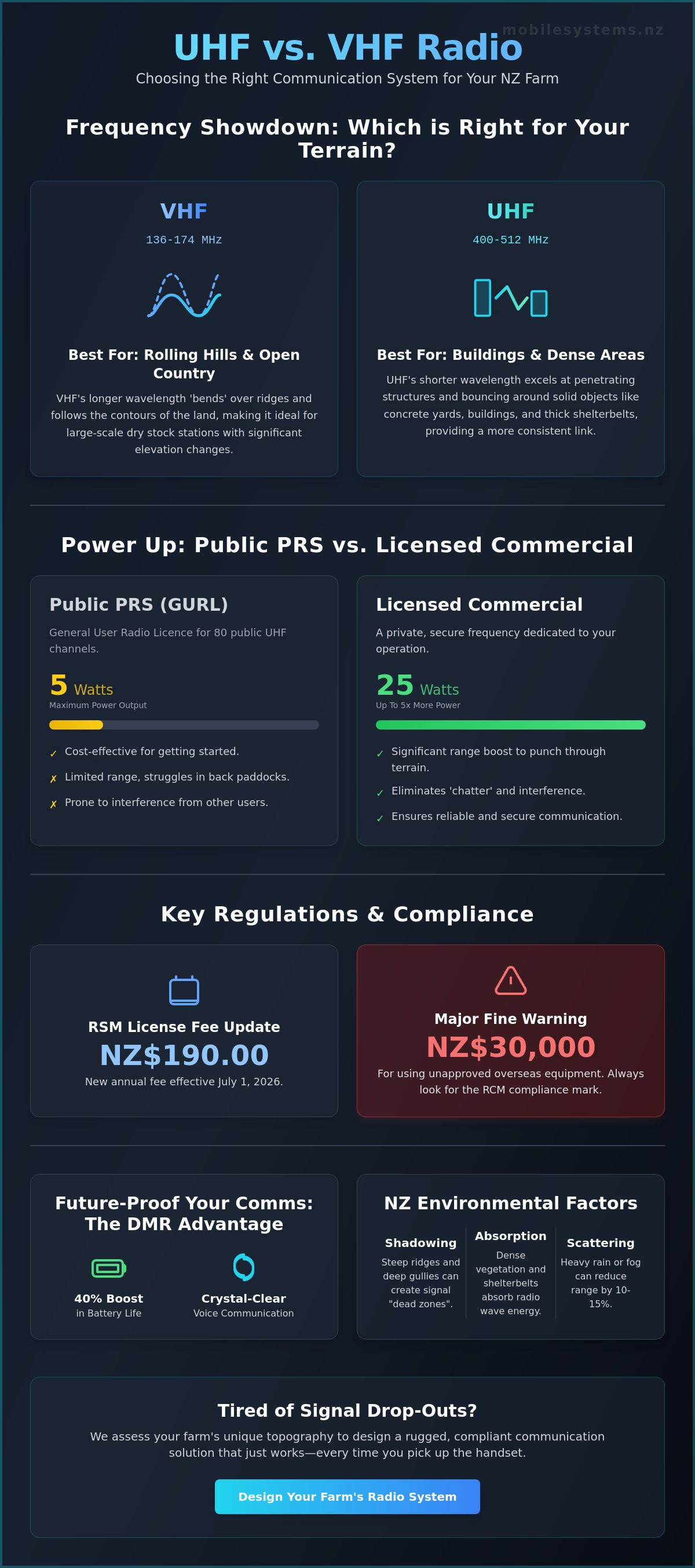
VHF (Very High Frequency) typically operates between 136 and 174 MHz, while UHF (Ultra High Frequency) sits between 400 and 512 MHz. For a deep technical dive into the latter, Understanding UHF Frequencies provides a solid foundation on how these waves propagate and interact with the environment. Selecting the wrong band can lead to permanent "dead zones" that no amount of extra battery power can fix.
The Science of Wavelengths: Why It Matters to a Farmer
VHF waves are physically longer, which allows them to "bend" or diffract over the top of rolling hills and follow the contours of the land. This makes VHF the industry standard for large-scale dry stock stations with significant elevation changes. If you need to reach a shepherd on the other side of a ridge, VHF is your best bet.
UHF waves are shorter and move in straighter lines. While they don't bend over hills well, they excel at bouncing around solid objects and penetrating structures. If your farm operation involves high-density housing, concrete yards, or thick shelterbelts, UHF often provides a more consistent link. However, both frequencies rely heavily on "line-of-sight" principles, meaning steep ridges will still create "shadowing" where the signal is completely lost.
PRS vs. Commercial Frequencies
Many New Zealand farmers start with the Personal Radio Service (PRS). These are 80 designated UHF channels available for public use under a General User Radio Licence (GURL). While PRS is cost-effective, it's limited to a maximum power output of 5 watts. This power cap often leaves farmers struggling for range in the back blocks of larger properties.
Moving to a private commercial frequency allows for much higher performance and security. Licensed systems, often featuring vehicle-mounted two-way radios, can operate at up to 25 watts. This provides significantly more "punch" through difficult terrain. Key facts for 2026 include:
- Licensing Costs: The RSM annual license fee for a private frequency is scheduled to increase to NZ$190.00 effective July 1, 2026.
- Interference: Private channels eliminate the "chatter" from neighbors or truckies that often plagues public PRS channels.
- Compliance: Professional systems must carry the RCM compliance mark to be legal in New Zealand; using unapproved overseas gear can lead to fines of up to NZ$30,000.
A tailored assessment of your farm's topography often prevents costly mistakes. By understanding the physics of your land, you can choose a system that ensures safety and efficiency across every paddock.
Terrain and Signal Propagation: How NZ Topography Affects Your Range
New Zealand's varied topography is the biggest hurdle for radio range. Soil moisture levels significantly impact signal absorption; high moisture in regions like the Waikato can dampen signal strength compared to drier eastern areas. Dense vegetation and thick shelterbelts also act as physical barriers, absorbing energy from the radio wave before it reaches its destination.
Shadowing occurs when a steep ridge or deep gully sits between the transmitter and receiver. Even with a high-power radio, the signal can't always pass through solid earth. This is a primary frustration when evaluating uhf vs vhf for farming nz. In regions like Southland, heavy rain or thick fog can cause signal scattering, which may reduce your effective range by 10% to 15% during severe weather events.
For farms with extreme topographic challenges, a repeater station is often the only solution. A repeater is installed on a high point to receive a signal and re-broadcast it, effectively "looking" over the hills that block your line-of-sight. To ensure your setup remains legal, all equipment must comply with RSM Regulations for NZ Farmers, avoiding interference with neighboring operations.
VHF: The King of the Hill Country
Rugged sheep and beef stations almost always require VHF. Its longer waves follow the ground's curve more effectively, requiring fewer towers to cover vast, rolling distances. The main trade-off is antenna size. VHF requires longer antennas, typically 1/4 wave or 1/2 wave lengths, which need secure mounting on quads or side-by-sides to handle the vibration of hill work.
UHF: Precision for Flat Land and Infrastructure
Dairy farms and intensive horticulture blocks benefit from UHF's ability to bounce around buildings. Shorter UHF waves penetrate wintering barns and milking sheds much better than VHF. UHF is also far more resilient against the electrical "noise" generated by electric fences and heavy machinery, which can cause significant static on older analogue VHF systems.
In 2026, the industry shift toward Digital Mobile Radio (DMR) has addressed many traditional interference issues. Unlike analogue radios that fade into static at the edge of their range, DMR provides clear audio until the signal is completely lost. This digital clarity is essential when coordinating staff near noisy harvesters or in high-interference environments. If you're unsure which frequency matches your farm's map, a tailored assessment often prevents costly mistakes.
Comparing UHF and VHF Performance for Specific NZ Farming Operations
The transition from analogue to Digital Mobile Radio (DMR) in 2026 has redefined how we measure performance. While analogue signals slowly dissolve into static as you reach the boundary, digital systems provide crystal-clear audio right up to the edge of the coverage area. This "all or nothing" clarity ensures instructions aren't misunderstood, though it requires a more precise understanding of uhf vs vhf for farming nz to avoid sudden signal drops.
Battery efficiency is a major driver for the digital shift. Modern DMR handhelds offer up to 40% better battery life than older analogue units because they only transmit for half the time during a conversation. For staff working 12-hour shifts during calving or mustering, this prevents the common frustration of a dead radio before the job is finished.
Decision Matrix: Hill Country vs. Flat Dairy
Operational needs dictate the hardware. A 5-watt handheld on a flat dairy farm in the Canterbury Plains will perform differently than the same unit on a rugged King Country station. Understanding these range expectations helps in selecting the right tool for the task:
- Hill Country (Sheep & Beef): VHF is the priority. A 5W handheld typically achieves 5-10km range over rolling terrain. Dense shelterbelts have minimal impact on these longer waves.
- Flat Land (Dairy & Horticulture): UHF is superior. While the range might be 3-5km, the signal penetrates milking sheds and wintering barns where VHF often fails.
- Multi-Vehicle Coordination: For teams using a mix of tractors, quads, and utes, vehicle-mounted 25W units provide the "backbone" of the network, significantly extending the reach of handheld users.
Mixed Environment Solutions
Many New Zealand properties feature a mix of river flats and steep back blocks. Relying on a single handheld frequency in these "mixed" environments often leads to communication gaps. While dual-band radios exist, they're often consumer-grade and lack the ruggedness required for daily farm use. A more reliable approach involves professional system design.
Integrating handhelds with vehicle-mounted high-gain antennas can bridge the gap between different terrains. A ute parked on a high point can act as a localized hub, allowing staff in the gullies to maintain contact with the main shed. If your operation is expanding or moving into more difficult country, understanding the Radio Spectrum Management (RSM) licensing process is the first step toward a legal, high-power commercial solution.
Professional installation of vehicle-mounted two-way radios ensures that antennas are tuned correctly for your specific landscape. This technical precision often doubles the effective range compared to out-of-the-box setups. If you're struggling with "dead spots" on your boundary, a tailored assessment of your current hardware can identify where signal is being lost.
Commercial Licensing and RSM Regulations for NZ Farmers
Operating a commercial farm in New Zealand requires more than just buying a set of walkie-talkies from a retail store. While the 80 public PRS channels are free to use under a General User Radio Licence, they're legally restricted to a 5-watt power limit. For many operations, this isn't sufficient to cover the entire property, making the uhf vs vhf for farming nz hardware choice even more critical.
Stepping up to a private, licensed frequency allows you to use 25-watt vehicle-mounted units, which provide a massive boost in range and reliability. Radio Spectrum Management (RSM) enforces these rules strictly to prevent interference between users. Using non-compliant overseas equipment or exceeding power limits on public channels can result in fines of up to NZ$30,000.
Standard annual license fees for a private frequency are scheduled to increase to NZ$190.00 effective July 1, 2026. This fee covers the right to use a dedicated channel without interference from others. Most farm licenses are renewed annually, ensuring your frequency remains protected under the current regulations.
Why Private Channels are a Safety Essential
Safety is the primary reason to move beyond public channels. On a busy day, having your team's emergency calls interrupted by a neighbor's chatter or a nearby trucking firm is a significant risk. Private channels ensure your communication remains confidential and clear, which is vital for WorkSafe compliance and operational efficiency.
Modern digital systems on private frequencies also unlock advanced safety features like "Lone Worker" and "Man Down" alerts. These functions automatically trigger an alarm if a staff member remains stationary for too long or if a radio is tilted beyond a certain angle, indicating a potential accident. These tools are only effective when you have a clear, interference-free channel to transmit the distress signal.
The Licensing Process Simplified
Obtaining a license isn't an automatic process. It requires an RSM Approved Radio Engineer (ARE) to conduct a site survey and engineer the frequency to ensure it doesn't interfere with existing users. This technical engineering is what guarantees your signal stays strong and legal across your entire boundary.
We manage the technical paperwork for farm owners, handling the application from the initial survey to the final frequency allocation. You'll need to decide between an "Area Wide" license, which allows for mobile use across a broader region, or a "Site Specific" license tailored to your farm's exact coordinates. If you're ready to secure a dedicated frequency for your team, contact our team for a licensing assessment.
Designing a Robust Communication Solution with Mobile Systems
Designing a robust network requires more than just picking a frequency. It involves mapping your terrain and understanding where signal shadowing occurs. Mobile Systems brings years of experience in bespoke rural communications, ensuring that your choice between uhf vs vhf for farming nz results in total coverage rather than a series of expensive dead zones.
Professional installation is non-negotiable for vehicle-mounted units. A poorly mounted antenna can lose 50% of its effective range through signal loss or cable interference. Our mobile service vehicles travel directly to your property to tune and test every unit in the actual environment where it'll be used, preventing the common "buy twice" trap of retail-grade gear.
On-site support is a cornerstone of our service. If a radio fails during the peak of the season, you don't have time to send it away for weeks. Our technicians provide field-based servicing to keep your fleet operational. This hands-on approach ensures that your hardware stays rugged and reliable, regardless of the Waikato mud or Southland frost.
From Handhelds to Repeaters: The Mobile Systems Range
Our range includes world-class Tait radios, engineered to survive the dust, vibration, and moisture of New Zealand's agricultural sector. These units are built to military standards, making them far more durable than consumer electronics. We pair these units with high-gain antennas specifically tuned to your licensed frequency to maximize range.
Digital Mobile Radio (DMR) technology is especially effective in high-interference environments. While older analogue systems might pick up static from electric fences or heavy machinery, DMR filters out this noise to provide clear voice data. For managers looking to improve operational oversight, we offer integrated solutions that combine voice communication with fleet tracking systems, allowing you to see vehicle locations in real-time.
Next Steps for Your Farm Comms
Don't wait for a communication failure during a critical muster or a safety incident. Booking a coverage audit allows us to identify dead zones before they become hazards. We use signal testing equipment to map your property's actual performance, ensuring your investment is backed by data rather than guesswork.
Future-proofing your farm with digital-ready hardware is a smart move for 2026 and beyond. As regulations and technology evolve, having a system that can handle data and enhanced safety features will keep your operation compliant and efficient. For a tailored assessment that fits your specific boundary, contact the experts at Mobile Systems today. A professional consultation often prevents the costly mistakes of a DIY setup.
Future-Proofing Your Farm Communications
Reliable communication is a critical safety tool that protects your team across every hectare. Balancing the technical trade-offs of uhf vs vhf for farming nz requires a clear understanding of your property's unique topography and the specific demands of your daily operations. Whether you're managing a steep hill station or an intensive dairy block, the 2026 shift toward digital systems ensures your hardware remains a reliable asset for years to come.
Navigating the July 2026 RSM licensing changes and selecting the right hardware can be complex. As authorized Tait and Hytera specialists, we provide the technical expertise needed to secure your private frequency and install equipment that withstands the harshest New Zealand conditions. Our NZ-wide mobile support vehicles bring this expertise directly to your gate, ensuring your system is tuned for peak performance from day one.
A professional audit of your current coverage can identify hidden risks before they lead to communication failures. Get a tailored radio assessment for your farm today to ensure your team stays connected, compliant, and safe. Investing in the right system now prevents the frustration of signal drop-outs when they matter most.
Frequently Asked Questions
Can UHF and VHF radios communicate with each other?
No, UHF and VHF radios cannot communicate directly because they operate on entirely different frequency bands. UHF uses 400 to 512 MHz while VHF uses 136 to 174 MHz. To connect the two, you would need a specialized cross-band repeater system, which is rarely practical or cost-effective for standard farming operations.
Do I need a license to use a two-way radio on my NZ farm?
You don't need to apply for a license to use public UHF PRS channels as they are covered by a free General User Radio Licence. However, if you want the 25-watt power boost and privacy of a commercial frequency, you must obtain a private license. Effective July 1, 2026, the annual RSM fee for these private licenses is NZ$190.00.
Which is better for hill country farming: UHF or VHF?
VHF is the better choice for rugged hill country because its longer wavelengths diffract over ridges more effectively. When comparing uhf vs vhf for farming nz, VHF provides a clear advantage on large dry-stock stations where line-of-sight is frequently broken by steep terrain. UHF is better suited for flat dairy blocks and working inside sheds.
What is the typical range of a 5W handheld radio on a farm?
A 5W handheld radio typically provides a range of 3 to 5 kilometres on open, flat land. In dense bush or deep gullies, this range can drop to less than 1 kilometre due to signal absorption and shadowing. Mounting a high-gain antenna on a vehicle can significantly extend this range by providing a higher, more stable transmission point.
Can I use a marine VHF radio for land-based farming operations?
It's illegal to use marine VHF radios for land-based farming in New Zealand. These frequencies are strictly reserved for maritime safety and emergency services. Using them on land can interfere with search and rescue operations and exposes you to severe penalties from Radio Spectrum Management (RSM), including equipment seizure and heavy fines.
What is the difference between PRS and a commercial radio license?
PRS (Personal Radio Service) uses 80 public UHF channels that anyone can access, but it's limited to 5 watts of power. A commercial license provides you with a private, dedicated frequency that allows for 25-watt transmissions. This extra power is essential for covering larger properties where public channels lack the necessary signal strength to reach the boundaries.
How does digital (DMR) radio improve farm communication?
Digital Mobile Radio (DMR) improves communication by providing 40% better battery life and crystal-clear audio even at the edge of the coverage area. Unlike analogue signals that fade into static, digital stays clear until the signal is completely lost. It also supports advanced safety features such as GPS tracking and automated "Man Down" alerts for staff.
What happens if I use an unlicensed high-power radio in NZ?
Using an unlicensed high-power radio or non-compliant overseas equipment can lead to fines of up to NZ$30,000. These radios often interfere with critical emergency frequencies used by police or fire services. RSM actively monitors the spectrum to ensure all users comply with the AS/NZS 4365:2011 standard and carry the required RCM compliance mark.
Related posts

- June 12, 2026
Relying on a cellular signal in the Southern Alps or the dense King Country bush is a calculated risk that...

- June 06, 2026
Did you know that 98.6% of radio licenses in New Zealand are subject to a fee increase starting July 1,...

- May 17, 2026
Read our 2026 NZ guide. DMR vs P25: Which Digital Radio Standard is Right for Your Business? Compare features to...