
GPS Technology for NZ Businesses: The 2026 Definitive Guide
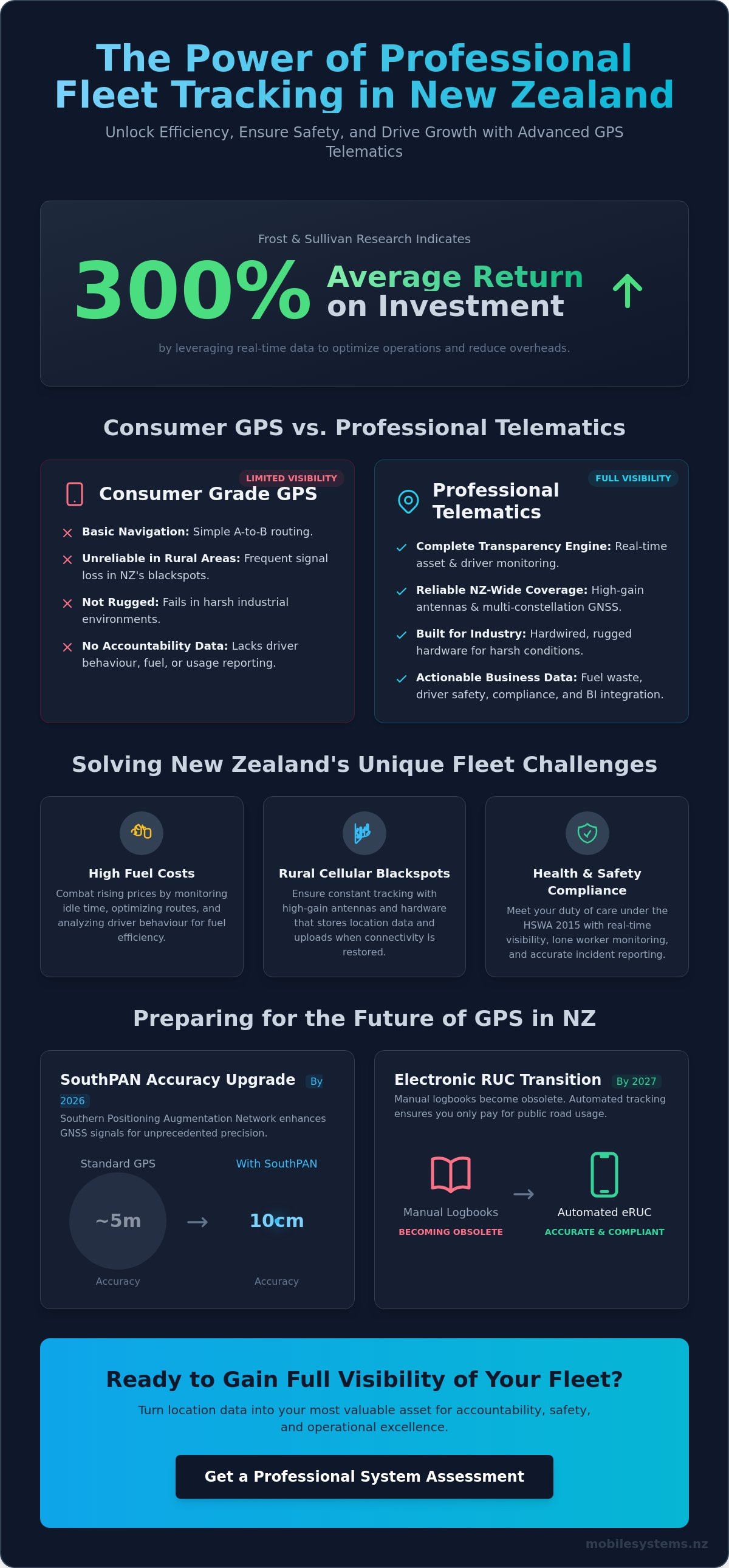
Research from Frost & Sullivan indicates that fleet tracking technology provides an average 300% return on investment for businesses. You likely already recognize that managing a New Zealand fleet with gps involves more than just basic navigation.
Research from Frost & Sullivan indicates that fleet tracking technology provides an average 300% return on investment for businesses. You likely already recognize that managing a New Zealand fleet with gps involves more than just basic navigation. It's about balancing high fuel costs and rural cellular blackspots with the strict requirements of the Health and Safety at Work Act 2015.
This definitive guide explains how professional tracking systems drive operational efficiency and ensure safety for your remote teams. By moving beyond simple tracking, your business can gain full visibility over assets and significantly reduce operational overheads. We'll show you how to turn location data into a tool for driver accountability and legal protection.
We'll examine the 2026 impact of the SouthPAN accuracy improvements, which now offer positioning within ten centimeters. You'll also learn how to prepare for the 2027 electronic Road User Charge (RUC) transition and how to select hardware that remains reliable in New Zealand's most isolated regions.
Key Takeaways
- Understand why commercial-grade gps telematics offer superior transparency and accountability compared to standard consumer navigation tools.
- Learn how the combination of high-quality antennas and satellite constellations ensures reliable coverage across New Zealand's diverse terrain.
- Identify the critical differences between basic location tracking and advanced fleet data to choose the right level of visibility for your operations.
- Ensure your business remains compliant with the Health and Safety at Work Act 2015 and the Privacy Act 2020 through transparent tracking policies.
- Discover the long-term benefits of professional hardware installation and tailored system assessments to avoid common implementation mistakes.
Understanding GPS Technology in the Modern Business Landscape
Business leaders often view the Global Positioning System as a simple dot on a map. In a commercial context, however, it functions as a transparency engine that drives accountability across your entire mobile workforce. It's no longer just about knowing where a vehicle is; it's about understanding how your assets are being utilized in real-time.
The transition from basic navigation to commercial telematics is significant. While a consumer app might tell you the best route to a destination, a professional system monitors how the vehicle is driven, how much fuel is wasted idling, and whether the asset is being used outside of authorized hours. This level of detail allows for precise operational control that mobile phones simply can't provide.
To better understand how this technology functions on a technical level, watch this helpful video:
Real-time data is the primary driver for modern decision-making. Managers can now see exactly where their teams are, which reduces the need for constant check-in calls and allows for faster dispatching during emergencies. This visibility is vital for meeting the duty of care requirements under the Health and Safety at Work Act 2015, particularly for workers in isolated areas.
Choosing professional hardware over consumer-grade smartphones is a critical distinction for Kiwi firms. Mobile devices frequently lose signal in rural areas and aren't built to withstand the dust and vibration of a construction site or forestry block. Dedicated gps units are hardwired into the vehicle, ensuring they're always powered and reporting accurately even in the harshest conditions.
The Evolution of GPS in Commercial Operations
GPS technology has moved from its military origins into a core piece of fleet management infrastructure. It now serves as the primary data source for complex logistics and supply chain management systems. By feeding location data into business intelligence tools, companies can automate their reporting and identify hidden inefficiencies that otherwise go unnoticed.
This evolution has led to massive gains in productivity. Research from Frost & Sullivan shows that businesses adopting this technology see an average 300% return on investment. It's not just about tracking; it's about using data to predict maintenance needs and optimize fuel consumption across the entire fleet.
Why NZ Businesses are Prioritizing GPS Integration
New Zealand's landscape presents unique challenges that off-the-shelf solutions often fail to address. From cellular blackspots in the King Country to the rugged terrain of the Southern Alps, businesses need professional GPS solutions that offer high-gain antennas and reliable data storage for when connectivity is temporarily lost.
With the government's transition to a comprehensive electronic Road User Charge (RUC) system expected by 2027, manual logbooks are becoming obsolete. Accurate tracking ensures that businesses only pay for the distance they actually travel on public roads. It also provides the necessary evidence for asset security in remote regions where theft and unauthorized use are growing concerns.
How GPS Works: Satellites, Signals, and NZ Coverage
Most users think of gps as a standalone system, but it's part of a broader network of Global Navigation Satellite Systems (GNSS). A receiver calculates its position by timing signals from at least four satellites. According to Official U.S. Government GPS information, the system provides highly accurate positioning, but the quality of your commercial hardware determines how well that signal is captured and processed.
Modern receivers now use multiple constellations simultaneously, including GPS (USA), GLONASS (Russia), and Galileo (Europe). This redundancy is vital for maintaining accuracy when parts of the sky are blocked. The 2026 rollout of the Southern Positioning Augmentation Network (SouthPAN) further enhances this by correcting signal errors, improving accuracy from five meters down to less than ten centimeters for certified applications across New Zealand.
Signal quality depends on several technical factors:
- Antenna Gain: High-quality antennas can pick up weaker signals that standard mobile devices miss.
- Atmospheric Conditions: Ionospheric delays can slightly shift signal timing, though SouthPAN now corrects most of this.
- Receiver Sensitivity: Commercial-grade chips process signals faster, reducing the time to first fix (TTFF) when starting a vehicle.
Overcoming the Challenges of the NZ Terrain
New Zealand's geography is notoriously difficult for satellite signals. Deep valleys in the Southern Alps or dense canopy in central North Island forestry blocks create signal shadows where line-of-sight is lost. High-gain antennas are essential for these rural operations. They provide the necessary sensitivity to maintain a lock where a standard smartphone would fail.
Correct hardware placement on a vehicle is just as important as the device itself. Mounting an antenna under a metal dashboard or behind heavy machinery can lead to multipath interference, where signals bounce off surfaces and cause location "drift." Local expertise ensures that hardware is positioned to maximize sky visibility while remaining protected from the elements. A tailored hardware assessment helps identify the specific mounting requirements for your unique operating environment.
GPS and Satellite Communication Synergy
It's important to distinguish between finding a location and transmitting it. GPS satellites only send data to your receiver; they don't send your vehicle's data back to the office. In areas with no cellular coverage, businesses must use Iridium or Starlink to transmit that location data. This synergy ensures that a lone worker's position is always visible to dispatch, even in cellular dead zones.
Learning what Starlink is and how it works reveals how satellite internet provides the necessary backbone for remote tracking. By combining accurate positioning with robust data transmission, New Zealand firms can eliminate operational blind spots. This integrated approach is the only way to ensure 100% visibility across the most rugged parts of the country.
GPS vs. Fleet Tracking: Choosing the Right Level of Visibility
Many managers confuse basic navigation with comprehensive telematics. While a standard consumer app provides turn-by-turn directions, professional fleet tracking integrates gps data with vehicle diagnostics to provide a complete operational picture. This distinction is the difference between simply reaching a destination and managing the cost and safety of that journey.
Fleet tracking adds layers of intelligence that navigation apps can't match. You gain visibility into engine idling times, precise speeding events, and fuel consumption patterns. This data allows for a granular analysis of operational costs. Reducing idling by just 10% can lead to significant annual fuel savings for a medium-sized New Zealand fleet, making the technology a profit centre rather than an expense.
Historical data is equally critical, especially when investigating incidents or verifying service delivery times. If a customer disputes a billing period or an accident occurs, having a second-by-second breadcrumb trail provides an indisputable record of events. This transparency protects your business from liability and supports your compliance with WorkSafe New Zealand standards by providing a clear audit trail of driver activity.
Feature Comparison: Consumer Apps vs. Professional Systems
Professional systems offer a level of reliability that mobile devices can't sustain. While a phone might refresh its position every 30 seconds to save battery, a hardwired gps unit provides updates every few seconds. This high-frequency data is essential for accurate geofencing, allowing you to receive instant alerts the moment a vehicle enters or leaves a specific site or depot.
Reliability also extends to the hardware itself. Consumer phones often overheat on dashboards or lose signal due to poor internal antennas. Professional units are built to industrial standards, designed to handle the vibrations and temperature extremes found in heavy machinery and commercial vans. You can learn more about how fleet tracking systems boost your business efficiency by providing consistent, high-quality data regardless of the environment.
Monitoring Driver Behaviour and Safety
Tracking systems do more than watch vehicles; they help protect people. By monitoring G-force sensors, these systems identify harsh braking, rapid acceleration, and aggressive cornering. This data serves as a practical tool for driver coaching, allowing managers to implement incentive programmes that reward safe, smooth driving. Improved habits don't just increase safety; they also reduce wear and tear on tyres and brakes.
For remote teams, these systems are a lifeline. In the event of a crash or a vehicle breakdown in a cellular blackspot, the last known position is automatically transmitted. This capability is a cornerstone of lone worker safety, ensuring that help can be dispatched to the exact coordinates even if the driver is unable to call for assistance. This proactive approach to safety is a key requirement for modern New Zealand businesses operating in high-risk sectors like forestry or agriculture.
Key Considerations for Implementing GPS Systems in New Zealand
Implementing a gps solution requires more than just purchasing hardware. It involves a strategic commitment to workplace safety and data integrity. For New Zealand businesses, this means aligning technology with specific local regulations while ensuring equipment can survive the country's demanding physical environment.
Ongoing technical support is a factor many firms overlook during the initial purchase. A system is only effective if it remains operational. Choosing a partner that provides local servicing and understands New Zealand's cellular blackspots ensures your investment continues to deliver value long after the initial installation. Reliable support prevents data gaps that could compromise your safety records.
Compliance and Duty of Care
The Health and Safety at Work Act 2015 (HSWA) mandates that employers take all reasonably practicable steps to ensure worker safety. GPS data serves as critical evidence of this compliance. It provides a verifiable record of location, speed, and rest periods, which is essential for managing the risks associated with long-haul driving or remote field work.
Privacy is equally important. Under the Privacy Act 2020, businesses must be transparent about how they collect and use tracking data. You should establish clear policies that inform staff about what is being monitored and why. Open communication builds trust and ensures your use of technology remains ethical and legally sound. Avoid covert tracking, as it is illegal in New Zealand and can lead to significant penalties.
- Establish a written GPS usage policy for all employees.
- Ensure data is stored securely and only accessed by authorized personnel.
- Use tracking data primarily for safety, efficiency, and training purposes.
Hardware Durability and NZ Standards
New Zealand's climate and terrain are notoriously hard on electronic equipment. Hardware used in the forestry, construction, or agricultural sectors must have high Ingress Protection (IP) ratings to resist dust and moisture. Standard consumer devices often fail when exposed to the high-vibration environments of heavy machinery or off-road vehicles.
Professional installation is the only way to ensure vehicle-mounted units function correctly over the long term. Poorly installed antennas or loose wiring can lead to intermittent signal loss, which creates dangerous blind spots in your tracking map. You can explore a range of robust options in our Portable Communications GPS Collection to find hardware built for these conditions.
Every business has unique operational hurdles that a generic solution won't solve. To ensure your system meets both legal requirements and your specific site needs, contact our expert team for a professional assessment of your fleet's requirements.
Expert GPS Installation and Support with Mobile Systems
Selecting the right hardware is only the first step in building a reliable tracking network. Mobile Systems Limited serves as the New Zealand authority on integrated communication, ensuring that your gps investment works in harmony with your existing tools. We specialize in complex environments where standard solutions often fail to perform.
One of our core strengths is the integration of location tracking with other critical technologies. We often combine satellite positioning with two-way radios and cellular boosters to create a seamless safety net. This holistic approach ensures that your team stays connected and visible, even when they're operating far beyond the reach of the standard mobile network.
Our fleet of mobile service vehicles allows us to provide nationwide support, bringing technical expertise directly to your site. This local presence is vital for minimizing downtime. If a unit requires servicing or a configuration change, you don't have to wait for international support queues; our technicians understand the specific challenges of New Zealand's rural and industrial sectors.
The Mobile Systems Advantage: Beyond the Box
With decades of experience based in Mount Maunganui and serving clients across the country, we've seen the pitfalls of "off-the-shelf" kits. These generic products often lack the necessary shielding or antenna quality for heavy industrial use. A tailored assessment often prevents costly mistakes in hardware choice by identifying the exact requirements of your specific vehicle types and operating regions.
Professional installation is a non-negotiable part of our service. Our technicians ensure that all equipment is mounted securely and integrated into the vehicle's electrical system without voiding manufacturer warranties. We pay close attention to cable routing and antenna placement to prevent the signal interference issues discussed in earlier sections, ensuring your data remains accurate and consistent.
- Customized hardware configurations for specialized machinery.
- Warranty-safe installation by qualified technicians.
- Integration with digital RUC and health and safety software.
- Nationwide mobile support for fleet-wide deployments.
Getting Started with Professional GPS
Initiating a consultation for your fleet or remote team is a straightforward process. We begin by analyzing your current operational blind spots and safety requirements. Whether you're managing a handful of delivery vans or a large-scale forestry operation, we provide a clear roadmap for implementation that focuses on long-term reliability and return on investment.
The value of a tracking system is realized through its ongoing performance. That's why we prioritize after-sales technical support and regular system health checks. We help you interpret the data your system generates, turning raw coordinates into actionable insights for your business. To begin your transition to a more efficient and safer operation, contact Mobile Systems today for a professional consultation.
Securing Your Operational Future with Precision Tracking
Adopting professional-grade gps technology is a strategic investment in transparency and safety. By integrating these systems, your business can meet the requirements of the Health and Safety at Work Act 2015 while preparing for the 2027 electronic RUC transition. Reliable data ensures you only pay for what you use while maintaining a clear audit trail for compliance.
Mobile Systems Limited is a 100% NZ-owned and operated specialist in rugged terrain solutions. We provide full lifecycle support, from professional installation to ongoing servicing, ensuring your hardware remains reliable in the most isolated regions. Our expertise helps you avoid the common pitfalls of consumer-grade equipment that fails in industrial environments.
Taking a proactive approach to asset visibility reduces operational overheads and protects your most valuable assets: your people. A tailored assessment often prevents costly mistakes; contact our experts today to discuss your requirements. We look forward to helping you build a more efficient, safer fleet.
Frequently Asked Questions
How accurate is professional GPS compared to a smartphone?
Professional receivers offer significantly higher precision than standard mobile devices. While a smartphone typically provides location data within a five to ten meter range, high-grade commercial units utilizing the SouthPAN network can achieve accuracy of less than ten centimeters. This level of detail is necessary for precise asset management in sectors like construction and civil engineering.
Do GPS tracking systems work in areas with no cellular coverage?
Positioning data is calculated via satellites and functions independently of cellular networks. However, to transmit that location data back to your office in real-time, the gps hardware must be paired with satellite communication tools like Iridium or Starlink. Without a satellite transmission link, the device will simply store the data until the vehicle returns to a cellular coverage area.
What is the cost of installing a GPS fleet tracking system in NZ?
Typical monthly subscriptions for fleet tracking in New Zealand range from $25 to $50 per vehicle. Some entry-level providers offer flat rates of $20 per month, while hardware costs can range from $0 to $280 plus GST per unit. The final price depends on whether you require basic location data or advanced telematics like engine diagnostics and fuel monitoring.
Can GPS tracking help my business comply with Health and Safety laws?
Tracking systems are a primary tool for meeting duty of care requirements under the Health and Safety at Work Act 2015. They provide real-time visibility of lone workers and allow for immediate emergency response in isolated regions. This data also acts as a record of your proactive efforts to manage workplace risks during any WorkSafe New Zealand investigations.
How long does it take to install a professional GPS unit in a vehicle?
A standard professional installation generally takes between one and two hours per vehicle. This process involves hardwiring the unit into the vehicle's power supply and securely mounting antennas to ensure clear sky visibility. Installations involving complex telemetry or integration with heavy machinery may require additional time for calibration and testing.
Is employee consent required for GPS tracking in New Zealand?
The Privacy Act 2020 requires businesses to be transparent with employees about the collection of tracking data. While you must have a legitimate business reason for monitoring, you are legally obligated to inform staff that the technology is in use. Covert tracking is illegal and can lead to significant penalties and industrial relations issues.
What happens to the GPS signal in heavy bush or mountainous terrain?
Signals can be weakened or blocked in deep valleys and dense forestry, which is often referred to as signal shadowing. Professional systems counteract this by using multi-constellation receivers that track several satellite groups simultaneously. High-gain external antennas also help maintain a stable connection in rugged environments where a standard smartphone would lose its fix.
Can I integrate GPS tracking with my existing two-way radio system?
Integration with digital two-way radio systems is a standard feature for many professional setups. This allows location data to be transmitted over radio frequencies, which is a critical safety backup in areas with no cellular reception. Combining these technologies ensures that dispatchers can see the location of every team member on a single interface, regardless of local infrastructure.
Related posts

- April 26, 2026
According to the 2023 Kantar Workplace Wellbeing Survey, 1 in 5 New Zealanders report feeling lonely or isolated at work,...

- April 07, 2026
For a business operating in the Southern Alps or the King Country, a standard consumer satellite dish isn't a connectivity...