
Handheld Radio Hire NZ: Your Guide to Mission-Critical Team Communication
handheld radio hire transactional service high New Zealand: Learn practical tips to boost safety and efficiency for busy teams.
In the demanding environments of New Zealand workplaces, from remote forestry blocks to noisy urban construction sites, standard mobile phones often fail. How do you guarantee your team can communicate instantly when cell service is non-existent or safety is on the line? A professional handheld radio hire service provides the immediate, reliable, and legally compliant solution that keeps your operations running safely and efficiently, without the significant upfront capital investment.
The Critical Need for Reliable Communication in NZ Workplaces
How do you ensure a crane operator instantly hears a critical "stop" command over the roar of a busy construction site? What is the safety lifeline for a lone worker checking fence lines on a sprawling Canterbury farm, miles from the nearest cell tower?
For thousands of New Zealand businesses, these are not hypothetical questions. They are daily operational risks that a standard mobile phone was never designed to handle.
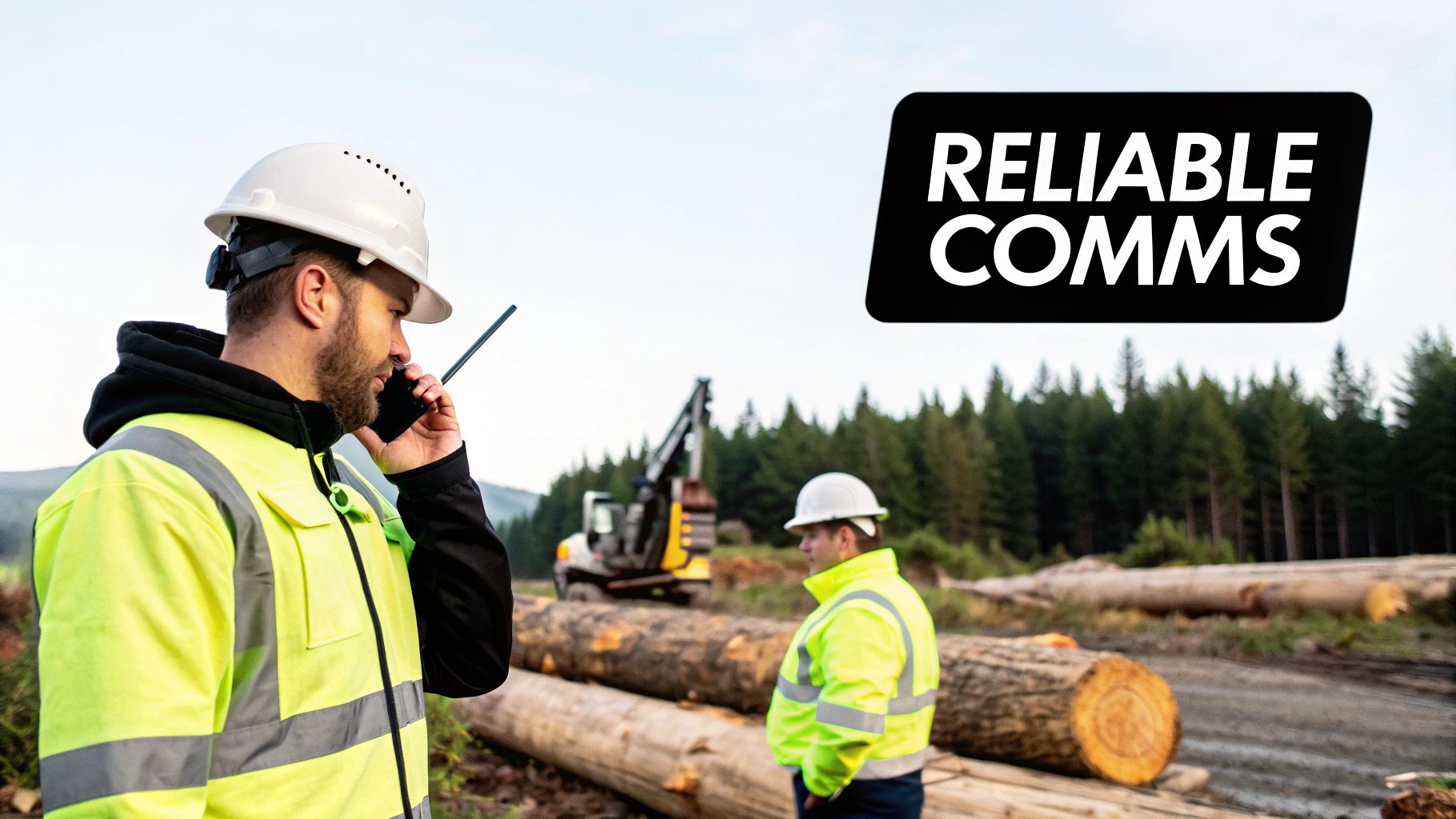
The reality of operating in New Zealand is that our diverse and often rugged landscape creates unique communication hurdles. From dense forestry plantations and remote agricultural land to steel-and-concrete city centres, robust connectivity is the absolute backbone of a safe and productive worksite.
The Problem: When Standard Comms Fail Your Team
Mobile phones are excellent for personal use, but their complete reliance on public cellular networks creates serious vulnerabilities for commercial and industrial teams across New Zealand's key sectors:
- Agriculture & Horticulture: Vast, remote properties often have zero reception, leaving teams isolated and compromising lone worker safety.
- Construction: Steel framing, concrete walls, and basement levels are notorious for killing mobile signals, creating dangerous communication blackouts at critical moments.
- Emergency & Disaster Response: Coordinated, reliable communication is non-negotiable when lives are at stake and public infrastructure is down.
- Energy & Exploration: Teams operating in remote exploration sites or around large-scale energy infrastructure need resilient communication that works, regardless of location.
- Forestry: With operations deep in areas with no cell coverage, instant and clear team communication is essential for both productivity and emergency response.
- Manufacturing & Processing: High-decibel environments demand the powerful, noise-cancelling audio of professional two-way radios to ensure every message is heard clearly.
- Maritime, Marine & Fishing: VHF marine radios are a legal and practical necessity for safety and operational coordination at sea.
- Retail, Hospitality & Tourism: Coordinating staff across large stores, hotels, or tourism sites requires instant one-to-many communication that a group chat cannot provide.
- Security: Private, encrypted communication is vital for security teams to coordinate effectively without their conversations being overheard.
- Sports & Recreation: Managing large-scale sporting events or outdoor recreation activities requires seamless coordination across wide areas.
- Traffic Management: Instant, clear directives are critical for maintaining safety for both the public and roading crews.
- Transport, Logistics & Fleet: Teams spread across cities or the entire country need reliable, nationwide communication to stay connected and efficient.
- Health and Safety: Meeting WorkSafe NZ requirements, especially for lone workers and teams in remote locations, demands a communication tool that is always reliable.
When standard communication fails, the consequences range from lost productivity to serious safety incidents. This is the operational pain point that a professional handheld radio hire service is specifically designed to solve.
Understanding Your Handheld Radio Options in New Zealand
Choosing the right communication technology is a critical decision that directly impacts your team's safety and operational efficiency. It’s not just about specs on a page; it's about understanding how the technology performs in your specific New Zealand environment.
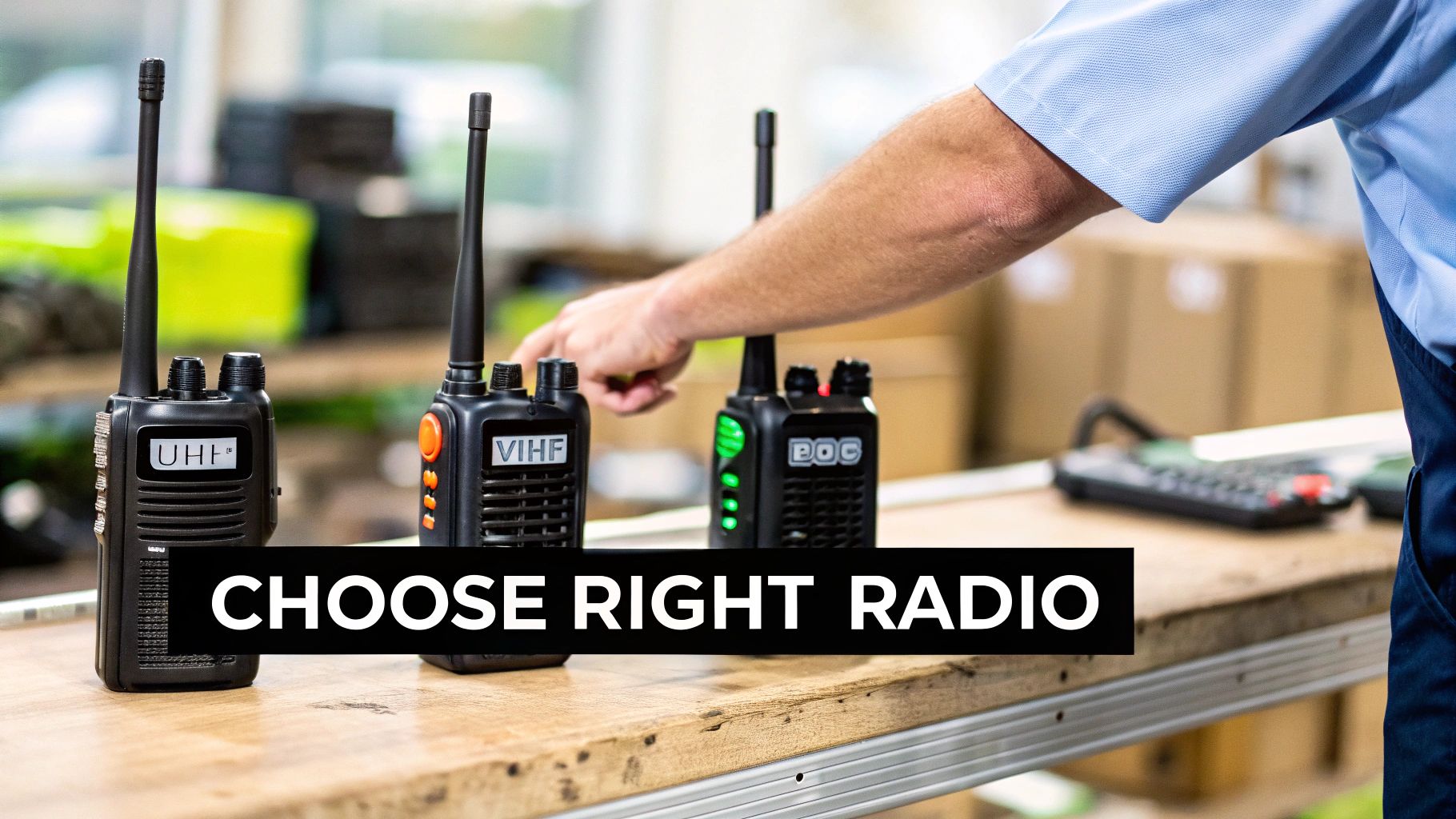
The success of any handheld radio hire hinges on one thing: getting the right tool for the job. A radio that works perfectly for a traffic management crew in the Wairarapa might be useless inside a multi-level build in central Auckland. A frank conversation with a communications specialist is the first step to flawless on-site comms.
In New Zealand, your choice boils down to a few core technologies, each suited to different operational needs.
UHF vs. VHF: The Right Frequency for Your Terrain
- UHF (Ultra High Frequency): These radios are the champions of obstructed environments. UHF's shorter wavelength is excellent at penetrating concrete, steel, and dense structures. This makes it the go-to choice for construction sites, manufacturing plants, warehouses, security teams, and indoor events.
- VHF (Very High Frequency): With a longer wavelength, VHF signals travel further over open, flat terrain with a clear line of sight. If your team is working in agriculture, forestry, maritime settings, or managing traffic on long, straight roads, VHF will provide superior range.
A common mistake is assuming "more range is always better." A VHF radio will struggle significantly on an urban worksite where a UHF radio would provide crystal-clear audio. For a deeper analysis, explore our detailed guide on PoC, UHF, and VHF for NZ worksites.
PoC (Push-to-Talk over Cellular): Nationwide Coverage
PoC is a modern solution that uses New Zealand’s cellular networks (Spark, One NZ, 2degrees) to provide instant, nationwide two-way radio communication. Devices like the Hytera P50 and Motorola TLK110 are perfect for transport, logistics, and field service fleets operating across different cities or regions, eliminating the need for traditional repeaters.
Satellite Devices: When You're Truly Off-Grid
For operations in New Zealand's most remote locations, where no cellular or radio repeater coverage exists, satellite devices are the only answer.
- Starlink: Offers high-speed internet connectivity, enabling VoIP calls, data transfer, and team collaboration from anywhere.
- Iridium, Inmarsat, InReach: Provide reliable voice and messaging services, including SOS functionality, ensuring a lifeline for lone workers and remote teams in sectors like energy exploration, marine, and emergency response.
Key Features That Matter in New Zealand Conditions
Beyond the core technology, several features separate a professional-grade radio from a consumer-grade toy. These are the practical specifications that deliver safety and reliability in demanding Kiwi environments.
- IP Rating (Ingress Protection): This is non-negotiable. An IP67 rating, standard on professional radios from Hytera, Tait, and Motorola, means the unit is completely dust-tight and can survive being submerged in one metre of water for 30 minutes. For a muddy construction site in a Waikato winter or any marine operation, a high IP rating is essential for device survival.
- Battery Shift-Life: A radio is useless if its battery dies mid-shift. Professional radios are built for long workdays, typically delivering 12-16 hours of genuine operational use from a single charge. A quality hire service ensures all batteries are properly conditioned to last the entire shift.
- Acoustic Performance: In noisy environments like sawmills or processing plants, standard audio is insufficient. Professional radios feature advanced noise-cancelling microphones and powerful speakers to ensure every word is heard clearly, which is critical for meeting your acoustic safety obligations.
- Essential Safety Functions: For staff working alone, features like Lone Worker (requires periodic check-ins) and Man Down (sends an automatic alert if the radio tilts, signalling a fall) are vital for meeting Health and Safety compliance and providing a lifeline to your team.
Industry Use Cases: Tailored Solutions for NZ Sectors
Different industries face unique communication challenges. Here’s how professional radio hire solves them:
- Construction: UHF radios with high IP ratings cut through concrete and steel, ensuring clear communication between crane operators, ground crew, and site managers. Lone worker features protect staff in isolated areas of the site.
- Forestry: VHF radios provide long-range communication across vast, remote blocks. Satellite devices offer a critical backup for emergency situations where there is no coverage. Durability and long battery life are paramount.
- Traffic Management: Instant, one-to-many communication is essential for coordinating road closures and ensuring crew safety. Durable radios with clear audio and long shift-life are critical.
- Events & Hospitality: Lightweight UHF radios with earpieces allow for discreet and clear communication between security, operations, and hospitality staff across large, noisy venues.
Mobile Systems Limited supports these industries end-to-end, providing expert device programming, on-site installation, servicing, and custom coverage mapping to ensure a flawless communication solution tailored to your specific operational needs.
Technology Comparison: Making the Right Choice
| Feature | PoC (Push-to-Talk over Cellular) | UHF / VHF Radio | Satellite Device |
|---|---|---|---|
| Coverage | Nationwide (where cell service exists) | Localised (line-of-sight, extendable with repeaters) | Global (even in the most remote areas) |
| Infrastructure | Uses existing cellular networks | Requires private infrastructure (repeaters for wide area) | Uses satellite constellations |
| Best For | Transport, logistics, nationwide fleets | Construction, forestry, events, manufacturing | Remote exploration, marine, emergency response |
| Key Advantage | Unlimited range within cellular coverage | Highly reliable in defined areas, no network fees | Works absolutely anywhere |
| Consideration | Dependent on cellular network availability | Range limited by terrain and obstructions | Higher operational cost per device |
Insider Knowledge: Avoiding Common Mistakes
With over 20 years of hands-on experience deploying communication systems across New Zealand, we've seen what works and what doesn't. Here are common mistakes NZ businesses make and how Mobile Systems helps you avoid them:
- Mistake 1: Choosing the Wrong Frequency. Using VHF on a dense urban construction site will result in poor coverage. MSL Solution: We conduct a thorough needs analysis of your operating environment to recommend the correct technology (UHF, VHF, or PoC) for reliable coverage.
- Mistake 2: Neglecting Battery Management. A dead battery is a critical safety failure. MSL Solution: Our hire fleet batteries are professionally conditioned and tested to guarantee full shift-life. We also provide smart multi-bay charging solutions to keep your fleet organised and ready.
- Mistake 3: Ignoring Lone Worker Compliance. Failing to provide a reliable communication device for lone workers is a significant WorkSafe violation. MSL Solution: We program and enable essential safety features like Lone Worker and Man Down alerts, helping you meet your legal obligations and protect your team.
- Mistake 4: Underestimating Coverage Needs. Assuming a standard radio will cover your entire site can lead to dangerous communication dead spots. MSL Solution: We offer on-site coverage mapping services to identify and eliminate dead zones, often using strategically placed repeaters to ensure 100% coverage.
NZ Compliance, Safety, and Operational Considerations
Operating professionally in New Zealand requires adherence to specific rules and a strong focus on safety.
- RSM Licensing: Using professional two-way radios requires a license from Radio Spectrum Management (RSM) to operate on a private, interference-free channel. When you hire from Mobile Systems, we manage all RSM licensing for you as part of the service. Authoritative information can be found on the official RSM website.
- Lone Worker Safety: WorkSafe NZ mandates that businesses must have effective communication systems in place for lone workers. Radios with GPS tracking, Man Down, and emergency alert functions are critical tools for compliance.
- Durability and IP Ratings: New Zealand's wet and dusty conditions demand rugged equipment. Look for high IP ratings (e.g., IP67) to ensure your devices can withstand the environment.
- Acoustic Safety: In loud environments, providing appropriate hearing protection and communication headsets is a legal requirement to prevent noise-induced hearing loss. We supply specialist headsets from brands like Sensear and OTTO.
Recommended Devices and Solutions for New Zealand
We only recommend professional-grade, field-tested equipment from the world’s leading manufacturers, ensuring reliability when it matters most.
- PoC Radios: The Hytera P50 and Motorola TLK110 offer exceptional durability and clear audio for nationwide communication over cellular networks.
- UHF/VHF Digital Radios: We supply a wide range of robust and reliable radios from trusted brands like Hytera, Tait, Motorola, Entel, Icom, GME, and Uniden.
- Marine Radios: For maritime operations, we provide certified VHF marine radios from GME, Uniden, and Icom.
- Satellite Devices: For ultimate remote connectivity, we offer solutions from Starlink, Iridium, Inmarsat, and InReach, ensuring you have a lifeline anywhere in New Zealand.
- Coverage Systems: We design and install repeater systems to extend radio coverage across large or challenging sites.
- GPS Tracking & Lone Worker Solutions: We integrate advanced tracking and safety features to protect your most valuable asset: your people.
Why Choose Mobile Systems Limited?
Choosing a communications partner is about more than just the hardware. It's about trust, reliability, and local expertise. It’s knowing that your partner understands the real-world challenges of operating in New Zealand.
- 100% NZ Owned and Operated: Based in Mount Maunganui and serving businesses nationwide for nearly two decades, we have an unmatched understanding of New Zealand's unique operational environments.
- Mobile On-Site Support: Our fleet of service vehicles brings our expertise directly to your worksite for installation, programming, troubleshooting, and coverage planning.
- Expert Technicians: Our in-house team possesses deep technical knowledge. We provide practical, solutions-focused advice, not a sales pitch.
- Custom Solutions: We take the time to understand your specific needs before recommending a solution, ensuring it is perfectly tailored to your operation.
- End-to-End Service: From the initial consultation and RSM licensing support to long-term maintenance and aftercare, we manage every detail.
Mobile Systems Limited is the safe, dependable partner for serious commercial buyers who cannot afford to compromise on communication and safety. We build trust by delivering robust solutions and unwavering support.
Let's Get Your Team Connected
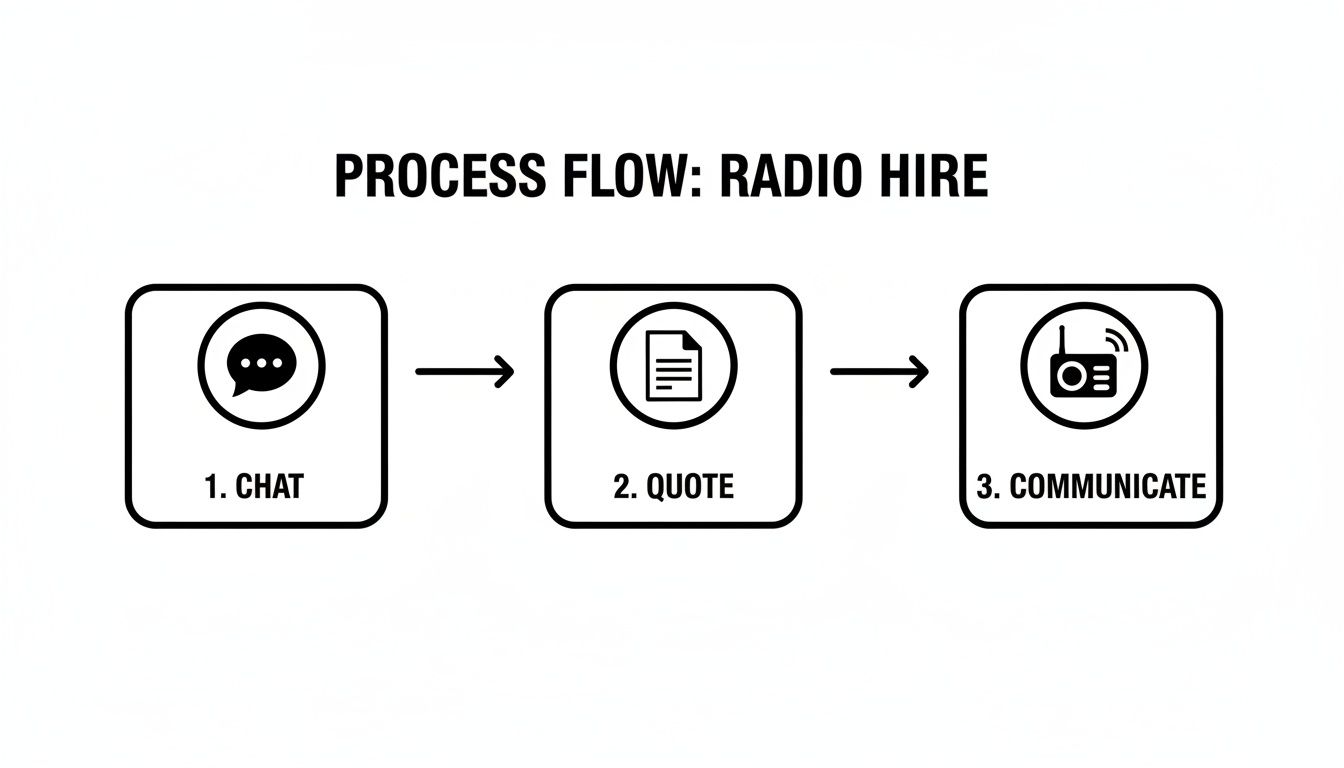
Reliable communication is the foundation of a safe and productive project. The process of equipping your team with a professional radio hire solution is straightforward and designed to give you complete confidence.
We invite you to:
- Request a quote: Get a customised proposal tailored to your team size, project duration, and specific technical needs.
- Ask for a demo: See the equipment in action and understand how it can solve your communication challenges.
- Speak to a communications specialist: Have a no-obligation chat with our friendly, NZ-based experts to get personalised device recommendations.
Our goal is to make the process easy and transparent, providing a solution that just works.
Frequently Asked Questions About Handheld Radio Hire
How much does it cost to hire handheld radios in NZ? The cost depends on the radio model, the quantity required, and the hire duration. For short-term projects, seasonal work, or events, hiring is a highly cost-effective operational expense compared to buying. Contact us for a detailed quote tailored to your project.
What is the real-world range of a UHF/VHF radio? Range is determined entirely by the environment. In open, flat terrain, VHF can achieve several kilometres. In a dense urban area or inside a large building, UHF might be limited to a few hundred metres. A key part of our service is ensuring the solution we provide is designed for your specific site to guarantee reliable coverage where you need it.
Do I need a license to use hired radios? Yes, for professional-grade radios operating on private channels, a license from Radio Spectrum Management (RSM) is a legal requirement. When you hire from Mobile Systems, we manage 100% of the licensing for you, ensuring your communications are legal, private, and interference-free.
What happens if a radio is damaged on site? We understand that worksites are tough environments. Our hire agreements include clear and fair terms for damage. We maintain a large inventory of spare equipment and can arrange a rapid replacement to minimise any downtime for your team. You can review our rental hire terms and conditions for more details.
Can you provide radios for a large, one-off event? Absolutely. We specialise in providing large fleets of handheld radios for events, festivals, and short-term projects. We can supply hundreds of units, complete with multi-bay chargers, accessories, and on-site support to ensure your event runs smoothly.
Click here to speak with a Mobile Systems communication specialist today.
Related posts

- June 05, 2026
Could a single corroded antenna connection result in a NZ$3 million fine? For New Zealand fleet operators working in forestry,...

- May 28, 2026
NZ police scanner frequencies are changing. Learn why & discover reliable communication solutions for NZ businesses in 2026. Authoritative guide.

- May 21, 2026
Most common two-way radio faults aren't caused by internal electronic failure but by physical degradation and environmental stress. In remote...