
Heavy Duty Walkie Talkies for NZ Industry: The Professional Buyer’s Guide
Most radios marketed as "heavy duty" are actually just consumer-grade gadgets destined for the landfill after their first drop on a South Island construction site. It's a frustrating cycle where a NZ$200 saving on hardware
Most radios marketed as "heavy duty" are actually just consumer-grade gadgets destined for the landfill after their first drop on a South Island construction site. It's a frustrating cycle where a NZ$200 saving on hardware leads to thousands in lost productivity when the signal fails in deep bush or near heavy plant machinery.
You likely understand that communication failure isn't just a nuisance; it's a critical safety risk that can halt an entire project. Investing in true heavy duty walkie talkies requires looking past the rugged plastic casing to the internal engineering that handles New Zealand’s high-humidity and high-vibration environments.
This guide provides the technical clarity needed to distinguish between marketing hype and industrial-grade tools that meet New Zealand RSM standards. We will examine why specific IP68 ratings and MIL-STD 810G certifications are the only way to guarantee your team stays connected from the first whistle until the final shift ends.
Key Takeaways
- Understand the critical difference between consumer-grade "ruggedness" and true industrial standards like MIL-STD-810 and IP ratings for dust and water resistance.
- Learn how digital technology like DMR and P25 filters out extreme background noise from machinery and wind to ensure clear communication in high-decibel environments.
- Identify the specific hardware requirements for heavy duty walkie talkies, including high-output 1000mW+ speakers and long-life Lithium-Ion battery chemistry.
- Discover why off-the-shelf solutions often fail and how professional coverage mapping ensures reliable performance across complex New Zealand worksites.
- Gain the expertise needed to transition from basic handsets to a professional radio fleet that meets commercial regulatory and operational requirements.
What Defines a True Heavy Duty Walkie Talkie?
A heavy duty walkie talkie represents a significant departure from the standard handheld radios found in retail electronics stores. While consumer models focus on aesthetics and occasional use, industrial units are engineered to survive the rigours of commercial environments. To understand the technical foundations of these devices, it helps to review what a two-way radio is and how professional standards differ from hobbyist equipment.
True durability encompasses more than just a thick plastic shell. It requires internal electronic stability where components are secured against high-frequency vibrations and extreme thermal shifts. Professional heavy duty walkie talkies utilize die-cast aluminium chassis to provide structural integrity and heat dissipation, ensuring the internal circuitry remains functional even after a fall onto concrete or exposure to the midday sun.
To better understand the practical reality of these robust devices, watch this helpful video analysis:
Consumer vs. Professional Grade: The Hidden Costs
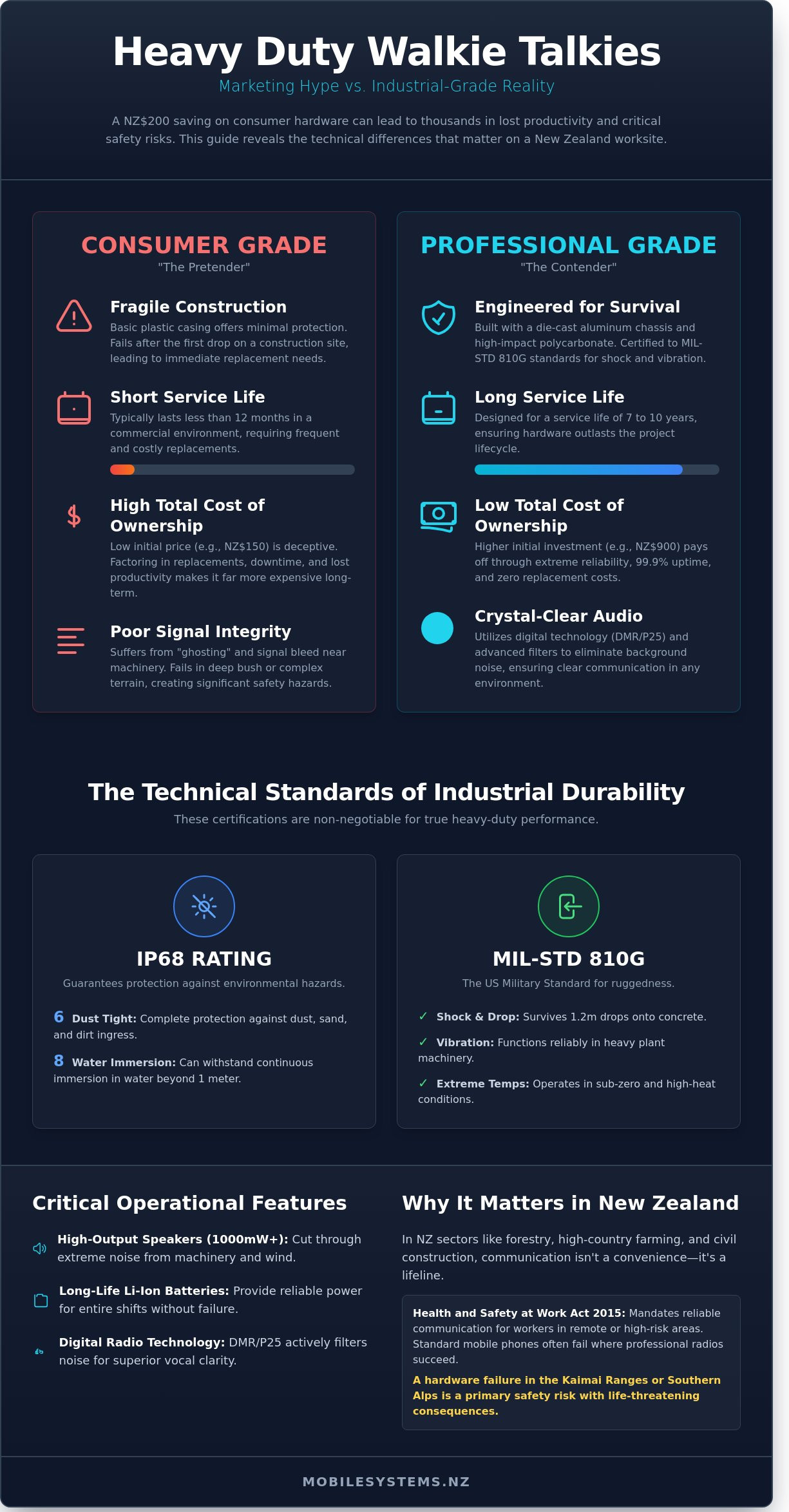
The life expectancy of a retail radio in a commercial setting is often less than 12 months. In contrast, commercial units from brands like Tait or Hytera typically provide a service life of 7 to 10 years. This longevity stems from superior ingress protection (IP) ratings and military-standard (MIL-STD) testing for shock and humidity.
Professional units also feature advanced interference rejection. In industrial zones filled with heavy machinery and electrical noise, consumer radios often suffer from "ghosting" or signal bleed. Commercial grade receivers use high-quality filters to isolate the intended voice signal, maintaining clear audio where cheaper alternatives fail. Industrial durability is the ability to maintain 99.9% uptime in sub-zero or high-vibration environments.
When calculating the total cost of ownership, a NZ$150 retail unit often proves more expensive than a NZ$900 professional radio. Frequent replacements, lost productivity during downtime, and the cost of proprietary batteries for low-end models quickly erode any initial savings. Investing in heavy duty walkie talkies ensures the hardware outlasts the project lifecycle.
The Importance of Reliability in NZ Industries
In New Zealand, communication is a critical safety component for sectors like forestry, high-country farming, and civil engineering. In the Kaimai Ranges or the Southern Alps, a communication failure isn't just an inconvenience; it's a primary safety risk. If a lone worker cannot call for assistance due to a hardware malfunction, the consequences can be life-threatening.
Under the Health and Safety at Work Act 2015, New Zealand businesses must provide reliable means of communication for workers in remote or high-risk areas. Standard mobile phones often lose signal in deep gullies or dense bush, making robust radio networks essential for WHS compliance. Seeking expert guidance ensures businesses deploy systems that meet these stringent legislative requirements.
A tailored assessment often prevents costly mistakes when selecting equipment for rugged terrain. Professional systems are designed to bridge the gap between remote worksites and emergency services, providing a lifeline when other technologies fail. For specific advice on integrating these units into your safety protocols, contacting a specialist is highly recommended.
The Technical Standards of Industrial Durability
Selecting heavy duty walkie talkies requires looking beyond the plastic casing. True industrial durability is measured by specific engineering certifications that guarantee performance in the harshest environments. For New Zealand's forestry, civil construction, and logistics sectors, these standards separate professional tools from consumer grade toys.
The US Military Standard (MIL-STD-810) is the benchmark for ruggedness. It involves a series of 29 laboratory tests, including high altitude pressure, shock, and vibration. On a Canterbury construction site or a Northland forestry block, this means the radio can survive a 1.2 meter drop onto concrete or continuous vibration inside a heavy excavator without internal component failure.
Chassis construction plays a vital role in longevity. High impact polycarbonate housings offer excellent resistance to cracking and chemical exposure. However, premium models often feature a die cast aluminium internal chassis. This metal frame provides structural rigidity and acts as a heat sink, which is critical for high duty cycle transmissions where the radio might otherwise overheat.
Understanding IP67 vs. IP68 Ratings
Ingress Protection (IP) ratings define how well the device keeps out solids and liquids. An IP67 rating means the unit is dust tight and can survive immersion in 1 meter of water for 30 minutes. IP68 takes this further, allowing for continuous immersion, usually up to 1.5 meters for 60 minutes. While water resistance is helpful during a West Coast downpour, dust protection is often more critical. Fine silica dust on NZ building sites can penetrate unsealed ports, causing terminal failure in months.
- Check the first digit: '6' is the highest rating for dust protection.
- Check the second digit: '7' or '8' is required for wet environments.
- Verify that the rating applies with the battery and accessory covers attached.
- Look for laboratory certification rather than "water resistant" marketing claims.
Hazardous Environments and ATEX/IECEx Ratings
Standard heavy duty walkie talkies can generate small internal sparks. In "Hazardous Areas" like fuel depots, grain silos, or paint manufacturing plants, these sparks can trigger explosions. Intrinsically Safe (IS) radios are engineered to operate below the energy levels required to ignite atmospheric gases or dust. In New Zealand, equipment must comply with specific IECEx or ATEX standards to meet health and safety obligations.
Using non-IS equipment in these zones creates a massive legal and safety liability. Compliance is monitored by New Zealand's Radio Spectrum Management and WorkSafe NZ. Ensuring your fleet meets these rigorous standards is a core part of operational risk management. If you are unsure which rating your site requires, a tailored assessment often prevents costly mistakes and ensures full compliance with local safety regulations.
Screen durability is the final piece of the hardware puzzle. Industrial radios use recessed displays or Gorilla Glass to prevent impact damage. A recessed screen sits below the bezel line, meaning the plastic frame takes the hit if the radio falls face down. This simple design choice can reduce screen replacement costs by 40% over the life of the device compared to flush-mounted screens.
Digital vs. Analog: Choosing the Right Technology
Selecting the right internal technology for heavy duty walkie talkies determines how your team communicates under pressure. Analog technology has served New Zealand industries for decades, but the shift toward digital is now nearly universal for professional fleets. Analog systems use continuous radio waves that become increasingly susceptible to static as you move toward the edge of the coverage area.
Digital technologies like DMR (Digital Mobile Radio) and P25 convert voice into data packets. This shift allows for advanced features that analog simply cannot support. While P25 is the gold standard for public safety agencies like Fire and Emergency NZ, DMR is the practical choice for most commercial sectors. Digital processing uses mathematical algorithms to identify human voice frequencies and actively suppress background noise.
On a busy construction site or a high-wind agricultural block, this filtering is vital. If a worker speaks while standing next to a running 30-tonne excavator, the digital processor removes the engine drone. The listener on the other end receives a clear voice signal rather than a wall of mechanical noise. Digital units also offer private calling, which allows managers to speak to individuals without broadcasting to the entire group.
Integrated GPS tracking is another hallmark of digital heavy-duty units. This allows dispatchers to monitor the real-time location of staff across a site, improving safety during lone-worker scenarios. For existing NZ fleets, the transition from analog to digital doesn't have to happen overnight. Many modern digital radios offer a "mixed mode" that allows them to communicate with older analog units while the fleet is gradually upgraded.
The DMR Advantage for NZ Businesses
DMR technology uses Time Division Multiple Access (TDMA) to divide a single 12.5 kHz channel into two distinct time slots. In practice, this doubles your calling capacity without requiring additional frequency licenses. You can have two separate conversations happening simultaneously on the same frequency, which is a massive efficiency gain for growing teams.
The audio quality in a DMR system remains consistent across the entire coverage area. Unlike analog, where the signal fades into static, digital audio stays 100% clear until you reach the absolute limit of the range. For those looking to modernize their fleet, viewing our range of two-way radios provides a starting point for selecting DMR-capable hardware.
Licensed vs. Unlicensed Frequencies in NZ
Many businesses start with the 80-channel UHF-CB band because it's unlicensed and free to use. However, these channels are shared with the public. On a large-scale worksite, you'll often encounter "chatter" from nearby hobbyists or other businesses. This interference isn't just annoying; it's a safety risk that can lead to missed instructions. While NZ follows RSM standards, global FCC guidelines on personal radio services provide a useful baseline for understanding why consumer-grade radios fail in industrial settings.
To achieve reliable communication, we recommend obtaining a private frequency license through Radio Spectrum Management (RSM). A private license costs approximately NZ$150 to NZ$300 per year depending on the specific requirements. This small investment grants you exclusive use of a frequency in your area. Using a private frequency with heavy duty walkie talkies ensures your team is the only group on the line, providing the privacy and security required for professional operations.
Operational Features That Support Heavy Use
Selecting heavy duty walkie talkies involves looking beyond the external casing. The internal components determine whether a device survives a full shift or fails when communication is most critical. High-performance hardware ensures clarity in high-noise environments and reliability during extended operations in remote New Zealand locations.
Lithium-Ion (Li-Ion) chemistry is the current industry standard for professional fleets. Unlike older Nickel-Metal Hydride (NiMH) batteries, Li-Ion cells offer higher energy density and do not suffer from "memory effect" issues. This allows workers to top up their charge during a lunch break without degrading the battery's total lifespan. For a standard 12-hour shift, a battery capacity of at least 2200mAh is recommended to ensure the radio remains operational until the final whistle.
Audio output is another critical factor often overlooked. In environments like construction sites or forestry blocks, ambient noise frequently exceeds 85 decibels. Standard consumer radios often peak at 500mW of audio output, which sounds thin and distorted in loud areas. Heavy duty units should feature speakers rated at 1000mW or higher. This extra headroom allows the audio to punch through engine roar and wind noise without clipping.
Physical ergonomics play a vital role in safety. Buttons must be large enough to operate while wearing heavy Grade 5 work gloves. Tactile feedback, such as a distinct "click" when the Push-To-Talk (PTT) button is engaged, prevents missed transmissions. Similarly, the antenna must be flexible. Rigid antennas are the most common snap point in rugged terrain; high-quality, "whip" style antennas can bend 90 degrees and return to their original shape without losing signal integrity.
Battery Management for 12-Hour Shifts
Manufacturers calculate battery life using the "5-5-90" duty cycle. This assumes the user spends 5% of their time transmitting, 5% receiving, and 90% on standby. While this is a helpful baseline, "smart" battery systems provide more accuracy. These batteries contain microchips that track charge cycles and health, alerting fleet managers when a cell can no longer hold a 80% charge and requires replacement.
In NZ alpine conditions, cold temperatures can reduce battery capacity by up to 30% almost instantly. To conserve power in the Southern Alps or central plateau, keep the radio inside a jacket when not in use. Using the body's natural heat prevents the chemistry from slowing down, ensuring the device is ready when an emergency call is necessary.
Essential Accessories for Heavy Duty Use
Remote speaker microphones (RSMs) are essential for protecting the main unit. By clipping an RSM to a lapel, the radio can stay securely in a pocket or holster, shielded from rain and impact. This setup reduces the risk of dropping the expensive primary unit while trying to communicate in difficult positions.
For extremely loud environments, specialised earpiece sets provide a significant advantage. These allow for discrete, clear communication directly into the ear canal, blocking out external noise. In high-stakes industries, this ensures that every instruction is heard correctly the first time.
Heavy duty carry cases, particularly those made of thick leather or reinforced nylon, significantly extend unit longevity. These cases act as a sacrificial layer against abrasion and chemicals. A NZ$60 case often prevents a NZ$800 radio from sustaining terminal housing damage during a fall onto concrete or gravel.
A tailored assessment often prevents costly mistakes. Contact Mobile Systems for expert advice on configuring your fleet.
Implementing a Professional Radio Fleet in New Zealand
Off-the-shelf radios from retail electronics stores often fail to meet the rigours of New Zealand commercial environments. These consumer-grade devices lack the ingress protection and chassis durability required for forestry, construction, or maritime use. When businesses rely on sub-standard equipment, they face frequent hardware failures and dead zones that compromise safety.
Deploying heavy duty walkie talkies effectively requires a strategic approach rather than a simple purchase. Coverage mapping and site testing are essential first steps. New Zealand's varied topography, from dense urban canyons in Auckland to the steep terrain of the Southern Alps, significantly impacts signal propagation. A professional site survey identifies blackspots before you invest in hardware, ensuring your team stays connected across the entire job site.
Mobile Systems provides nationwide support and on-site servicing to keep your fleet operational. Our technicians understand that downtime costs money; therefore, we maintain mobile service vehicles equipped to handle repairs and programming in remote locations. This proactive support model ensures your communication infrastructure remains robust regardless of your project's location.
Creating a formal radio etiquette and maintenance policy is vital for fleet longevity. Staff should be trained on basic care, such as proper battery cycling and checking antenna connections daily. Clear communication protocols, like using standard "over" and "out" terminology, reduce airtime congestion and ensure critical messages get through during emergencies. A well-maintained fleet of heavy duty walkie talkies can last 5 to 7 years, whereas neglected units often fail within 18 months.
The Value of Expert Installation and Servicing
Professional tuning of antennas can double your effective range by reducing Standing Wave Ratio (SWR) levels. Most factory settings are generic, but our technicians calibrate every unit to your specific licensed frequency. Our mobile support vehicles provide on-site repairs in remote NZ locations, which eliminates the need to send equipment away for weeks at a time. A tailored assessment prevents the common mistake of over-investing in unused features while ensuring you have the power and durability required for your specific trade.
Next Steps: Getting a Custom Communication Audit
If your current communication system feels unreliable, it's time for a professional review. You can contact Mobile Systems for a site-specific evaluation tailored to your operational needs. To get the most out of your audit, have your team size, a map of your primary terrain, and a list of current communication pain points ready for our consultants. We focus on solving dead zones and improving clarity rather than just selling hardware. Remember, heavy duty is a promise of safety, not just a product category.
Optimising Your Site Communications
Selecting the right heavy duty walkie talkies requires balancing IP68 water resistance with the technical demands of New Zealand's radio spectrum. Industrial environments in sectors like forestry or civil engineering demand hardware that survives drops and dust while maintaining clear digital audio. Choosing between Tait, Hytera, or Icom systems depends on your specific coverage needs and existing infrastructure.
Mobile Systems Limited provides end-to-end support for these critical assets. Our team manages Radio Spectrum Management (RSM) licensing and frequency coordination to ensure your fleet remains compliant with local regulations. We operate a fleet of mobile service vehicles across the country, providing on-site technical assistance to keep your teams connected without downtime.
A tailored assessment often prevents costly mistakes when upgrading hardware. It's the most reliable way to ensure your coverage matches your terrain. You can request a professional communication audit for your NZ business to identify the most efficient configuration for your site. Investing in professional-grade equipment ensures your communication remains reliable when it matters most.
Frequently Asked Questions
What is the difference between IP67 and IP68 for walkie talkies?
The main difference lies in the depth and duration of water submersion the device can withstand. IP67-rated heavy duty walkie talkies are protected against immersion in water up to 1 metre deep for 30 minutes. In contrast, IP68 ratings signify the radio can handle deeper immersion, often up to 2 metres for 2 hours or more, depending on the specific manufacturer test data.
For New Zealand industries like aquaculture or heavy civil construction, IP68 provides a necessary safety margin. While IP67 is sufficient for heavy rain or accidental drops in a puddle, IP68 is the standard for equipment likely to face prolonged exposure to wet environments. Mobile Systems Limited recommends IP68 models for any site where water ingress is a daily operational risk.
Do I need a license to use heavy duty walkie talkies in New Zealand?
Most high-powered professional radios require a license issued by Radio Spectrum Management (RSM). While 80-channel PRS (Personal Radio Service) units are license-free, they're limited to 5 watts and often suffer from congestion. Commercial users typically opt for a managed spectrum license, which costs approximately NZ$150 per year for a dedicated frequency to ensure private, interference-free communication.
Operating without a license on restricted frequencies can result in significant fines from the Ministry of Business, Innovation and Employment. We help our clients navigate the RSM application process to secure the correct licensing for their specific geographic area. This ensures your team isn't interrupted by hobbyist chatter or local interference during critical tasks.
Can digital walkie talkies talk to my old analog ones?
Most modern digital radios include an "analog mode" that allows them to communicate with older legacy fleets. You'll need to have the new digital units programmed with the specific frequencies and CTCSS or DCS tones used by your existing equipment. This backwards compatibility allows businesses to phase in new technology without replacing every handset simultaneously.
You won't have access to digital features like GPS tracking or enhanced encryption while communicating with analog units. The audio quality will also drop to the standard of the older analog technology during these transmissions. A tailored assessment of your current fleet often prevents costly mistakes when choosing which digital standard to adopt.
What is the typical range of a professional handheld radio in NZ terrain?
In typical New Zealand bush or rolling farmland, you can expect a reliable range of 2 to 5 kilometres. In dense urban environments like the Auckland or Christchurch CBDs, this range often drops to 1 or 2 kilometres due to signal absorption by concrete and steel. Line-of-sight transmissions from a high ridge to a valley floor can occasionally exceed 15 kilometres.
Range is heavily dictated by local topography and the height of the antenna. If your site requires coverage across a larger area, we often recommend installing a repeater system to bridge the gaps. This can extend your communication footprint to 50 kilometres or more, depending on the repeater's elevation and power output.
What makes a radio "intrinsically safe" for fuel or gas sites?
An intrinsically safe radio is designed to operate in explosive atmospheres without the risk of causing an ignition. These units meet the IECEx standard, which ensures that even in a fault condition, the internal circuitry cannot produce a spark or enough heat to ignite vapors. This is a mandatory requirement for workers at fuel terminals, timber mills, or gas processing plants.
These radios are easily identified by their bright blue or green casings or specific IECEx labeling. Using a standard radio in a hazardous zone is a major health and safety breach that voids insurance and endangers lives. We provide certified intrinsically safe solutions that meet the rigorous New Zealand safety standards for high-risk environments.
How long do the batteries last on industrial walkie talkies?
Most heavy duty walkie talkies provide between 12 and 20 hours of operation on a single charge. This estimate is based on a standard 5-5-90 duty cycle, meaning 5% of the time is spent transmitting, 5% receiving, and 90% on standby. High-capacity lithium-ion batteries used in these units are built to withstand at least 500 charge cycles before the capacity begins to noticeably degrade.
Cold temperatures in places like Central Otago can reduce battery efficiency by up to 25% during winter months. To counter this, we recommend using "smart" batteries that provide real-time health data to the user. This ensures your team isn't left without communication halfway through a 12-hour shift because of a failing battery cell.
Why are professional radios so much more expensive than retail ones?
Professional radios cost between NZ$500 and NZ$1,200 because they're built to MIL-STD-810 standards for durability. Unlike retail units found in electronics stores, these radios feature die-cast aluminium chassis and high-grade gaskets to keep out dust and moisture. They're designed to survive a 1.5-metre drop onto concrete, which would shatter a consumer-grade device instantly.
The internal components are also significantly more sophisticated, offering better signal selectivity and noise cancellation. This allows clear communication in high-noise environments like construction sites or near heavy machinery. Investing in professional-grade hardware reduces the total cost of ownership by eliminating the need for frequent replacements and repairs.
Can I track my staff using their walkie talkies?
You can track staff movements in real-time if your heavy duty walkie talkies are equipped with integrated GPS and connected to dispatch software. This is an essential safety feature for lone workers in remote New Zealand locations where mobile phone coverage is non-existent. Managers can view the exact location of every handset on a digital map from a central office.
This tracking capability is often paired with "Man Down" and "Lone Worker" alerts. If a radio detects a sudden impact or remains motionless for a set period, it automatically sends an emergency signal with GPS coordinates to the dispatcher. This ensures a rapid response during an incident, fulfilling critical health and safety obligations for your business.
Related posts

- June 05, 2026
Could a single corroded antenna connection result in a NZ$3 million fine? For New Zealand fleet operators working in forestry,...

- May 28, 2026
NZ police scanner frequencies are changing. Learn why & discover reliable communication solutions for NZ businesses in 2026. Authoritative guide.

- May 21, 2026
Most common two-way radio faults aren't caused by internal electronic failure but by physical degradation and environmental stress. In remote...