
Professional Radio Repair Service NZ: Maintaining Business-Critical Communications
During a 2023 winter storm, a North Island civil engineering team found their entire project halted because a single base station failed. This wasn't a catastrophic hardware meltdown, but a gradual degradation of signal.
During a 2023 winter storm, a North Island civil engineering team found their entire project halted because a single base station failed. This wasn't a catastrophic hardware meltdown, but a gradual degradation of signal quality that could've been caught by a professional radio repair service nz.
You likely understand that in high-stakes environments, a radio isn't just a tool; it's a lifeline. When communication drops out in remote areas, production stops and safety risks escalate immediately.
This article explains how professional radio servicing ensures fleet safety, maintains strict RSM regulatory compliance, and maximizes operational uptime for New Zealand businesses.
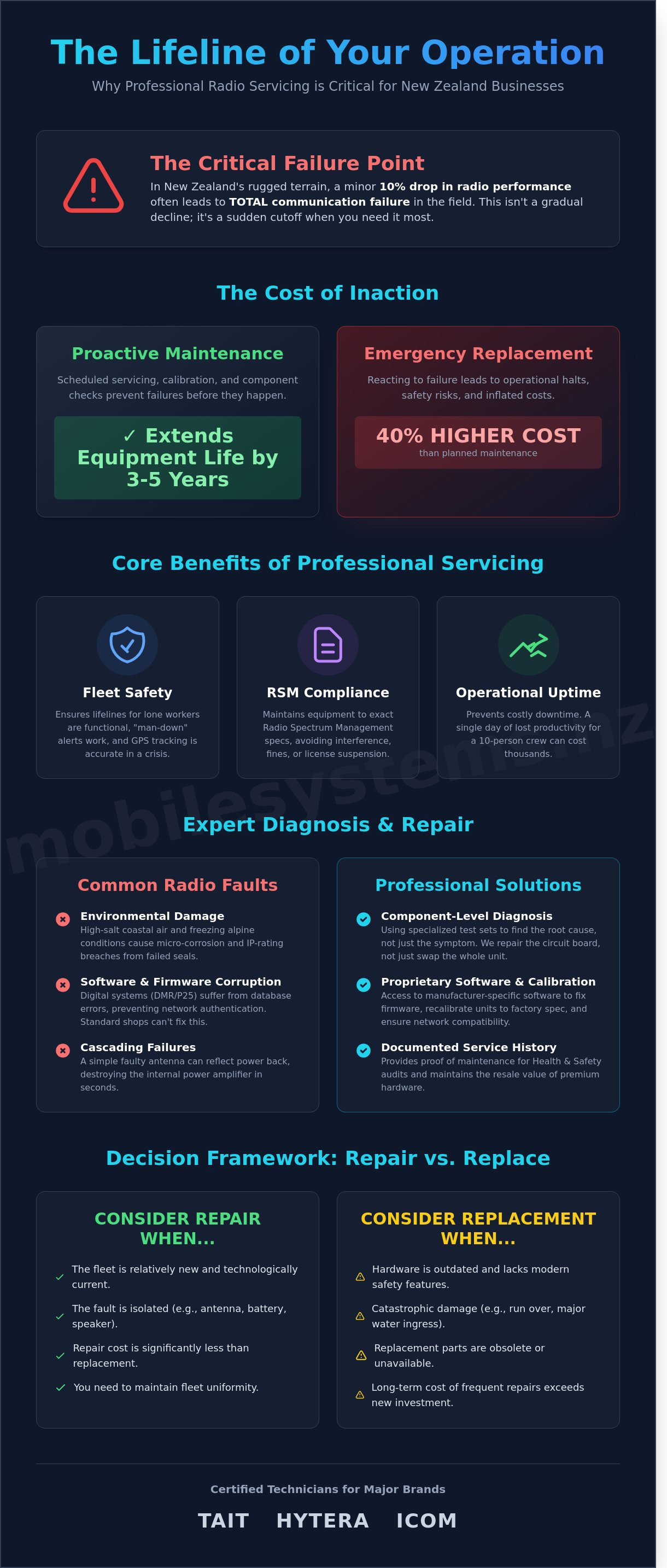
We'll examine the technical benefits of component-level repairs, the necessity of documented service histories for health and safety audits, and why proactive maintenance prevents the 40% higher cost of emergency equipment replacement.
Key Takeaways
- Understand how professional calibration overcomes New Zealand's unique environmental challenges to prevent total communication failure in the field.
- Discover why a professional radio repair service nz utilizes specialized diagnostic test sets to identify root causes rather than just treating hardware symptoms.
- Learn the decision framework for evaluating whether to repair aging hardware or invest in new fleet technology to maximize operational uptime.
- Identify common faults in DMR and P25 systems, including firmware and software corruption issues that require expert technical intervention.
- Gain insights into how partnering with certified technicians ensures your Tait, Hytera, and Icom equipment remains compliant with local regulatory standards.
Why Professional Radio Repair Services are Critical for NZ Operations
Commercial radio repair is a specialized technical discipline. It involves diagnosing and restoring UHF, VHF, or digital equipment to exact manufacturer specifications. This process ensures every component, from the receiver sensitivity to the transmitter frequency stability, operates at peak performance.
In New Zealand's rugged terrain, equipment health is non-negotiable. A minor 10% drop in radio performance often leads to total communication failure in the field. Deep valleys and dense bush already challenge signal propagation; a degraded radio simply cannot bridge those gaps. Understanding the underlying Two-way radio technology is essential for recognizing why professional calibration is necessary.
Professional servicing ensures your equipment remains compliant with Radio Spectrum Management (RSM) licensing requirements. Operating out-of-spec hardware can cause interference on neighboring frequencies, leading to potential fines or the suspension of your operating license. Regular maintenance also prevents "cascading failures." A common example is a faulty antenna that reflects power back into the unit, which can destroy a radio's internal power amplifier in a matter of seconds.
The Role of Communication in Workplace Health and Safety
Reliable radios serve as the primary safety tool for lone workers in New Zealand's forestry, farming, and civil construction sectors. When a team member is kilometers away from the nearest base, their handheld unit is their only lifeline. Faulty equipment can lead to failed emergency "man-down" alerts or significant GPS tracking errors during a crisis.
Maintaining your communication hardware is a core component of meeting obligations under the New Zealand Health and Safety at Work Act 2015. If an incident occurs and the investigation reveals that communication gear was poorly maintained, the business can face severe liability. Partnering with a professional radio repair service nz ensures your safety protocols are backed by functional hardware.
Economic Benefits of Servicing vs. Neglect
Professional alignment and cleaning can extend the operational life of a two-way radio fleet by three to five years. This significantly reduces the total cost of ownership by delaying expensive capital expenditure on new hardware. It's a practical approach to asset management that favors longevity over constant replacement.
- Battery Management: Early detection of battery degradation prevents unexpected downtime. Most lithium-ion batteries lose 20% of their capacity after 500 charge cycles, making regular testing vital.
- Resale Value: Consistent servicing through a radio repair service nz maintains the resale value of high-tier hardware. Brands like Tait or Hytera hold their value well if they have a documented service history.
- Operational Efficiency: Preventing a single day of downtime for a 10-person crew can save a business thousands of dollars in lost productivity.
A tailored assessment often prevents costly mistakes. By identifying minor issues like perished seals or loose connectors early, you avoid the high costs of emergency repairs during peak operational periods.
Common Faults in Commercial Two-Way Radios and UHF Systems
Hardware failures in New Zealand often stem from the country's diverse environments. High-salt coastal winds and freezing alpine conditions put constant stress on internal components. A professional radio repair service nz provides the specific expertise required to diagnose these environmental failures before they lead to total communication blackouts.
Digital systems like DMR or P25 introduce software complexities that analog units don't experience. These radios can suffer from firmware corruption or database errors that prevent them from authenticating on a network. Standard electronic repair shops usually lack the proprietary diagnostic software and tuning files needed to recalibrate these units to factory specifications.
Environmental and Physical Damage
Heavy-duty use in construction and agriculture frequently leads to IP (Ingress Protection) rating breaches. When seals fail, dust and moisture enter the chassis and cause micro-corrosion on the circuit board. This damage is often invisible to the naked eye but results in intermittent power or failed audio accessories.
- Mechanical failure of PTT (Push-to-Talk) buttons after thousands of cycles in high-pressure environments.
- Worn volume potentiometers that create "crackling" audio or unexpected volume spikes.
- Corroded battery contacts from high-salt exposure in marine or coastal settings, leading to rapid voltage drops.
Technical Performance and Frequency Issues
Antenna system degradation is the primary reason for reduced range. A high Standing Wave Ratio (SWR) often results from pinched cables, water ingress in connectors, or incorrect mounting. If left unaddressed, this reflected energy can destroy the radio's internal power amplifier, requiring a comprehensive radio repair service nz to replace delicate surface-mount components.
Frequency drift is another common issue where the radio "off-tunes" from its assigned channel. This results in distorted audio or a total inability to communicate with the rest of the fleet. All equipment must remain compliant with standards set by the Radio Spectrum Management (RSM) to ensure legal operation and prevent interference with emergency services.
Receiver sensitivity loss is a subtle fault that often goes unnoticed. The radio might transmit perfectly but struggle to hear distant signals that it previously handled with ease. This often indicates a failing front-end filter or an internal alignment issue caused by physical vibration. A tailored assessment of your fleet can catch these performance drops before they impact your business operations.
The Decision Framework: When to Repair vs. Replace Your Radio Fleet
Fleet managers across New Zealand often face a difficult choice between immediate maintenance costs and the long-term reliability of aging technology. Balancing these factors requires more than a simple budget check. It demands an understanding of how hardware degrades over time in local conditions.
A professional radio repair service nz provides the technical data needed to make an informed choice. A tailored assessment often prevents the 15% to 20% waste typically seen when businesses prematurely replace hardware that only needs minor servicing. This evaluation also ensures your fleet remains compliant with standards set by Radio Spectrum Management, which is vital for avoiding signal interference and legal risks.
Technological shifts, such as the ongoing migration from analog to digital, play a massive role in this framework. While older analog models are rugged, the availability of genuine spare parts is shrinking. Modern digital units offer better encryption and clarity, making them a more viable long-term investment for growing teams.
Criteria for Economical Repair
Repair is generally recommended if the total cost stays below 50% of a new, comparable commercial radio unit. High-tier professional radios, particularly those from Tait or Motorola, are built with modularity in mind. This allows technicians to replace specific failed components without discarding the entire device.
- Minor faults like screen replacements or housing refreshes are almost always worth the investment.
- Battery terminal cleaning and antenna port re-soldering can extend a unit's life by 2 to 3 years.
- Firmware updates can often resolve software glitches that mimic hardware failure.
- Modular components in high-tier brands make component-level repairs fast and cost-effective.
When Replacement is the Smarter Choice
Replacement becomes the logical path when the hardware's physical integrity is compromised. If a radio shows signs of "salt-creep" corrosion, common in New Zealand's coastal industries, the internal circuitry is likely to fail again shortly after any repair. Reliability is the priority for business-critical communications.
- Units that have suffered significant liquid ingress often face recurring mainboard issues.
- When a radio is declared End of Life (EOL), manufacturers stop providing security patches and firmware updates.
- If your operational needs now require integrated GPS tracking for worker safety, older hardware cannot be upgraded to match.
- The cost of sourcing rare parts for obsolete analog models often exceeds the price of a modern digital entry-level radio.
What to Expect from a Professional Radio Servicing Process
A professional radio repair service nz involves technical precision that goes far beyond simple parts replacement. It's a structured process designed to return a device to its original factory specifications. At Mobile Systems Limited, every repair begins with a full diagnostic to identify the root cause of a failure. This prevents the common issue where a technician fixes a symptom, like a blown fuse, only for the underlying power surge issue to destroy the radio again a week later.
The Diagnostic and Bench Testing Phase
Our workshop utilizes specialized equipment such as Aeroflex or Freedom communications analyzers to measure precise radio parameters. We don't just check if it talks; we test the radio under load to simulate real-world usage and heat generation. This identifies components that might fail during a long shift in the field.
We also monitor harmonic emissions during this phase. If a radio drifts, it can interfere with other licensed frequencies. This is a critical check to ensure your equipment remains compliant with New Zealand's Radio Spectrum Management (RSM) regulations.
- Precision Measurement: Analyzing frequency error, modulation, and signal-to-noise ratios.
- Load Simulation: Testing the transmitter at 100% duty cycle to check for thermal stability.
- Spectrum Analysis: Ensuring no illegal spurious emissions are present.
Preventative Maintenance and Alignment
Preventative maintenance is essential for longevity. We clean internal components to remove dust that traps heat and reapply thermal paste to ensure efficient cooling. For units used in New Zealand's coastal or forestry environments, we inspect seals to maintain IP67 or IP68 ratings against water and dust ingress.
Our technicians re-align the local oscillator to ensure the radio stays exactly on its assigned frequency. We also update firmware to the latest stable version. This process often fixes known software bugs and can improve battery efficiency by up to 12% through optimized power management.
Every repair concludes with a final verification of transmit power and receiver sensitivity. We document these results in a detailed 'bench report'. This provides your business with a vital audit trail for fleet management and health and safety compliance. It proves that your business-critical communications meet the required standards for field reliability.
Partnering with Mobile Systems for Nationwide Radio Support
Mobile Systems Limited delivers high-trust, specialized repair services for New Zealand's commercial, marine, and industrial sectors. As a leading provider of radio repair service nz, we manage complex communication fleets where failure isn't an option. Our technicians possess deep technical knowledge of Tait, Hytera, GME, and Icom hardware, ensuring your equipment returns to service meeting original manufacturer specifications.
We do more than just swap parts. Our team bridges the gap between reactive maintenance and custom system design to ensure your infrastructure remains resilient. Based in Mount Maunganui, our facility acts as a central hub for nationwide courier-based repairs. We typically provide a diagnostic window of 48 hours for portable units sent from any corner of the country.
Specialized On-Site and Mobile Support
For fixed-mount vehicle systems, our mobile support units provide on-site diagnostics for large commercial fleets. We don't just look at the radio. Our technicians assess the entire signal chain, including the antenna, cabling, and power supply. Faulty cabling causes roughly 60% of signal degradation issues, so we ensure every component is verified under load.
Efficient scheduling helps minimize operational downtime. We coordinate with your fleet managers to service gear during scheduled stand-down periods. This proactive approach ensures business-critical communications are always ready for the next shift. It's about keeping your team safe and productive without unnecessary delays.
Comprehensive Communication Solutions
Our expertise spans all tiers of technology. This includes satellite phones used in remote forestry blocks and complex Tier 3 DMR networks used in heavy industry. We provide detailed reporting on fleet health, giving you the data needed to plan future capital expenditure rather than facing unexpected replacement costs. Knowing the lifespan of your assets allows for better budgeting.
Choosing a professional radio repair service nz means gaining a long-term technical partner. We offer transparency in our repair process and provide technical advice that prioritizes safety and regulatory compliance. A tailored assessment of your current equipment often prevents costly communication blackouts during critical operations. Contact our Mount Maunganui office to discuss your specific fleet requirements.
Securing the Future of Your Communication Network
Reliable communication remains a non-negotiable requirement for site safety and operational efficiency. Choosing a professional radio repair service nz ensures your equipment operates within legal RSM frequency tolerances while extending the hardware's functional life. Regular maintenance prevents the common 15% drop in signal clarity that occurs as components age.
Mobile Systems brings specialized Tait and Hytera expertise to every diagnostic bench test we perform. We support commercial and industrial fleets nationwide, ensuring every handset and base station meets rigorous performance standards. Our systematic approach identifies hidden faults that cause intermittent dropouts or battery drain before they disrupt your workflow.
Book your radio service or request a fleet assessment today to maintain your competitive edge. Investing in expert technical support is the most effective way to avoid the high costs of unplanned downtime. Your communication network is too important to leave to chance.
Frequently Asked Questions
How often should commercial two-way radios be serviced?
Commercial two-way radios should undergo a professional service every 12 months to ensure peak performance. This schedule prevents the 15% performance degradation typically seen in unmaintained units over a year. It's a proactive approach to safety.
Our technicians check battery health and realign frequencies to meet original factory specifications. Regular maintenance identifies hardware failures before they cause an expensive site-wide communication outage.
Can you repair radios that were not originally purchased from Mobile Systems?
We accept all units regardless of their original point of purchase or existing service provider. Our radio repair service nz team handles diverse fleets for forestry and emergency services. We're brand agnostic.
We maintain an extensive inventory of genuine parts for legacy models. This ensures we're a reliable partner for every NZ business, providing a seamless repair experience even for equipment we didn't initially supply.
What is the typical turnaround time for a radio repair in NZ?
Standard repairs typically take 3 to 5 business days from the moment the hardware arrives at our service centre. We move quickly. For mission-critical operations, we offer a 24-hour diagnostic assessment to minimize operational downtime for your team.
If specific components must be sourced internationally, we'll provide a firm timeline within 24 hours. We prioritize transparency so you can manage your fleet requirements effectively.
Is it worth repairing an older analog radio, or should I switch to digital (DMR)?
Switching to digital is highly recommended if your analog hardware is more than 7 years old. Digital Mobile Radio (DMR) provides 40% better coverage and superior noise cancellation compared to older analog systems. It's a significant upgrade.
Since legacy component prices have risen by 25% recently, investing in new digital technology often proves more cost-effective. A transition also allows for advanced features like GPS tracking and private calling.
Do you provide loaner radios while my fleet is being repaired?
We provide loaner radios to ensure your business stays fully operational during the repair process. This service is essential for teams in high-risk environments like logistics where communication gaps create safety hazards. We've got you covered.
Our loaner fleet includes various models compatible with standard NZ frequencies and digital networks. We'll configure these units to match your existing channels, ensuring your staff can continue working without needing additional training.
How do I know if my radio problem is the unit itself or the antenna?
You can identify the source of the problem by swapping the antenna with a known working unit from another radio. If the signal remains weak after the swap, the issue likely resides in the radio's internal power amplifier. It's a simple test.
Statistics show that 70% of communication failures are caused by external antenna damage or loose connectors. Our technicians use specialized testers to measure the Voltage Standing Wave Ratio (VSWR) for precision diagnostics.
Are your repairs compliant with NZ Radio Spectrum Management (RSM) standards?
Every repair we perform complies strictly with the Radiocommunications Act 1989 and RSM technical standards. We use calibrated test equipment to ensure your equipment stays within the legal 2.5kHz or 5kHz deviation limits. Accuracy is non-negotiable.
Maintaining these standards prevents interference with other license holders and avoids regulatory fines. We provide documentation for every service to prove your fleet meets all current New Zealand compliance requirements.
What brands of radios does Mobile Systems specialise in repairing?
Mobile Systems specialises in tier-one brands including Motorola, Tait, Hytera, Kenwood, and Icom. We use genuine manufacturer parts for 100% of our repairs to maintain the integrity of your equipment's IP ratings. We don't cut corners.
Our technicians undergo regular training to stay current with the latest digital protocols from these global leaders. We also support specialized hardware from Vertex Standard and GME to ensure comprehensive support for your entire fleet.
Related posts

- June 05, 2026
Could a single corroded antenna connection result in a NZ$3 million fine? For New Zealand fleet operators working in forestry,...

- May 28, 2026
NZ police scanner frequencies are changing. Learn why & discover reliable communication solutions for NZ businesses in 2026. Authoritative guide.

- May 21, 2026
Most common two-way radio faults aren't caused by internal electronic failure but by physical degradation and environmental stress. In remote...