
Two-Way Radio Hire in NZ: Professional Communication Solutions for Business
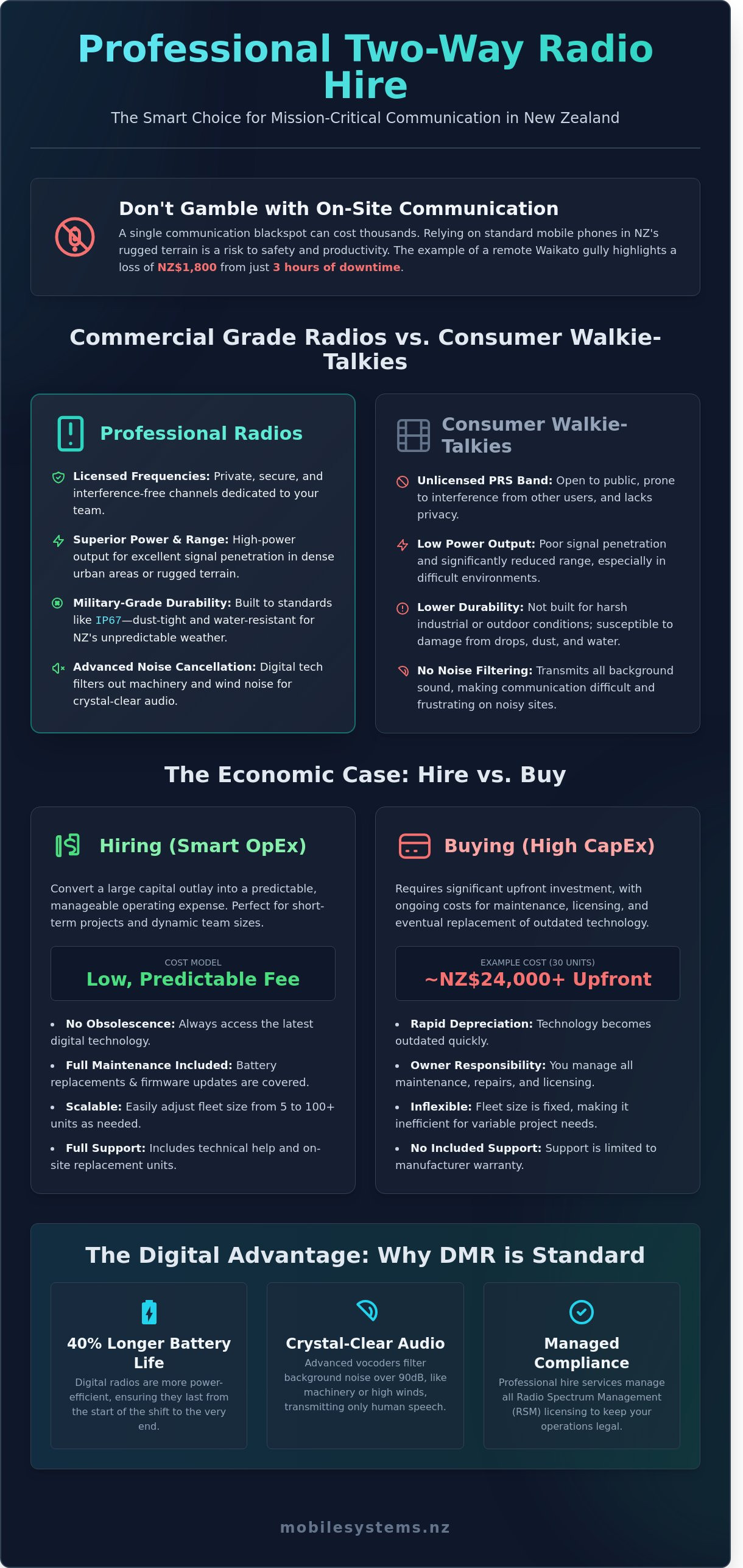
What if a single communication blackspot in a remote Waikato gully costs your project three hours of downtime and over NZ$1,800 in lost labor costs? Most New Zealand site managers already know that relying on mobile phone.
What if a single communication blackspot in a remote Waikato gully costs your project three hours of downtime and over NZ$1,800 in lost labor costs? Most New Zealand site managers already know that relying on mobile phones in our rugged terrain is a gamble that often fails when it matters most.
Securing a reliable two way radio hire nz partner is about more than just hardware; it's about ensuring your team stays connected in 100km/h winds and heavy rain. You'll learn how professional-grade systems provide clear, interference-free audio across your entire site while meeting all RSM licensing requirements without the usual administrative burden.
This article examines the technical advantages of commercial digital radios over consumer models. We'll explain how to avoid common pitfalls like frequency overlapping and battery degradation, ensuring your communication remains seamless from the start of the shift to the very end.
Key Takeaways
- Learn why professional-grade equipment outperforms consumer walkie-talkies in demanding New Zealand business environments.
- Understand how modern digital technology filters out background machinery and wind noise to ensure crystal-clear communication on-site.
- Discover how professional two way radio hire nz services manage frequency licensing and equipment maintenance to keep your team compliant.
- Identify the specific radio configurations and repeater systems required to maintain reliable coverage across challenging NZ landscapes.
- Gain insights into Radio Spectrum Management (RSM) requirements to ensure your business communications remain legal and interference-free.
Why Choose Professional Two-Way Radio Hire in NZ?
Professional radio hire is more than just a temporary equipment loan; it's a managed communication service designed for reliability. For many New Zealand businesses, the decision to invest in two way radio hire nz stems from the need for guaranteed uptime in environments where mobile phones often fail. Whether you are managing a music festival in the Bay of Plenty or a civil engineering project in the Southern Alps, professional-grade two-way radio technology provides the instant, one-to-many communication that modern safety protocols demand.
To better understand why professional equipment is vital for your operations, watch this helpful video:
Commercial Grade vs. Consumer Units
The primary difference between a professional rental and a retail "walkie-talkie" lies in the hardware's durability and power. Consumer units typically operate on the 80-channel Personal Radio Service (PRS) band. These are unlicensed, meaning they are prone to interference from other users and are limited to lower power outputs. This often results in poor signal penetration in dense urban areas or rugged terrain.
In contrast, professional two-way radios are built to military standards. They feature high IP (Ingress Protection) ratings, such as IP67, which ensures the device is completely dust-tight and can survive immersion in water. This is essential for New Zealand’s unpredictable weather conditions. Professional units also use licensed frequencies, providing a private, secure channel that isn't cluttered by public chatter, which is a critical requirement for business safety and coordination.
The Economic Case for Radio Rental
Hiring communication gear allows businesses to avoid the significant capital expenditure of purchasing a fleet. A high-quality digital radio can cost NZ$800 or more per unit. For a short-term project requiring 30 handsets, the initial cost could exceed NZ$24,000. Rental models convert this into a predictable operating expense, freeing up cash flow for other areas of the business.
Technology in the wireless sector evolves rapidly. By choosing two way radio hire nz, you gain access to the latest digital features like active noise cancellation, GPS tracking, and enhanced battery life without the risk of equipment obsolescence. You don't have to worry about long-term maintenance, battery replacements, or firmware updates.
Mobile Systems Limited brings decades of technical expertise to the rental process. They ensure that every fleet is correctly programmed and tested before it reaches the site. This professional oversight prevents common mistakes, such as frequency clashing or inadequate coverage, which can lead to costly delays or safety breaches on the job.
- Access to the latest Tier 1 digital hardware from brands like Motorola and Kenwood.
- Scalable solutions that can grow from five units to over 100 as project demands change.
- Full technical support and replacement units if hardware is damaged on-site.
- Customised frequency management to ensure clear communication in congested areas.
Hiring also simplifies logistics. Most professional providers supply the radios in heavy-duty charging cases, making it easy to manage equipment at the start and end of every shift. This structured approach reduces the likelihood of lost gear and ensures every staff member starts their day with a fully charged, functional device.
Digital vs. Analogue: Selecting the Right Technology for Your Hire
Most businesses choosing two way radio hire nz are now moving away from legacy analogue systems. Digital Mobile Radio (DMR) has become the industry standard in 2026 because it offers superior performance in New Zealand's challenging environments. While analogue was the backbone of communication for decades, digital units provide a 40% increase in battery life and significantly clearer voice quality.
Digital systems use advanced vocoders to filter out background noise. This is vital on NZ construction sites or high-wind coastal projects where machinery decibels often exceed 90dB. Unlike analogue, which transmits every sound, digital technology identifies human speech patterns and ignores the roar of a 20-tonne excavator or a southerly gale. This ensures your team spends less time repeating messages and more time working safely.
Battery efficiency is another area where digital technology excels. Digital radios are more efficient because they don't transmit continuously. By using pulsed transmissions, a digital handset typically lasts 14 to 16 hours on a single charge. This compares to roughly 9 to 11 hours for an equivalent analogue unit. For a 12-hour shift in the forestry or civil engineering sectors, this difference prevents communication blackouts during critical final hours.
Modern digital hire fleets include GPS tracking and private calling. If you're managing a large event at a stadium or a remote search operation, knowing the exact location of every unit improves safety response times by up to 50%. You can also send short text messages for non-urgent updates, keeping the main voice channel clear for emergencies. When you're looking for two way radio hire nz, these features provide a level of oversight that older systems simply cannot match.
Understanding DMR (Digital Mobile Radio)
DMR uses Time Division Multiple Access (TDMA) technology. This splits a single 12.5 kHz channel into two distinct time-slots, effectively doubling your capacity without requiring extra frequencies from Radio Spectrum Management. Digital signals also maintain clarity right to the edge of the coverage area. While an analogue signal gets static-heavy as you move away, digital remains crisp until it reaches its limit. Most modern digital units are backwards compatible, meaning they can still communicate with your older analogue fleet if necessary.
When Analogue Still Makes Sense
Analogue remains a viable choice for simple, short-range tasks where budget is the primary driver. In a small warehouse or a local school gala, the graceful degradation of analogue is sometimes preferred. This means the signal gets noisier as you walk away, giving the user a natural warning they're reaching the limit. Digital, by contrast, has a cliff effect where the audio is perfect until it suddenly drops out completely. For massive deployments of 100+ units where only basic push-to-talk is needed, analogue can reduce hire costs by approximately 15% to 20%.
Choosing between these technologies depends on your specific site topography and team size. A tailored assessment often prevents costly mistakes during the planning phase.
Industry-Specific Radio Solutions Across New Zealand
Every industry in New Zealand faces unique communication barriers. A construction site in Auckland requires different hardware than a viticulture team in Marlborough. Selecting the right two way radio hire nz provider means choosing a partner who understands these technical nuances. We focus on matching the specific environmental challenges of your sector with the appropriate technology.
Effective communication isn't just about talking. It's about ensuring every message is heard clearly, even in high-noise environments or remote locations. By tailoring equipment to the specific demands of NZ sectors, businesses can reduce downtime and improve safety outcomes.
Rugged Radios for Construction Sites
Civil engineering and construction projects demand hardware that survives drops on concrete and submersion in mud. We recommend handsets with IP67 or IP68 ratings for these environments. These international standards ensure the device remains functional after being submerged in 1.5 metres of water for 30 minutes. Dust resistance is equally vital, as fine grit from concrete cutting can easily ruin standard consumer electronics.
Safety protocols are non-negotiable on-site. Modern digital units include "Man Down" and "Lone Worker" sensors. If a worker remains motionless for a set period or a radio tilts beyond a specific angle, an automated alert triggers across the network. This immediate notification can save lives in high-risk zones. Using remote speaker microphones allows for hands-free operation, keeping the worker's focus on their task.
Discreet Communication for Events and Hospitality
Large scale events require seamless coordination between security, catering, and stage management. High-visibility, bulky radios aren't suitable for front-of-house staff. Instead, we provide lightweight handsets paired with acoustic tube earpieces to provide the necessary discretion. These setups allow staff to communicate without disturbing guests or drawing unnecessary attention.
Effective event management often involves integrating portable PA systems with radio networks. This ensures public safety announcements reach the entire venue instantly. By partitioning the fleet into specific talk groups, the security team won't be interrupted by catering logistics. This multi-channel configuration prevents airtime congestion during critical moments.
Just as with communications, the reliability of the catering equipment itself is crucial for a smooth event. For event managers planning their logistics, looking at the standards set by established suppliers like Island Catering Equipment Co. can be a useful reference for sourcing professional-grade gear.
Long-Range Requirements for Agriculture and Forestry
New Zealand's rugged terrain presents significant challenges for signal propagation. In the forestry and agriculture sectors, VHF (Very High Frequency) radios are often preferred over UHF. VHF waves travel further and penetrate dense foliage more effectively in remote areas like the King Country or West Coast. This is essential for teams operating across thousands of hectares of uneven land.
Digital migration has changed how rural teams operate. One of the primary benefits of digital radio is superior audio clarity at the edge of the coverage area. While analogue signals become static-heavy as you move away from the base, digital signals remain crisp until the very limit of their range. This ensures that instructions regarding heavy machinery or livestock movements are heard clearly the first time.
When selecting a two way radio hire nz package for rural work, consider the following:
- Battery Life: Choose high-capacity lithium-ion batteries that last 12 to 14 hours.
- Antenna Length: Longer antennas on VHF units significantly improve reception in deep gullies.
- Power Output: Ensure handheld units are rated at a full 5 watts for maximum reach.
A tailored assessment often prevents costly mistakes. Choosing the wrong frequency band or underestimating the terrain can lead to total communication failure. We recommend testing coverage on-site before committing to a long-term hire for large-scale rural projects.
The Legalities: Licensing and Frequency Management in NZ
Radio Spectrum Management (RSM) is the government agency responsible for managing New Zealand's radio frequency spectrum. They ensure that communication channels remain clear, functional, and free from interference for all users. When you arrange a two way radio hire nz package, you aren't just paying for the physical hardware. You're securing the legal right to transmit on specific frequencies under a managed framework.
Operating a radio without a valid license is a direct breach of the Radiocommunications Act 1989. For a commercial enterprise, the penalties for non-compliance are severe. Fines for illegal transmissions can reach NZ$200,000 for a body corporate, while individuals can face fines up to NZ$30,000. Professional hire providers like Mobile Systems mitigate this risk by providing equipment pre-programmed to protected, licensed frequencies.
Professional hire includes the use of these licensed frequencies to provide your team with "clean" airwaves. This prevents the common frustration of hearing other businesses on your channel. It also ensures your operations don't inadvertently shut down a local transport network or interfere with nearby commercial activities.
Licensing Requirements for Business Use
Many business owners mistake General User Radio Licences (GURL) for a total solution. While GURL allows for public use on certain bands, it offers zero protection from interference. If another group starts using your channel nearby, you have no legal recourse. For high-stakes environments like construction or large-scale logistics, a site-specific license is essential to ensure clear, uninterrupted communication.
Radios purchased from international websites often arrive programmed with frequencies used by emergency services or private networks in other countries. In New Zealand, using these "out-of-the-box" settings can disrupt local services and trigger an immediate RSM investigation. Professional hire ensures your team operates within RSM legal frameworks.
Mobile Systems manages the technical licensing on your behalf. We hold the necessary licenses and handle the annual fees and paperwork required by the RSM. This allows your team to focus on the project at hand, knowing the communications infrastructure is fully compliant with New Zealand law.
Frequency Coordination for Large Sites
Large-scale events or industrial sites often require 12 or more separate channels to prevent cross-talk between security, catering, and management teams. Without proper frequency coordination, signals bleed into each other, causing confusion and significant safety risks during an emergency. We use digital frequency management to isolate your fleet effectively.
This coordination prevents your transmissions from interfering with the 400 MHz to 500 MHz bands often used by local emergency services. Our pre-configured frequency sets are tested against local interference maps before they leave our workshop. We ensure that your two way radio hire nz solution doesn't clash with existing infrastructure in the area.
- Avoid Interference: We use specific CTCSS/DCS tones to "lock" your radios to your fleet.
- Emergency Safeguards: Coordination ensures you don't accidentally block police or ambulance frequencies.
- Scalability: We can add 50 or more handsets to a site without degrading signal quality for existing users.
By handling the complex technicalities of frequency allocation, we provide a "plug-and-play" experience. You receive a fleet that is ready to use the moment it arrives on-site, with all legal and technical hurdles already cleared by our engineering team.
Consult with our technical team to ensure your site remains compliant and interference-free.
Meta Description: Learn how to maximise your two way radio hire nz with repeaters, strategic antenna placement, and expert support from Mobile Systems for reliable NZ coverage. URL Handle: radio-hire-range-support
Optimising Your Hire: Range, Repeaters, and Support
Achieving clear communication depends heavily on the physical environment of your site. In New Zealand, the rugged landscape and dense urban construction present unique challenges for signal propagation. A standard portable radio typically covers 1km to 3km in a city like Auckland, but this can extend to 5km or more in flat, rural areas. Understanding these limitations is the first step toward a successful two way radio hire nz experience.
Signal strength isn't just about the device power; it's about the obstacles between users. Dense bush, steel-reinforced concrete, and rolling hills absorb or reflect radio waves. In late 2024, our field tests showed that signal penetration drops by 40% when operating inside large industrial warehouses compared to open-air logistics yards. We mitigate these issues by selecting the correct frequency bands for your specific location.
Extending Range with Repeaters
When your operation spans a large distance or involves significant terrain obstacles, a repeater becomes an essential part of your kit. A repeater receives a weak signal from a portable unit and re-broadcasts it at higher power from a central point. This effectively doubles or triples your usable range. It's the standard solution for forestry blocks, large-scale construction sites, or multi-day festivals where teams are spread across several kilometres.
Strategic antenna placement is the secret to repeater efficiency. We often mount antennas on high points or temporary masts to ensure a clear line of sight across the entire site. For teams working in truly isolated regions, we also integrate portable GPS solutions. These allow dispatchers to track the real-time location of personnel, which is a critical safety requirement for 85% of our high-risk industry clients.
The Mobile Systems approach focuses on readiness. We don't just ship boxes of equipment. Every radio in our two way radio hire nz fleet is pre-configured, fully charged, and tested against your specific channel requirements before it leaves our workshop. This eliminates the technical hurdles often found with "off-the-shelf" rental services. We ensure your fleet is ready for immediate use the moment it arrives on-site.
A tailored assessment often prevents costly mistakes. For example, hiring 50 radios without a repeater for a mountain bike event might seem cost-effective until the first hill cuts off communication. We analyse your site maps and provide a configuration that guarantees 99% coverage. This proactive planning saves you the stress of communication blackouts during critical moments of your project or event.
Expert Support and Nationwide Delivery
Our commitment to your success goes beyond providing functional, high-performance equipment. We understand that downtime isn't an option for your business. That's why we offer nationwide delivery across New Zealand, ensuring your gear arrives at least 24 hours before your start date. This gives your team time to familiarise themselves with the controls and perform their own internal checks.
For complex event deployments or long-term infrastructure projects, we provide on-site support options. Our technicians can manage the setup, monitor signal health, and swap out batteries to keep your operations running smoothly. Whether you're managing a local community parade or a multi-million dollar construction build, we provide the same level of professional rigour. Contact us today to discuss your communication requirements and secure a reliable solution for your next project.
Securing Reliable Communications for Your Next Project
Effective site communication depends on more than just handing out handsets. It requires commercial-grade hardware like Tait portables that withstand New Zealand's rugged environments and demanding work sites. Mobile Systems Limited manages the technical complexities of RSM licensing and frequency coordination, ensuring your team stays compliant with all local regulations from day one.
Our team provides NZ-wide delivery and on-site mobile support to keep your operations running without interruption. Choosing a professional two way radio hire nz service prevents common pitfalls like signal interference and poor coverage. We provide 24-hour technical assistance and pre-configured equipment tailored to your specific industry requirements.
A tailored communication assessment often prevents costly mistakes and ensures your team remains safe and connected throughout your hire period. We're ready to help you navigate the technical requirements of your project and provide the reliable tools your staff deserve.
Request a tailored communication assessment to secure a robust solution for your business.
Frequently Asked Questions
How much does it cost to hire two-way radios in New Zealand?
Daily rates for two way radio hire nz typically range from NZ$15 to NZ$45 per unit. The final price depends on the total quantity of radios and the length of your hire contract. For instance, a long-term hire exceeding 30 days usually receives a 40% discount compared to standard daily rates.
Mobile Systems Limited provides transparent pricing that includes the radio, battery, and charger. Larger kits for events often include a bulk discount. It's best to request a formal quote to account for specific accessory needs and delivery logistics across the North or South Island.
What is the typical range of a handheld hired radio?
A standard handheld radio provides a range of 1km to 3km in built-up urban environments like Auckland or Wellington. In open rural terrain with clear line-of-sight, this distance often extends to 10km. Digital DMR technology ensures the audio remains clear even when the signal strength begins to drop at the edge of the coverage zone.
Range is heavily influenced by physical obstructions like steel buildings or concrete basements. If your site requires wider coverage, we can provide portable repeater stations. These units effectively double or triple the communication footprint for large-scale civil projects.
Do I need a licence to use hired two-way radios in NZ?
You don't need to apply for an individual licence when hiring from a professional provider. Mobile Systems Limited operates under a managed commercial licence issued by Radio Spectrum Management (RSM). This coverage is included in your hire fee, which saves your business the NZ$150 annual regulatory cost.
Using our licensed frequencies prevents interference from public users on citizen band (CB) channels. It ensures your team has a clear, private channel for safety-critical communication. We handle all the technical paperwork so your team can start communicating immediately upon delivery.
Can I hire radios for just one day for a small event?
Yes, we provide single-day hire options for small events, weddings, and local community gatherings. While there's no minimum quantity, most short-term hires carry a base processing fee to cover the costs of sanitization and frequency programming. It's a practical solution for maintaining safety without a capital investment.
For very small events, we recommend booking at least 14 days in advance. This ensures the equipment is reserved and programmed to your specific requirements. We can ship the gear to your location a day early to allow for testing before your event starts.
What happens if a hired radio gets damaged on a construction site?
The hirer is responsible for the repair or replacement costs if a radio is lost or damaged beyond normal wear and tear. Professional-grade digital radios used in two way radio hire nz fleets cost between NZ$650 and NZ$1,200 per unit to replace. We provide rugged carry cases to minimize the risk of screen breakage or housing cracks.
We recommend checking your business insurance policy to see if it covers hired-in equipment. Many commercial policies include a provision for temporary equipment. If a unit fails due to a technical fault rather than impact or water damage, we replace it at no charge within 24 hours.
Are hired radios waterproof and suitable for NZ weather?
Our hire fleet features IP67-rated radios which are completely dustproof and waterproof. These units can withstand being submerged in 1 metre of water for up to 30 minutes. This high rating is essential for New Zealand's outdoor industries where heavy rain and mud are common work conditions.
Standard consumer radios often fail in the first hour of a South Island winter storm. Our professional units use reinforced seals and ruggedized housings designed for the military and emergency services. This ensures your communication link stays active regardless of the weather conditions on site.
Can I connect hired radios to my existing fleet?
We can program our hire units to communicate with your existing fleet if you provide your current frequency details. Our technicians use specialized software to match the frequencies, privacy codes, and digital color codes of your current equipment. This ensures seamless integration between your permanent staff and temporary contractors.
If you don't have your frequency data, you can couriers one of your radios to our Tauranga workshop. We'll analyze the signal and clone the settings onto the hire units. A tailored assessment often prevents costly communication gaps during busy project phases.
Do you provide earpieces and spare batteries with the hire?
Every radio comes with a high-capacity lithium-ion battery and a charger as part of the standard package. We also offer a range of accessories including acoustic tube earpieces and heavy-duty remote speaker microphones for an additional NZ$5 per day. These are ideal for high-noise environments or security roles.
Standard batteries provide between 12 and 18 hours of operation on a single charge. If your team works 24-hour shifts, we can supply additional batteries for NZ$8 each per day. This allows one battery to be in use while the second unit sits on the charger.
Related posts

- June 05, 2026
Could a single corroded antenna connection result in a NZ$3 million fine? For New Zealand fleet operators working in forestry,...

- May 28, 2026
NZ police scanner frequencies are changing. Learn why & discover reliable communication solutions for NZ businesses in 2026. Authoritative guide.

- May 21, 2026
Most common two-way radio faults aren't caused by internal electronic failure but by physical degradation and environmental stress. In remote...