
Two-Way Radio Hire in New Zealand: The Ultimate Guide for High-Performing Teams
Discover how two way radio hire transactional service high New Zealand delivers reliable, scalable comms for safety and operational efficiency.
Is your team's safety and productivity being undermined by patchy mobile coverage? For New Zealand businesses managing critical operations—from a sprawling construction site in Christchurch to a remote forestry block in the Gisborne District—two-way radio hire is the proven solution for instant, reliable communication that keeps teams safe and projects on schedule.
When a critical instruction needs to reach everyone right now, how do you guarantee the message gets through? What is the true cost to your timeline, budget, and WorkSafe compliance when communication fails? These are daily realities for Kiwi businesses, where dependable comms are mission-critical.
Why NZ's Toughest Industries Rely on Professional Radio Hire
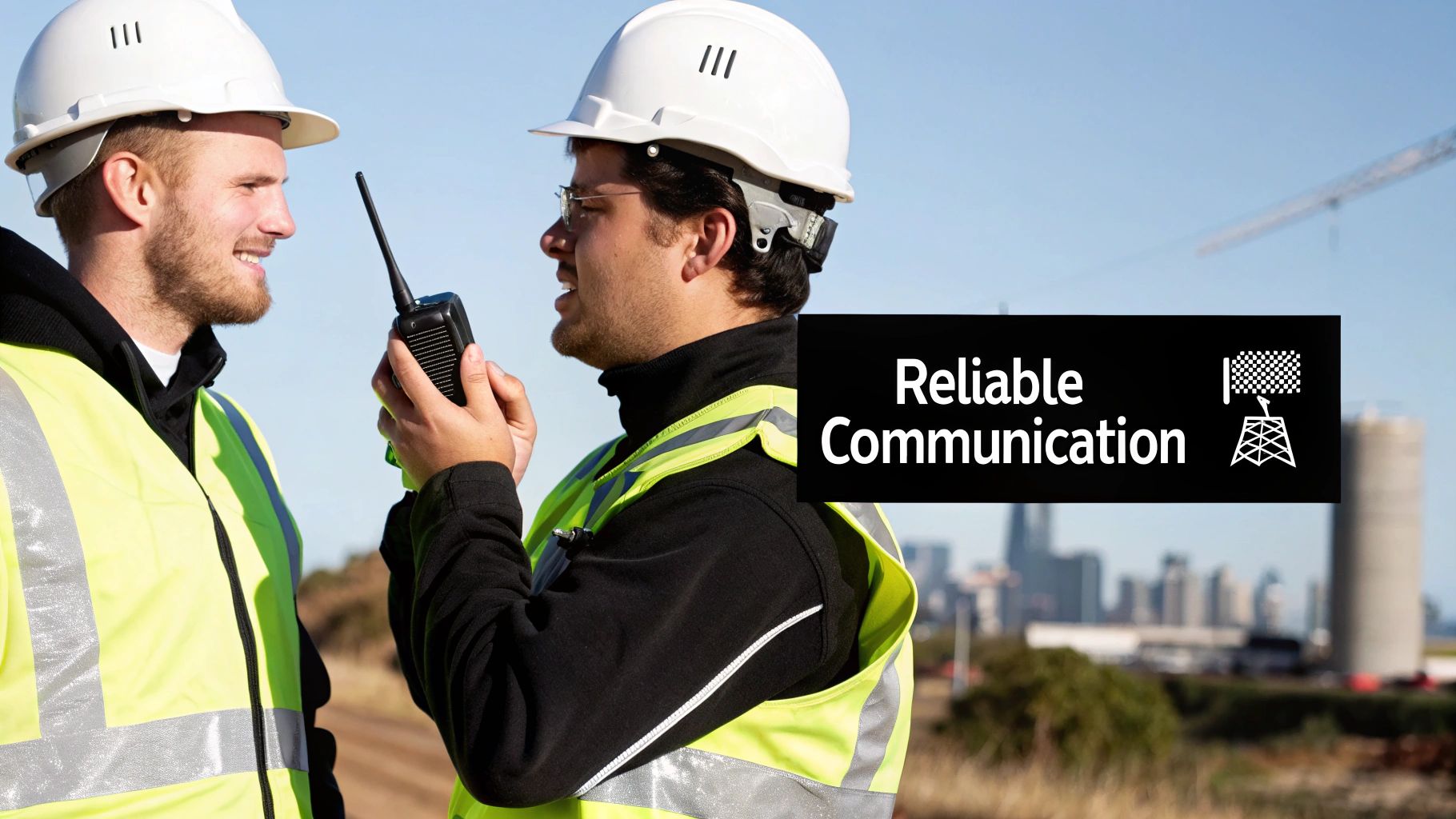
Mobile phones are essential for modern life, but they are not reliable tools for professional, high-stakes environments. The operational pain points are all too common across every major New Zealand industry:
- Agriculture & Horticulture: Coordinating teams across vast farms or orchards where mobile signal is non-existent.
- Construction: Managing crane operators, ground crews, and traffic controllers on noisy, complex sites with concrete and steel blocking signals.
- Emergency & Disaster Response: Needing a resilient communication network when cellular towers are down or overloaded.
- Forestry: Ensuring lone worker safety in remote blocks with zero mobile reception and challenging terrain.
- Manufacturing & Processing: Cutting through extreme factory noise to maintain production flow and respond instantly to machinery issues.
- Maritime & Fishing: Requiring marine-rated, waterproof devices for safe vessel-to-vessel and on-board communication.
- Security & Events: Managing large crowds and coordinating security teams across sprawling venues without relying on congested public networks.
- Transport & Logistics: Keeping dispatchers connected with a fleet of drivers spread across the country.
These communication failures lead directly to project delays, wasted resources, and serious health and safety risks. As highlighted by WorkSafe NZ, employers have a legal duty to manage risks, and that includes providing a reliable means of communication, especially for remote and lone workers.
Hiring professional-grade two-way radios is a strategic decision to build operational resilience. It provides a dedicated, fully managed communication network tailored to your project's unique demands—without the capital expense of purchasing a full fleet.
Choosing the Right Radio Technology for New Zealand Conditions
Selecting the right radio isn't just about the brand; it's about matching the underlying technology to the unique demands of your New Zealand worksite. A radio that works brilliantly in the open spaces of a Canterbury farm may be useless inside an Auckland warehouse. Understanding the core differences is the first step to a successful hire.
Your team size, the terrain you need to cover, and the working environment dictate the best technology for the job.
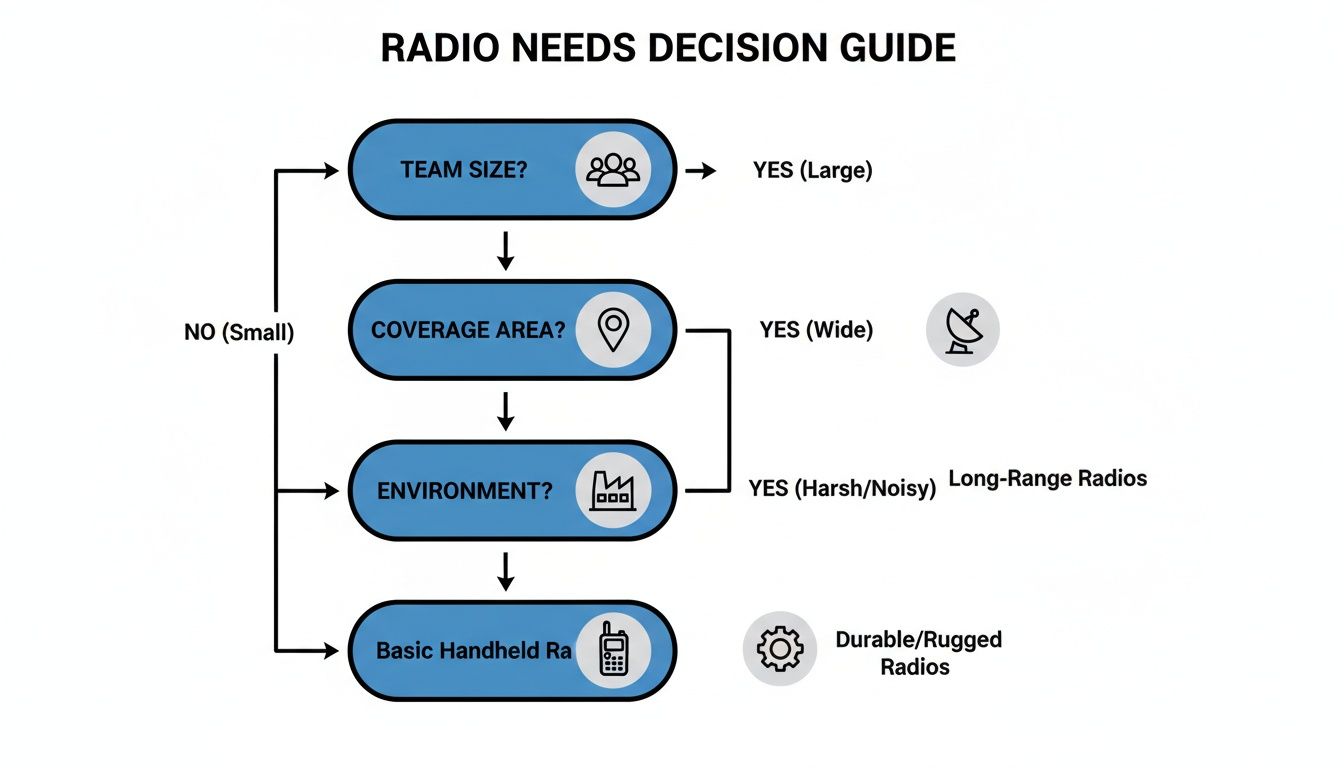
To make the choice clearer, this table breaks down the key radio technologies used across New Zealand.
| Technology | Best For | Coverage Range | Key Advantage (NZ Context) | Potential Limitation |
|---|---|---|---|---|
| UHF / VHF Radio | Localised sites (construction, events, farms). | Up to several kilometres. | Independent of public networks. Highly reliable for defined areas. | Range is limited by terrain and obstructions. Requires repeaters for large areas. |
| PoC (Push-to-Talk over Cellular) | Nationwide operations (transport, logistics, field services). | National (wherever there is mobile coverage). | Instant communication across cities and islands. GPS and advanced features. | Dependent on the cellular network; will not work in remote mobile black spots. |
| Satellite Devices | Extremely remote areas (marine, alpine, exploration). | Global or near-global. | Works where no other network can. The ultimate solution for off-grid safety. | Higher running costs. Not designed for rapid, chatty team communication. |
UHF & VHF Radios: The Workhorses of NZ Industry
For defined worksites, traditional UHF (Ultra High Frequency) and VHF (Very High Frequency) radios are the gold standard for reliability. They create a private, independent communication network that you control completely.
- UHF: Its shorter wavelength is excellent at penetrating concrete, steel, and other obstructions, making it the top choice for construction sites, manufacturing plants, warehouses, and dense urban environments.
- VHF: Its longer wavelength travels further over open country and rolling terrain, making it ideal for agriculture, forestry, and marine applications.
Key Features & Benefits:
- Instant Push-to-Talk: One-to-one and one-to-many communication at the press of a button.
- Durability: Built to high IP ratings (e.g., IP67) for dust and water resistance, and to withstand drops and vibration.
- Superior Audio: Powerful speakers and noise-cancelling microphones cut through loud industrial noise.
- Shift-Long Battery Life: Professional batteries designed to last 10-12 hour shifts without fail.
Push-to-Talk over Cellular (PoC): Nationwide Team Communication
What if your team operates across different cities or even between islands? This is where Push-to-Talk over Cellular (PoC) is a game-changer. PoC devices, like the Hytera P50 or Motorola TLK110, use New Zealand’s cellular networks to provide instant, nationwide radio communication.
Key Features & Benefits:
- Unlimited Range: Communicate instantly from Kaitaia to Invercargill, wherever there is mobile coverage.
- GPS Tracking: See your team's location in real-time for improved logistics and safety oversight.
- Advanced Features: Leverage dispatch software, emergency alerts, and integration with other systems.
- Cost-Effective: No need to build or maintain your own repeater infrastructure.
For a deeper analysis, learn more about PoC radios versus UHF/VHF in our detailed guide.
Satellite Devices: The Ultimate Off-Grid Lifeline
For teams working in New Zealand's most remote areas—alpine guides, maritime crews, or exploration teams—where no cellular or radio coverage exists, satellite devices are the only option. Brands like Iridium, Inmarsat, and Starlink provide a vital link for safety and coordination.
Key Features & Benefits:
- Global Coverage: Communicate from virtually anywhere on the planet.
- SOS Functionality: Dedicated emergency buttons link directly to global rescue coordination centres.
- Data & Voice: Depending on the device, allows for voice calls, text messaging, and data transfer for weather reports or logistics.
- Peace of Mind: The ultimate assurance for lone workers in high-risk, isolated environments.
NZ Compliance, Safety, and Operational Realities
Deploying a professional communication system in New Zealand involves more than just choosing a device. It requires a deep understanding of local regulations, safety protocols, and the practical challenges of our unique environment.
RSM Licensing and Legal Compliance
In New Zealand, the radio spectrum is managed by Radio Spectrum Management (RSM), a division of MBIE. To operate professional two-way radios on a private frequency, you need a licence. This is not optional paperwork; it is a legal requirement that ensures your communications are secure, private, and free from interference. A professional provider like Mobile Systems manages the entire RSM licensing process for you, guaranteeing your hired radios are fully compliant and ready for legal use on your site.
Lone Worker Safety and Man Down Alerts
Under the Health and Safety at Work Act 2015, businesses have a strict obligation to ensure the safety of their lone and remote workers. Modern digital radios are critical tools for this.
- Lone Worker: This feature requires the user to check in at regular intervals. If they fail to do so, an alert is automatically sent to the supervisor.
- Man Down: An internal sensor detects if a radio (and its user) has been tilted beyond a certain angle for a set period, indicating a potential fall or injury, and triggers an emergency alarm.
- GPS Tracking: Allows a dispatcher to pinpoint a worker's exact location in an emergency, dramatically speeding up response times.
Durability and IP Ratings for NZ Conditions
New Zealand’s weather is notoriously harsh. Your equipment must be built to withstand it. Look for an IP (Ingress Protection) rating. An IP67-rated radio, for example, is completely dust-tight and can be submerged in 1 metre of water for 30 minutes, making it ideal for construction, agriculture, and marine use.
Recommended Devices and Solutions for NZ Businesses
At Mobile Systems, we only recommend field-tested, reliable equipment from world-leading brands. Here are some of the solutions trusted by New Zealand's top companies:
- PoC Radios: Hytera P50, Motorola TLK110
- UHF/VHF Digital Radios: Tait, Hytera, Motorola, Entel
- Marine Radios: Icom, GME, Uniden
- Satellite Devices: Starlink, Iridium, Inmarsat, Garmin inReach
- Coverage Systems: We design and deploy repeaters and antenna systems to guarantee coverage across your entire site.
- Lone Worker Solutions: Integrated GPS tracking and man-down systems for ultimate peace of mind.
Why Choose Mobile Systems Limited?
Choosing a communications partner is a critical decision. It’s about trust, local expertise, and knowing you have a team on your side that understands the realities of operating in New Zealand.
- 100% New Zealand Owned: Based in Mount Maunganui, we have proudly served Kiwi businesses for nearly two decades. We understand the local landscape, from the Coromandel to the Southern Alps.
- Expert In-House Technicians: Our team handles everything—expert programming, on-site installation, and ongoing servicing. We ensure your system works flawlessly from day one.
- Mobile On-Site Support: Our dedicated support fleet comes to you, providing installation and training right on your worksite, anywhere in New Zealand.
- End-to-End Solution: We manage the complex parts for you, from custom coverage planning and RSM licensing support to developing long-term replacement and maintenance plans.
- Long-Term Reliability: We don’t just supply equipment; we build lasting partnerships. Our commitment to aftercare and support ensures your communication system remains a reliable asset for years to come.
Get Expert Advice for Your Project Today
Stop letting unreliable communication put your team and your project at risk. Our friendly, New Zealand–based specialists are here to provide clear, practical advice tailored to your exact operational needs.
Whether you need a simple hire for a weekend event or a complex, multi-site system for a major infrastructure project, we can design a solution that delivers.
Contact a Communications Specialist Today to request a no-obligation quote or a free demonstration. Let's get your team connected.
Frequently Asked Questions (FAQ)
What is the typical cost to hire two-way radios in NZ?
The cost depends on your specific needs: the type of radio (UHF/VHF, PoC), the number of units, the hire duration, and any required accessories like noise-cancelling headsets or multi-unit chargers. Short-term hire for a simple radio might be just a few dollars per day, while a sophisticated digital radio with GPS for a long-term project will be quoted differently. We provide a clear, itemised quote with no hidden fees.
What is the shortest period I can hire radios for?
Our minimum hire period is just one day. This is perfect for single-day events, film shoots, or short-term operational needs. We also offer highly competitive weekly, monthly, and long-term hire rates for extended projects.
What happens if a radio gets lost or damaged?
Our hire fleet consists of robust, commercial-grade equipment built for tough NZ conditions. Our hire agreement outlines the terms for damage and loss. Normal wear and tear are covered by us. In cases of significant damage due to misuse, or if a unit is lost, repair or replacement costs may apply. We ensure these terms are clear and transparent from the outset.
Do I need a licence to use hired two-way radios?
For private, interference-free communication on professional UHF or VHF frequencies, a licence from Radio Spectrum Management (RSM) is legally required. As part of our comprehensive service, Mobile Systems handles the entire licensing application process on your behalf, ensuring your radios are fully compliant for use in New Zealand.
Can you provide coverage for a very large or difficult site?
Absolutely. This is one of our core specialities. If your site has black spots or covers a large area, we can deploy temporary repeaters and antenna systems to guarantee seamless communication coverage across your entire operational zone. Our technicians perform on-site testing to map coverage and design the optimal solution.
Related posts

- June 05, 2026
Could a single corroded antenna connection result in a NZ$3 million fine? For New Zealand fleet operators working in forestry,...

- May 28, 2026
NZ police scanner frequencies are changing. Learn why & discover reliable communication solutions for NZ businesses in 2026. Authoritative guide.

- May 21, 2026
Most common two-way radio faults aren't caused by internal electronic failure but by physical degradation and environmental stress. In remote...