
Two-Way Radio Installation Auckland: Professional Solutions for 2026
Last Tuesday, a site foreman in the Waitakere Ranges discovered that a poorly mounted antenna was the sole reason his team lost contact during a critical lift. In a city where volcanic hills and dense CBD high-rises.
Last Tuesday, a site foreman in the Waitakere Ranges discovered that a poorly mounted antenna was the sole reason his team lost contact during a critical lift. In a city where volcanic hills and dense CBD high-rises create constant signal shadows, a generic setup often fails when you need it most.
You likely know that reliable communication is the backbone of a safe operation, yet dead zones and scratchy audio remain a daily frustration for many local firms. Professional two way radio installation auckland isn't just about mounting a bracket. It's about engineering a system that defies the region's unique geography and challenging weather.
This guide provides a comprehensive roadmap to achieving crystal clear communication and full compliance with Radio Spectrum Management (RSM) regulations. We'll examine how precision engineering and robust hardware selection will transform your fleet's connectivity for the 2026 landscape.
Key Takeaways
- Understand how Auckland’s unique geography, from CBD skyscrapers to the Waitakere Ranges, impacts signal reliability and antenna placement.
- Discover why professional two way radio installation auckland is essential for navigating the technical transition from analog to high-clarity digital systems.
- Learn the critical performance trade-offs between 25W vehicle-mounted radios and portable handheld units for construction and event environments.
- Identify common installation mistakes that lead to signal loss and how a structured technical approach ensures consistent connectivity.
- Explore the benefits of utilizing mobile on-site support and high-tier equipment from industry-leading brands like Tait and Hytera.
Why Professional Two-Way Radio Installation Matters in Auckland
Reliable communication in New Zealand's largest city isn't a simple "plug and play" scenario. Auckland's unique mix of high-density urban zones and rugged coastal terrain makes two way radio installation auckland a task for qualified specialists. A basic setup might work on a flat site, but commercial operations across the Isthmus require precision engineering to overcome natural and man-made barriers.
To understand the physical requirements of a high-quality vehicle setup, watch this video on mounting mobile units correctly:
To better understand this concept, watch this helpful video:
In New Zealand, the Radio Spectrum Management (RSM) governs all transmissions. Commercial operators must comply with strict licensing standards to avoid interference with emergency services or other businesses. Professional installers ensure your equipment operates within legal frequencies, protecting your company from potential fines. While Two-way radio technology has evolved into the digital age, the physics of signal propagation and hardware protection remain constant.
Modern digital radios are sensitive pieces of electronic equipment. Incorrect DIY wiring can drain a 12V vehicle battery overnight or cause voltage spikes that fry internal circuit boards. Mobile Systems Limited technicians focus on fused power leads and ignition-sense wiring to protect your investment. We ensure that your hardware is integrated into the vehicle's electrical system without compromising the manufacturer's warranty.
Overcoming Auckland’s Terrain and Urban Interference
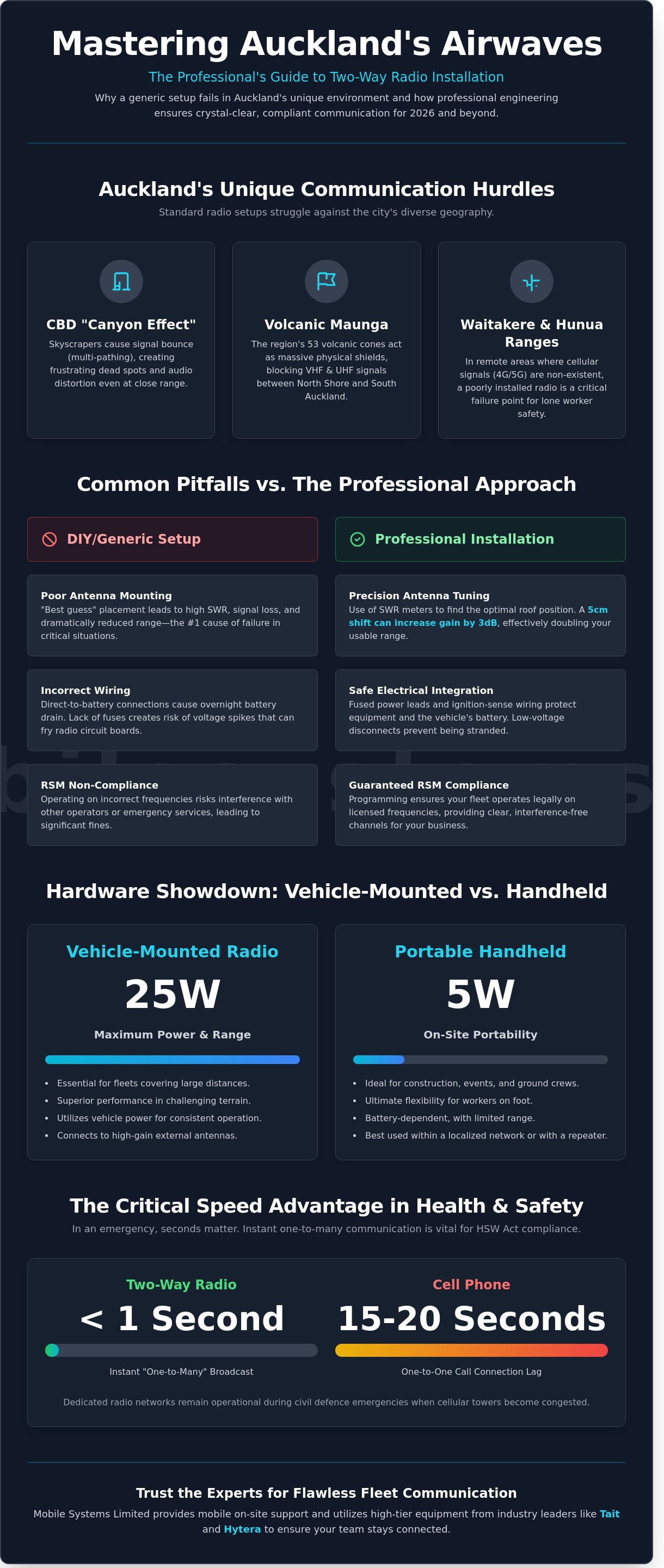
Auckland's CBD creates a "canyon effect" where signals bounce off glass and steel, leading to multi-pathing issues. This results in frustrating dead spots even when you're physically close to a transmitter. Professional site surveys identify these gaps before any hardware is bolted down. We use specific data to determine if your fleet requires high-gain antennas or specialized filtering to cut through urban noise.
The region’s 53 volcanic cones, or maunga, act as physical shields for VHF and UHF signals. If your fleet moves between the North Shore and South Auckland, antenna placement on the vehicle roof is critical. A 5cm shift in position can increase signal gain by 3dB, effectively doubling your range in challenging terrain like the Waitakere Ranges. Professional installers use SWR (Standing Wave Ratio) meters to tune every antenna for peak performance.
The Safety Critical Role of Reliable Communications
Logistics firms in Auckland often find cellular networks insufficient for rapid dispatch. While a mobile phone call takes 15 to 20 seconds to connect, radio provides "one-to-many" communication in under a second. This speed is vital for meeting health and safety compliance under the Health and Safety at Work Act 2015. It allows a dispatcher to alert an entire crew to a hazard instantly.
- Network Resilience: During heavy weather events or civil defence emergencies, Auckland’s cellular towers frequently become congested. Dedicated radio networks remain operational.
- Remote Coverage: In areas like the Hunua Ranges where 4G signals drop out, a correctly installed VHF radio provides a consistent lifeline for lone workers.
- Battery Management: Professional installs include low-voltage disconnects to ensure radios don't leave workers stranded with a dead vehicle battery.
A tailored assessment often prevents costly mistakes and ensures your team stays connected when it matters most. Choosing the right partner for your two way radio installation auckland project ensures your fleet meets both NZ safety standards and operational requirements for 2026 and beyond.
Technical Considerations for Auckland Radio Systems
Precision in two way radio installation auckland projects requires a deep understanding of the city's unique topography. Auckland's mix of dense high-rise corridors, volcanic cones, and sprawling coastal plains creates distinct signal challenges. Choosing the right hardware depends entirely on your specific operational footprint and the physical obstacles within it.
UHF vs. VHF: Which is Right for Your Business?
UHF (Ultra High Frequency) is the industry standard for urban environments. Because UHF waves are shorter, they navigate the concrete, steel, and glass of the Auckland CBD more effectively than other frequencies. This makes it the preferred choice for construction sites, retail centers, and warehouse operations.
VHF (Very High Frequency) excels in "ground-wave" propagation. These longer waves follow the curvature of the earth and are less likely to be absorbed by foliage. This makes VHF ideal for maritime applications in the Waitematā Harbour or rural operations in the Rodney and Franklin districts.
UHF offers superior building penetration for CBD use, while VHF provides better distance in open Auckland rural areas.
Digital Mobile Radio (DMR) and P25 Standards
The transition from analog to Digital Mobile Radio (DMR) has transformed local fleet management. DMR systems use Time Division Multiple Access (TDMA) technology to provide two communication channels on a single frequency. This effectively doubles your capacity without requiring additional licenses from Radio Spectrum Management (RSM).
For private Auckland fleets, DMR offers integrated GPS tracking, encrypted voice calls, and text messaging. Public safety and government agencies typically utilize P25 standards to ensure interoperability across different departments during emergency responses. You can explore compliant hardware options in our Two-Way Radio Devices collection.
Environmental Durability and IP Ratings
Auckland's environment is notoriously harsh on electronics. With average humidity levels often exceeding 80% and constant salt spray in coastal zones, standard hardware often fails prematurely. Professional installations require devices with high Ingress Protection (IP) ratings.
- IP67: Dust-tight and survives immersion in water up to 1 meter for 30 minutes.
- IP68: Provides total protection against dust and continuous immersion under pressure.
- MIL-STD-810: Military-grade testing for shock, vibration, and extreme temperature shifts.
Extending Coverage with Repeaters
Auckland's hilly terrain, including the Waitakere Ranges and various volcanic peaks, can create significant "dead zones." To maintain seamless communication from the North Shore to South Auckland, a repeater system is often necessary. A repeater receives a weak signal and re-broadcasts it at a higher power from a strategic elevation.
A well-placed repeater can extend a handheld radio's 5km range to over 50km, ensuring your team stays connected across the entire Auckland isthmus. A tailored assessment often prevents costly mistakes in hardware placement. If you need to verify your signal strength, contact our technical team for a professional coverage map analysis.
Vehicle-Mounted vs. Handheld: Selecting Your Auckland Setup
Choosing the right hardware depends on your specific operational environment. While handhelds offer mobility, a professional two way radio installation auckland project often focuses on high-power vehicle units for wide-area coverage. The decision impacts both your signal reach and the long-term reliability of your communication network.
Fixed-mount radios deliver up to 25W of power, which significantly outperforms the 5W limit of most handhelds. This extra wattage is vital for maintaining clear signals across Auckland's undulating terrain, from the North Shore to the Bombay Hills. A professional installation ensures your team remains connected even in areas with poor cellular reception.
The Power of Fixed-Mount Vehicle Radios
Fixed-mount units utilize external antennas to clear the metal "cage" interference caused by the vehicle's body. This setup provides the maximum possible range across the Auckland region. Brands like Tait and Hytera are staples in New Zealand commercial fleets because they handle the vibrations and temperature shifts of daily use.
Hard-wired power is another major advantage. Because the radio draws from the vehicle's battery, it's constantly available during long shifts without the need for recharging. Before deploying these systems, it's essential to comply with New Zealand's radio licensing requirements to ensure your frequencies are legal and interference-free.
Portable Radios for On-Site Flexibility
Handheld units are essential for staff on foot at Auckland construction sites or event venues. Modern portable radios meet MIL-SPEC standards for durability. They're designed to survive drops on concrete and heavy rain in the Waitakere Ranges, making them ideal for Auckland's rugged construction and forestry sectors.
Battery life is a critical factor for teams working in remote locations. High-capacity lithium-ion batteries now provide 15 to 20 hours of active use. You can explore specialized Portable Communications and GPS options to find hardware that balances weight with rugged performance for your specific site needs.
- Hybrid Systems: These allow seamless communication between vehicle-based teams and those on foot.
- Integrated GPS: Modern radios assist with Auckland fleet dispatch and driver safety by providing real-time location data.
- Safety Features: Many units include "Man Down" or "Lone Worker" functions to protect staff in high-risk zones.
Integrated GPS tracking in modern radios assists with fleet dispatch and driver safety. This visibility reduces response times during emergencies and helps managers optimize routes across the city. A tailored assessment of your fleet often prevents costly mistakes when choosing between these two formats.
The Professional Radio Installation Process
Adopting a structured approach to hardware integration prevents the "solar cowboy" mistakes that frequently plague amateur setups. In Auckland, where varied topography can interfere with signal clarity, a poorly grounded antenna or a loose connection often leads to intermittent signal loss. These failures usually happen at the worst possible moments during critical field operations.
Mobile Systems eliminates these risks by utilizing a fleet of mobile support vehicles. Our technicians perform on-site two way radio installation Auckland wide, coming directly to your depot or job site. This reduces vehicle downtime and ensures your fleet stays operational while we work. We don't just "plug and play"; we engineer each setup for the specific vehicle type.
Every professional install includes a rigorous Voltage Standing Wave Ratio (VSWR) test. This technical check measures how much power is actually reaching the airwaves versus how much is reflected back into the radio. A high VSWR can damage your transceiver and cut your range by 50% or more. We ensure every antenna is tuned to peak efficiency before signing off.
Custom dash mounting is another priority. We focus on ergonomic access so drivers can operate the radio without looking away from the road. Our mounts are positioned to avoid airbag deployment zones and ensure the microphone is always within reach. This attention to detail improves safety and prolongs the life of the equipment by reducing physical stress on cables and connectors.
Step-by-Step Vehicle Installation
- Step 1: Strategic Antenna Mounting. We position antennas to maximize the ground plane, typically on the center of the roof. This ensures a balanced signal radiation pattern, which is vital for maintaining contact in Auckland’s hilly suburbs.
- Step 2: Clean Power Routing. Our technicians route power directly from the battery using high-quality cabling and appropriate fusing. This prevents electrical noise from the vehicle's alternator or ignition system from bleeding into your audio.
- Step 3: Secure Transceiver Mounting. We use vehicle-specific brackets to secure the radio body. This prevents vibration damage, which is a common cause of internal component failure in commercial vehicles that travel on unsealed roads.
Programming and Commissioning
The hardware is only half the battle. We handle the complex process of programming frequencies and talk-groups specifically for your Radio Spectrum Management (RSM) license. This ensures your team communicates on legal, interference-free channels. We also configure privacy codes to keep your business conversations secure from unauthorized listeners.
Regular firmware updates are included during the commissioning phase. Modern digital radios rely on software to manage features like GPS tracking, emergency alerts, and noise cancellation. Keeping your firmware current ensures compatibility with the latest digital network features across New Zealand. A tailored assessment often prevents costly mistakes during large-scale rollouts.
If you're ready to upgrade your fleet, contacting Mobile Systems is the first step for a tailored installation quote.
Why Choose Mobile Systems for Auckland Radio Services
Selecting a partner for two way radio installation auckland requires more than just technical skill; it demands deep local knowledge. Mobile Systems brings over 25 years of hands-on experience to the New Zealand market. We've built robust networks for the transport, construction, and emergency sectors across the North Island, ensuring teams stay connected when it matters most.
Our technicians are certified experts in high-tier equipment from Tait, Hytera, and GME. We don't believe in "off the shelf" packages. Every environment, from a high-rise construction site in the CBD to a remote forestry block, has unique signal challenges. We design systems that are strictly fit for purpose, ensuring your investment delivers 100% coverage where you operate.
Beyond Installation: Long-Term Support and Servicing
Reliable communication doesn't end when the last antenna is mounted. We provide scheduled preventative maintenance to ensure Auckland commercial fleets avoid unexpected downtime. This proactive approach can extend equipment life by up to 30% compared to reactive repairs. Our specialized mobile units provide Auckland-wide on-site support, bringing the workshop directly to your yard or depot.
- Full management of Radio Spectrum Management (RSM) licensing and frequency renewals.
- Rapid response for hardware repairs and firmware updates.
- Integration of cellular boosters and satellite options for a true fail-safe communication mix.
Our team handles the administrative burden of frequency management, so your team stays focused on operations. We ensure your hardware remains compliant with current New Zealand regulations year after year, preventing potential fines or interference issues.
Custom System Design for Complex Needs
For organizations requiring seamless coverage across the entire Auckland isthmus, we design wide-area simulcast systems. These networks eliminate "dead zones" and allow teams to move from Silverdale to Pukekohe without losing contact. Our approach to two way radio installation auckland involves a site-specific signal audit to identify geographic hurdles before hardware is even selected.
Modern digital radio now integrates directly with GPS fleet tracking for a unified operational view. This allows dispatchers to see exactly where units are located while communicating with them in real-time. You can learn more about our 25-year history in the New Zealand communications industry by visiting the Mobile Systems About page.
A tailored assessment often prevents costly mistakes and ensures your system can scale as your business grows. If you're ready to upgrade your fleet's capabilities with a professional solution, contact our Auckland team for a consultation.
Future-Proof Your Auckland Fleet Communications
Reliable communication in 2026 requires more than just hardware; it demands a system integrated for Auckland's unique terrain and regulatory standards. Selecting the right vehicle-mounted or handheld setup ensures your team stays connected in rugged commercial environments where consumer-grade devices often fail.
Mobile Systems Limited operates a fleet of NZ-wide mobile support vehicles to provide on-site service wherever your business operates. As authorized partners for Tait and Hytera, we implement high-tier technology that meets rigorous safety and performance benchmarks. Investing in a professional two way radio installation auckland prevents the 20% signal loss typically seen in poorly configured DIY setups.
Our technicians focus on technical precision to ensure every radio operates at peak efficiency from day one. Don't leave your critical connectivity to chance. You can request a tailored Auckland radio installation assessment to identify the most cost-effective solution for your specific operational needs.
Taking the time to plan your infrastructure now ensures your business remains resilient and responsive throughout 2026 and beyond.
Frequently Asked Questions
Do I need a license for a two-way radio in Auckland?
Most commercial-grade radios require a license managed by Radio Spectrum Management (RSM). While PRS (Personal Radio Service) channels are license-free for anyone to use, they're often crowded and limited to 5 watts of power. A dedicated business license ensures your team communicates on a private frequency, which prevents interference from other users in busy Auckland industrial hubs.
How far will a two-way radio reach in Auckland?
Typical range varies from 2km in dense urban areas like the CBD to over 20km in flat, open terrain. Local geography plays a massive role in performance. Professional two way radio installation Auckland solutions often include high-gain antennas that help push signals through built-up environments or across the Hauraki Gulf for marine-based operations.
Can you install two-way radios in any type of vehicle?
We install communication systems in everything from 12V courier vans to 24V heavy machinery and coastal freight vessels. Our technicians use specialized voltage converters and custom mounting brackets to protect your vehicle's interior. We've completed over 450 vehicle installations in the last year, ensuring every unit is securely fitted and wired for maximum longevity.
What is the difference between UHF and VHF for Auckland businesses?
UHF (Ultra High Frequency) is the standard for urban Auckland because its shorter waves penetrate concrete, steel, and wood effectively. VHF (Very High Frequency) is better for rural or maritime use as the waves follow the earth's curve more efficiently. If you're working in construction or warehousing in Penrose or Wiri, UHF is almost always the right choice.
How much does professional two-way radio installation cost?
Standard vehicle installations typically start at NZ$185 per unit, while complex base station setups with external antennas can range from NZ$1,200 to NZ$2,500. These prices cover high-quality cabling, waterproof seals, and precise frequency tuning. Investing in a professional setup prevents the NZ$500 repair costs often associated with DIY wiring failures or antenna ground plane issues.
Can digital radios talk to my old analog ones?
Most modern digital units we supply feature "dual-mode" capability, allowing them to communicate with your existing analog fleet. This means you don't have to replace every radio at once. We program your new digital hardware to match your current frequencies, allowing for a phased and cost-effective upgrade to your communication network.
Do you provide on-site radio installation in Auckland?
Our mobile technical teams provide full on-site service across the Auckland region, from Silverdale down to Pukekohe. We bring all the necessary diagnostic tools to your depot or job site to minimize your fleet's downtime. Most standard vehicle installs are completed in 90 minutes, ensuring your drivers stay productive and on the road.
What happens if my radio signal is blocked by Auckland’s hills?
We overcome terrain obstacles like the Waitakere Ranges or the Bombay Hills by installing a repeater system. A repeater receives your signal and re-broadcasts it from a high point at 25 or 50 watts of power. This can expand your coverage from a few kilometers to a 60km radius, effectively covering the entire Auckland isthmus.
Related posts

- June 05, 2026
Could a single corroded antenna connection result in a NZ$3 million fine? For New Zealand fleet operators working in forestry,...

- May 28, 2026
NZ police scanner frequencies are changing. Learn why & discover reliable communication solutions for NZ businesses in 2026. Authoritative guide.

- May 21, 2026
Most common two-way radio faults aren't caused by internal electronic failure but by physical degradation and environmental stress. In remote...