
Vehicle Tracking NZ: The Complete Guide to Fleet Management in 2026
If your fleet management strategy still relies on manual logbooks and reactive maintenance, you aren't just losing time; you're likely overpaying your Road User Charges (RUC) by up to 10% through administrative errors
If your fleet management strategy still relies on manual logbooks and reactive maintenance, you aren't just losing time; you're likely overpaying your Road User Charges (RUC) by up to 10% through administrative errors and missed off-road credits. In the competitive landscape of 2026, these hidden costs quickly erode your bottom line.
You understand that managing a mobile workforce across New Zealand's unique geography is a relentless challenge. Between the cellular blackspots of the rural backblocks and the increasing pressure of Health and Safety compliance for lone workers, keeping a clear eye on your assets often feels like a complex, high-stakes puzzle.
This guide provides the roadmap to choosing a vehicle tracking nz system that delivers 100% RUC accuracy and real-time visibility, regardless of where your drivers are on the map. We'll show you how to turn raw data into actionable insights that protect your team and your profits.
We'll explore the essential features required for modern operations, from satellite-failover hardware to automated compliance reporting. You'll learn how to integrate these tools to slash operational overhead while ensuring your fleet remains fully compliant with the latest NZ transport regulations.
Key Takeaways
- Learn why New Zealand’s unique geography requires specific GNSS and cellular configurations to maintain reliable fleet visibility across the regions.
- Discover how to automate Road User Charges (RUC) and monitor driver behavior to significantly reduce administrative overhead and fuel costs.
- Understand the critical importance of professional installation to ensure signal accuracy and prevent electrical interference or safety hazards.
- Explore a framework for choosing the right vehicle tracking nz hardware based on vehicle type, environment, and long-term durability.
- Identify why high-trust commercial-grade technology outperforms "cheap" alternatives in the demanding New Zealand market.
Understanding Vehicle Tracking in the New Zealand Landscape
Vehicle tracking nz is no longer an optional luxury for local businesses. It's a sophisticated integration of Global Navigation Satellite System (GNSS) hardware and cloud-based telematics software. This vehicle tracking system technology allows businesses to monitor location, speed, and engine diagnostics in real-time. For a Kiwi fleet manager, this means moving from guesswork to data-driven decision making.
To better understand how these systems function in a practical environment, watch this helpful video:
New Zealand's unique topography creates specific hurdles for GPS reliability. Unlike the flat plains found in other countries, our steep valleys and dense native bush often cause signal multi-pathing or complete blockage. Reliable systems must account for these geographic variables to ensure data remains accurate when crossing the Crown Range or traversing the Rimutakas. A system that works in a city might fail in the Southern Alps without the right hardware configuration.
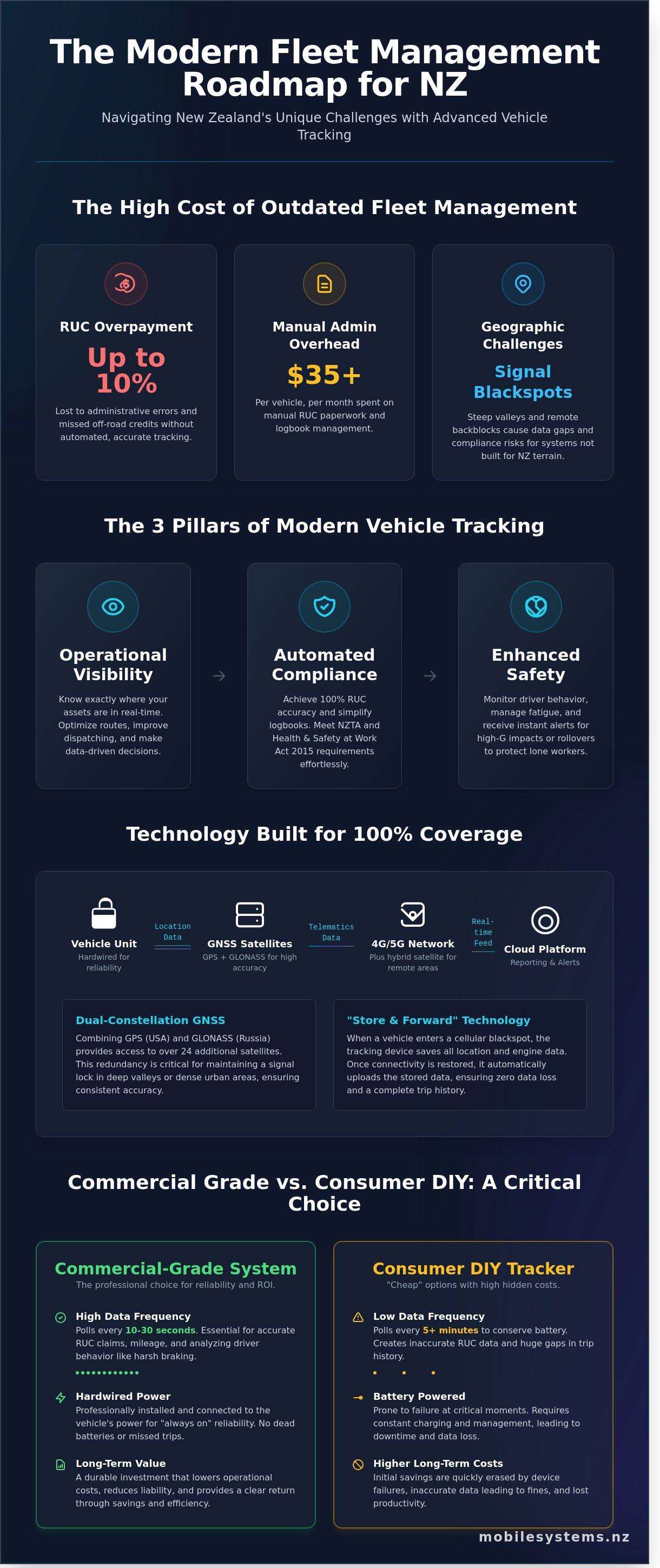
The industry has moved beyond simple theft recovery. Most Kiwi operators now use tracking to meet strict requirements under the Health and Safety at Work Act 2015. Accurate data helps manage driver fatigue and ensures vehicles are maintained to high standards, reducing corporate liability. Automated systems also simplify Road User Charges (RUC), where manual paperwork can cost a business upwards of NZ$35 per vehicle each month in administrative time.
Effective vehicle tracking nz provides three core pillars of value for local companies:
- Operational visibility: Knowing exactly where assets are at any given minute.
- Compliance: Meeting NZTA standards for logbooks and electronic RUC.
- Safety: Immediate notification if a vehicle is involved in a high-G impact or rollover.
The Evolution of Telematics in NZ
The phase-out of 3G networks by New Zealand providers has forced a rapid shift to 4G and 5G enabled devices. Older 2G units are now obsolete and provide no value. Modern hardware uses "store and forward" technology. This ensures that if a driver enters a cellular blackspot in the King Country, the device saves the data and uploads it once it regains a signal. We're also seeing the rise of hybrid satellite systems, sometimes integrating with Starlink, to provide 100% coverage across the most remote high-country stations.
Commercial vs. Consumer Tracking Systems
Many small business owners start with cheap, battery-powered DIY trackers. These often fail during critical moments because they lack the robust power management of hardwired commercial-grade units. A consumer tracker might poll its location every five minutes to save battery life. In contrast, a commercial fleet system often polls every 10 to 30 seconds. This high-frequency data is essential for accurate RUC reporting and identifying harsh braking events. Choosing low-cost hardware often results in higher long-term costs due to device failure and data gaps.
The Technology Behind Reliable Fleet Monitoring
Modern vehicle tracking nz systems rely on a dual-constellation approach to maintain accuracy. By combining the United States' GPS with Russia's GLONASS, hardware can access over 24 additional satellites. This redundancy is vital in New Zealand's varied terrain, especially when vehicles travel through the deep valleys of the Southern Alps or the high-density urban canyons of Auckland's CBD.
Data transmission happens via local cellular providers, including Spark, One NZ, and 2degrees. These networks carry telematics data in near real-time, often at 10-second or 30-second intervals. Adhering to standards similar to those found in NZ Government fleet management frameworks ensures that data remains secure and consistent across these different carrier backbones.
Hardware durability is a non-negotiable factor for New Zealand industries. In construction and forestry, devices must feature ruggedized enclosures with IP67 or IP69K ratings. These ratings confirm the unit's ability to withstand high-pressure water jets and total dust immersion, preventing hardware failure in the harsh, muddy conditions typical of North Island forestry blocks.
Advanced systems integrate directly with a vehicle's CAN-bus to monitor more than just location. Digital and analogue sensors provide a granular view of fleet health.
- Fuel Sensors: Detect rapid level drops to alert managers of potential theft or fuel leaks.
- Temperature Probes: Essential for cold chain logistics, ensuring NZ$50,000 loads of perishables stay within safe margins.
- Door Status: Monitors cargo bay access to improve security and operational transparency.
Satellite vs. Cellular Tracking
Standard cellular tracking covers roughly 95% of where New Zealanders live, but only about 50% of the landmass. For operations in the deep South Island or remote coastal regions, satellite tracking becomes essential. These systems ensure that a driver's location is never lost, even when they're well beyond the reach of the nearest Spark or One NZ tower.
Hybrid solutions provide the best of both worlds by switching networks automatically. The device uses cost-effective cellular data when available and shifts to the Iridium satellite network the moment the cellular signal drops. You can explore various cellular devices that support high-coverage hardware options for diverse fleet requirements.
Integration with Two-Way Radio Systems
Modern GPS tracking isn't limited to cellular or satellite modems. In areas where voice communication is handled via private UHF or VHF networks, tracking data can be "piggybacked" over the same radio waves. This is particularly useful for civil engineering teams where site-wide radio coverage is already established but cellular signal is non-existent.
Having tracking and voice communications in a single dashboard simplifies dispatch operations. It allows a controller to see exactly where a unit is located before initiating a voice call, reducing "where are you" chatter by 40%. For integrated fleet setups, reviewing two-way radio collections helps identify hardware that supports these combined data and voice protocols.
A tailored assessment often prevents costly mistakes when choosing between these hardware configurations. If you're unsure which network suits your specific regional routes, consulting with a technical specialist at Mobile Systems can clarify your requirements for vehicle tracking nz.
Choosing the Right Tracking Hardware for Your Operations
Selecting the right hardware for vehicle tracking nz requires more than just looking at the price tag. New Zealand's diverse terrain and climate demand industrial-grade durability. A device mounted in a South Island logging truck faces different vibrations and temperature extremes than one in an Auckland courier van. A tailored assessment often prevents costly mistakes during the rollout phase.
Cheap, uncertified hardware often leads to a false economy. Based on our technical assessments, entry-level consumer devices have a failure rate of nearly 25% within the first 18 months of commercial use. These failures often stem from poor soldering or low-quality GPS chipsets that lose signal under heavy canopy. Investing in high-specification hardware ensures your data remains consistent for years, not months.
While the market specifics differ, the principles of selecting robust hardware are universal. For a detailed breakdown of features found in commercial-grade trackers, the UK-based specialists at Safe & Sound Mobile offer a helpful comparison that covers many of the core technologies relevant to any fleet.
Internal backup batteries are a non-negotiable safety feature for professional fleets. If a vehicle's main power is cut, either through a mechanical fault or intentional tampering, the device must continue to broadcast its location. Quality units provide at least 4 to 12 hours of tracking on their internal power supply. This window is critical for recovery efforts in the event of theft.
Tamper-proof designs are equally vital for commercial operations. In a business environment, devices should be hidden from view and secured with professional mounting brackets. This prevents accidental damage and discourages staff from interfering with the unit. A secure installation ensures the integrity of your data for both safety and tax purposes.
Hardwired vs. Plug-in (OBD-II) Devices
Hardwired units are the gold standard for heavy plant and machinery. They're wired directly into the vehicle's electrical system, making them difficult to bypass. This reliability is essential for businesses managing the Official Road User Charges (RUC) System, where data gaps can lead to compliance issues and NZ$1,000+ fines for inaccurate records.
While OBD-II devices offer "plug and play" convenience, they carry significant risks. They're easily knocked by a driver's knee or intentionally unplugged to hide unauthorized vehicle use. For light commercial fleets, we recommend hardwired installations to ensure 100% data uptime. It's a more permanent solution that removes the human element of error.
Battery-Powered Asset Trackers
Not every asset provides a steady power source. For trailers, skip bins, or shipping containers, battery-powered units are the practical choice. These devices rely on high-capacity internal batteries and smart power-saving modes. They only wake up to send a location ping at set intervals or when movement is detected by an internal accelerometer.
Modern asset trackers can last up to 5 or 7 years on a single battery pack if configured correctly. You can browse our range of GPS trackers and portable comms to see options suited for non-powered equipment. Choosing a unit with an IP67 or IP68 rating is essential for these applications. This ensures the hardware survives New Zealand's high rainfall and coastal salt spray without internal corrosion.
Maximizing ROI: RUC Compliance and Driver Safety
Implementing a high-quality vehicle tracking nz solution offers more than just location data. It creates a direct financial return through automated compliance and reduced operational overhead. For New Zealand businesses operating diesel fleets, managing Road User Charges (RUC) manually often leads to human error and missed refund opportunities.
Automating these processes removes the administrative burden from your staff. Digital systems ensure that licenses are always current, avoiding the NZ$1,000+ fines associated with expired labels. By integrating GPS data with Waka Kotahi (NZTA) systems, businesses can reclaim costs for every kilometer driven off-road on private sites, farms, or forestry tracks.
Automating RUC and E-Road User Charges
Modern tracking systems verify distance data by cross-referencing GPS coordinates with official NZTA road maps. When a vehicle leaves a public highway, the system logs the exact point of exit and entry. This precise tracking allows for automated off-road refund claims, which can save a medium-sized civil construction firm upwards of NZ$5,000 annually in recovered costs.
- Tracking hardware captures distance data directly from the vehicle's odometer for 100% accuracy.
- Software automatically identifies "off-road" zones based on high-resolution mapping.
- Electronic RUC (eRUC) labels update over-the-air, eliminating the need to manually swap physical plastic pouches.
Manual filing often leads to "rounding down" or missing short off-road trips entirely. Tracking avoids these mistakes by documenting every meter traveled. This level of detail provides an airtight audit trail for Waka Kotahi inspections, reducing the risk of back-dated assessments and penalties.
Improving Driver Safety and Culture
Driver behavior monitoring is a powerful tool for reducing fuel burn and vehicle wear-and-tear. Rapid acceleration and harsh braking can increase fuel consumption by as much as 15%. By using vehicle tracking nz data as a coaching tool, fleet managers can identify patterns and provide targeted training. This approach focuses on professional development rather than punishment.
- Set real-time alerts for speeding or excessive idling to change habits in the moment.
- Use "Panic Buttons" or satellite-linked pendants for lone workers in areas with zero cellular coverage.
- Implement "Privacy Mode" for staff who take vehicles home, ensuring tracking only occurs during work hours.
The Health and Safety at Work Act 2015 mandates that NZ employers provide a safe working environment. This duty of care extends to the vehicle, which is legally considered a workplace. Tracking data provides proof that your business is taking "reasonably practicable" steps to monitor worker safety and respond to emergencies.
Beyond safety, these systems offer tangible insurance benefits. Many New Zealand insurers offer premium discounts of 5% to 10% for fleets with active GPS tracking. The ability to recover a stolen asset within hours rather than days significantly reduces the insurer's risk, and those savings are passed on to you.
Why Professional Installation is Critical for NZ Fleets
Cutting corners during the installation of vehicle tracking nz hardware often leads to systemic failures that cost significantly more than the initial savings. Poorly routed wiring or insecure mounting creates two primary hazards: signal interference and electrical fires. In modern vehicles, sensitive CAN-bus systems can malfunction if tracking hardware isn't integrated correctly. We've seen cases where improper grounding caused a 15% increase in parasitic battery drain, leading to unexpected fleet downtime and battery replacements costing upwards of NZ$400 per unit.
Antenna placement determines the ultimate success of your GNSS data. A hidden unit tucked deep under a metal dashboard might lose signal 30% more often than a professionally placed glass-mount or external antenna. High-precision tracking requires a clear view of the sky to maintain a lock on multiple satellite constellations. Our technicians ensure that every install accounts for the specific cab geometry of your trucks or vans. This attention to detail maximizes accuracy for geofencing and route optimization, ensuring your data is reliable for health and safety compliance.
Accessing nationwide support is a logistical necessity for New Zealand businesses operating across the North and South Islands. Mobile Systems operates a fleet of mobile service vehicles, bringing technical expertise directly to your depot or job site. This approach eliminates the need for you to drive assets to a workshop, which can save a business up to 4 hours of productive time per vehicle during a rollout. We position ourselves as a partner capable of handling complex integrations that standard "plug-and-play" providers simply cannot manage.
The Mobile Systems Installation Standard
Our process begins with a custom design phase for your fleet's communication and tracking needs. We don't believe in a one-size-fits-all approach because a delivery van in Auckland faces different environmental stresses than a logging truck in the central North Island. On-site servicing is a core part of our commitment to minimizing your vehicle downtime. A tailored assessment often prevents costly mistakes before the first wire is crimped. We invite you to contact us for a comprehensive fleet assessment today.
After-Sales Support and System Maintenance
Hardware isn't "set and forget" technology. Firmware updates are necessary to patch security vulnerabilities and improve GPS polling rates. Periodic hardware checks ensure that vibrations haven't loosened connections or damaged antennas over thousands of kilometers on NZ roads. Working with a local NZ company means you get technical troubleshooting in your time zone without waiting for international support tickets. We focus on long-term partnerships rather than one-off sales, ensuring your vehicle tracking nz solution continues to deliver ROI years after the initial install.
- Professional installs reduce the risk of electrical shorts and vehicle fires.
- Correct antenna placement improves GNSS accuracy by up to 30%.
- Mobile service vehicles minimize fleet downtime by performing on-site work.
- Local support ensures firmware is kept up to date for security and performance.
Choosing a professional installer means you're investing in the longevity of your assets. When systems are installed to a high standard, you avoid the "ghost data" and connectivity drops that plague DIY setups. Our team understands the specific requirements of the New Zealand transport industry, from RUC management to driver fatigue monitoring. We provide the technical backbone that allows you to focus on your core business operations with total confidence in your fleet data.
Future-Proofing Your NZ Fleet Operations
Effective fleet management in 2026 requires more than just dots on a map. It's about automating RUC compliance to reduce administrative overhead and ensuring every driver remains safe on challenging roads. Selecting the right vehicle tracking nz solution depends on matching rugged hardware with our country's unique topographical demands.
Mobile Systems Limited has supported local businesses since 1998. As authorized dealers for industry leaders like Tait and Hytera, we provide hardware that survives the harshest conditions. Our fleet of nationwide mobile support vehicles brings expert installation directly to your yard, so you don't have to worry about downtime or technical errors.
Expert guidance helps you avoid common pitfalls like poor signal coverage or non-compliant data logging. A tailored assessment often prevents costly mistakes and ensures your technology investment delivers a measurable return for your business. We're ready to help you implement a system that works as hard as your team does.
Request a tailored fleet tracking assessment from our NZ experts
Frequently Asked Questions
Is vehicle tracking legal in New Zealand?
Yes, vehicle tracking is legal in New Zealand provided you comply with the Privacy Act 2020. Businesses must have a legitimate reason for collecting data, such as health and safety or asset security. You're required to inform employees that tracking is in place, typically through a clear written policy or employment agreement clause.
How much does vehicle tracking cost for a small fleet in NZ?
Hardware for a professional system typically costs between NZ$250 and NZ$550 per vehicle. Monthly software subscriptions generally range from NZ$30 to NZ$65 per unit depending on the feature set. Professional installation by a qualified technician usually adds NZ$150 to NZ$200 per vehicle to ensure the wiring is secure and hidden.
Can vehicle tracking systems work in areas with no cell phone coverage?
Standard units store location data on internal memory and upload it once the vehicle returns to a 4G or 5G coverage area. For fleets operating in remote regions like the Southern Alps, satellite-based hardware is necessary. These specialized units use the Iridium satellite network to provide 100% coverage across New Zealand, though hardware costs often exceed NZ$900 per unit.
How does GPS tracking help with RUC (Road User Charges)?
GPS tracking automates the distance recording required for diesel vehicles, removing the need for manual logbooks. Certified electronic RUC (eRUC) systems integrate directly with Waka Kotahi (NZTA) to purchase licenses automatically. This precision eliminates the 5% to 10% error margin common with manual entries and simplifies claiming refunds for off-road travel on private land.
What is the difference between a GPS tracker and a fleet management system?
A GPS tracker simply provides the real-time location and movement history of an asset. A fleet management system uses that data to provide deep insights into fuel efficiency, driver behavior, and maintenance schedules. While a tracker tells you where a vehicle is, a comprehensive vehicle tracking nz system tells you how that vehicle is performing and where costs can be reduced.
Will installing a tracker void my vehicle’s warranty?
Installing a tracking device won't void your manufacturer warranty if the work is performed by a competent professional. The Consumer Guarantees Act protects owners from arbitrary warranty cancellations. Mobile Systems technicians use high-impedance connections and CAN bus interfaces to ensure the device doesn't interfere with the vehicle's factory electrical systems or computer modules.
How often does the tracking data update?
Most commercial systems update the vehicle's position every 30 to 60 seconds while the ignition is on. Some high-definition systems offer updates every 2 to 5 seconds for precise turn-by-turn tracking. When the vehicle is parked, the system typically sends a heartbeat signal every 4 to 12 hours to conserve the battery while still confirming the asset's location.
Can I track my fleet on my mobile phone?
You can manage your entire fleet through dedicated mobile apps available for iOS and Android devices. These apps provide live map views, instant push notifications for unauthorized movement, and basic reporting tools. It's a standard feature for modern vehicle tracking nz solutions, allowing business owners to stay informed without being tied to a desktop computer.
Related posts

- May 28, 2026
NZ police scanner frequencies are changing. Learn why & discover reliable communication solutions for NZ businesses in 2026. Authoritative guide.

- May 21, 2026
Most common two-way radio faults aren't caused by internal electronic failure but by physical degradation and environmental stress. In remote...

- May 18, 2026
A single communication failure can cost an average of $2,500 per hour in lost productivity for New Zealand businesses operating...