
Professional Radio Accessories in NZ: The Complete 2026 Business Guide
A single communication failure can cost an average of $2,500 per hour in lost productivity for New Zealand businesses operating in remote or industrial environments. You've likely experienced the frustration of a snapped antenna or a battery that fails halfway through a critical shift.
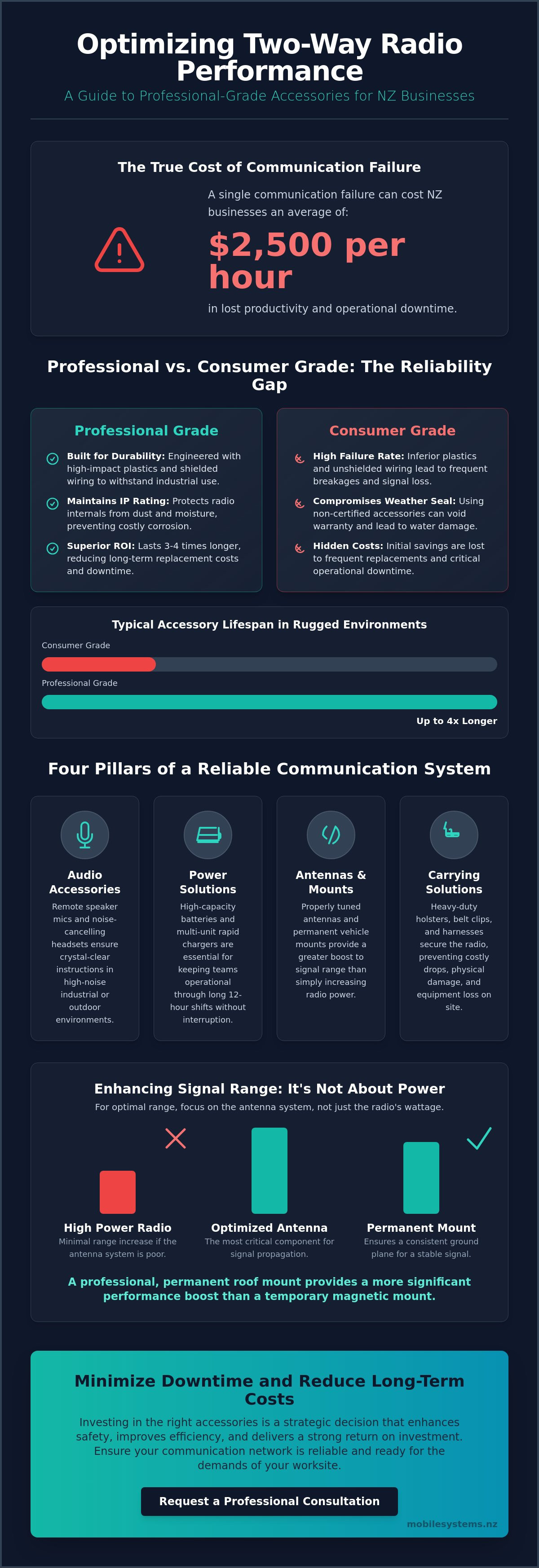
A single communication failure can cost an average of $2,500 per hour in lost productivity for New Zealand businesses operating in remote or industrial environments. You've likely experienced the frustration of a snapped antenna or a battery that fails halfway through a critical shift. While the radio unit itself is essential, your operational reliability often depends on the quality of your radio accessories nz.
It's a common challenge to find gear that survives the rigours of local outdoor work while maintaining audio clarity in noisy conditions. Investing in the correct peripheral hardware isn't just about convenience; it's a strategic decision that prevents downtime and reduces long-term replacement costs for your business.
This guide explains how to select professional-grade components that enhance range and safety for commercial fleets. We'll examine essential hardware for 2026, the impact of the July licensing fee increases, and how to ensure seamless compatibility across your entire communication network.
Key Takeaways
- Learn how professional-grade hardware ensures compliance with New Zealand health and safety standards by maintaining reliable contact with remote field teams.
- Understand why specific antenna gain profiles and mounting locations are more critical to signal range than the radio unit's power output.
- Evaluate different audio solutions, from remote speaker microphones to heavy-duty headsets, to maintain communication clarity in high-noise industrial environments.
- Identify the specific IP ratings required for high-quality radio accessories nz to survive the demanding weather and dust conditions found on local worksites.
- Discover how professional installation and system-wide consultation by Mobile Systems Limited minimize technical downtime and reduce long-term hardware replacement costs.
Essential Radio Accessories for New Zealand Business Operations
Radio accessories serve as the critical interface between the operator and the broader two-way radio technology infrastructure. They aren't merely optional add-ons; they're the physical touchpoints that determine how effectively a team communicates. In New Zealand, selecting professional-grade hardware is often a safety requirement. Under the Health and Safety at Work Act 2015, businesses must provide reliable equipment to ensure workers in high-risk sectors can signal for help without hardware failure. High-quality radio accessories nz ensure that your communication chain remains unbroken even in the most demanding environments.
Professional communication systems rely on four primary accessory categories to function at peak performance:
- Audio: Remote speaker microphones, earpieces, and noise-cancelling headsets that ensure clarity.
- Power: High-capacity batteries and rapid chargers designed for 12-hour shifts.
- Antennas: Specialized whips and vehicle mounts that optimize signal propagation.
- Carrying: Heavy-duty holsters and belt clips that prevent drops and equipment loss.
To understand how specialized audio components can be customized for individual comfort and performance, watch this short demonstration:
Professional vs. Consumer Grade: The Reliability Gap
Industrial sectors like forestry, civil construction, and agriculture demand hardware that exceeds standard consumer specifications. Generic accessories often utilize inferior plastics and non-shielded wiring, which leads to signal loss or physical damage to the radio's port. For New Zealand fleets utilizing Tait radios, using genuine or certified compatible accessories is vital. These components are engineered to maintain the radio's IP rating, protecting the internal circuitry from the dust and moisture common on local worksites. Using a consumer-grade mic on a professional handheld often compromises the weather seal, leading to expensive internal corrosion.
The Business Case for High-Quality Accessories
The true cost of an accessory isn't its purchase price; it's the cost of its failure. While generic radio accessories nz may seem cost-effective initially, their high failure rate in rugged conditions leads to frequent replacements and operational downtime. High-quality gear provides a better return on investment by lasting three to four times longer than cheap alternatives. Improved audio clarity directly reduces operational errors. When a crane operator or a remote forestry worker hears an instruction clearly the first time, the risk of accidents and the need for repeated transmissions disappear. Investing in ruggedized gear ensures your team stays focused on the task rather than struggling with failing equipment.
Enhancing Signal Range: Antennas and Mounting Solutions
Most operators believe that increasing transmitter power is the only way to extend range. In reality, the antenna is the most critical component in any communication system. High-quality radio accessories nz, specifically antennas tuned to your exact frequency, provide a more significant performance boost than a higher-wattage radio. The antenna acts as the final gatekeeper of your signal; if it's poorly matched or incorrectly mounted, your operational range will suffer regardless of your hardware's cost.
Permanent vehicle installations are the professional standard for commercial fleet efficiency. While magnetic mounts offer temporary flexibility, they lack the consistent ground plane connection required for optimal signal reflection. A permanent roof mount provides a stable radiation pattern and prevents the cable damage often caused by pinching wires in door seals or window gaps. For businesses managing multiple vehicles, standardized mounting ensures consistent communication performance across the entire team.
Choosing the Correct Antenna for NZ Topography
New Zealand's rugged terrain poses unique challenges for signal propagation. While "high gain" antennas are often marketed as superior, they focus the signal in a narrow, horizontal beam. This is ideal for flat areas like the Canterbury Plains but ineffective in the dense bush or mountain ranges of the Central North Island. In hilly environments, a lower-gain antenna, such as a 1/4 wave, provides a wider vertical radiation pattern. This allows the signal to "climb" over ridges and reach into deep gullies more effectively than a 5/8 wave alternative.
Matching your antenna frequency to your specific UHF or VHF license is vital for legal and technical compliance. Aligning your hardware choices with New Zealand's radio spectrum management guidelines ensures your system doesn't cause interference with other licensed users. Using an antenna that isn't tuned to your specific frequency band results in significant power loss and poor reception.
Coaxial Cables and Connectors: The Forgotten Link
Signal loss often occurs before the transmission even reaches the antenna. Using low-loss cables like RG58 or LMR240 is essential for professional vehicle installations to maintain signal integrity over longer cable runs. Connectors must be high-quality and properly shielded to prevent moisture ingress, which is a primary cause of system failure in damp NZ conditions. A poorly crimped connector or a frayed shield can cause a high Standing Wave Ratio (SWR), which reflects power back into the unit and eventually destroys the radio transmitter.
A tailored signal assessment can identify whether your current antenna configuration is limiting your team's operational range.
Audio Accessories for Clarity and Hands-Free Operation
Audio clarity is the cornerstone of safe industrial operations. In high-decibel environments, the stock speaker on a handheld unit is often insufficient for reliable communication. Professional radio accessories nz solve this by bringing the audio closer to the user's ear and utilizing advanced noise-cancelling microphones to filter out ambient machinery or wind noise. This ensures that every instruction is heard correctly the first time, reducing the risk of errors in high-stakes environments.
New Zealand transport regulations mandate hands-free operation for drivers to maintain road safety. Utilizing external audio gear allows vehicle operators to stay connected with dispatch without violating local laws. Compliance with Radio Spectrum Management (RSM) standards often involves selecting gear that minimizes audio bleed into public spaces, making earpieces a strategic choice for security and hospitality teams.
Remote Speaker Mics vs. Earpieces: Which is Best?
The choice between a Remote Speaker Microphone (RSM) and an earpiece depends on your specific work environment and the level of discretion required. RSMs are the primary choice for walkie talkie users in the construction and forestry sectors because they're designed for impact and can be operated while wearing heavy gloves.
| Feature | Remote Speaker Mic (RSM) | Earpiece / Surveillance Kit |
|---|---|---|
| Durability | High; built for impact and extreme weather. | Moderate; utilizes thinner cables for comfort. |
| Audio Profile | Loud external speaker for group hearing. | Private audio delivered directly into the ear. |
| Ease of Use | Large, glove-friendly PTT buttons. | Discreet, tactile inline PTT switches. |
Professional-grade microphones often include integrated emergency buttons. This allows a worker to trigger a distress signal without needing to reach for their radio, which is a critical safety feature for lone workers in remote NZ locations.
Specialized Audio for High-Noise Environments
Standard microphones struggle in environments like sawmills or busy airports where background noise exceeds 85 decibels. Specialized radio accessories nz use acoustic tube technology or bone conduction to bypass ambient noise entirely. Acoustic tubes utilize a clear plastic pipe to deliver sound via air pressure, which protects the audio from wind interference and provides a high level of comfort during long shifts.
For workers already required to wear hearing protection, integrated headsets offer a seamless solution. These systems combine high-attenuation earmuffs with built-in speakers and boom microphones, allowing workers to communicate without removing their safety gear. Modern fleets are also adopting wireless Bluetooth PTT options, which eliminate the risk of snagging cables on machinery while maintaining a secure, encrypted link to the radio unit.
Durability and Protection in Rugged NZ Conditions
New Zealand's environmental conditions are notoriously hard on electronic equipment. From the high-moisture environments of West Coast forestry to the fine dust found on Canterbury civil construction sites, your hardware must withstand constant exposure to the elements. Selecting radio accessories nz with the appropriate Ingress Protection (IP) ratings ensures that your communication system doesn't fail when weather conditions deteriorate.
An IP rating consists of two digits; the first measures protection against solids like dust, and the second measures resistance to liquids. For professional use, an IP67 rating is recommended. This indicates the accessory is completely dust-tight and can withstand temporary immersion in water. Investing in ruggedized chassis protectors and reinforced connectors prevents damage from the vibrations and drops that occur during daily transit in utility vehicles.
Carrying Solutions: Chest Packs, Holsters, and Belt Clips
Ergonomic carrying solutions are vital for both equipment longevity and worker safety. Chest packs are particularly effective for operators using safety harnesses or heavy machinery, as they keep the radio central and prevent it from snagging on external objects. Unlike standard belt clips, a chest pack ensures the microphone remains close to the user's face, facilitating faster response times during emergencies.
- Leather Holsters: Offer superior abrasion resistance and protection against heat, making them ideal for heavy industrial and welding environments.
- Nylon Holsters: Provide a lightweight, breathable, and often washable alternative for general commercial use.
- Swivel Mounts: Allow the radio to move with the user's body, reducing the leverage force that often snaps plastic belt clips during physical activity.
Advanced Battery and Charging Infrastructure
Reliable power management is essential for long-range remote operations where charging opportunities are limited. Lithium-Ion (Li-Ion) batteries are the modern standard due to their high energy density and lack of "memory effect." However, in extreme southern winters where temperatures drop significantly, specialized cold-weather battery formulations may be required to maintain voltage stability and prevent premature shutdown.
Centralized fleet management benefits from multi-unit chargers, which allow supervisors to monitor the health and charge status of multiple units simultaneously. For teams operating in the field, ruggedized in-vehicle charging solutions ensure that handheld units remain at full capacity between sites. This infrastructure prevents the operational downtime caused by battery failure during extended shifts.
If your current gear is failing to survive the work environment, you can request a durability audit to identify more resilient hardware options.
Mobile Systems Limited provides comprehensive communication architecture, moving beyond simple hardware sales to offer full system design. Choosing the right radio accessories nz is only half the battle; the other half is ensuring those components are integrated into a reliable, high-performance network. By consulting on the entire system, we help businesses avoid the common pitfalls of mismatched hardware or insufficient power infrastructure.
Professional installation is a cornerstone of operational longevity. Modern vehicles are complex environments with sensitive electronic control units and safety systems. Incorrectly installed radio equipment can interfere with vehicle management systems or, in extreme cases, compromise airbag deployment zones. Our technicians ensure that every component is mounted securely and wired correctly to prevent electrical noise from degrading your signal.
Optimizing antenna placement is another critical factor for maximizing radio waves propagation. Even the highest-quality antenna will underperform if it's shielded by the vehicle's cabin or mounted in a location with a poor ground plane. A tailored assessment prevents costly mistakes in fleet-wide rollouts.
Why Professional Installation Matters for Vehicle Accessories
Precision in mounting determines whether your gear survives the vibrations of unsealed New Zealand roads. Our installation process focuses on cable management and connector shielding to prevent the moisture ingress that causes most system failures. By utilizing professional-grade brackets and dedicated power looms, we ensure that your communication gear doesn't drain the vehicle's battery or cause thermal issues within the dashboard.
Beyond the physical install, we provide ongoing technical support and servicing for clients across the country. Whether you're operating a single site or a nationwide fleet, having a dedicated partner for maintenance ensures your equipment remains compliant with local regulations and performs at peak efficiency throughout its lifecycle.
Custom Solutions for Fleet and Industrial Clients
Different industries face distinct communication hurdles. For a remote forestry operation, a standard handheld setup might be insufficient due to deep gullies and heavy timber cover. In these scenarios, Mobile Systems designs bespoke kits that might include high-gain vehicle-mounted antennas, ruggedized remote speaker mics, and satellite phone integration for emergency backup. This multi-layered approach ensures that workers remain connected even when they move beyond traditional radio coverage.
We also address "black spot" issues by integrating cellular boosters or fleet tracking systems into the accessory strategy. This creates a unified communication platform where data and voice work together to improve safety and logistics. The most effective way to optimize your team's performance is through a professional equipment audit. This process identifies weak points in your current setup and provides a clear roadmap for upgrades. Contact Mobile Systems today to discuss a tailored communication strategy for your New Zealand business.
Optimizing Your Communication Network for 2026
Selecting high-performance radio accessories nz is a strategic investment in your team's safety and operational range. The right combination of IP-rated housing, correctly tuned antennas, and specialized audio gear ensures your network remains reliable throughout the demanding 2026 season. These components serve as the physical link between your operators and their safety net, so you shouldn't leave their reliability to chance.
Mobile Systems Limited specializes in rugged industrial environments, offering deep technical expertise in Tait and Hytera systems. Our fleet of NZ-wide mobile support vehicles ensures that professional installation and maintenance are always accessible, regardless of your location. We focus on creating durable, high-trust communication solutions that withstand the unique pressures of the New Zealand landscape and regulatory environment.
A tailored equipment strategy eliminates the risks associated with generic hardware and intermittent signal loss. You can request a professional assessment of your radio accessory needs to secure a robust communication framework for your business. Reliable connectivity is the foundation of a productive workforce, and we're here to help you maintain it.
Frequently Asked Questions
Are all radio accessories compatible across different brands?
No, radio accessories nz are not universally compatible because manufacturers utilize proprietary connection ports. While some 2-pin configurations look similar, the internal wiring and impedance levels often differ between brands like Tait and Hytera. Using incompatible connectors can damage the radio's pins or lead to intermittent audio transmission.
What does an IP67 rating mean for radio accessories in NZ?
An IP67 rating indicates the accessory is completely dust-tight and can withstand immersion in water up to one metre deep for 30 minutes. This is a critical standard for New Zealand industries like forestry or marine operations where equipment is regularly exposed to heavy rain and mud. It ensures the internal circuitry remains protected even in extreme weather.
Do I need a high-gain antenna for my vehicle in the South Island?
High-gain antennas are often less effective in the South Island's mountainous terrain than lower-gain alternatives. High-gain models focus the signal horizontally, which is ideal for flat plains but causes signal loss when trying to communicate over ridges. A 1/4 wave antenna provides a wider vertical signal spread, making it more reliable in alpine or high-country environments.
How do I know if I need an intrinsically safe (IS) accessory?
You need intrinsically safe (IS) radio accessories if your team operates in hazardous areas where explosive gases, dust, or vapours are present. This includes environments like fuel terminals, chemical processing plants, or underground mines. IS-certified gear is engineered to prevent the generation of sparks or heat that could trigger an explosion in these volatile atmospheres.
Can I use Bluetooth earpieces with my existing professional two-way radio?
You can use Bluetooth earpieces if your radio has built-in Bluetooth or if you use a brand-specific wireless adapter. Professional Bluetooth radio accessories nz are preferable to consumer phone earpieces because they feature dedicated Push-to-Talk (PTT) buttons and more robust encryption. This maintains security and operational speed during critical communications.
What is the difference between a 1/4 wave and a 5/8 wave antenna?
The primary difference lies in the signal radiation pattern and physical length. A 1/4 wave antenna is shorter and sends signals in a broad, upward pattern, which is superior for hilly terrain. A 5/8 wave antenna is longer and compresses the signal into a narrow, horizontal beam to maximize range over flat land or open sea.
How often should I replace my radio batteries and antennas?
Professional radio batteries typically require replacement every 18 to 30 months depending on usage cycles and environmental exposure. Antennas should be inspected monthly and replaced immediately if the outer shroud is cracked or the whip is bent. Degraded antennas can cause power to reflect back into the radio, eventually destroying the transmitter circuitry.
Is it legal to use a handheld radio while driving in New Zealand?
Handheld radio use while driving is restricted under New Zealand road safety regulations unless the device is secured in a cradle or used via a hands-free accessory. Utilizing a remote speaker microphone (RSM) or a fixed vehicle-mounted radio allows drivers to communicate without taking their hands off the wheel. This ensures compliance with transport laws while maintaining fleet connectivity.
Related posts

- June 27, 2026
Searching "commercial radio suppliers NZ" turns up broadcasting licences before real hardware. Here's how to cut through that, and what's...

- June 17, 2026
Did you know that fines for an expired Road User Charges (RUC) license in New Zealand can exceed $1,000 per...

- June 07, 2026
A single wiring error in a modern vehicle's digital bus system can lead to repair costs of up to NZ$4,500....