
VHF Marine Radio in NZ: The Complete Guide to Maritime Communication
Last summer, a skipper off the coast of Whangamata discovered that a poorly crimped antenna connector can turn a top-tier vhf marine radio nz into a silent brick. This single point of failure is more common than most.
Last summer, a skipper off the coast of Whangamata discovered that a poorly crimped antenna connector can turn a top-tier vhf marine radio nz into a silent brick. This single point of failure is more common than most realize, often surfacing only when help is needed urgently. Maritime New Zealand incident reports consistently highlight that equipment failure is frequently a result of poor maintenance rather than hardware defects.
You likely already know that a reliable radio is your most vital piece of safety equipment, far outperforming mobile phones in remote areas. We recognize the confusion that often comes with licensing requirements and the technical challenges of the harsh New Zealand salt-air environment. This guide provides the expert knowledge required to choose, install, and operate a system that ensures your voice is heard clearly every time.
We will cover everything from selecting the right hardware for your vessel type to the specifics of Maritime NZ compliance and antenna optimization. You'll gain a clear understanding of how to build a communication setup that remains dependable in the most demanding conditions.
Key Takeaways
- Understand why VHF is superior to mobile phones in New Zealand's maritime environment due to its critical "one-to-many" emergency broadcasting capability.
- Learn how to maximize your communication range by balancing power output with the physics of line-of-sight propagation and horizon limits.
- Evaluate the trade-offs between fixed-mount systems and handheld units to select the most reliable vhf marine radio nz solution for your specific vessel type.
- Discover how proper antenna selection and mounting height significantly impact signal performance and ensure reliable contact with coastal stations.
- Gain insights into how custom system designs from Mobile Systems Limited address New Zealand’s unique coastal topography for commercial and industrial maritime operations.
Why a VHF Marine Radio is Essential for New Zealand Waters
A vhf marine radio nz is the most critical communication tool for any vessel navigating the South Pacific. Unlike standard land-based systems, this equipment operates on the 156-174 MHz band, a dedicated frequency range specifically reserved for maritime safety and navigation. It provides a reliable link between boaters, the Coastguard, and the Maritime Radio Service, ensuring help is always within reach.
The core technology behind Marine VHF radio technology is designed for the unique challenges of the ocean environment. It uses line-of-sight propagation to transmit signals over the water, which is far more effective than cellular signals that struggle with coastal terrain. Whether you are fishing in the Hauraki Gulf or crossing the Cook Strait, a VHF radio serves as your primary lifeline to the outside world.
To better understand the importance of these devices for your safety, watch this helpful video from Maritime New Zealand:
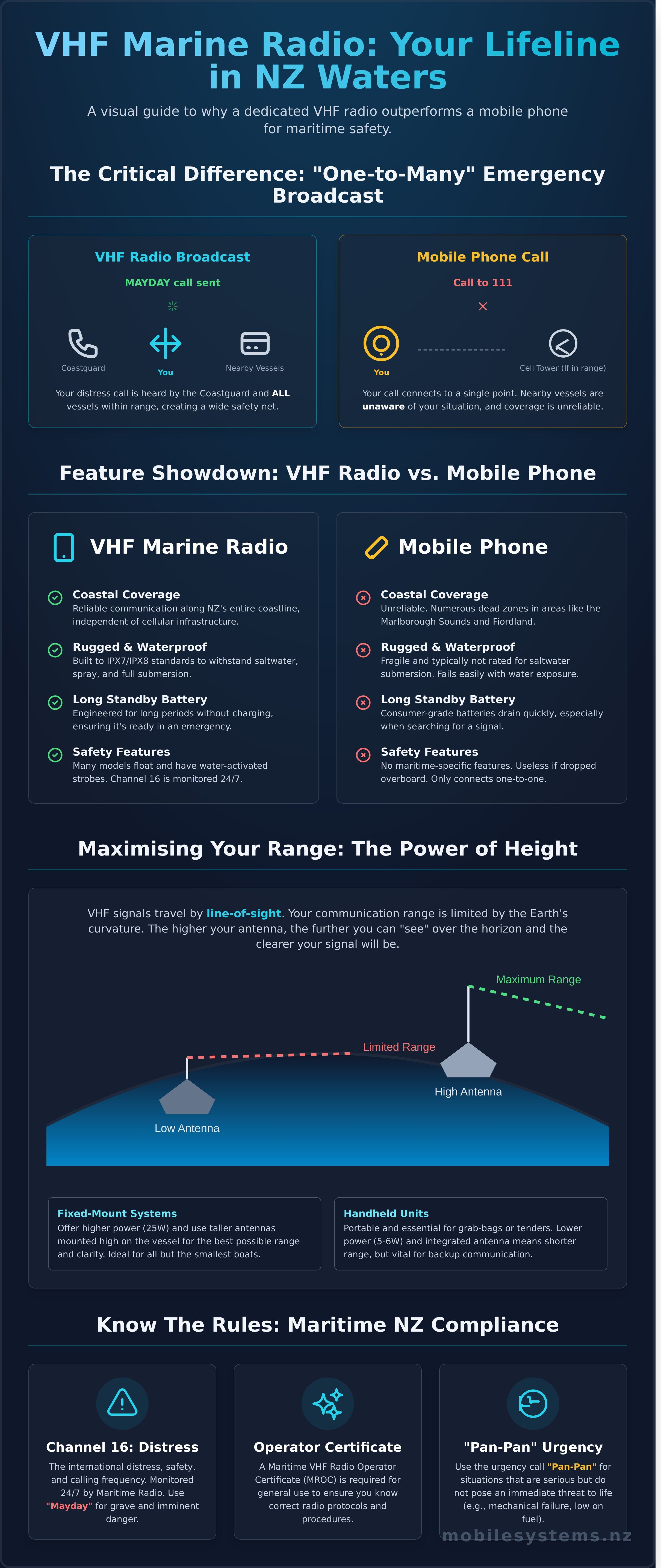
The most significant advantage of VHF is its "one-to-many" broadcast capability. In an emergency, a mobile phone only connects you to one person at a time. A VHF transmission, however, is heard by every vessel and shore station within range. This creates a safety net where the closest boat can often reach you long before official rescue services arrive. In New Zealand, Channel 16 is the international distress frequency monitored 24/7 by the Maritime Radio Service, providing constant watch over our coastal waters.
VHF vs. Mobile Phones: The Safety Reality
Relying on a mobile phone for marine safety is a common mistake that can lead to tragic outcomes. New Zealand's rugged coastline is notorious for cellular dead zones. Areas like the Marlborough Sounds or the Fiordland coast have almost no mobile coverage once you leave the immediate vicinity of a town. A vhf marine radio nz bypasses these infrastructure limits by communicating directly boat-to-boat.
- Ruggedization: Marine radios are built to IPX7 or IPX8 standards, meaning they can survive being submerged in saltwater. Most mobile phones will fail instantly if dropped in the bilge or exposed to heavy spray.
- Battery Life: Dedicated marine units have batteries designed for long standby periods, ensuring they work when you need them most.
- Emergency Visibility: Many modern handheld units float and feature water-activated strobe lights, making them easy to find if you end up in the water.
Maritime NZ Standards and Compliance
Understanding the legal landscape is vital for any boat owner. Maritime New Zealand oversees the regulations that govern radio use to ensure the airwaves remain clear for emergencies. While recreational boaters aren't always legally required to carry a radio, it's considered best practice by all safety authorities. For commercial vessels, carrying a functioning VHF is a strict requirement under Maritime Rule Part 40.
It's important to remember that using a VHF radio requires a level of technical knowledge. While anyone can use the radio in a life-threatening emergency, a Maritime VHF Radio Operator Certificate (MROC) is required for general use. This qualification ensures you know how to use the correct protocols, such as "Mayday" for immediate danger to life and "Pan-Pan" for urgent but non-life-threatening situations. Following these standards prevents the frequency from being cluttered with unnecessary chatter, keeping the lines open for those in genuine need.
Meta Description: Discover why a VHF marine radio is essential for NZ waters. Learn about Channel 16, Maritime NZ regulations, and why VHF outperforms mobile phones for safety.
URL Handle: vhf-marine-radio-nz-guide
Understanding VHF Technology: How Distance and Power Interact
VHF radio signals operate on a line-of-sight basis. Unlike lower frequency bands that can bounce off the ionosphere, VHF waves travel in straight lines. This means the physical horizon and any intervening landmasses directly limit your communication range. For a standard vessel with an antenna mounted 3 meters above the waterline, the theoretical radio horizon is approximately 12 kilometers.
Power output plays a secondary but vital role in signal clarity. Most vhf marine radio nz units offer dual power settings: 1 Watt and 25 Watts. Choosing the correct setting is a matter of both etiquette and efficiency. Using 25 Watts when you are only 500 meters from another vessel can "bleed" into adjacent channels, causing interference for other users in the area.
- 1 Watt Setting: Reserved for short-range communication, such as talking to a marina bridge or a nearby vessel in a crowded anchorage.
- 25 Watt Setting: Necessary for reaching Coastguard repeaters or calling for assistance when you are offshore or in heavy weather.
- Antenna Gain: A higher decibel (dB) rating on your antenna can effectively double your perceived signal strength without increasing battery drain.
A common mistake is assuming that a 25-Watt handheld will perform as well as a 25-Watt fixed mount. Handheld units are limited by their small antennas and lower battery voltage. For those navigating the rugged coastlines of the South Island or the outer Hauraki Gulf, a fixed-mount unit with a dedicated external antenna is the recommended standard for reliable safety.
Digital Selective Calling (DSC) and MMSI
Digital Selective Calling acts as a digital paging system for your boat. It allows you to send an automated distress signal that includes your precise GPS coordinates at the push of a button. For this to work, you must register for a Maritime Mobile Service Identity (MMSI) number through Radio Spectrum Management. This 9-digit number is unique to your vessel and acts like a digital phone number.
When you trigger a DSC distress alert, every DSC-equipped radio within range will sound an alarm. This system bypasses the need for voice communication during the initial seconds of an emergency, which is critical if the crew is injured or incapacitated. According to Maritime New Zealand VHF Information, a DSC-equipped radio connected to a GPS source is the most effective tool for ensuring a rapid rescue response in local waters.
AIS Integration in Modern VHF Units
The Automatic Identification System (AIS) has transitioned from a commercial shipping requirement to a vital tool for recreational boaters. Modern vhf marine radio nz models often include integrated AIS receivers. This technology allows your radio to "see" other vessels equipped with AIS transponders, displaying their name, speed, and heading directly on your radio screen or a connected chartplotter.
This integration is particularly valuable when navigating high-traffic areas such as the Waitemata Harbour or the approaches to the Port of Tauranga. AIS helps you identify large commercial ships that may be traveling faster than they appear, providing a calculated "Closest Point of Approach" (CPA) to prevent collisions. Seeing the name of a container ship allows you to call them directly via DSC to clarify their intentions, rather than making a generic call to "the large ship entering the channel."
Choosing the right hardware configuration depends heavily on your typical cruising grounds and vessel type. Seeking a tailored assessment of your communication needs often prevents costly mistakes when integrating AIS and DSC systems.
Fixed-Mount vs. Handheld VHF: Choosing the Right Tool
Selecting the right vhf marine radio nz involves more than just picking a price point. It's about matching hardware to your operational range and vessel type. A 6-metre trailer boat operating in the Hauraki Gulf has vastly different requirements than a commercial trawler working off the West Coast. Understanding the technical divide between fixed and portable units ensures your communication remains clear when conditions deteriorate.
Fixed-mount systems are the primary communication hub for any serious offshore vessel. These units operate at 25 watts, providing the maximum legal power for civilian marine use. Because they're integrated into the vessel's 12V or 24V DC power supply, they offer unlimited transmission time without the risk of battery depletion during a crisis. Their performance is largely dictated by the external antenna, which provides the height necessary for long-distance line-of-sight communication.
Handheld units serve as the ultimate tool for mobility and short-range coordination. While they're limited to 5 or 6 watts of output, their independence from the boat's electrical system makes them a critical safety asset. If a vessel suffers a total electrical failure or an engine room fire, a handheld radio in a waterproof grab-bag becomes your only link to the New Zealand Coastguard.
When to Rely on a Fixed-Mount Radio
Fixed-mount radios provide a range advantage that handhelds cannot match. A standard 25W unit paired with a 2.4-metre whip antenna can reliably reach stations 15 to 25 nautical miles away. In contrast, a handheld used at deck level often struggles to reach beyond 5 nautical miles. This distance is vital for NZ mariners crossing bars or operating in remote coastal areas where repeaters may be distant.
Permanent mounting also ensures the device is always where you need it. In heavy seas, a handheld can easily be dropped or misplaced. A fixed unit stays secured to the console, often featuring larger buttons and clearer displays that are easier to navigate when the boat is pitching. For those managing commercial fleets, you can view our range of professional two-way radio devices to see how high-spec fixed units integrate with existing bridge systems.
The Role of Handheld VHF in Your Fleet
Handheld radios excel in localized communication. They're the preferred choice for jet skis, kayaks, and tenders where space is at a premium. Modern units often include "float-and-flash" technology. If the radio falls overboard, it floats on the surface and activates a strobe light, making it easy to retrieve even in low-light conditions. This feature is a significant safety upgrade for solo boaters.
Internal lithium-ion batteries have improved significantly by 2026. Most professional-grade handhelds now provide 10 to 12 hours of operation on a single charge. However, users must manage the trade-off in range. Because the antenna is small and close to the water, the signal is easily blocked by swells or coastal topography. They're best used for bridge-to-deck talk or as a secondary backup for the main vhf marine radio nz system.
Professional operators in New Zealand rarely choose one over the other; they implement a redundancy strategy. This typically involves a high-power fixed-mount unit for primary distress calling and a ruggedized handheld for emergency scenarios. A tailored assessment often prevents costly mistakes when configuring your vessel's safety profile. Relying on a single point of failure is a common oversight that can be avoided with a dual-device approach.
Optimising Performance: Antenna Selection and Installation
Your antenna is the most critical component of your communication system. Even the most expensive vhf marine radio nz boaties can buy will perform poorly if it's paired with a low-quality or incorrectly mounted antenna. Many users assume a higher decibel (dB) rating always translates to better performance, but this is a common misconception in the New Zealand marine environment. Antenna gain, measured in dB, dictates how the radio signal is shaped. A 6dB antenna compresses the signal into a flat, wide "doughnut" shape to reach further toward the horizon. This is ideal for stable, larger vessels. However, on a smaller boat pitching in a choppy Cook Strait swell, that flat signal often points into the sky or the water rather than the receiver. For vessels under 7 metres, a 3dB antenna offers a more rounded signal pattern that maintains a connection despite the boat's movement. VHF radio waves operate on a line-of-sight basis. The physics of height are uncompromising; doubling your antenna's elevation can increase your reception range by approximately 40%. Mounting an antenna on a cabin roof rather than the gunwale provides a clear path over obstacles. You should also consider the coaxial cable. Standard RG-58 cable is acceptable for short runs, but for lengths exceeding 10 metres, signal loss can reach 30%. Using high-grade RG-213 or double-shielded cables ensures your 25-watt transmission actually reaches the antenna at full strength. Professional installation prevents the grounding issues that plague DIY setups. In a saltwater environment, even a tiny gap in a connector leads to capillary action, drawing moisture up the cable. This corrodes the copper core and ruins the system within 12 months. Ensuring your radio has a dedicated, fused power source directly from the battery busbar prevents the voltage drops that cause radios to cut out during transmission.
Common Marine Radio Installation Mistakes
* Creating shadow zones: Placing the antenna directly alongside a mast, radar arch, or outboard motor blocks the signal in specific directions. * Poor power supply: Sharing a power circuit with high-draw items like anchor winches or fridges often leads to significant interference and "low battery" warnings during transmission. * Incorrect soldering: Cold solder joints on PL-259 connectors are the leading cause of intermittent signal failure. * Proximity to electronics: Mounting the VHF antenna within 1 metre of GPS or AIS antennas can cause "front-end overload," desensitising your receiver.
Testing Your System for Reliability
Regular testing is vital for safety. Don't clog Channel 16 with radio checks. In New Zealand, use the local Coastguard "Radio Check" channels, such as Channel 80, 81, or 82 depending on your region. A clear response confirms your system is radiating power correctly. Understanding Standing Wave Ratio (SWR) is the professional way to verify an installation. An SWR meter measures how much energy is being reflected back into the radio. A perfect 1:1 ratio is rare; however, any reading above 2:1 indicates a serious fault in the cable or antenna. Left unaddressed, a high SWR will eventually overheat the radio's internal power amplifier, leading to a permanent hardware failure. Routine maintenance should include an annual inspection of all connections. Apply a non-conductive dielectric grease to the back of the radio terminals to prevent "green rot" corrosion. If you notice your range has decreased by even 20%, it's usually a sign that moisture has entered the cable.
Ensuring your communication system is reliable in offshore conditions requires technical precision. A tailored assessment by our technicians often prevents costly mistakes and ensures your safety at sea.
Professional Maritime Solutions from Mobile Systems Limited
Mobile Systems Limited provides engineering expertise that goes beyond simple retail sales. We recognize that New Zealand's coastal topography, characterized by steep cliffs and remote inlets, requires a strategic approach to signal propagation. A standard off the shelf vhf marine radio nz might work in open water, but commercial operators in regions like the Marlborough Sounds require precision-tuned antenna systems to maintain contact with shore stations.
A professional vhf marine radio nz installation involves more than just mounting hardware. Our technical team designs custom communication architectures for industrial clients, analyzing the vessel's electrical environment to eliminate electromagnetic interference. This ensures that your voice transmissions remain crystal clear even when heavy machinery or high-draw electronics are active on deck.
We offer ongoing technical support and mobile servicing to ensure zero downtime for your fleet. Our technicians travel to your location, whether it's a commercial fishing port or a private marina, to perform onsite repairs. This proactive maintenance schedule prevents hardware failure before it happens, which is critical for vessels operating under Maritime NZ's MOSS (Maritime Operator Safety System) requirements.
Modern maritime safety relies on the integration of various technologies. We specialize in linking your VHF systems with wider fleet management tools and satellite communication arrays. This provides a seamless data flow for vessel tracking and emergency response, giving onshore managers real-time visibility of their offshore assets even when they are beyond traditional radio range.
Why NZ Businesses Trust Mobile Systems
With over 25 years of experience in rugged communication environments, we've built a reputation for reliability. We are authorized dealers for industry-leading brands like Tait and Hytera, brands chosen for their durability in high-salt, high-vibration settings. These units are built to withstand the physical demands of the New Zealand maritime industry.
Our focus remains on operational efficiency. We ensure your team spends less time troubleshooting radios and more time focusing on the task at hand. Our solutions meet all local technical standards, ensuring your equipment is fully compliant with Radio Spectrum Management (RSM) regulations and optimized for New Zealand frequencies.
Get a Tailored Maritime Communication Assessment
Every vessel has a unique electronic footprint. Our expert team evaluates your specific needs by conducting a professional vessel survey. We analyze the physical layout to determine the most effective cable runs and mounting positions to maximize range and minimize signal loss.
The assessment includes:
- Signal strength testing in known coastal dead zones.
- Battery and power redundancy audits for emergency scenarios.
- Compatibility checks with existing AIS and GPS hardware.
- Operator training to ensure staff can use advanced digital features.
A tailored assessment often prevents costly mistakes, such as purchasing underpowered equipment or installing antennas in dead zones. You can speak with a communication specialist today to discuss your maritime requirements and schedule a site visit. This professional oversight ensures your 2026 fleet upgrades provide a measurable return on investment through improved safety and coordination.
Securing Your Maritime Safety and Connectivity
Selecting the right vhf marine radio nz setup is a critical safety decision that goes beyond a simple hardware purchase. High-performance communication relies on the synergy between your radio unit and a professionally installed antenna. This ensures your signal reaches the Rescue Coordination Centre New Zealand when it matters most.
Commercial operators must weigh the 25-watt power of fixed-mount units against the 6-watt portability of handhelds. Mobile Systems Limited supports these decisions with technical expertise as an Authorized Tait and Hytera Service Centre. Our team operates NZ-wide mobile support vehicles to provide on-site installations and complex fleet integration for commercial vessels.
It's common for DIY installations to suffer from signal loss due to improper cable termination. A tailored technical review prevents these costly mistakes and ensures your equipment survives harsh salt-spray environments. You can request a professional maritime communication assessment to verify your vessel's readiness. Investing in verified equipment and professional calibration provides the confidence required for every journey into New Zealand's coastal waters.
Frequently Asked Questions
Do I need a license to use a VHF marine radio in New Zealand?
Yes, you must hold a Maritime VHF Radio Operator Certificate (MROC) to operate a vhf marine radio nz legally. The only exception to this rule is during a genuine distress emergency where any person may use the radio to seek assistance.
You can obtain this qualification through Coastguard Boating Education for a fee of approximately NZ$130. Operating without a certificate for non-emergency communication can result in fines under the Radiocommunications Act 1989.
What is the range of a standard 25W fixed-mount VHF radio?
A standard 25W fixed-mount radio typically provides a communication range of 15 to 60 kilometres. This distance is primarily determined by the height of your antenna rather than the power of the radio itself.
Because VHF signals travel in a straight line, an antenna mounted 5 metres above the waterline will reach much further than one mounted at deck level. Obstructions like cliffs or heavy swells can also reduce this effective range.
Can I use a VHF radio on land in New Zealand?
You cannot legally use a marine VHF radio on land without a specific land mobile license from Radio Spectrum Management. These frequencies are strictly reserved for maritime safety and ship-to-shore communication.
Using these frequencies on shore can interfere with vital search and rescue operations. If you require land-based communication, you should use a dedicated UHF PRS radio or apply for a commercial land mobile frequency.
How do I register for an MMSI number for my DSC radio?
You register for a Maritime Mobile Service Identity (MMSI) number through the Maritime New Zealand website. This 9 digit number is unique to your vessel and is required for your Digital Selective Calling (DSC) functions to work correctly.
The registration process is free and requires you to provide your vessel details and emergency contact information. This ensures that when the distress button is pressed, rescue coordinators immediately know who you are and what boat you are on.
What is the difference between a VHF radio and a UHF radio?
VHF radios operate on a lower frequency range of 156 to 162 MHz, which is ideal for long-distance communication over open water. UHF radios use higher frequencies between 400 and 520 MHz, which are better at penetrating solid objects like buildings.
While a vhf marine radio nz is the standard for boat-to-boat safety, UHF is often used for internal crew communication on larger ships. You cannot use these two types of radios to talk to each other as they operate on completely different bands.
What should I do if I accidentally transmit on Channel 16?
If you accidentally transmit or trigger a DSC alert on Channel 16, you should immediately broadcast a cancellation message. Clearly state your vessel name and call sign, then announce that the alert was accidental and there is no emergency.
Do not simply turn the radio off, as this leads rescue authorities to believe a disaster has occurred. Correcting the mistake immediately prevents the unnecessary deployment of helicopters or lifeboats, which saves significant public resources.
Is a handheld VHF radio sufficient for offshore sailing?
A handheld VHF radio is not sufficient as your primary communication tool for offshore sailing. Handheld units are limited to 5W or 6W of power, which restricts their range to about 5 to 8 kilometres in most sea conditions.
For blue water cruising or trips more than 5 nautical miles from the coast, a 25W fixed-mount radio is essential. Handhelds should be kept as a secondary backup or for use in a life raft during an emergency abandonment.
How often should I have my marine radio system professionally serviced?
You should have your marine radio system professionally inspected every 24 months to ensure it remains reliable. Salt air and vibration can degrade antenna connections and cables, leading to a loss of signal strength that isn't always obvious.
Mobile Systems Limited recommends a technical check of your Standing Wave Ratio (SWR) and battery health before every major summer season. A tailored assessment often prevents costly equipment failure when you are far from the coast.
Related posts

- May 28, 2026
NZ police scanner frequencies are changing. Learn why & discover reliable communication solutions for NZ businesses in 2026. Authoritative guide.

- May 21, 2026
Most common two-way radio faults aren't caused by internal electronic failure but by physical degradation and environmental stress. In remote...

- May 18, 2026
A single communication failure can cost an average of $2,500 per hour in lost productivity for New Zealand businesses operating...