
Communication Equipment for Civil Defence: A Resilience Checklist for 2026
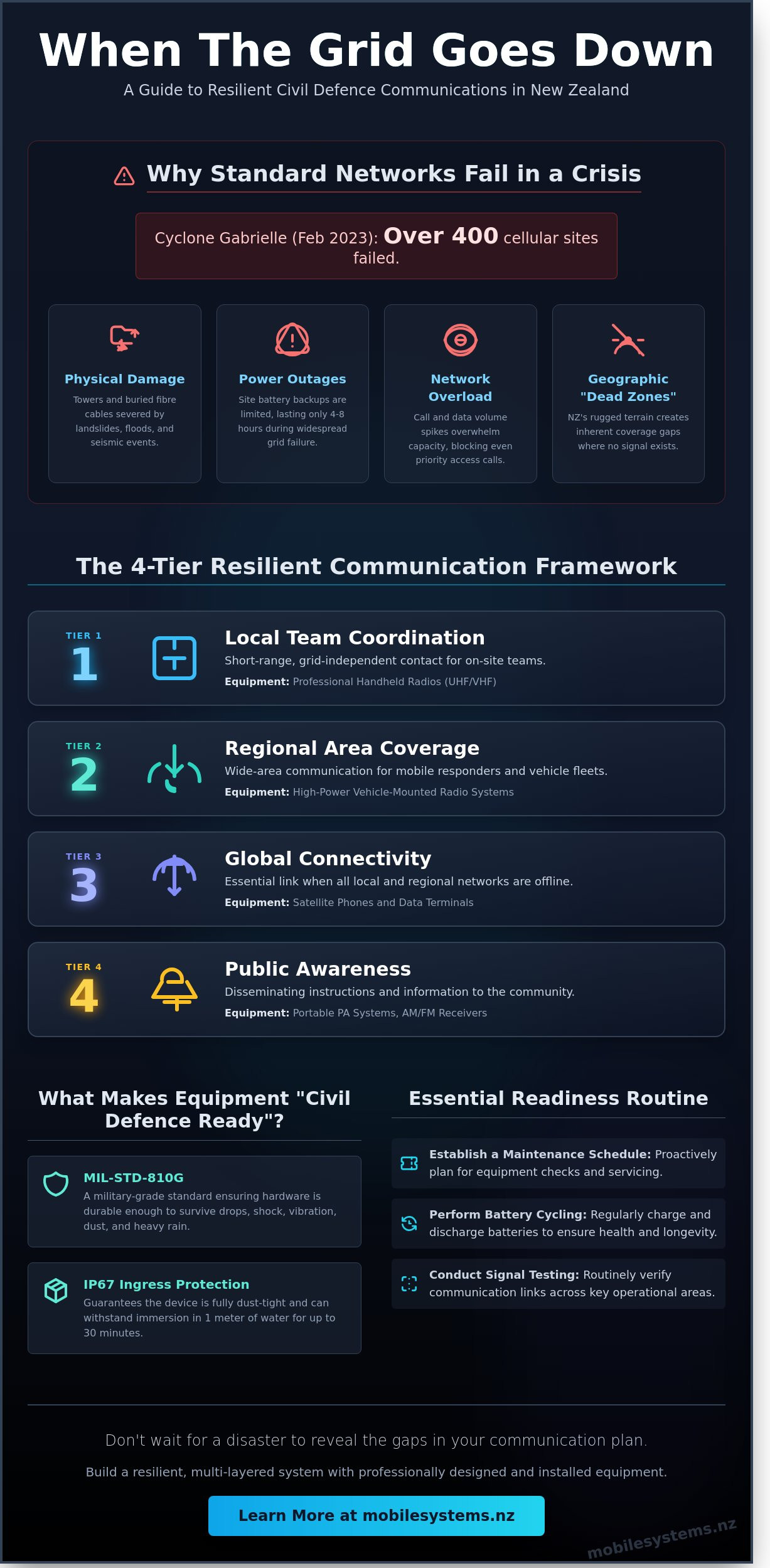
When Cyclone Gabrielle struck in February 2023, more than 400 cellular sites across the North Island failed, proving that standard communication equipment for civil defence must extend far beyond a basic smartphone.
When Cyclone Gabrielle struck in February 2023, more than 400 cellular sites across the North Island failed, proving that standard communication equipment for civil defence must extend far beyond a basic smartphone. It's a sobering reminder that our primary networks are far more fragile than we like to admit during blue-sky days.
You likely recognize that relying on a mobile network during a regional emergency is a significant risk to your team's safety and operational continuity. This professional guide provides a clear roadmap to the essential tools and systems required to maintain connectivity when the national grid falters.
We'll explain how to build a resilient, multi-layered system that ensures you stay informed and reachable when every second counts. Reliability isn't a luxury. You'll gain a technical understanding of the differences between consumer-grade gear and the professional systems that actually work under pressure in the New Zealand landscape.
Key Takeaways
- Understand why standard cellular and fibre networks fail during seismic events and how to maintain connectivity through network congestion.
- Identify the essential tiers of communication equipment for civil defence, ranging from professional handheld radios to high-power vehicle-mounted systems.
- Learn how to evaluate hardware durability using MIL-STD ratings and IP67 ingress protection standards suited for New Zealand weather.
- Establish a reliable maintenance schedule for signal testing and battery cycling to ensure your equipment is ready for immediate deployment.
- Discover how strategic system design and professional installation can eliminate communication dead zones in challenging regional terrain.
Why Standard Networks Fail During Civil Defence Emergencies
Communication resilience is the ability to operate independently of public infrastructure. In a major emergency, standard cellular networks are often the first systems to fail because they rely on a complex, interconnected web of physical towers and fiber-optic backhaul. When seismic activity or severe weather strikes, these physical assets are highly vulnerable to damage. Most cellular sites in New Zealand are equipped with battery backups designed to last only 4 to 8 hours. Once these batteries deplete during a widespread power outage, the site goes dark. This creates a critical gap for those relying on standard mobile phones as their primary communication equipment for civil defence. To better understand the necessity of independent systems, watch this address on tactical civil defence communications in the US:
The Fragility of the "Grid"
The backbone of New Zealand's digital connectivity is a network of fiber-optic cables that are often buried along main roads or suspended on poles. Landslides, floods, or shifting ground can easily sever these lines. When a "backhaul" cable is cut, every cell tower connected to that line stops functioning, even if the towers themselves remain standing and powered. Network congestion is another significant hurdle. During the initial minutes of an emergency, call volumes typically spike to levels that standard infrastructure cannot handle. While some services use "Priority Access" to give emergency callers a better chance of connecting, this system does not guarantee a line. If the underlying hardware is damaged or the total capacity of the tower is reached, even priority users will face "network busy" errors. Many people assume SMS is a reliable fallback. While it's true that emergency communication systems often handle text better than voice during congestion, SMS is a store-and-forward technology. This means messages can be delayed by minutes or hours, making it unsuitable for real-time tactical coordination or life-safety instructions.
New Zealand’s Unique Geographic Challenges
Our nation’s geography creates inherent "dead zones" where cellular coverage is non-existent even on a good day. The Southern Alps and our rugged, winding coastlines block signals and make it difficult to build redundant infrastructure. In remote areas, the distance between towers is often too great to provide a reliable safety net during a crisis. The February 2023 Hawke’s Bay floods provided a stark illustration of network fragility. Entire communities were cut off for days when fiber lines were washed away and power was lost to regional hubs. Without independent communication equipment for civil defence
The Civil Defence Communication Equipment Checklist
Establishing a resilient communication framework requires a layered approach. We categorise these into four distinct tiers to ensure no single point of failure exists during an emergency. This hierarchy ensures that as local infrastructure fails, your communication equipment for civil defence scales to meet the challenge.
- Tier 1: Short-range coordination using professional handheld radios for team-to-team contact.
- Tier 2: Regional wide-area coverage via high-power vehicle-mounted UHF/VHF systems for mobile responders.
- Tier 3: Global connectivity using satellite phones and data terminals when all local networks are offline.
- Tier 4: Public awareness tools including portable PA systems and AM/FM receivers for community instructions.
Two-Way Radio Systems for Local Coordination
Local response relies on the durability of your hardware. A walkie talkie used in civil defence must meet MIL-STD-810G standards to survive drops, dust, and heavy rain. Consumer-grade units often fail during the first 24 hours of a high-stress deployment.
Digital Mobile Radio (DMR) is now the standard for New Zealand responders. Unlike analog systems that degrade into static, DMR maintains voice clarity until the very edge of the coverage area. This clarity is vital for intra-site communication requirements in warehouses, campuses, or community hubs. Digital systems also offer better battery life, often lasting 40% longer than analog counterparts on a single charge.
Satellite Solutions for Off-Grid Connectivity
When local cellular towers go dark, satellite technology is the only viable backup. Choosing between a satellite phone and a data terminal depends on your data needs. Handheld phones are best for voice and SMS, while terminals support high-speed internet and email.
Understanding what is Starlink and how does it work is essential for 2026 planning. These systems provide broadband speeds but require a clear line-of-sight to the sky. Research into civil defense communication requirements shows that redundant paths are mandatory for maintaining operational continuity. Relying solely on one satellite provider can be a risk if atmospheric conditions or orbital geometry shift during a crisis.
Public Address and Warning Systems
Directing large groups requires high-decibel output that can cut through wind and rain. Using portable PA systems allows teams to broadcast instructions clearly over 100 metres or more. This is critical for managing evacuation points or distribution centres where verbal shouting is ineffective.
Immediate life-safety warnings often require sirens and air horns to alert the public to tsunamis or floods. All communication equipment for civil defence in this category must be battery-powered. Integrating solar charging options ensures these tools remain functional for weeks. A tailored assessment often prevents costly mistakes when selecting the right power capacity for your specific site needs.
Key Specifications: What Makes Equipment "Civil Defence Ready"?
Effective communication equipment for civil defence must withstand conditions that destroy standard office hardware. Consumer electronics often fail in the moisture and dust of a disaster zone. Professional units are built to the MIL-STD 810H standard. This military-grade rating ensures the device survives extreme shock, vibration, and thermal stress common during seismic events or rapid deployments.
Ingress Protection (IP) is non-negotiable in New Zealand. Given our high annual rainfall and coastal environments, an IP67 rating is the minimum requirement. This ensures the device remains functional after submersion in one metre of water for 30 minutes. Higher ratings like IP68 provide even greater peace of mind for teams operating in flood-prone regions like the West Coast or Tairāwhiti.
Battery architecture dictates how long your team stays connected. High-capacity Lithium-Ion (Li-Ion) batteries are preferred for their energy density and lack of memory effect. For multi-agency responses, 6-way multi-unit chargers allow for rapid fleet turnaround. It's vital to have a charging rotation that keeps spares ready at all times.
Understanding P25 and DMR Standards
Interoperability is the backbone of disaster response. P25 standards are the benchmark for digital radio, allowing different agencies like NZ Police or Fire and Emergency NZ to communicate on shared frequencies during a crisis. For large-scale commercial networks or municipal utilities, DMR Tier 3 offers trunking capabilities that manage high traffic volumes across wide areas efficiently.
Security is equally vital. AES-256 encryption ensures your emergency channels remain private and free from malicious interference or eavesdropping. Practical advice on maintaining these standards can be found in the Emergency Communicator Field Guide, which outlines operational best practices for field units.
Power Management and Backup Systems
Resilience requires independence from the national grid. Solar charging kits are essential for handheld devices and satellite terminals when power lines are down. Fleet vehicles should be equipped with heavy-duty vehicle-mounted chargers to ensure constant readiness. These chargers secure the radio while providing a stable power source from the vehicle's electrical system.
Safety protocols also benefit from integrating GPS trackers with long-life batteries. These allow coordinators to monitor personnel and asset locations in real-time without relying on compromised cellular towers. A tailored assessment often prevents costly mistakes when selecting these critical components.
Establishing a Routine: Testing and Maintaining Your Emergency Gear
Resilience isn't a one-time purchase. It's a continuous process of verification and refinement. Effective communication equipment for civil defence requires a disciplined maintenance schedule to prevent hardware failure during a crisis. Without regular intervention, batteries degrade and signal environments change, leaving teams vulnerable when primary networks fail.
Conduct monthly signal tests to identify new dead zones or sources of interference. Urban development or geographic shifts can alter how radio waves travel. Performing these tests on the first Monday of every month ensures that your coverage maps remain accurate for 2026 requirements.
Battery health is a common point of failure in emergency kits. Cycle and test all portable batteries every 90 days. Lithium-ion cells can lose capacity if left at 100% charge for years without use. Discharging them to 40% for storage and then performing a full charge cycle keeps the chemistry active and reliable.
- Update firmware annually to patch security vulnerabilities and improve power efficiency.
- Verify frequency licenses with Radio Spectrum Management (RSM) to ensure your operations remain legal and interference-free.
- Train staff on "Radio Etiquette" to ensure clear communication. Using standard phrases like "Over," "Out," and "Roger" prevents confusion during high-stress events.
The Importance of Physical Inspections
New Zealand's coastal air is notoriously harsh on electronics. Salt spray causes rapid corrosion on external antennas and connector ports. Inspect all hardware quarterly for signs of oxidation or physical wear. A small amount of salt buildup can significantly degrade signal gain and transmission quality.
Check that seals on waterproof devices remain pliable and intact. Heat and age can cause rubber gaskets to perish, compromising the IP rating of the unit. Ensure that all cellular devices and signal boosters are functioning in standby mode. A booster that appears "on" but isn't actively processing a signal is a common hidden failure point in remote sites.
Drills and Simulation Training
Technical readiness is only half the battle. Run "Comms-Out" drills twice a year where teams must operate without cellular or internet access. These simulations force staff to rely solely on radio and satellite links, highlighting gaps in their practical knowledge before a real emergency occurs.
Teach team members how to troubleshoot common interference issues in the field. This includes basic techniques like repositioning for line-of-sight or identifying electronic noise from nearby machinery. Document all emergency channels, contact hierarchies, and protocols in a physical, waterproof "Go-Book" stored with the gear. Digital files are useless if the power is out and devices are uncharged.
A tailored assessment of your current maintenance protocols often prevents costly hardware failures. Contact Mobile Systems for a professional equipment audit.
Strategic Communication Planning with Mobile Systems
Reliable communication equipment for civil defence requires more than just purchasing hardware off a shelf. Mobile Systems Limited specialises in the bespoke design and installation of systems specifically engineered for New Zealand's unique geographical challenges. Our expert team conducts thorough assessments of your operational requirements to ensure total coverage across your entire area of responsibility.
New Zealand's rugged terrain frequently creates signal shadows that can cripple emergency responses. We eliminate these dead zones by analysing your specific operational environment, whether it involves dense urban centres or isolated alpine regions. A tailored assessment prevents the costly mistake of investing in technology that cannot penetrate local topography or meet the high-bandwidth demands of a modern emergency event.
- On-site signal testing to verify real-world performance in known blackspots.
- Customised installation in command vehicles, emergency hubs, and remote repeaters.
- Ongoing technical support and preventative maintenance via our fleet of mobile service vehicles.
- Strict compliance with New Zealand Radio Spectrum Management (RSM) licensing and standards.
Custom System Design for New Zealand
A "one size fits all" communication kit rarely meets the rigorous standards of a professional response organisation. Effective resilience depends on a cohesive plan that integrates multiple platforms into a unified network. We design systems that bridge the gap between UHF, VHF, and Satellite technologies, ensuring your team remains connected even when traditional cellular networks are congested or offline.
By synchronising these different frequencies into a single response plan, your organisation gains vital redundancy. If a local repeater is compromised, your satellite backhaul or high-frequency radio links maintain the chain of command. You can request a professional consultation to begin mapping your organisation's specific infrastructure needs.
Local Support and Expertise
Partnering with a New Zealand-based specialist ensures your equipment complies with local regulations and remains operational during the most demanding conditions. As an authorised dealer for Tier 1 brands like Tait and Iridium, Mobile Systems Limited provides access to world-class technology backed by local accountability. Tait, with its deep roots in Christchurch, remains a global leader in critical communications, making their hardware a staple for local civil defence infrastructure.
Our commitment extends beyond the initial sale. We provide scheduled servicing and emergency repairs through our mobile service vehicles, ensuring your equipment is ready for the 2026 resilience standards. Don't leave your emergency response to chance. Ensure your organisation is truly ready for the next event by contacting our team today for a comprehensive equipment audit and strategic planning session.
Securing Operational Continuity for 2026 and Beyond
Resilience doesn't happen by accident. It's the result of deliberate planning and selecting hardware that meets the rigorous standards of New Zealand's unique geography. Since 2002, we've helped local organisations bridge the gap between standard operations and emergency response.
Selecting robust communication equipment for civil defence requires a balance of satellite technology and digital radio networks. Relying solely on cellular towers is a known risk. Most mobile sites only have 4 to 8 hours of battery backup, meaning infrastructure often fails during the first critical day of a natural disaster.
As authorised Tait and Iridium dealers, Mobile Systems provides NZ-wide mobile service and installation to ensure your gear remains functional. A proactive approach to maintenance and strategic planning reduces the risk of total isolation during a crisis. Request a professional communication audit for your organisation to verify your current readiness levels.
Building a reliable network today ensures your team can respond effectively when it matters most.
Frequently Asked Questions
What is the most reliable communication for civil defence in NZ?
Satellite-based systems and Land Mobile Radio (LMR) networks provide the highest reliability across New Zealand's diverse terrain. During the 2023 North Island weather events, cellular networks failed in multiple regions, leaving satellite phones and high-power radio as the only functional links.
For most organisations, a combination of Iridium satellite devices and digital mobile radios (DMR) ensures you aren't reliant on a single point of failure. These systems operate independently of local terrestrial infrastructure, making them essential communication equipment for civil defence.
Do I need a license to use two-way radios for emergency purposes?
You don't need a license for low-power PRS (Personal Radio Service) units, but professional-grade equipment usually requires one. Radio Spectrum Management (RSM) regulates these frequencies in New Zealand to prevent interference during critical operations.
Operating high-power VHF or UHF sets without a license can result in fines. We recommend securing a dedicated frequency through RSM to ensure your channel remains clear when you need it most. In a genuine life-and-death emergency, these rules are often secondary to saving lives, but legal compliance is necessary for training and readiness.
Can I use my mobile phone if the cellular towers are down?
Your mobile phone won't connect to standard services if the local towers lose power or their fibre backhaul is severed. While some modern smartphones now include basic satellite SOS features, these are limited to short text bursts and don't support full voice or data coordination.
Relying on a standard smartphone as your primary tool is a significant risk. Dedicated satellite sleeves or portable hotspots like the Iridium GO! can turn your phone into a satellite terminal, but standalone rugged devices are generally more dependable in harsh conditions.
How long do satellite phone batteries last in an emergency?
Most modern satellite phones provide between 4 and 8 hours of continuous talk time and up to 160 hours of standby time. Battery performance often drops by 25% in the cold, damp conditions typical of New Zealand winters or alpine regions.
It's vital to include solar chargers or spare battery packs in your emergency kit. We suggest keeping at least two fully charged spares for every handheld unit to cover a 72-hour isolation period without mains power.
What is the difference between UHF and VHF for civil defence?
VHF signals travel further over open water and rolling hills, while UHF is superior for penetrating buildings and dense bush. In rural NZ settings, VHF is often the preferred choice for long-distance line-of-sight communication.
UHF is the standard for urban search and rescue teams who need to communicate through concrete structures. Choosing the right communication equipment for civil defence depends on your specific geographic location and the obstacles between your team members.
How often should we test our emergency communication equipment?
You should conduct a full system test at least once every 90 days to ensure everything functions correctly. Regular checks catch issues like battery degradation or firmware bugs before a real disaster strikes.
A simple radio check isn't enough; you should test the full range, verify satellite signal acquisition, and check all charging cables for corrosion. Documenting these tests helps maintain compliance with health and safety standards for NZ businesses.
Is Starlink suitable for primary civil defence communication?
Starlink is an excellent tool for high-speed data, but it's best used as a secondary system rather than a primary voice link. It requires a stable 230V power source and a clear view of the sky, which might not be available after a major earthquake or storm.
If your Starlink dish is damaged or the power grid fails, you lose your entire connection. Using it alongside a handheld satellite phone provides a balanced approach, giving you both high-bandwidth data and a portable, battery-powered voice option.
What is an IP rating and why does it matter for emergency gear?
An IP (Ingress Protection) rating tells you how well a device resists dust and water. For New Zealand conditions, you should look for a minimum of IP67, which means the device is dust-tight and can survive being submerged in one metre of water for 30 minutes.
Emergency situations rarely happen in perfect weather. If your gear isn't rated for heavy rain or mud, it'll likely fail when you're out in the elements. Investing in IP68-rated equipment provides the highest level of protection against the unpredictable NZ climate.
Related posts

- June 11, 2026
New Zealand's workplace fatality rate is 1.7 times higher than Australia's, a stark figure that highlights the urgent need for...

- June 10, 2026
Did you know that approximately 15% of New Zealanders work in isolated conditions, with many operating entirely outside of reliable...

- May 30, 2026
Could your business withstand a $3 million fine for a health and safety oversight? Under the Health and Safety at...