
High Noise Environment Headsets: A Guide for NZ Industrial Operations
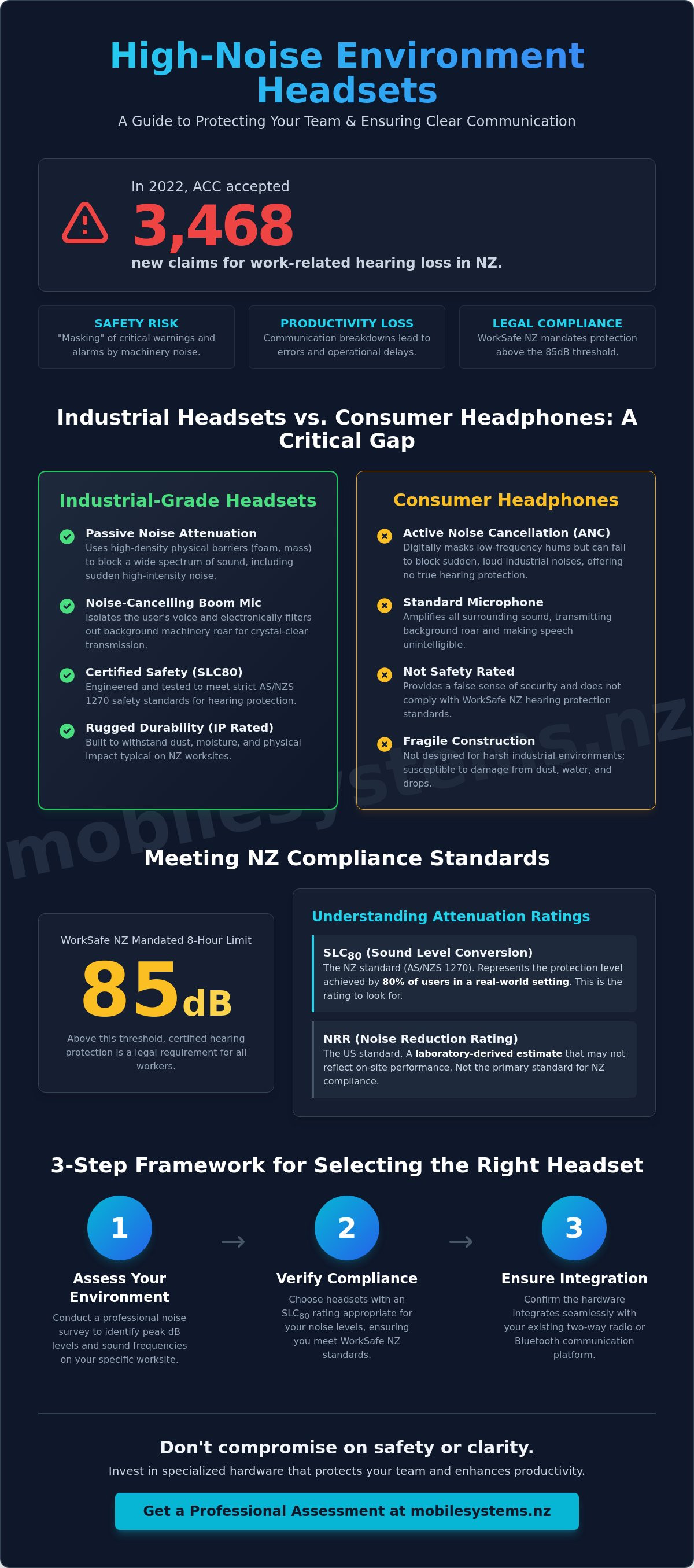
In 2022, ACC accepted 3,468 new claims for work-related gradual process hearing loss, a figure that underscores the severe risks within our local industrial sectors. Protecting your team requires more than simple passive headsets.
In 2022, ACC accepted 3,468 new claims for work-related gradual process hearing loss, a figure that underscores the severe risks within our local industrial sectors. Protecting your team requires more than simple passive earmuffs. It demands specialized high noise environment headsets that can isolate a human voice from the thunder of heavy machinery or aircraft engines.
You've likely experienced the frustration of communication breakdowns when a standard radio system transmits background roar instead of clear instructions. It's a common struggle in New Zealand's logging, manufacturing, and civil engineering sites where safety depends on every word being understood the first time. Relying on inadequate gear doesn't just hinder productivity; it compromises your site's safety culture.
This guide explains how to choose hardware that ensures crystal-clear speech while remaining fully compliant with WorkSafe NZ hearing protection standards. We'll look at the specific trade-offs between different noise-cancelling technologies and the durability features needed to survive rugged Kiwi work environments. Our team at Mobile Systems Limited has found that a tailored assessment often prevents the costly mistake of investing in gear that fails under pressure.
Key Takeaways
- Understand the critical engineering differences between consumer active noise cancellation and industrial-grade hearing attenuation for worker safety.
- Learn how to interpret SLC80 ratings to ensure your equipment meets New Zealand’s specific health and safety compliance standards.
- Discover how to select high noise environment headsets that provide crystal-clear speech while integrating seamlessly with professional radio networks.
- Identify the essential durability factors, including IP ratings, required to protect your communication hardware from dust and moisture on NZ worksites.
- Gain a practical framework for conducting noise surveys and matching hardware to your specific communication platform, whether Bluetooth or radio.
What Defines a High Noise Environment Headset?
High noise environment headsets are specialized audio hardware systems designed to facilitate clear speech while providing certified hearing attenuation. These aren't standard headphones with added padding. They're precision-engineered safety tools that allow workers to communicate in zones where ambient noise levels make normal conversation impossible.
The critical difference lies in the method of sound reduction. While consumer electronics often rely on active noise control (ANC) to digitally mask low-frequency hums, industrial headsets prioritize passive attenuation. Passive protection uses high-density physical barriers to block sound waves across the entire frequency spectrum, ensuring the inner ear is protected from sudden, high-intensity impulses that digital systems might miss.
To better understand how these systems function in loud settings, watch this helpful video:
Standard office headsets fail in environments exceeding 85 decibels because their microphones lack the sophisticated gating required to filter out industrial roar. In these settings, an office-grade mic often amplifies the background noise instead of the wearer's voice, leading to total communication breakdown. High noise environment headsets solve this through several primary components:
- Noise-cancelling boom microphones: These use dual-microphone arrays to isolate the human voice while electronically suppressing mechanical drones.
- Cushioned earcups: Engineered with high-grade acoustic foam to create an airtight seal, which is vital for passive noise reduction.
- Integrated radio interfaces: These allow for seamless connection to digital two-way radios, ensuring the audio signal remains clear over long distances.
The Impact of Noise on Operational Safety
In industrial settings, "masking" occurs when loud machinery covers the sound of critical safety warnings or approaching vehicles. This isn't just a nuisance; it's a primary cause of workplace accidents. When workers can't hear alarms, they rely on visual cues that may not be in their line of sight.
The psychological cost of constant noise is equally high. Sustained exposure leads to significant fatigue, decreased concentration, and higher error rates among staff. Within industrial settings, speech intelligibility is the quantitative measure of how much spoken information a worker can accurately understand while operating heavy machinery.
New Zealand WorkSafe Standards
New Zealand employers must adhere to strict regulations regarding noise exposure. WorkSafe NZ sets the 8-hour equivalent continuous A-weighted sound pressure level (LAeq,8h) at 85 dB. If your site consistently hits this threshold, providing certified hearing protection isn't optional; it's a legal obligation.
Selecting the right hardware involves more than just checking a box. Employers must ensure the protection is suitable for the specific frequency of the noise produced on-site. When integrating these headsets with existing communication systems, refer to our Walkie Talkie NZ: The Professional Buyer’s Guide
Technical Standards: Understanding NRR and SLC80 Ratings
Attenuation is the physical reduction of sound energy as it travels from the environment to your inner ear. In industrial settings, high noise environment headsets use specialized materials to absorb or reflect these damaging waves. Effective protection relies on a combination of mass, seal integrity, and electronic intervention to ensure sound levels remain below 85 decibels.
New Zealand operations primarily use the SLC80 (Sound Level Conversion) rating, which follows the AS/NZS 1270 standard. This differs from the NRR (Noise Reduction Rating) used in the United States. While NRR is a laboratory estimate, SLC80 represents the protection level achieved by 80% of users in a real-world setting. Following NIOSH recommendations for noise exposure helps managers understand that even small decibel reductions significantly lower the risk of permanent hearing loss.
Reading a spec sheet requires looking beyond the highest number. A headset with a very high rating can sometimes be counterproductive if it causes "over-protection." If a worker is isolated from all ambient sound, they cannot hear warning signals or approaching vehicles. Modern gear often includes SENS (Speech Enhancement, Noise Suppression) technology. This circuitry identifies and amplifies the frequencies of the human voice while simultaneously suppressing dangerous background frequencies like engine roar.
Passive vs. Active Attenuation
Passive attenuation relies on high-density acoustic foam and the physical seal of the earcup. If the seal is broken by safety glasses or facial hair, the effective protection can drop by as much as 5 to 10 decibels. It's the most reliable method for constant, high-frequency noise found in manufacturing plants.
Active attenuation uses internal microphones to monitor external sounds. The circuitry "clips" any sound exceeding 82 decibels, providing immediate protection against impact noises like nail guns or heavy stamping. Listen-through technology is a specific type of active attenuation that allows workers to maintain full situational awareness without removing their high noise environment headsets.
Microphone Technology: Isolating the Human Voice
Communication in 100+ decibel environments requires specialized microphone hardware. Electret microphones are common for their clarity, but dynamic microphones are often preferred in high-vibration NZ industries like forestry or heavy Earthmoving. These units are less sensitive to the physical shaking that can distort audio signals.
- Noise-cancelling boom arms: These use dual-microphone arrays to phase out background noise, ensuring only the operator's voice is transmitted.
- Bone conduction: This technology bypasses the ear canal by sending vibrations through the temple or jawbone. It's becoming a viable alternative for NZ emergency services and specific underground mining roles.
- Wind suppression: Specialized foam covers and digital filtering are essential for outdoor NZ worksites where wind shear can drown out radio traffic.
Selecting the correct rating for your specific site prevents both hearing damage and communication breakdowns. A tailored assessment often prevents costly mistakes when matching equipment to specific decibel profiles.
Industrial Headsets vs. Consumer Headphones: The Critical Gap
Choosing the right high noise environment headsets requires understanding that consumer-grade audio equipment isn't built for the West Coast rain or a Waikato construction site. While high-end Bose or Sony headphones offer excellent noise cancellation for a quiet office, they lack the structural integrity needed for industrial applications. Relying on consumer electronics in a heavy industry setting often leads to equipment failure within weeks.
Industrial environments demand hardware that can withstand physical abuse, extreme temperatures, and constant vibration. Consumer devices prioritize aesthetics and lightweight materials, which translates to fragile hinges and plastic components. In contrast, professional gear is engineered to meet rigorous safety standards while providing clear communication in decibel levels that would overwhelm standard headphones.
The Pitfalls of Consumer ANC in Industry
Consumer Active Noise Cancellation (ANC) often creates a "vacuum" sensation by filtering out all ambient frequencies. On a busy site, this leads to situational blindness. Workers can't hear approaching machinery, reversing beeps, or verbal warnings from colleagues. This isolation is a significant safety risk that can lead to preventable accidents.
Most consumer models also lack a dedicated Push-to-Talk (PTT) interface. Attempting to coordinate a team using touch-sensitive earcups or tiny buttons is impossible when wearing heavy work gloves. These headsets don't offer the seamless integration required for professional two-way radio systems, leaving workers disconnected from the wider communication network.
Durability and Mission-Critical Reliability
New Zealand's outdoor industries face unpredictable weather and high dust levels. Industrial headsets carry IP67 or IP68 ratings, meaning they're completely dust-tight and can survive submersion in water. Consumer headphones rarely offer this level of protection, leading to internal corrosion and electrical shorts after the first heavy downpour.
Battery life is another critical differentiator. A standard consumer headset might last 20 hours in a controlled environment, but cold temperatures and high-volume output drain batteries much faster. Industrial units are designed for 12-hour "mission-critical" shifts. They often feature field-replaceable batteries, ensuring the headset stays in service even if the power runs low during an overtime shift.
Calculating the Total Cost of Ownership
The initial investment for industrial gear is higher, but the longevity is significantly better. A consumer headset might cost NZ$550 but require replacement twice a year due to physical damage. High-quality industrial headsets typically last five times longer than consumer alternatives, providing a much lower cost over a three-year period.
Compliance is the most important financial factor. Under the Health and Safety at Work Act 2015, WorkSafe can issue substantial fines for providing inadequate PPE. Using uncertified consumer gear for hearing protection increases the risk of ACC claims related to noise-induced hearing loss. Professional systems are built to meet NZ standards, protecting both the worker's hearing and the employer's liability.
Local support also plays a role in total cost. When a consumer headset breaks, it's usually discarded. Industrial equipment is modular. You can easily source replacement ear pads, boom microphones, and cables from New Zealand suppliers like Mobile Systems Limited, extending the life of the asset for years.
A Selection Framework for NZ Industry Applications
Selecting the right high noise environment headsets for a New Zealand workforce involves more than checking a spec sheet. You need a systematic approach to ensure the equipment meets local safety standards while remaining practical for daily use. Follow these four steps to narrow down your options.
Step 1: Conduct a noise survey. You can't manage what you haven't measured. Use a calibrated sound level meter to determine the decibel levels at your site. This data dictates the required SLC80 (Sound Level Conversion) class under the AS/NZS 1270:2002 standard. For environments exceeding 105 dB(A), a Class 5 protector is typically mandatory.
Step 2: Identify the primary communication platform. Determine how your team actually talks. If they're moving across a large site, they'll need Digital Mobile Radio (DMR) integration. For supervisors who need to stay connected to their phones, Bluetooth is essential. Wired options are often best for stationary operators where interference must be eliminated.
Step 3: Evaluate the physical environment. NZ conditions are notoriously harsh on electronics. Consider the impact of high humidity in geothermal areas or salt spray in coastal projects. Check for IP ratings that guarantee protection against moisture and dust ingress. You'll also need to verify if the headsets require specific helmet-mount adapters to maintain the safety rating of your existing head protection.
Step 4: Trial for comfort. The most expensive headset is worthless if a worker leaves it on the seat of the ute. The best headset is the one the worker actually wears for their entire shift. Conduct a trial with a small group of staff to check for heat buildup, weight distribution, and ease of use with gloves.
Forestry and Heavy Construction
In the NZ bush, communication is a critical safety layer. Workers require helmet-mounted high noise environment headsets that don't compromise their hard hat's integrity. High-visibility finishes are standard for safety compliance on active logging sites. Because these teams often work in remote "black spots" without cellular coverage, integrating your headsets with a reliable radio system is vital. You can learn more about these requirements in The Best Handheld VHF Radio NZ Guide.
Marine and Aviation Environments
Marine environments demand hardware that survives constant saltwater exposure. Look for headsets featuring stainless steel components and specialized coatings to prevent corrosion. For aviation and marine engine rooms, the focus shifts to high-frequency noise suppression to protect against turbine and outboard engine whine. Proper integration ensures clear voice transmission over the roar of the machinery. For a deeper look at sea-based setups, see our Marine Communication Guide.
Choosing the wrong protection can lead to permanent hearing damage or missed safety alerts on site. A tailored assessment from our technical team often prevents these costly mistakes and ensures your fleet is fully compliant.
Professional Integration: The Mobile Systems Advantage
Purchasing high noise environment headsets from a general retailer often results in technical friction. Standard "off-the-shelf" units frequently fail to sync with the complex Push-to-Talk (PTT) protocols required by industrial fleet radios. Mobile Systems bridges this gap by providing custom-engineered cabling and adapter solutions specifically for Tait, Hytera, and Motorola systems.
Generic equipment often suffers from impedance mismatches or incorrect pin configurations. This leads to low volume, distorted audio, or complete PTT failure. We ensure every component is electronically compatible, so your team's communication remains crystal clear even in the harshest 100+ decibel environments. Local NZ servicing means you won't wait months for overseas repairs; our technicians handle maintenance and repairs right here in New Zealand.
Tailored Communication Architecture
We focus on creating a unified ecosystem where headsets, vehicle-mounted radios, and handheld units work in perfect synchronisation. Mobile Systems doesn't guess your requirements. Our team assesses how your hardware interacts and identifies the specific site noise profile, whether it's constant engine drone or intermittent impact noise. A tailored assessment prevents costly hardware mismatches that can sideline a fleet for weeks.
When designing these systems, we prioritize four critical integration factors:
- Direct compatibility with Tait, Hytera, and Motorola radio protocols.
- On-site frequency calibration to match your specific noise floor.
- Local NZ-based warranty repairs and technical support for minimal downtime.
- Custom cable fabrication for specialized vehicle or heavy machinery setups.
Getting Started with a Site Assessment
Ready to upgrade your fleet's communication? You can request a full consultation to determine the best fit for your operational needs. We understand that industrial sites don't stop for technical upgrades. That's why we operate a fleet of mobile support vehicles equipped to provide on-site testing and calibration across New Zealand. We come to you, ensuring the equipment performs in the actual environment where it's needed.
Our technicians arrive at your facility to test high noise environment headsets in real-world conditions. We check for signal interference and ensure the physical fit is comfortable for staff working ten-hour shifts. This hands-on approach eliminates the guesswork and provides your business with a reliable, long-term communication strategy. It's about more than just hardware; it's about operational safety and technical precision.
Securing Your Industrial Communication Strategy
Selecting the right high noise environment headsets is a critical safety decision that impacts both hearing protection and operational efficiency. It's about more than just volume. Choosing equipment with the correct SLC80 rating ensures your site remains WorkSafe compliant while maintaining clear communication. Consumer-grade gear often fails in harsh NZ conditions, making industrial-strength solutions the standard for long-term reliability.
Mobile Systems provides the technical expertise needed to navigate these complex requirements. As an authorized NZ dealer for Tait and other leading industrial audio brands, we offer WorkSafe compliant systems tailored to your specific site needs. Our fleet of mobile support vehicles provides on-site servicing nationwide, ensuring your communication infrastructure stays functional.
A professional assessment helps you avoid the costs of mismatched equipment and potential safety breaches. Consult with a Mobile Systems expert to find the right high-noise headset for your team to ensure your workers stay protected and connected.
Frequently Asked Questions
What is the difference between noise cancellation and noise suppression?
Noise cancellation uses electronics to create "anti-noise" waves that cancel out low-frequency hums like engines or fans. Noise suppression, often found in high noise environment headsets, uses physical barriers and digital limiters to reduce the volume of sudden, harmful sounds. Suppression is generally preferred for industrial safety because it protects against impact noise while allowing workers to stay aware of their surroundings.
How do I know what SLC80 rating my team needs for our worksite?
To determine the correct SLC80 rating, you must first measure the decibel (dB) levels at your worksite using a calibrated sound level meter. The goal is to reduce the noise reaching the ear to between 75 and 80 dB. For example, if your workshop averages 105 dB, you require a Class 5 headset with an SLC80 rating of at least 26 to meet WorkSafe New Zealand standards.
Can I use Bluetooth headsets with my existing industrial two-way radios?
You can use Bluetooth headsets with existing two-way radios if the radio unit features built-in Bluetooth capability or uses a dedicated external adapter. Mobile Systems Limited provides adapters for most major brands to bridge this gap. This setup allows for wireless communication while maintaining the long-range reliability of traditional radio frequencies in rugged environments.
Are there headsets that allow me to hear people talking but block machine noise?
Yes, headsets with "level-dependent" or "active listening" technology use external microphones to pass through speech and ambient sounds at safe volumes. These high noise environment headsets instantly suppress loud machine impulses that exceed 82 dB. This allows workers to hold conversations and hear safety sirens without needing to remove their hearing protection in dangerous zones.
How often should ear cushions and hygiene kits be replaced on industrial headsets?
Ear cushions and hygiene kits should be replaced every 6 months for headsets used daily in industrial settings. Over time, the foam loses its elasticity and the PVC covers can crack, which significantly reduces the SLC80 protection level. Regular replacement ensures the seal remains airtight and prevents skin irritation from sweat and dirt buildup.
Do high-noise headsets require a special license to operate in NZ?
High-noise headsets don't require a specific license to operate in New Zealand, but the two-way radios they connect to often do. If you're using UHF or VHF frequencies for business, you'll likely need a license from Radio Spectrum Management (RSM). Mobile Systems Limited helps manage these licensing requirements to ensure your fleet remains compliant with the Radiocommunications Act 1989.
What happens if a headset is damaged on-site? Can they be repaired locally?
Most professional-grade industrial headsets can be repaired locally in New Zealand. Mobile Systems Limited operates a full service center to handle physical damage, cable replacements, and component failures. Repairing high-quality units is often more cost-effective than replacement and ensures your equipment continues to meet its original safety certifications.
Related posts

- June 11, 2026
New Zealand's workplace fatality rate is 1.7 times higher than Australia's, a stark figure that highlights the urgent need for...

- June 10, 2026
Did you know that approximately 15% of New Zealanders work in isolated conditions, with many operating entirely outside of reliable...

- May 30, 2026
Could your business withstand a $3 million fine for a health and safety oversight? Under the Health and Safety at...