
Communication in Remote Areas NZ: A Professional Guide for Businesses
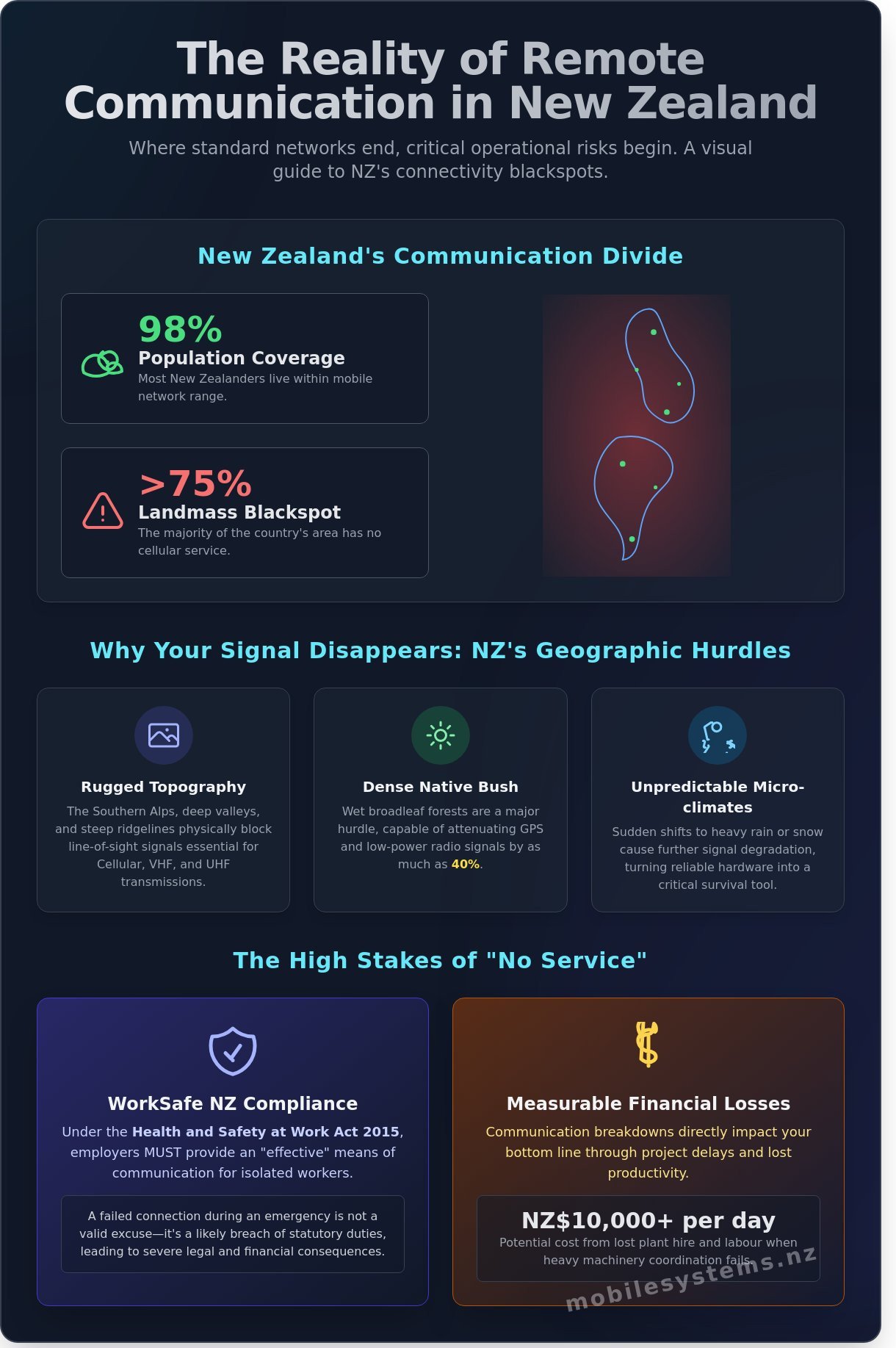
While 98% of New Zealanders live within mobile coverage, over 75% of the country's actual landmass remains a total digital blackspot. If your operations take you into rugged valleys or high country stations.
While 98% of New Zealanders live within mobile coverage, over 75% of the country's actual landmass remains a total digital blackspot. If your operations take you into rugged valleys or high country stations, you've likely experienced the frustration of "no service" during a critical task. Relying on a single mobile device for communication in remote areas NZ is no longer a viable strategy for professional teams.
You understand that maintaining contact isn't just about convenience; it's a fundamental requirement for WorkSafe NZ compliance and team safety. A single failed connection during an emergency can lead to significant financial and legal consequences. We'll show you how to maintain reliable connectivity across New Zealand's most challenging terrains using a strategic mix of radio, satellite, and cellular technology.
This guide provides a clear roadmap for implementing hybrid communication systems that protect your staff and reduce operational downtime. We'll explore specific hardware options available in the New Zealand market and explain the practical steps to bridge the gap between the office and the field.
Key Takeaways
- Understand how New Zealand’s unique topography creates communication shadow zones and why standard cellular networks are insufficient for remote operations.
- Discover how to strategically combine radio, satellite, and cellular technologies to maintain reliable communication in remote areas NZ.
- Compare the hardware costs, licensing fees, and connection speeds of various off-grid solutions to optimize your business's communication budget.
- Learn the critical steps for conducting signal audits and securing Radio Spectrum Management (RSM) licensing to ensure operational safety and compliance.
- Identify how to design a custom, integrated workflow that eliminates the risks of a "one-size-fits-all" approach in the New Zealand backcountry.
The Reality of Remote Communication in New Zealand
For most New Zealanders, staying connected means glancing at the signal bars on a smartphone. In a commercial context, true remote communication begins where the terrestrial networks of Spark, One NZ, and 2degrees end. This boundary isn't just a minor inconvenience; it's a critical operational threshold that affects roughly 25% of New Zealand's landmass.
Understanding New Zealand's telecommunications landscape requires acknowledging that cellular coverage is largely confined to state highways and populated hubs. Once your team moves into the back country for forestry, farming, or civil engineering, they enter a different technical environment. Reliable communication in remote areas NZ demands more than just a standard mobile plan.
To better understand how these challenges impact off-grid operations, watch this helpful video on remote work dynamics:
New Zealand's topography creates "shadow zones" where traditional radio and cellular signals cannot penetrate. Deep valleys and steep ridgelines act as physical barriers to line-of-sight transmissions. Even as satellite-to-text services emerge in 2024, they remain insufficient for commercial safety. These consumer-grade tools often lack the "always-on" reliability and rapid response times required for high-risk industrial sites.
The operational cost of these "blackspots" is measurable in dollars and cents. In the forestry sector, a single communication breakdown can delay emergency medical services by hours, potentially turning a treatable injury into a fatality. For civil engineering firms, the inability to coordinate heavy machinery in real-time can lead to project delays costing upwards of NZ$10,000 per day in lost plant hire and labour productivity.
New Zealand’s Geographic Challenges
The Southern Alps and the rugged North Island ranges frequently disrupt line-of-sight signals essential for VHF and UHF radios. Dense native canopy also presents a unique hurdle; wet broadleaf forests can attenuate GPS and low-power signals by as much as 40%. When micro-climates shift and heavy rain or snow sets in, these signals degrade further, making robust hardware a survival tool rather than a luxury.
The Role of WorkSafe NZ and Health & Safety
Under the Health and Safety at Work Act 2015, New Zealand employers must provide an "effective" means of communication for workers in isolated areas. Relying on the excuse that "we tried to call" is not a valid legal defence following a remote incident. If a lone worker cannot summon help immediately, the business is likely in breach of its statutory duties. Lone worker protection systems must be proactive, offering automated check-ins and GPS location data that works regardless of local topography.
Choosing the right hardware involves balancing cost against the specific risks of your site. A tailored assessment often prevents costly mistakes and ensures your team remains visible, even in the deepest "shadow zones" of the high country. For expert advice on your specific site requirements, you can reach out to our team at the Mobile Systems contact page.
Core Technologies for Off-Grid Connectivity
Reliable communication in remote areas NZ requires more than a standard smartphone. New Zealand's rugged topography, from the deep valleys of Fiordland to the dense bush of the Kaimai Ranges, creates significant barriers for standard radio waves. Achieving 100% connectivity for a mobile workforce demands a layered approach where different technologies back each other up.
Commercial Two-Way Radio Systems
Digital Mobile Radio (DMR) has largely superseded older analogue systems in professional environments. DMR technology provides roughly 25% better battery life and significantly clearer audio at the edge of a coverage area. Unlike analogue signals that fade into static, digital signals remain clear until the very limit of the range.
For fleet coordination, fixed-mount vehicle radios provide the highest power output, typically 25 watts compared to the 5 watts found in portable units. This power difference can mean the gap between reaching a mountain-top repeater or being cut off in a gully. However, handheld radios remain the gold standard for ground crews who need rugged, IP67-rated reliability. These units withstand immersion in water and heavy drops, which are common occurrences in NZ forestry and civil engineering sectors.
Satellite Solutions for Modern Fleets
When you move beyond the reach of terrestrial repeaters, satellite technology is the only fail-safe. Choosing the right constellation is critical for New Zealand operations. Iridium is often preferred for its 66 cross-linked low-earth orbit satellites that provide true pole-to-pole coverage. This is particularly effective in deep NZ valleys where a geostationary satellite, like those used by Inmarsat, might be blocked by a ridgeline.
The landscape is shifting with the latest government initiatives aimed at improving rural infrastructure, but satellite remains the primary choice for immediate, high-bandwidth needs. For stationary site offices, Starlink has become a transformative tool, providing low-latency internet that supports video conferencing and large file transfers in locations that previously had zero data access. For mobile workers, satellite hotspots allow a standard smartphone to send text messages and SOS alerts via an app, bridging the gap between consumer tech and industrial safety.
Cellular Extension Technology
Many businesses struggle with "fringe" coverage where a signal exists but is too weak to maintain a stable connection. High-gain antennas mounted to a vehicle's bullbar or roof can increase signal reception by up to 15dB. This often provides a stable 4G connection in areas where a handheld phone shows "No Service."
In New Zealand, it's vital to understand the legal landscape of cellular boosters. The Radio Spectrum Management (RSM) agency prohibits the use of "cheap" wide-band boosters often found on international sites. These units can cause massive interference with local cell towers, leading
Comparing Solutions: Satellite vs. Radio vs. Cellular
Selecting the right hardware for communication in remote areas NZ involves more than just checking a coverage map. You must weigh the speed of connection against the specific environment where the gear will be used. While the NZ Rural Broadband Initiative continues to expand cellular reach, many commercial operations still find themselves in black spots where only radio or satellite can provide a reliable lifeline.
Financial planning for remote kits must include the total cost of ownership over a three to five year period. A high quality digital radio might cost NZ$950 upfront, but it carries zero ongoing airtime fees if you operate on your own licensed frequency. Conversely, a satellite phone may cost NZ$1,850 plus a monthly subscription of NZ$75 to NZ$120. For a team of five, a radio system can save over NZ$4,500 in operating expenses annually.
Time to connect is a safety critical metric that varies wildly between technologies. Land Mobile Radio (LMR) offers instant Push-to-Talk (PTT) capabilities with sub-second latency. Satellite devices require a clear view of the sky and can take 30 to 90 seconds to acquire a signal and transmit a message. In emergency situations where every second counts, the "instant on" nature of radio provides a distinct psychological and practical advantage.
Durability is non-negotiable in New Zealand's backcountry. The West Coast can experience over 200mm of rain in a single 24 hour period, which will destroy standard consumer electronics. When evaluating gear, look for these specific ratings:
- IP67 Rating: The unit is dust tight and can survive immersion in 1 metre of water for 30 minutes.
- IP68 Rating: Provides protection against continuous immersion under pressure, essential for river crossings.
- MIL-STD-810H: A military grade standard that ensures the device survives drops, vibration, and extreme temperature shifts.
Battery life considerations are equally vital for multi-day operations. Digital handheld radios typically provide 12 to 18 hours of heavy duty cycle use. Satellite messengers like the Garmin inReach can last up to 14 days in power saving modes because they only transmit small bursts of data. Cellular devices are the least reliable in this category, as they rapidly drain their batteries searching for a tower in low-signal areas.
VHF vs. UHF: Which Frequency Wins in NZ?
VHF (Very High Frequency) remains the gold standard for the New Zealand bush. Because VHF waves are roughly two metres long, they can "bend" or diffract around limestone outcrops and heavy Rimu stands. UHF (Ultra High Frequency) waves are much shorter, around 70cm, making them prone to being blocked by the first significant ridge line. For communication in remote areas NZ, a 5W VHF handheld with a high-gain 6dBi antenna provides the most reliable reach through steep, mountainous valleys.
Satellite Phones vs. Satellite Messengers
The choice between a satellite phone and a messenger depends on the complexity of the information you need to relay. The Iridium Extreme offers full voice capability, which is essential for coordinating complex medical evacuations where tone of voice and rapid back-and-forth detail are required. Satellite messengers are more cost effective for routine check-ins and GPS tracking. Both utilize 24/7 monitoring centers, but the Iridium network uses 66 cross-linked satellites to ensure coverage even in deep canyons where geostationary satellites might be obscured.
A tailored assessment of your specific topography often prevents costly mistakes in hardware procurement. Choosing the wrong frequency or network can lead to dead zones that compromise team safety.
Implementation, Licensing, and Safety Compliance
Deploying a robust system for communication in remote areas NZ requires more than just purchasing hardware. Success depends on a structured five-step implementation process that addresses local environmental challenges and legal requirements. Skipping these steps often leads to signal failure when the equipment is needed most.
This process often involves partnering with specialized IT and telecommunications firms that can manage the complexity from start to finish. For example, companies like SolaaS LTD focus on delivering such tailored, scalable solutions for businesses that operate in challenging environments.
Step 1: Conduct a site-specific signal audit and topography analysis. New Zealand's geography is notoriously difficult for radio waves. We use digital terrain mapping to perform path profile analysis. This identifies "dead zones" caused by steep valleys or dense bush in areas like the Ureweras or the Southern Alps. Understanding these barriers allows us to select the right frequency band and repeater locations before you invest in hardware.
Step 2: Secure Radio Spectrum Management (RSM) licensing. While many businesses start on public bands, these are often congested. We facilitate the acquisition of private frequencies through the RSM. This legal protection ensures your business has a dedicated "lane" on the airwaves, preventing interference from recreational users or nearby contractors.
Step 3: Professional installation of vehicle-mounted hardware. Vibration is the primary killer of electronics on unsealed rural roads. Professional installation involves secure mounting of transceivers and high-gain antennas. We ensure that cable runs are protected from moisture and that antenna placement maximizes the ground plane of the vehicle for better range.
Step 4: Team training on radio etiquette and emergency protocols. A radio is only as effective as its operator. Training should cover basic "clear speech" protocols and the specific use of emergency buttons. In a crisis, your team needs to know how to trigger an emergency alarm without hesitation. Clear communication reduces airtime and keeps channels open for critical updates.
Step 5: Establishing a regular maintenance and battery replacement cycle. We recommend a formal 18-month battery replacement cycle for all handheld units. Lithium-ion batteries lose capacity over time, and their performance drops significantly in the sub-zero temperatures common in the Central Plateau or South Island high country. Regular testing ensures that a "full" battery icon actually represents a full day of operational life.
Navigating NZ Radio Licensing
New Zealand operates under two main frameworks: General User Radio Licences (GURL) and private licences. GURL channels, like those used for PRS (Personal Radio Service), are free to use but offer no protection from interference. If a nearby logging crew is on the same channel, your operations will overlap. To solve this, an Approved Radio Engineer (ARE) must calculate technical parameters for a private frequency. This ensures your communication in remote areas NZ remains clear, private, and professional.
Safety Standards and IP Ratings
Hardware longevity depends on Ingress Protection (IP) ratings. IP67 equipment is rated for immersion in 1 meter of water for 30 minutes. However, for New Zealand’s high-rainfall environments like the West Coast, IP68 is the preferred standard. IP68 devices are typically tested at depths of 1.5 meters for longer durations, providing a necessary buffer against accidental drops in streams or heavy storms.
For high-risk industries involving fuel, gas, or dust, Intrinsically Safe (IS) radios are a legal requirement. These units are designed to never produce a spark, even if dropped or damaged. Integrating GPS trackers into your communication fleet adds another layer of safety. These trackers provide real-time location data, which is vital for coordinating a rescue if a worker becomes incapacitated in a remote location.
A tailored assessment often prevents costly mistakes and ensures your team stays connected in the most challenging terrain.
New Zealand's backcountry doesn't forgive poor planning. A one-size-fits-all approach fails because the Southern Alps or the dense bush of the Ureweras create unique signal shadows. Reliable communication in remote areas NZ requires a hybrid strategy. You can't rely on a single device to cover every valley and ridge.
Mobile Systems designs workflows that bridge the gap between VHF radio for local teams, satellite for data-heavy tasks, and cellular boosters for vehicle-based transit. A robust strategy integrates these diverse technologies into a single, cohesive workflow. This might involve using a Starlink dish for office-grade internet at a base camp, while field crews use ruggedized handheld radios for instant voice comms.
We ensure these systems talk to each other. By using cross-band gateways, a remote worker on a handheld radio can communicate with a manager in Auckland via a cellular bridge. This level of integration is what separates a hobbyist setup from a professional industrial solution. We operate a fleet of specialized service vehicles across the country. This ensures on-site support even in high-country stations or remote coastal sites.
Our engineers don't just ship hardware; they build infrastructure. Moving from a "no signal" dead zone to a fully connected operation involves mapping your specific topographical challenges. We look at where your people are, what data they need to send, and how quickly they need help in an emergency.
Expert Installation and Support
Professional installation is about more than mounting a bracket. We prioritize antenna tuning and SWR (Standing Wave Ratio) testing. An untuned antenna can lose up to 40% of its effective range or even damage your radio's internal components. Our technicians use high-end analyzers to ensure every watt of power reaches the airwaves.
Mobile Systems remains committed to after-sales technical support long after the initial setup. In 2023, we solved critical connectivity gaps for a remote Bay of Plenty forestry crew. By installing high-gain antennas and custom repeaters, we increased their safety coverage by 85%. This ensured every worker remained within reach of the base station, regardless of the terrain.
Taking the Next Step
A tailored assessment often prevents costly hardware mistakes that lead to "shelfware." Our team analyzes your operational footprint to recommend specific NZ-compliant hardware that meets Radio Spectrum Management (RSM) standards. You can contact the Mobile Systems team for a consultation on your site’s requirements.
Final checklist for remote communication readiness in 2026:
- Verify all VHF/UHF licenses are current with RSM and match your hardware.
- Test battery backup systems to ensure at least 24-hour autonomy for base stations.
- Update firmware on all satellite terminals and cellular routers to the latest NZ-stable versions.
- Conduct a physical signal heat map of your primary worksite to identify remaining dead zones.
- Ensure every staff member is trained on emergency "mayday" protocols for your specific radio types.
Investing in a custom system design means you aren't just buying gear; you're securing a lifeline. Whether it's for a small adventure tourism operation or a large-scale forestry project, the right setup ensures your team stays connected when it matters most.
Future-Proofing Your Off-Grid Connectivity
Establishing reliable communication in remote areas NZ requires more than just hardware. It demands a strategy that balances satellite reach with the immediate reliability of digital radio and cellular boosters. Ensuring your team stays connected means adhering to RSM licensing requirements and WorkSafe NZ safety standards to prevent operational downtime.
Mobile Systems Limited provides nationwide support through a fleet of mobile service vehicles. Our technicians are specialists in Tait, Hytera, and Iridium hardware, ensuring your equipment performs in the most demanding environments. We manage the technical complexities of frequency licensing so you don't have to worry about compliance issues.
A proactive approach to connectivity protects your staff and your bottom line. Since every site presents unique geographical challenges, a professional evaluation is the most effective way to identify potential dead zones before they become safety risks. It's the best way to ensure your technology investment actually delivers when you're in the field.
To ensure your team remains reachable regardless of their location, request a tailored communication assessment for your remote operations. Building a robust network now ensures your business stays productive and safe in the most isolated corners of the country.
Frequently Asked Questions
Do I need a licence to use a two-way radio in New Zealand?
You generally require a licence to operate commercial two-way radios in New Zealand, as regulated by Radio Spectrum Management (RSM). While the 80-channel PRS (UHF CB) band is licence-free for public use, professional business frequencies must be registered to prevent interference. Annual fees for a single frequency usually start around NZ$150. Using unlicenced commercial equipment can result in fines under the Radiocommunications Act 1989.
Will a satellite phone work everywhere in NZ?
Satellite phones provide 100% geographic coverage across New Zealand, provided you have a clear line of sight to the sky. Signals can be obstructed in deep limestone canyons or beneath dense 30-metre canopy cover in areas like Fiordland. For reliable communication in remote areas NZ, we recommend Iridium network devices. These utilize 66 low-earth orbit satellites to ensure connectivity even in steep alpine terrain where other networks fail.
What is the difference between UHF and VHF for remote farms?
VHF (Very High Frequency) is the superior choice for rugged hill country because the longer waves bend over ridges and penetrate thick scrub more effectively. UHF (Ultra High Frequency) works best for line-of-sight communication or around steel-framed farm buildings. On a typical 500-hectare Waikato farm, a 25-watt VHF mobile unit will often outperform a UHF equivalent by 30% in terms of total signal distance.
Can I use a cellular booster in my vehicle legally?
You can legally use a cellular booster in your vehicle only if the device is specifically approved by New Zealand carriers like Spark, One NZ, or 2degrees. The Cel-Fi ROAM R41 is a common example that meets RSM standards. Using unapproved wide-band repeaters is illegal because they can oscillate and shut down local cell towers. This violation carries significant penalties under the Radiocommunications Regulations 2001.
What happens if my remote communication device fails during an emergency?
If your primary device fails, you should immediately switch to a secondary redundancy system such as a Personal Locator Beacon (PLB). We advise all remote teams to carry a 406 MHz PLB as a fail-safe. These devices alert the Rescue Coordination Centre NZ (RCCNZ) directly via the Cospas-Sarsat satellite system. Statistics show that 95% of rescues initiated by a PLB in New Zealand result in a successful location within 30 minutes.
How much does a professional remote communication system cost?
A basic professional setup starts at approximately NZ$550 for a high-quality IP67-rated handheld radio. For a full vehicle-integrated system, including a 25-watt mobile radio and high-gain antenna, budgets typically range from NZ$1,200 to NZ$1,800. Large-scale solutions involving solar-powered repeaters for backcountry stations can exceed NZ$15,000. Investing in professional-grade hardware reduces long-term maintenance costs by roughly 20% compared to consumer-grade alternatives.
Is Starlink a viable replacement for two-way radios on work sites?
Starlink is an excellent tool for data and Wi-Fi calling, but it isn't a direct replacement for two-way radios on active work sites. Radios offer instantaneous, one-to-many communication without the 30-second boot-up time or high power consumption of a satellite dish. In forestry or civil construction, Starlink provides the office link, while UHF or VHF radios remain the primary tool for real-time safety coordination and heavy machinery movement.
How do I ensure my team actually knows how to use the equipment?
Effective communication in remote areas NZ depends on structured training and documented Standard Operating Procedures (SOPs). You should conduct quarterly comms checks where team members practice switching channels and sending location coordinates. Mobile Systems Limited provides on-site orientations for new installations to ensure every staff member understands the difference between simplex and repeater modes. This hands-on approach reduces user error by an estimated 40% during critical incidents.
Related posts

- May 28, 2026
In 2024, New Zealand recorded 70 work-related fatalities, a statistic that underscores the critical importance of protecting staff in isolated...

- May 25, 2026
In a 2025 survey of the New Zealand road freight industry, 62% of respondents cited rising business costs and economic...

- May 17, 2026
Relying on a standard radio in a Zone 0 environment is a critical safety breach that can lead to catastrophic...