
Intrinsically Safe Radio NZ: The Professional Guide to Hazardous Area Communications
Relying on a standard radio in a Zone 0 environment is a critical safety breach that can lead to catastrophic failure. Selecting the correct intrinsically safe radio nz solution is essential for businesses operating in explosive atmospheres.
Relying on a standard radio in a Zone 0 environment is a critical safety breach that can lead to catastrophic failure. Selecting the correct intrinsically safe radio nz solution is essential for businesses operating in explosive atmospheres, such as petrochemical plants or specialized manufacturing. You likely understand that standard communication tools are insufficient, yet the technical distinctions between various international certifications often create unnecessary confusion for procurement teams.
Managing hazardous areas in New Zealand requires navigating a complex web of international standards and local health and safety regulations. This professional guide simplifies that process by explaining how to select IECEx-certified hardware that meets New Zealand standards and protects your team. It's a system-wide commitment to safety that goes beyond a simple hardware purchase.
We will examine the differences between IECEx and ATEX standards and review reliable hardware options from manufacturers like Tait and Hytera. Additionally, we provide an overview of your regulatory obligations under the Radiocommunications Regulations 2025 and the updated RSM licensing fees effective July 2026. This ensures your communication strategy remains compliant, functional, and cost-effective.
Key Takeaways
- Understand how intrinsic safety engineering prevents ignition by limiting thermal and electrical energy in explosive environments.
- Identify why IECEx is the preferred standard for an intrinsically safe radio nz solution compared to the European ATEX directive.
- Evaluate high-performance hardware options like the Hytera HP7Ex series and Tait portables tailored for New Zealand industrial conditions.
- Learn critical operational protocols, including the necessity of charging batteries outside hazardous zones to maintain system integrity.
- Discover how professional site surveys and custom programming ensure your communication fleet meets both coverage needs and safety obligations.
What is an Intrinsically Safe (IS) Radio?
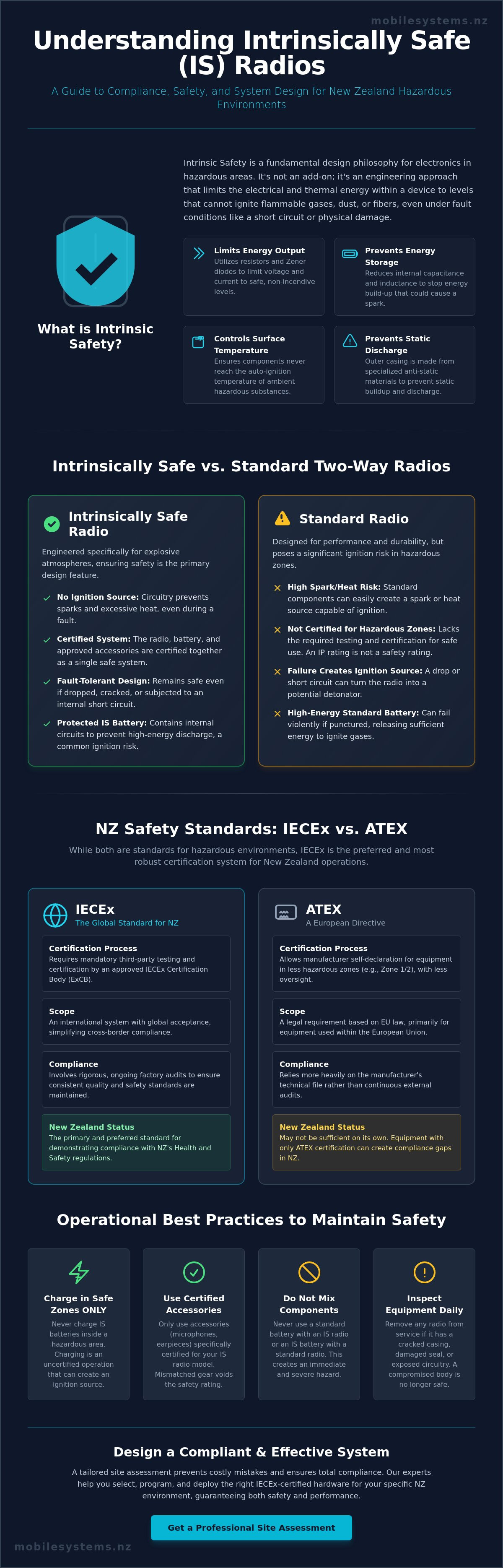
Intrinsic safety is a protection technique for the safe operation of electronic equipment in hazardous areas. It's not a secondary feature or an add-on. Instead, it's a fundamental design philosophy that limits the electrical and thermal energy available for ignition. This ensures that even in the event of a circuit failure, the device cannot generate a spark or heat up enough to ignite flammable substances.
Many site managers mistake "ruggedized" or "waterproof" radios for being safe in explosive environments. While an IP68 rating protects against dust and water, it doesn't prevent internal components from creating a spark. A certified intrinsically safe radio nz is built to remain safe even under fault conditions, such as a short circuit or a cracked casing during a fall.
The Engineering Behind Spark Prevention
The technical objective of intrinsic safety is to ensure that no spark or thermal effect can ignite a specific hazardous atmospheric mixture. To understand What is Intrinsic Safety?, you must examine how engineers control energy levels within the device. They achieve this through several specific design requirements:
- Reducing internal capacitance and inductance to prevent energy storage that could cause electrical arcing.
- Utilizing resistors and barriers to limit current flow to safe levels throughout the circuitry.
- Managing surface temperatures of internal components to ensure they stay well below the auto-ignition temperature of surrounding gases or dust.
- Designing the outer casing with specialized anti-static materials to prevent discharge in dry or volatile environments.
If a device is dropped and the battery housing cracks, a standard radio might produce a high-energy spark. An IS radio is designed so that even in this failure scenario, the energy released remains below the threshold required for ignition. This level of engineering is what differentiates professional safety equipment from consumer-grade hardware.
Intrinsically Safe vs. Standard Two-Way Radios
Standard handheld radios are designed for performance and durability but lack the specialized circuitry found in IS models. Standard lithium-ion batteries are a major risk factor in hazardous zones. They contain high energy density and can fail violently if punctured or shorted, potentially acting as a detonator in a gas-rich environment.
In contrast, IS radios use batteries with internal protection circuits that prevent excessive current discharge. The entire device, including the battery and any attached accessories like remote speaker microphones, must be certified as a complete system. Mixing and matching non-certified accessories with an IS radio body voids the safety rating and creates a significant hazard for the operator.
Choosing the right intrinsically safe radio nz means looking beyond the sticker on the back. You must ensure the certification matches the specific gas or dust groups present on your site. This system-based approach to safety ensures that your communication tools don't become the source of a site-wide emergency.
Understanding NZ Safety Standards: IECEx vs. ATEX
New Zealand businesses operating in hazardous environments must adhere to strict NZ Safety Standards. The Health and Safety at Work (Hazardous Substances) Regulations require employers to ensure all equipment used in explosive atmospheres is designed and certified to prevent ignition. While you might see European ATEX labels on imported equipment, the primary international standard accepted in New Zealand is IECEx.
IECEx stands for the International Electrotechnical Commission System for Certification to Standards Relating to Equipment for Use in Explosive Atmospheres. Unlike ATEX, which is a European directive based on self-declaration for certain zones, IECEx requires independent third-party testing and ongoing factory audits. This rigorous process provides the highest level of confidence when deploying an intrinsically safe radio nz solution. Relying solely on ATEX markings can lead to compliance gaps if the equipment hasn't been cross-certified for the NZ market.
Hazardous Zone Classifications in New Zealand
Understanding your site's specific zone is the first step in hardware selection. Explosive atmospheres are categorized based on the frequency and duration of the presence of flammable substances. These are divided into gas and dust environments:
- Zone 0 / Zone 20: Flammable gas (0) or combustible dust (20) is present continuously or for long periods.
- Zone 1 / Zone 21: Flammable gas (1) or combustible dust (21) is likely to occur in normal operation occasionally.
- Zone 2 / Zone 22: Flammable gas (2) or combustible dust (22) is not likely to occur in normal operation but, if it does, will persist for a short period only.
A radio certified for Zone 0 offers the highest protection level and is backward compatible with Zones 1 and 2. However, a radio rated only for Zone 2 must never enter a Zone 0 area. Matching the hardware to the zone is a legal requirement that protects both the workforce and the business from liability.
Reading an IS Compliance Label
The compliance label is a technical summary of the device's capabilities. It features an "Ex" marking followed by a string of codes. These codes identify the protection method, the gas group (such as IIC for hydrogen or IIB for ethylene), and the temperature class. The temperature class, or T-rating, indicates the maximum surface temperature the radio can reach. For example, a T4 rating means the surface won't exceed 135°C.
If you work around chemicals with low auto-ignition temperatures, choosing the wrong T-rating could lead to a disaster. Safety auditors always check these labels first to confirm that the hardware matches the site's hazardous zone documentation. Confirming these details during procurement prevents expensive compliance failures. If you're unsure about your site's specific requirements, a professional safety assessment can clarify which certifications are mandatory for your operation.
Selecting the Best Intrinsically Safe Radios for NZ Industries
Choosing hardware for hazardous zones involves more than checking a certification sticker. The device must perform in high-noise environments where operators wear heavy hearing protection. For a reliable intrinsically safe radio nz, the hardware must balance safety with functional features like long battery life and emergency alerting.
Modern digital radios offer safety enhancements that older analog systems cannot provide. These features are essential for personnel operating in remote or volatile areas:
- GPS Tracking: Provides real-time location data for rapid emergency response.
- Man Down: Uses internal sensors to detect horizontal positioning or lack of movement.
- Lone Worker: Automated check-in timers that alert dispatch if a worker fails to respond within a set period.
When selecting equipment, consult the Understanding NZ Safety Standards: IECEx vs. ATEX framework to ensure the hardware meets global and local benchmarks. A professional assessment often reveals that specific audio requirements are as important as the safety rating itself.
Hytera HP7 Series: Advanced Digital Features
The Hytera HP7Ex series is specifically designed for high-noise industrial sites. It utilizes AI-based noise cancellation to filter out background machinery hum while isolating the speaker's voice. This ensures that critical instructions are heard clearly the first time, reducing the risk of operational errors.
Battery efficiency is another priority for sites with extended shift rotations. The HP7 series provides enough power for 20-plus hours of operation, ensuring that workers remain connected throughout their entire shift. You can explore our range of handheld radios to see the specific models available for different hazard zones.
Tait Communications: Local Support and Durability
Tait Communications offers a distinct advantage for New Zealand fleets due to their local design and engineering heritage. Their intrinsically safe portables are known for exceptional durability and seamless integration into existing Tait P25 or DMR networks. This makes them a preferred choice for large-scale utility and public safety organizations.
Using NZ-designed systems often simplifies the procurement and maintenance process for local businesses. Tait hardware is built to handle the unique environmental conditions found in New Zealand, from high-humidity coastal sites to freezing alpine environments. For more information on general radio selection, see The Professional Guide to Walkie Talkie NZ.
Selecting the right brand depends on your existing infrastructure and the specific hazards present on your site. A tailored assessment often prevents costly mistakes during large-scale deployments.
Operational Best Practices for IS Radio Systems
Maintaining the integrity of an intrinsically safe radio nz solution requires strict adherence to operational protocols. Safety isn't a one-time configuration; it's a continuous process that depends on how equipment is handled daily. The most common point of failure in hazardous environments isn't the radio itself, but the human error associated with battery management and accessory use.
A certified IS radio body is only safe when paired with its specific, certified battery. Standard batteries from non-IS models often fit the same chassis, but they lack the internal current-limiting circuitry required for hazardous zones. Swapping a standard battery into an IS-rated radio immediately voids the certification and creates a significant ignition risk. Your team must be trained to recognize the specific markings that distinguish IS batteries from standard fleet components.
Charging protocols are equally critical. Radio chargers are not intrinsically safe and must never be located within a hazardous zone. The charging process involves higher voltages and generates thermal energy that can easily ignite volatile gases or dust. Establish a dedicated "safe zone" for all charging activities, ideally in a temperature-controlled office or equipment room far from the production floor.
Certified Accessories: The Missing Link
The "system" certification of an IS radio extends to every attached component. Remote speaker microphones (RSMs), earpieces, and headsets must carry the same IECEx rating as the radio itself. Using an uncertified, aftermarket accessory creates a path for unregulated electrical energy to reach the external ports, potentially causing a spark.
- Always verify that the accessory model number is explicitly listed on the radio's certification document.
- Inspect accessory cables for fraying or exposed wires that could lead to short-circuiting.
- Avoid using "consumer-grade" audio gear, even if it seems compatible with the radio's connector.
Storage and Maintenance Protocols
Industrial environments are harsh, and physical damage can compromise the internal seals of a radio. A small crack in the housing or a loose seal around the antenna port allows explosive gases to enter the device. Staff should perform a visual inspection at the start of every shift, looking for impact damage or signs of casing degradation.
Chemical exposure is another factor often overlooked. Over time, certain industrial solvents and cleaning agents can weaken the specialized anti-static plastics used in IS housings. If a radio shows signs of "crazing" or the plastic feels brittle, it must be decommissioned immediately. Regular audits by a technician ensure that the internal components remain within their original safety tolerances. For ongoing fleet support, professional communication system installation and servicing provides a structured way to manage these safety risks.
Designing a Compliant Communication System with Mobile Systems
Implementing a robust intrinsically safe radio nz solution requires more than just hardware procurement. A reliable system must account for the specific topography and structural challenges of your work site. Mobile Systems Limited provides a comprehensive approach to ensure that your communication network remains functional even in the most volatile environments.
Transitioning from a standard radio fleet to a fully compliant IS fleet involves a structured audit of existing equipment and operational needs. We assist businesses in mapping out this transition to ensure no gaps in safety or communication occur during the upgrade process. This systematic approach ensures that every component, from antennas to handheld units, meets the necessary regulatory standards.
Professional system design includes the following elements:
- Customized programming for emergency alerts, Man Down, and Lone Worker functions.
- Integration of fleet management software to monitor device health and location.
- Configuration of talk groups to minimize channel congestion during critical operations.
- Ongoing maintenance schedules to ensure IECEx certifications remain valid through regular testing.
Tailored Assessments for High-Risk Sites
A one-size-fits-all approach often leads to critical failures in complex industrial settings. Professional site surveys are essential for identifying "dead zones" where signal penetration might be obstructed by heavy machinery, thick concrete, or steel structures. These gaps in coverage represent a significant risk to worker safety in hazardous zones where immediate communication is mandatory.
Customizing radio programming allows for the integration of specific safety features tailored to your site's emergency protocols. This ensures that every device in the network is optimized for the specific role of the operator, whether they are in a Zone 0 gas environment or a Zone 21 dust environment. To begin this process, you can schedule a safety communication assessment with our technical team.
Why NZ Businesses Choose Mobile Systems
Mobile Systems Limited has extensive experience supporting NZ-specific industries, including forestry, marine, and petrochemical sectors. We understand the local regulatory environment and the physical demands placed on equipment in New Zealand’s diverse terrain. Our expertise covers everything from standard handheld units to complex vehicle-mounted systems and satellite solutions.
We provide ongoing technical support and servicing to ensure your equipment remains compliant with the Radiocommunications Regulations 2025. Whether you require a specialized intrinsically safe radio nz or a broader communication strategy, our focus remains on clarity, reliability, and safety. For those operating in coastal or offshore environments, you may also find value in our guide on The Best Handheld VHF Radio NZ: A 2026 Buyer Guide.
A tailored assessment often prevents costly mistakes and ensures that your investment in safety equipment provides the protection your team deserves. Contacting a specialist early in the procurement phase ensures that your system is built for compliance from day one.
Advancing Your Site Safety Standards
Achieving compliance in explosive atmospheres requires a disciplined approach to hardware selection and operational maintenance. Prioritizing IECEx-certified equipment ensures your fleet meets New Zealand's rigorous safety expectations while protecting your personnel from ignition risks. It's vital to remember that intrinsic safety is a system-wide requirement where the radio, battery, and accessories must all function within certified parameters.
Transitioning to a fully compliant intrinsically safe radio nz fleet doesn't have to be a complex procurement hurdle. By focusing on reliable hardware from Tait or Hytera and establishing strict charging and inspection protocols, you can significantly reduce the risk of equipment failure in volatile zones. Mobile Systems Limited supports these efforts with nationwide service vehicles and deep technical expertise in hazardous area communications.
A tailored assessment often prevents costly mistakes and ensures your communication network remains a reliable asset during critical operations. If you're ready to upgrade your current systems or need to verify your site's compliance, contact Mobile Systems for an expert safety assessment of your communication needs. Our specialists are available to help you design a system that prioritizes both worker safety and operational efficiency.
Frequently Asked Questions
What does "intrinsically safe" actually mean for a radio?
An intrinsically safe radio is engineered to limit electrical and thermal energy to levels below what is required to ignite a specific hazardous atmospheric mixture. This design ensures that even if the device suffers an internal fault or is dropped, it cannot produce a spark or reach a surface temperature high enough to cause an explosion.
Is IECEx certification mandatory for radios in New Zealand?
Yes, for equipment used in hazardous areas. WorkSafe New Zealand recognizes the IECEx international standard as a primary pathway for compliance under the Health and Safety at Work (Hazardous Substances) Regulations. Choosing an intrinsically safe radio nz with IECEx certification ensures your business meets local legal obligations without requiring additional NZ-specific testing.
Can I use a standard battery in an intrinsically safe radio?
No, you must never use a standard battery in an IS-rated radio body. Standard batteries lack the internal current-limiting protection found in certified units. Inserting a non-IS battery immediately voids the safety rating and creates a significant ignition risk for the operator and the site.
What is the difference between Zone 1 and Zone 2 radio requirements?
Zone 1 requirements apply to areas where an explosive atmosphere is likely to occur occasionally during normal operation. Zone 2 requirements are for areas where such an atmosphere is unlikely or will only persist for a short time. While Zone 1 radios are backward compatible for Zone 2 use, a radio rated only for Zone 2 must never enter a Zone 1 area.
Do intrinsically safe radios have a shorter range than standard radios?
Intrinsically safe radios provide the same communication range as standard professional models. They typically operate at the same power levels, such as 4W or 5W for UHF models. The safety modifications focus on internal energy management and casing materials rather than reducing the radio frequency output or performance.
How do I know if my current radio is intrinsically safe?
Every certified radio features a prominent compliance label, usually located behind the battery or on the rear of the chassis. This label must display the "Ex" logo along with a specific certification string and an IECEx certificate number. If this label is missing, defaced, or doesn't mention a hazardous area standard, the device is not intrinsically safe.
Why do IS radios cost more than standard UHF radios?
The higher cost is due to specialized internal components, anti-static housing materials, and the extensive third-party testing required for certification. Manufacturers must also undergo regular factory audits to maintain their IECEx status. These radios are precision safety tools rather than high-volume consumer electronics.
What happens if an IS radio is dropped or the casing is cracked?
You must remove the radio from service immediately for a professional inspection. Even a hairline crack can compromise the device's protection by allowing explosive gases to enter the housing or by damaging the internal seals. Operating a damaged intrinsically safe radio nz in a hazardous zone is a major safety breach that can lead to catastrophic results.
Related posts

- June 19, 2026
Fall detection, no-motion sensors, and GPS - here's exactly how a man down alarm knows something's wrong, and how the...

- June 13, 2026
In 2024, New Zealand recorded 70 work-related fatalities and more than 209,000 injury claims. These statistics underscore the heavy responsibility...

- June 11, 2026
New Zealand's workplace fatality rate is 1.7 times higher than Australia's, a stark figure that highlights the urgent need for...