
Panic Button for Staff Safety NZ: The Professional Guide (2026)
New Zealand's workplace fatality rate is 1.7 times higher than Australia's, a stark figure that highlights the urgent need for better protection protocols. You likely recognize that implementing a reliable panic button for staff safety nz is essential for fulfilling your duty of care, yet the path to compliance often feels clouded by technical jargon.
New Zealand's workplace fatality rate is 1.7 times higher than Australia's, a stark figure that highlights the urgent need for better protection protocols. You likely recognize that implementing a reliable panic button for staff safety nz is essential for fulfilling your duty of care, yet the path to compliance often feels clouded by technical jargon. It's common to feel concerned about whether a safety app will actually function during a cellular outage in a remote area or if your current systems meet the latest 2026 legal standards.
This guide clarifies your obligations under the Health and Safety at Work Act 2015 and the significant amendments introduced in February 2026. You'll learn how to evaluate dedicated hardware against mobile apps, ensuring you select a duress system that remains functional during high-stress incidents. We provide a practical roadmap for integrating robust safety tools into your existing radio or satellite communications to protect your workforce and manage critical risks with confidence.
Key Takeaways
- Understand how the Health and Safety at Work Act 2015 and 2026 amendments define your legal "Duty of Care" regarding duress systems.
- Evaluate the critical differences between cellular, radio, and satellite transmissions to ensure your panic button for staff safety nz works in remote environments.
- Identify essential technical features like "Man Down" automated triggers and indoor location beacons that provide protection when a worker cannot manually trigger an alert.
- Learn how to conduct a site-specific communication audit to determine whether alerts should be managed by an internal team or a professional monitoring centre.
- Discover why dedicated hardware is superior to smartphone apps during high-stress incidents where fine motor skills and reaction times are compromised.
Staff Safety and the Health and Safety at Work Act 2015
A professional Panic button is a purpose-built duress alarm system designed to trigger an immediate emergency response. It's not a secondary feature on a consumer device. These systems provide a dedicated communication channel that bypasses the friction of mobile phone interfaces. In high-stress scenarios, a single tactile press is more reliable than navigating a touchscreen.
In New Zealand, the Health and Safety at Work Act 2015 (HSWA) mandates that businesses ensure worker safety "so far as is reasonably practicable." Implementing a reliable panic button for staff safety nz is a direct response to this requirement. It shifts the burden of emergency notification from the worker to an automated or one-touch system, ensuring help is summoned even when verbal communication is impossible.
To better understand how these systems protect personnel in high-risk environments, watch this helpful video:
Legal Obligations for NZ Employers
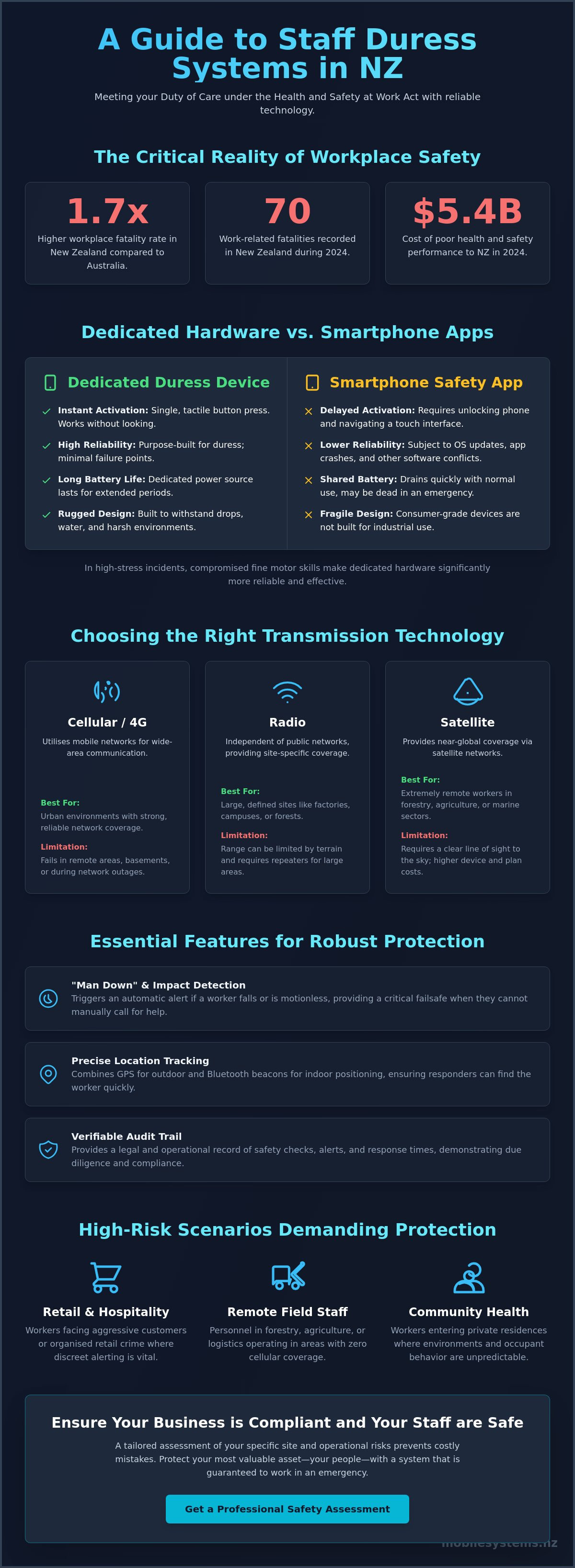
Employers function as Persons Conducting a Business or Undertaking (PCBUs). Under the HSWA 2015, you have a primary duty of care to provide a work environment without risks to health and safety. The 2026 amendments specifically refocus the system on "critical risks," providing clearer definitions for small businesses. With 70 work-related fatalities recorded in New Zealand during 2024, WorkSafe NZ guidelines increasingly point toward robust, fail-safe communication tools for lone worker protection.
Failing to provide reliable emergency communication can lead to significant legal penalties and reputational damage. The cost of New Zealand's health and safety performance reached $5.4 billion in 2024. Investing in professional hardware is a practical step toward reducing this liability. A tailored assessment often prevents costly mistakes. Contact our team to discuss your specific site requirements.
Identifying High-Risk Staff Scenarios
Specific sectors face heightened threats that necessitate a professional panic button for staff safety nz. These environments often involve isolation or potential conflict. Key scenarios include:
- Retail and Hospitality: Workers facing aggressive customers or organized retail crime where discreet alerting is vital.
- Remote Field Staff: Personnel in forestry, agriculture, or logistics operating in areas with zero cellular coverage.
- Community Health: Workers entering private residences where environmental variables and occupant behavior are unpredictable.
Dedicated hardware reduces corporate liability by providing a verifiable audit trail of safety checks and response times. When a business chooses professional-grade devices over smartphone apps, they demonstrate a commitment to utilizing the highest available standard of protection. This proactive approach ensures that your safety protocols are not just compliant, but effective in real-world emergencies.
Comparing Panic Button Technologies for NZ Environments
New Zealand's varied topography makes selecting a panic button for staff safety nz a complex technical decision. While urban environments often permit the use of cellular-based systems, these technologies fail in the deep bush or high-country regions. Selecting the right transmission method is essential for compliance with the Health and Safety at Work Act 2015, which requires businesses to provide reliable communication tools for their workers.
Smartphone safety apps are often marketed as a convenient solution, but they possess significant limitations in high-stress moments. In a duress situation, an individual experiences an adrenaline dump that compromises fine motor skills. Unlocking a phone and navigating a touchscreen interface is rarely feasible. Professional hardware provides a tactile, physical button that can be activated instantly without looking at the device.
Cellular and 4G Personal Alarms
Cellular-based devices are highly effective for staff operating in urban centers like Auckland or Wellington where network density is consistent. These cellular devices transmit GPS coordinates and voice data to a monitoring center using existing 4G infrastructure. They are ideal for retail or office staff, but they remain vulnerable to network congestion during public emergencies or signal dropouts in rural areas.
UHF/VHF Radio Integrated Duress
For industrial plants, construction sites, and large campuses, UHF/VHF systems are often the most reliable choice. These handheld radios feature a dedicated emergency button that triggers an alert across the entire radio fleet. Because these systems operate on private frequencies, they don't rely on third-party mobile networks or monthly cellular data fees, ensuring the duress signal remains priority traffic on your own network.
Satellite Messengers for Remote Safety
In New Zealand's "black holes"—remote areas such as the Southern Alps or the Urewera ranges—satellite technology is the only viable protection. Satellite messengers bypass local infrastructure entirely by communicating with low-earth orbit constellations. This ensures a panic button for staff safety nz remains functional for forestry crews or maritime workers who operate far beyond the reach of standard 4G signals. Using portable GPS safety tools ensures that location data is transmitted even when cellular towers are miles away.
Determining which technology fits your specific operational footprint is a critical safety step. A tailored assessment often prevents costly mistakes in hardware selection and ensures your team remains protected in every environment they encounter.
Critical Features of a Professional Staff Safety System
Professional hardware provides functional advantages that consumer-grade mobile applications simply cannot replicate. While a smartphone relies on a user being conscious and capable of navigating a digital interface, a dedicated panic button for staff safety nz includes sensors designed for passive protection. These features ensure that an alert is triggered even if the worker is physically unable to press a button, addressing the "critical risks" mentioned in the official text of the HSWA 2015.
Discreet activation is a vital requirement for retail and public-facing roles. In a threatening situation, such as a robbery or an aggressive encounter, reaching for a mobile phone can escalate the tension. A professional duress device allows for silent, tactile activation from a pocket or belt clip. Many systems also support two-way voice communication or "listen-in" modes, allowing a monitoring center to assess the severity of the incident in real-time without alerting the aggressor.
Automated Alerts: Man Down and Fall Detection
Automated triggers use internal accelerometers to detect sudden impacts or a lack of movement. If a staff member falls or remains stationary for a set period, the device enters a pre-alarm phase. This phase issues a localized vibration or tone, allowing the user to cancel the alert if it's a false alarm. If the user doesn't respond, the system automatically transmits a high-priority duress signal. This functionality is essential for medical emergencies, such as a heart attack or stroke, where the individual may lose consciousness immediately.
Location Accuracy: GPS and Indoor Beacons
Standard satellite-based positioning is highly effective for outdoor staff, but it often fails inside multi-story complexes, basements, or large warehouses. Concrete and steel structures block satellite signals, leading to "GPS drift" that can misplace a worker by hundreds of meters. Professional systems solve this by integrating with indoor Bluetooth beacons. These small, low-power transmitters provide room-level accuracy, ensuring security teams know exactly which floor and office to attend.
High-quality GPS trackers and duress devices utilize a hybrid approach, switching between satellite and beacon technology as the environment changes. This ensures that the staff recovery process is precise and efficient. Relying on a system that only offers outdoor positioning leaves a significant gap in your safety protocol. A tailored assessment often prevents costly mistakes when choosing between these location technologies.
Implementing a Response Protocol for Your Business
Deploying a panic button for staff safety nz is only effective if a clear response protocol exists. A device that triggers an alert to an unmonitored terminal provides no actual protection. Businesses must establish a structured workflow that dictates exactly what happens from the moment a duress signal is received until the situation is resolved.
A professional protocol should follow these four critical steps:
- Conduct a site-specific communication audit: Identify if your staff operate in urban environments with 4G access or remote regions requiring satellite or UHF coverage.
- Define alert recipients: Determine if alerts will be managed by an on-site supervisor or a 24/7 professional monitoring centre.
- Establish escalation paths: Create a hierarchy where local security is notified first, followed by management, and finally emergency services if no confirmation is received.
- Schedule regular testing: Implement a mandatory monthly check to verify signal strength and device battery health.
Internal Monitoring vs. Professional Response
In-house monitoring is often suitable for localized operations like warehouses, industrial plants, or retail stores. Alerts are sent directly to a base station or a fleet of handheld radios, allowing for immediate peer-to-peer response. For detailed information on setting up a base station for your team, refer to our walkie talkie guide.
Professional monitoring services are essential for high-risk or 24-hour operations. These centres provide a guaranteed response even if your internal management is unavailable. While this involves ongoing service fees, it ensures that every duress signal is logged and actioned by trained dispatchers who can coordinate with New Zealand emergency services. This level of oversight is a key component of a robust safety management system.
Training and Drills
Effective safety protocols rely on muscle memory. Staff must be trained to trigger their panic button for staff safety nz without looking at the device. This is critical during an incident where an "adrenaline dump" occurs and fine motor skills are lost. Conduct silent drills monthly to ensure every team member is familiar with the tactile feel and location of the duress button.
Documented monthly system checks are a legal necessity under the HSWA 2015 to prove you are managing "reasonably practicable" risks. Proper calibration of "Man Down" sensors also reduces alarm fatigue. If sensors are too sensitive, staff may stop wearing the devices due to frequent false alerts. A well-calibrated system ensures that when an alarm sounds, it's treated with the necessary urgency.
If you are ready to design a fail-safe response chain for your workforce, contact Mobile Systems Limited for a professional consultation.
Why Professional Hardware Outperforms Smartphone Apps
In a high-stress emergency, the human body undergoes a significant physiological shift known as an adrenaline dump. This response prioritizes gross motor skills, such as running or striking, while simultaneously compromising fine motor skills. Attempting to unlock a smartphone, navigate a touchscreen, or locate a specific app icon becomes nearly impossible when a worker is under duress or physically threatened.
A dedicated panic button for staff safety nz circumvents these digital barriers by providing a physical, tactile interface. Unlike a smartphone, which may fail to recognize a fingerprint or face due to sweat, gloves, or low light, a professional duress device is designed for blind operation. A worker can trigger an alert from a belt-mounted unit or a concealed pendant without ever needing to look at the device, ensuring a faster and more discreet response.
Tactile Reliability in Emergencies
Professional devices offer superior physical durability compared to standard consumer smartphones. Most dedicated safety hardware features high Ingress Protection (IP) ratings, ensuring the unit survives heavy rain, mud, and significant drops onto concrete. This ruggedness is essential for New Zealand's primary industries, such as forestry and construction, where a standard mobile phone screen would likely shatter during a fall or a physical struggle.
Battery longevity remains a critical differentiator for workforce protection. While a smartphone running a background GPS safety app can deplete its charge in less than eight hours, dedicated duress devices are engineered for low power consumption. Many units operate for several days on a single charge. This ensures the panic button for staff safety nz remains functional throughout extended shifts or multi-day remote operations without the constant risk of a dead battery.
Expert Consultation with Mobile Systems
Mobile Systems Limited provides the technical expertise required to integrate these hardware solutions into your specific communication infrastructure. We don't just supply devices; we design integrated safety ecosystems. Whether your team requires handheld radios with integrated duress or specialized GPS trackers, we ensure the hardware matches your unique operational topography.
Selecting safety technology without professional guidance often leads to a false sense of security. We support New Zealand businesses with on-site servicing and technical installations to ensure your systems remain compliant with evolving HSWA standards. A tailored assessment often prevents costly mistakes in safety tech by identifying coverage gaps before they result in a failed emergency response. Our team focuses on functional communication to ensure your workforce is protected by reliable, mission-critical equipment.
Contact our team for a safety communication audit to ensure your staff have the most reliable protection available for their specific working environment.
Securing Your Workforce with Reliable Duress Systems
Implementing a robust panic button for staff safety nz is a fundamental component of your organization's risk management strategy. By selecting dedicated hardware over smartphone applications, you ensure that your team has access to tactile, fail-safe communication when fine motor skills are compromised by stress. Whether your operations are based in urban centers or remote high-country regions, the integration of cellular, satellite, and UHF/VHF technologies provides the redundancy required for modern safety compliance.
Mobile Systems Limited specializes in custom system design for high-risk industries, ensuring your safety protocols are backed by mission-critical hardware. Our team provides NZ-based technical support and maintains a fleet of mobile service vehicles to assist with on-site installations and servicing across the country. We possess the deep technical expertise needed to bridge the gap between complex legal requirements and functional communication tools.
A tailored assessment often prevents costly mistakes in hardware selection and protocol design. Contact our safety experts for a tailored communication assessment to verify that your current duress systems meet the highest standards of reliability. Taking proactive steps today ensures your workforce remains protected in every environment they encounter.
Frequently Asked Questions
Do panic buttons for staff work without a mobile signal?
Panic buttons operate without a mobile signal if they utilize UHF/VHF radio or satellite networks instead of cellular infrastructure. Radio-based systems allow for localized duress alerts across a private network, while satellite devices provide global coverage in remote areas. It's essential to match the transmission technology to your specific operational environment to ensure the device remains functional where cellular towers are absent.
What is the difference between a duress alarm and a panic button?
A panic button is the physical trigger used to signal an emergency, while a duress alarm system refers to the complete communication infrastructure that receives and actions that signal. Professional duress systems often include automated features like "Man Down" sensors. In contrast, a simple panic button may only provide a manual alert. Both are critical components of a comprehensive panic button for staff safety nz strategy.
How does GPS tracking work inside a building for staff safety?
Standard GPS signals often cannot penetrate concrete and steel structures, leading to inaccurate location data indoors. Professional staff safety systems solve this by integrating with indoor Bluetooth beacons. These small transmitters communicate with the duress device to provide room-level or floor-level accuracy. This ensures that security teams can locate a worker within a multi-story complex or large warehouse where satellite-based GPS remains unreliable.
Are there monthly fees associated with staff panic buttons?
Monthly fees depend on the transmission technology and monitoring level you choose for your organization. Cellular and satellite-based devices typically require a monthly subscription for network access and data transmission. Private UHF or VHF radio systems generally don't incur ongoing network fees because they operate on your own licensed frequencies. Professional 24/7 monitoring services also involve recurring costs to ensure alerts are actioned by a dedicated response centre.
Can panic buttons connect directly to 111 in New Zealand?
Panic buttons don't connect directly to the 111 emergency service to prevent accidental false alarms from overwhelming dispatchers. Instead, the signal is routed to a professional monitoring centre or an internal supervisor who verifies the emergency. Once the threat is confirmed, the monitor contacts New Zealand Police, Fire, or Ambulance services. This managed response ensures that emergency services receive accurate location data and situational context.
What is a "Man Down" alarm and how does it trigger?
A "Man Down" alarm is an automated trigger that uses internal accelerometers to detect sudden impacts or a lack of movement. If a device detects a fall or remains stationary beyond a pre-set interval, it enters a pre-alarm state. If the user doesn't cancel the pre-alarm, the system automatically transmits a duress signal. This feature is vital for medical emergencies where a worker may be unconscious and unable to manually trigger an alert.
How do I meet my HSWA 2015 obligations for lone workers?
Meeting HSWA 2015 obligations requires taking "reasonably practicable" steps to ensure the safety of lone workers. This involves conducting a risk assessment, providing a reliable means of emergency communication, and establishing a documented response protocol. Utilizing a professional panic button for staff safety nz demonstrates that you've implemented the highest available standard of protection. Documenting regular system checks and staff training drills is also essential for legal compliance.
Which is better for retail: a fixed button or a wearable device?
Wearable devices are generally superior for retail environments because they allow staff to trigger an alert from anywhere in the store. This is particularly important if a worker is moved away from the point of sale during an incident. Fixed buttons are useful as a secondary measure at high-risk locations like the cash wrap. A combination of both ensures that duress signals can be sent discreetly without escalating a threatening situation.
Related posts

- June 13, 2026
In 2024, New Zealand recorded 70 work-related fatalities and more than 209,000 injury claims. These statistics underscore the heavy responsibility...

- June 10, 2026
Did you know that approximately 15% of New Zealanders work in isolated conditions, with many operating entirely outside of reliable...