
Lone Worker Safety Devices NZ: The 2026 Professional Buyer’s Guide
A safety alarm is only as reliable as the network it connects to, yet many New Zealand businesses overlook the geographic black spots that render standard equipment useless in an emergency. Selecting the right lone worker safety devices nz requires more than just a panic button.
A safety alarm is only as reliable as the network it connects to, yet many New Zealand businesses overlook the geographic black spots that render standard equipment useless in an emergency. Selecting the right lone worker safety devices nz requires more than just a panic button.It demands a solution that works across our unique, rugged terrain. With 70 work-related fatalities recorded in 2024, the stakes for remote and isolated staff have never been higher.
You likely feel the pressure of the Health and Safety at Work Amendment Bill introduced on February 9, 2026, which shifts the regulatory focus toward managing critical risks. It's difficult to balance these legal obligations with the reality of unreliable cellular coverage in rural areas. You need the peace of mind that comes from knowing help is reachable 24/7, even when a worker is far from the main office or deep in the field.
This guide provides a clear path to selecting and implementing lone worker alert systems that ensure both compliance and real-world durability. We'll examine the practical differences between satellite and cellular hardware, explain how to integrate these tools into your existing workflows, and help you navigate the 2026 regulatory landscape. A tailored assessment often prevents costly mistakes, ensuring your safety solution matches your specific geographic challenges.
Key Takeaways
- Understand how the 2026 Health and Safety at Work Amendment Bill refocuses compliance efforts on managing critical risks for remote staff.
- Learn to select lone worker safety devices nz based on geographic reality, comparing the reliability of cellular, satellite, and radio networks in rural black spots.
- Identify essential hardware features like tactile SOS buttons and automatic fall detection that ensure a response during a real emergency.
- Determine the best safety technology for high-risk NZ industries, including forestry and agriculture, where standard mobile coverage often fails.
- Discover the importance of site-specific coverage testing and professional system integration to create a truly dependable worker safety ecosystem.
Understanding Lone Worker Safety Obligations in New Zealand
Under the Health and Safety at Work Act (HSWA) 2015, a PCBU (Person Conducting a Business or Undertaking) must ensure the health and safety of all workers. This includes those working in isolation. To understand the scope of these responsibilities, one must first ask, What is a lone worker? In New Zealand, this definition covers anyone working where assistance is not readily available, such as a forester in the King Country or a community nurse in a remote township.
The primary legal "duty of care" requires employers to provide a reliable system for effective communication. With 70 work-related fatalities recorded in 2024, WorkSafe NZ has increased its focus on how businesses manage isolated staff. Simply handing an employee a standard mobile phone is rarely enough to meet these standards in rural regions where coverage is inconsistent.
To better understand the practical application of these safety requirements, watch this helpful video:
The concept of "reasonable practicability" is central to New Zealand law. It means you must do what is reasonably able to be done to ensure safety, taking into account the likelihood of a risk and the availability of technology. For high-risk sectors like forestry and rural utilities, investing in professional lone worker safety devices nz is often the only way to satisfy this legal threshold when operating outside urban centers.
The Legal Framework: HSWA 2015 and Lone Workers
A PCBU is responsible for providing equipment that works when it's needed most. Standard mobile phones often fail the "effective communication" test because they rely on fragile cellular networks that don't reach deep into New Zealand's backcountry. Regulatory compliance also requires documented check-in procedures. If a worker fails to report in, the system must trigger an immediate, reliable alert that doesn't depend on a single point of failure.
Identifying Risk Profiles in NZ Operations
Risk management begins by distinguishing between social and environmental hazards. Social risks involve public-facing roles where aggression is a threat. Environmental risks are common in agriculture and remote contracting, where rugged terrain causes slips or vehicle accidents. A "failsafe" communication hierarchy usually starts with satellite or radio systems as the primary link, with cellular as a secondary backup. A tailored assessment helps identify which technology fits your specific risk profile and geographic needs.
Comparing Alert Technologies: Cellular, Satellite, and Radio
Not all networks are created equal. When selecting lone worker safety devices nz, the most expensive hardware is useless if the signal can't penetrate the forest canopy or reach a distant tower. Understanding the technical limitations of each platform is a core part of Managing health and safety risks effectively across diverse New Zealand landscapes.
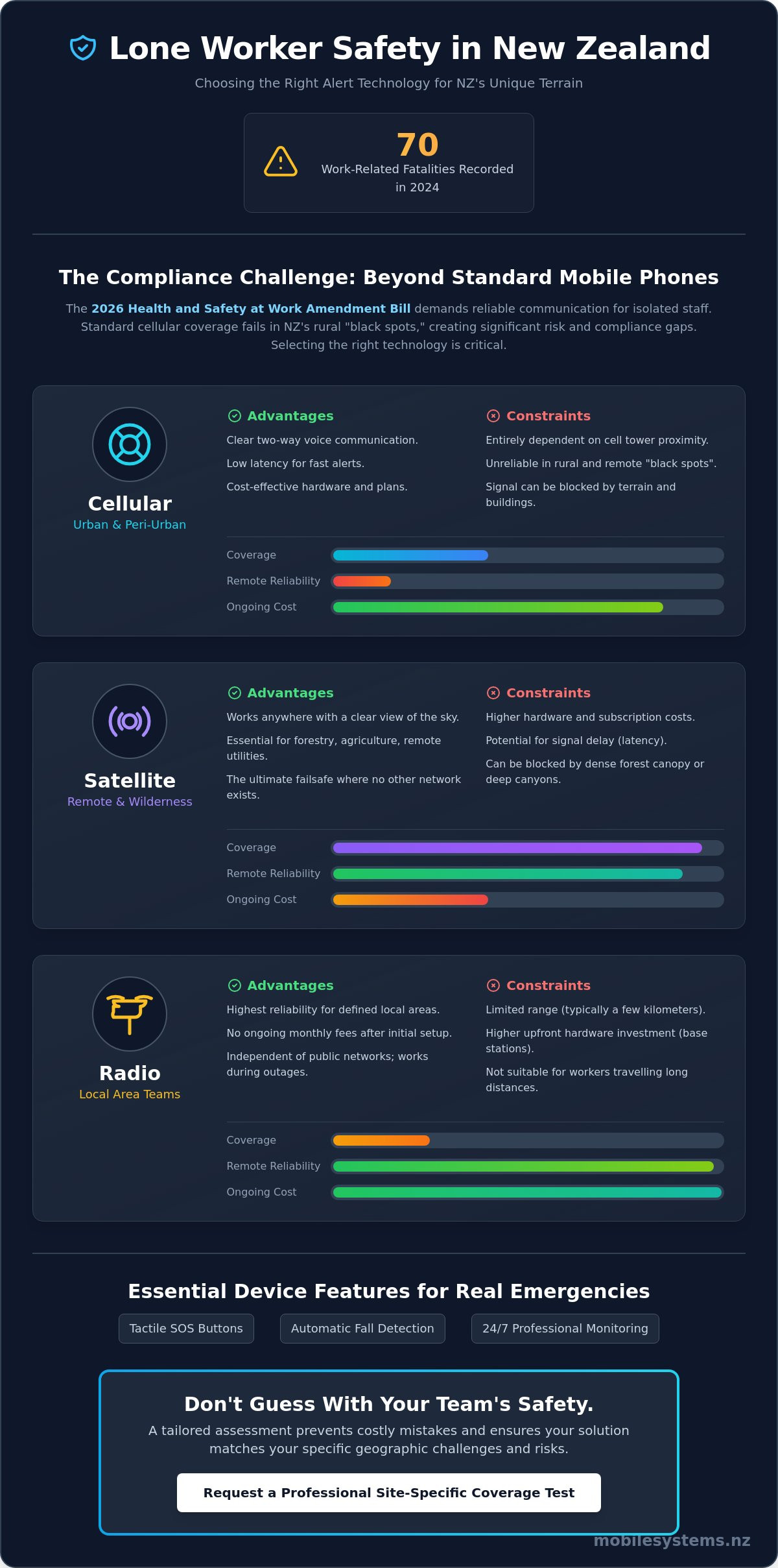
- Cellular: Best for city-based staff; features clear two-way voice.
- Satellite: Essential for remote wilderness; works where towers don't exist.
- Radio: Highest reliability for local teams; no ongoing monthly fees.
Cellular Alert Buttons: Pros and Constraints
Cellular-based units are the standard choice for urban and peri-urban environments. They provide low latency and two-way voice communication, which allows responders to talk directly to the worker during an incident. These cellular devices are cost-effective but rely entirely on local tower proximity. In 2026, while 5G expansion continues, large sections of New Zealand’s rural roading network remain "black spots" where cellular signals vanish entirely.
Satellite Messengers: When Cellular Isn’t Enough
For deep-country forestry, alpine work, or remote conservation projects, satellite technology is essential. Systems like Garmin InReach utilize the Iridium network to provide 100% global coverage. These portable GPS solutions ensure a worker is never truly out of reach. You should remember that satellite messaging isn't always instantaneous; signal transmission can take several minutes depending on sky visibility and satellite passes.
The Radio Advantage: DMR and P25 Private Networks
Professional radio networks remain the gold standard for high-reliability local coverage. Unlike cellular systems, private VHF or UHF networks don't suffer from public network congestion during widespread emergencies. Modern Tait and DMR radio systems include integrated "Man Down" and "Lone Worker" modes. These features automatically trigger an alert if the radio stays horizontal for too long or if the user fails to respond to a periodic prompt.
Selecting the right lone worker safety devices nz involves balancing battery life, upfront hardware costs, and ongoing subscription fees. Satellite devices often require monthly plans starting from NZ$50, whereas private radio networks have no per-user monthly costs once the infrastructure is in place. If you're unsure which network fits your specific worksite, requesting a coverage audit can prevent investment in the wrong technology.
When you evaluate lone worker safety devices nz, the specific hardware features determine the speed and accuracy of a potential rescue. It isn't just about having an emergency button; it's about how that button functions under extreme pressure. High-quality devices align with NZ safety regulations for lone workers, ensuring the technology mitigates the actual risks your staff face in the field.
- Tactile SOS Buttons: Recessed designs are preferred in industrial settings to prevent false alarms, while tactile feedback ensures the user knows the alert was successfully sent.
- Automatic Fall Detection: Professional-grade sensors use algorithms to distinguish between a device being dropped on a hard surface and a human body hitting the ground by looking for a sequence of freefall, impact, and immobility.
- No-Motion (Man Down) Alerts: These act as a critical last line of defense by triggering an alarm if the device remains stationary for a set period, which is vital for medical events like a stroke or heart attack.
Precision Tracking and Geo-Fencing
New Zealand's heavy forest canopy and deep valleys pose a significant challenge for standard GPS receivers. Professional lone worker safety devices nz utilize high-sensitivity chipsets and multi-constellation GNSS, including GPS, GLONASS, and Galileo, to maintain a signal lock in dense bush. Geo-fencing adds another layer of protection by automatically notifying managers when a worker enters a high-risk zone, such as a steep felling site or a restricted utility area. GPS breadcrumbing is a continuous log of movement that provides Search and Rescue (SAR) operations with a precise historical path to follow if a worker goes missing or their vehicle leaves the road.
Two-Way Voice vs. One-Way Alerting
Voice communication allows for immediate triage during an emergency. If an alert is triggered, a monitoring center can speak directly to the worker to determine whether they need a first-aid kit or a helicopter. This prevents unnecessary emergency deployments for minor issues. However, voice has limitations in high-wind environments or near loud machinery where audio clarity is poor. Standard trackers don't always perform well in these conditions. Choosing between silent alerts and loud sirens depends on the specific social or environmental risks. For example, a silent alert is safer during a confrontation, while a loud siren helps local colleagues locate a downed worker in a large manufacturing plant.
Selecting the Right Device for Your NZ Industry
Every industry faces a unique set of hazards. A dairy farmer in Southland deals with different environmental risks than a social worker in Auckland. To ensure compliance and reliability, you must match your lone worker safety devices nz to the specific physical and social conditions of the worksite. A mismatch often leads to equipment being left in the glovebox rather than being worn on the person.
- Agriculture and Farming: These roles require extreme durability and long-range connectivity. High-power handheld radios or satellite trackers are preferred for their ability to signal through hills and valleys.
- Forestry and Remote Contracting: Due to heavy canopy and lack of towers, satellite-radio hybrids are often the only way to maintain a continuous safety link.
- Community Health and Social Work: Social risks like aggression require discreet, wearable cellular pendants that look like standard ID badges or jewelry.
- Civil Engineering and Construction: Sites with heavy machinery and dust require ruggedized hardware with high IP ratings to survive drops and vibration.
Environmental Factors: IP Ratings and Battery Life
New Zealand's climate is notoriously hard on electronics. IP67 devices are rated for immersion in water up to 1 meter for 30 minutes, while IP68 provides even greater protection against fine dust and deeper water. For civil engineering teams working in mud or heavy rain, anything less than IP67 is a liability. Battery life is equally critical. Lithium-ion batteries can lose up to 20% of their effective capacity in freezing conditions, which is a common occurrence during winter shifts in the Central Plateau or Southern Alps. You should select devices that offer at least 24 to 48 hours of operation on a single charge to cover multi-day field work.
Monitoring Options: Professional vs. Self-Monitored
The device is only the first half of the safety chain; the second half is who receives the alert. A professional Alarm Response Centre (ARC) provides 24/7 monitoring by trained operators who follow a strict escalation protocol. This removes the risk of "notification fatigue" that often plagues internal monitoring, where managers might miss a smartphone alert during a meeting or while asleep. While self-monitoring via a manager's app is a lower-cost entry point, it lacks the redundancy required for high-risk operations. A tailored assessment often prevents costly mistakes in monitoring choice by identifying where your internal response capacity might fail.
For teams requiring precise location data in rugged terrain, portable GPS trackers offer the most reliable way to coordinate a rescue. Choosing the right hardware ensures your safety ecosystem remains robust regardless of the weather or location.
Implementing a Robust Safety Ecosystem with Mobile Systems
A safety device is only as effective as the network it connects to and the person operating it. Buying lone worker safety devices nz is a significant first step, but true protection comes from a fully integrated ecosystem. This involves more than just unboxing hardware; it requires verifying that signals reach the specific valleys or remote sites where your team actually works.
One of the most effective ways to enhance safety is by integrating lone worker alerts into your broader fleet communication systems. This creates a unified response network where a panic alert can be seen by both a central dispatcher and nearby vehicle-mounted units. It ensures that help can be dispatched from the closest possible resource, which is critical when a worker is deep in the field.
Staff training remains a vital part of the safety equation. Technology only provides 50% of the solution; the other half is the human response. Workers must be comfortable with the tactile SOS buttons and understand the specific protocols for "Man Down" alerts. If your team doesn't trust the equipment or finds it cumbersome to integrate into their daily workflow, they simply won't use it.
Custom System Design and Installation
Mobile Systems starts every project by assessing the specific network black spots that affect your operations. We don't believe in a "one-size-fits-all" approach because New Zealand's topography is too varied. For remote workers, we often recommend vehicle-mounted boosters or high-gain antennas to extend the reach of standard cellular or radio signals. Unlike generic providers, we specialize in integrating these alerts directly into your professional radio networks. You can contact our team for a professional assessment of your current coverage gaps.
Ongoing Support and Maintenance
Reliability is a long-term commitment, not a one-time purchase. Regular firmware updates and battery health checks are vital to ensure that your lone worker safety devices nz perform during a real crisis. Our service vehicles provide nationwide support, ensuring that your communication infrastructure remains operational regardless of your location. Prioritizing long-term reliability over the lowest initial hardware cost is essential for meeting your HSWA 2015 obligations. With 209,400 work-related injury claims recorded in 2024, the cost of a failed device far outweighs the investment in professional maintenance.
By choosing a partner that understands both the technology and the terrain, you move beyond simple compliance. You build a system that actually works when it matters most. A tailored assessment often prevents costly mistakes, ensuring your team stays connected even in the most isolated parts of the country.
Securing Your Remote Workforce for the Future
Effective safety isn't just about the hardware; it's about network reliability and regulatory compliance. We've explored how matching lone worker safety devices nz to your specific geographic "black spots" ensures your team remains protected even in the most remote corners of the country. Whether you utilize satellite messengers for alpine work or private radio networks for industrial sites, the goal remains the same: ensuring every worker returns home safely.
With over 20 years of commercial communication experience, Mobile Systems Limited understands the unique challenges of the New Zealand landscape. Our team provides deep expertise in Tait, Hytera, and Garmin systems, supported by a fleet of NZ-wide mobile service vehicles that maintain your infrastructure on-site. Don't leave your staff's welfare to chance or unreliable consumer hardware that fails when the signal drops.
Request a tailored lone worker safety assessment from our experts to identify and close your current coverage gaps. Taking proactive steps today ensures your business stays compliant with the latest safety standards while providing your team with the protection they deserve.
Frequently Asked Questions
Do I legally need a lone worker safety device in New Zealand?
Under the Health and Safety at Work Act 2015, you must provide a system of work that includes effective communication with lone workers. While the law doesn't name a specific device, it mandates that you manage "critical risks" as emphasized in the February 9, 2026, amendment bill. If a worker is in an area without reliable contact, professional lone worker safety devices nz are the practical way to meet this legal duty.
What is the difference between an SOS button and a man-down alarm?
An SOS button requires the user to physically press a button to call for help. In contrast, a man-down alarm uses internal sensors to detect a fall or a period of non-movement. This automatic trigger is vital if the worker is unconscious or incapacitated and cannot reach their device manually.
Will a 4G lone worker alarm work in remote areas like the Southern Alps?
No, a 4G device will not function in areas without cellular tower coverage. Large sections of the Southern Alps and remote forestry blocks are cellular black spots. For these environments, you must use satellite-based messengers or private radio networks that operate independently of the mobile phone grid.
How much does it cost to monitor a lone worker safety device?
Monitoring costs vary based on the technology and service level. Software subscriptions like OK Alone cost approximately $5 per worker monthly as of 2026. Satellite-based monitoring often starts from NZ$50 per month. Standalone 4G devices can be purchased for $475 to $599 plus GST, with some including pre-paid SIM credit for initial use.
Can I use a satellite phone as a lone worker safety device?
Yes, a satellite phone is an excellent safety tool for remote New Zealand operations. Modern units often include a dedicated SOS button that sends GPS coordinates to a monitoring center. They provide the added benefit of two-way voice communication in areas where standard mobile phones have no signal.
What happens if a worker triggers a false alarm?
Most professional monitoring systems include a triage phase to manage false alerts. When an alarm is triggered, the response center attempts to contact the worker via two-way voice or text to confirm the emergency. Using devices with recessed or "press-and-hold" buttons significantly reduces the false alarm rates common with consumer-grade hardware.
Is a lone worker app on a smartphone sufficient for HSWA compliance?
A smartphone app is often insufficient for high-risk or remote roles. While apps are cost-effective for urban staff, they rely on fragile screens and limited battery life. Professional lone worker safety devices nz offer superior durability and dedicated physical buttons that are easier to operate in the rain or while wearing gloves.
How do I choose between a wearable pendant and a handheld radio?
Your choice depends on the specific work environment and risk profile. Wearable pendants are ideal for community health workers who need a discreet, lightweight solution for social risks. Handheld radios are better for industrial or agricultural sites because they offer rugged IP67 protection and don't require monthly cellular subscriptions.
Related posts

- June 19, 2026
Fall detection, no-motion sensors, and GPS - here's exactly how a man down alarm knows something's wrong, and how the...

- June 13, 2026
In 2024, New Zealand recorded 70 work-related fatalities and more than 209,000 injury claims. These statistics underscore the heavy responsibility...

- June 11, 2026
New Zealand's workplace fatality rate is 1.7 times higher than Australia's, a stark figure that highlights the urgent need for...