
Lone Worker Safety Requirements in NZ: A Comprehensive Guide for 2026
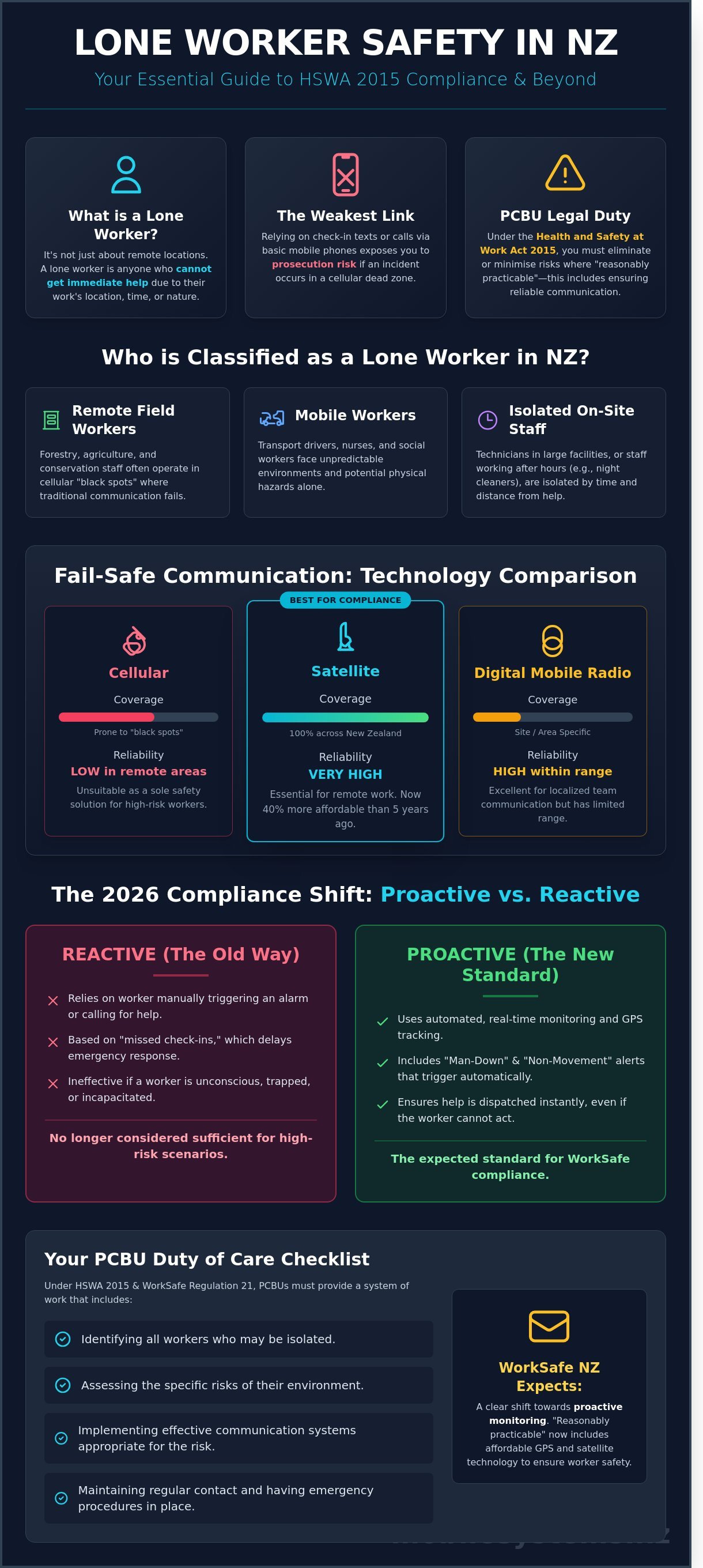
What if the check-in text your staff sends at the end of the day is actually the weakest link in your liability chain? Relying on basic mobile phones to meet lone worker safety requirements NZ often leaves businesses exposed.
What if the check-in text your staff sends at the end of the day is actually the weakest link in your liability chain? Relying on basic mobile phones to meet lone worker safety requirements NZ often leaves businesses exposed to WorkSafe prosecution if an incident occurs in a cellular dead zone.
You likely understand that the Health and Safety at Work Act 2015 demands more than just a verbal agreement to stay safe. It's a heavy responsibility for any PCBU, particularly when your team operates in remote regions where communication is notoriously unreliable.
This guide clarifies your legal obligations for 2026 and provides a roadmap for implementing fail-safe communication systems. We'll show you how to protect your staff and your management team from the consequences of a safety failure.
We'll examine the specific technology needed for 100% coverage across New Zealand, how to automate check-ins, and the best practices for creating a culture of genuine safety.
Key Takeaways
- Understand your legal obligations under the Health and Safety at Work Act 2015 and how the law defines 'isolation' for staff.
- Identify the specific PCBU duty of care requirements for managing risks and maintaining regular contact with remote workers.
- Discover how to address lone worker safety requirements NZ by navigating cellular black spots with resilient communication technology.
- Compare the performance of Satellite, Cellular, and Digital Mobile Radio (DMR) systems to find the right fit for your environment.
- Learn how professional site audits and tailored safety frameworks ensure your communication gear performs reliably in the field.
Understanding Lone Worker Definitions and NZ Legal Framework
The Health and Safety at Work Act (HSWA) 2015 serves as the cornerstone of New Zealand's workplace safety legislation. It places a primary duty of care on the Person Conducting a Business or Undertaking (PCBU) to ensure the safety of all workers. While the Act is broad, it specifically addresses the unique risks faced by those who operate without direct supervision or immediate assistance.
In a legal context, a lone worker isn't just someone working in a remote forest. Under NZ law, isolation is defined by the inability to access help. This might be due to the time of day, the physical location, or the nature of the work being performed. Understanding What is a Lone Worker? is the first step for any business attempting to navigate these regulations effectively.
Meeting lone worker safety requirements NZ involves more than a simple "call if you can" policy. By 2026, safety standards are expected to move entirely away from reactive measures. Relying on a worker to manually trigger an alarm is no longer considered sufficient in high-risk scenarios. If a worker is unconscious or trapped, they cannot call for help, making automated, proactive monitoring a necessity for compliance.
The 2015 Act requires PCBUs to eliminate risks so far as is "reasonably practicable." If elimination isn't possible, you must minimize those risks. For lone workers, this means implementing communication systems that work even when the cellular network fails or the worker is incapacitated. A failure to provide these tools can lead to significant legal exposure and heavy fines under the HSWA framework.
The Role of WorkSafe New Zealand
WorkSafe New Zealand provides the regulatory oversight for these laws. They specifically point to the Health and Safety at Work (General Risk and Workplace Management) Regulations 2016. Regulation 21 states that a PCBU must provide a system of work that includes effective communication with lone workers.
- WorkSafe monitors whether the chosen safety system is appropriate for the specific risk level.
- The regulator expects a shift toward proactive monitoring rather than waiting for a missed check-in.
- "Reasonably practicable" now includes the use of GPS and satellite technology, which has become 40% more affordable over the last five years.
Mobile Systems Limited works with businesses to ensure their technology meets these WorkSafe expectations. We focus on systems that provide real-time data, ensuring help is dispatched the moment a "man-down" or "non-movement" alert is triggered. This proactive approach is what separates a compliant business from one at risk of prosecution.
Who is Classed as a Lone Worker in NZ?
Identifying lone workers in your organization is often more complex than it seems. In New Zealand, this category spans several high-risk industries. Forestry, agriculture, and conservation workers are the most obvious examples. These individuals often work in "black spots" where traditional mobile coverage is non-existent, requiring specialized satellite hardware.
Mobile workers also face significant risks. This group includes transport drivers, district nurses, and social workers visiting private residences. Their environment is unpredictable, and they may encounter physical hazards or aggressive behavior without any colleagues nearby to intervene.
Finally, on-site staff can be lone workers if they are isolated from others. A technician working in a large cold-storage facility or a cleaner working at 2:00 AM in a multi-story office block is isolated. If they suffer a medical event or an accident, the distance to the nearest person could be the difference between a minor incident and a fatality. A tailored assessment often prevents these costly mistakes and ensures every team member is protected.
Professional services such as The Cleaning Crew are a key example, as their teams often work alone in commercial buildings after hours, making these safety considerations essential.
The PCBU Duty of Care: Managing Risks to Isolated Staff
Under the Health and Safety at Work Act 2015 (HSWA), the responsibility for lone worker safety requirements NZ falls squarely on the Person Conducting a Business or Undertaking (PCBU). This legal duty of care requires businesses to identify, assess, and either eliminate or minimise risks to staff working in isolation. It's not enough to simply acknowledge the risk; the law demands a proactive approach to ensure help is available when things go wrong.
Maintaining "regular contact" is a primary legal necessity. According to the NZ Government Health and Safety Lead, failing to provide a reliable means of communication can lead to severe penalties. While a written lone worker policy is mandatory, it's often insufficient on its own. A policy that sits in a folder without practical, tested hardware to support it won't protect a worker in a crisis or a business in court.
The consequences of non-compliance are significant. Under the HSWA, organizations can face fines of up to NZ$3 million for serious breaches. Beyond financial penalties, the reputational damage following a preventable accident can be permanent. Adhering to lone worker safety requirements NZ is about more than avoiding fines; it's about building a culture where staff feel secure in remote environments.
A tailored assessment often prevents costly mistakes. Seeking expert advice to discuss your specific operational challenges can help bridge the gap between policy and practical implementation, ensuring your safety measures are robust and effective.
Conducting a Lone Worker Risk Assessment
A robust risk assessment starts with the environment. In New Zealand, this means evaluating terrain like the Southern Alps or dense bush where weather changes in minutes. You must identify cellular dead zones, which still affect approximately 30% of New Zealand’s landmass. If a worker enters these areas, your standard safety protocols may fail instantly without satellite or radio redundancy.
Next, you should assess the task itself. Operating high-risk machinery like chainsaws or heavy plant in isolation requires different controls than low-risk administrative work in a satellite office. High-risk roles often necessitate "man-down" sensors that trigger automatic alerts if the worker becomes incapacitated. These sensors remove the need for the worker to manually call for help during a medical event or accident.
Finally, consider the individual. A worker with 20 years of experience may handle isolation differently than a new recruit. You must also account for pre-existing medical conditions and ensure that training is current. Documenting these variables ensures that your safety system is responsive to the actual people on the ground rather than a generic template.
Defining "Effective Communication" in 2026
The legal standard for "effective communication" has evolved. It's now defined as the capability for two-way communication at all times. If a worker can't send and receive messages, the system is non-compliant. Standard mobile phones are often inadequate because they rely on terrestrial towers that don't cover remote forestry blocks, farms, or coastal areas.
Check-in intervals must be based on the specific risk level of the job, not what's convenient for the office. For high-risk tasks, a 30-minute check-in might be necessary. For lower-risk roles, a two-hour interval could suffice. Relying on a "text me when you're done" approach is a common mistake that regulators frequently cite during audits.
Modern systems automate these check-ins to reduce the administrative burden. If a worker misses a scheduled window, the system should automatically escalate the alert to a supervisor or a 24/7 monitoring station. This ensures that a lapse in communication is treated as a potential emergency until proven otherwise, providing a critical safety net for your most vulnerable staff.
Communication Challenges: Navigating NZ Cellular Black Spots
New Zealand's geography presents a unique set of challenges for businesses attempting to maintain constant contact with remote staff. While 98 percent of the population lives within cellular reach, the actual landmass coverage tells a different story. Approximately 70 percent of New Zealand's rugged terrain remains a "black spot" where standard mobile signals cannot penetrate.
Failing to account for these gaps is a significant risk when attempting to meet New Zealand's Health and Safety at Work Act 2015. Under this legislation, employers must provide a reliable means of communication for their staff. Relying on a standard mobile phone in areas like the Kaimai Ranges or the Southern Alps often leaves workers isolated when they are most vulnerable.
A single "bar" of signal is frequently misinterpreted as a functional connection. In reality, a weak signal often fails to sustain the data packets required for GPS tracking or VoIP calls. If a worker enters a "signal shadow" caused by a ridgeline or dense bush, a cellular-only safety app will stop updating. This creates a dangerous false sense of security for both the worker and the fleet manager back at the office.
Identifying Telecommunication Dead Zones
Dead zones are not limited to the deep wilderness. They occur frequently in the Central Plateau, along coastal roads in the South Island, and even in deep valleys near urban fringes. Maritime environments also present challenges; signal propagation over water is often inconsistent due to atmospheric ducting and tidal changes that affect line-of-sight transmission.
Technological isolation occurs when workers move between these zones without an automated failover system. Professional safety requires hardware that can transition seamlessly between cellular and satellite networks. Without this capability, a worker is effectively "off the grid" the moment they step behind a hill or into a thick forest canopy, making it impossible to satisfy lone worker safety requirements NZ.
The Limitations of Consumer-Grade Devices
Standard smartphones are designed for urban convenience, not industrial safety. In harsh New Zealand conditions, consumer-grade hardware faces three primary failure points that can compromise a safety plan:
- Battery Depletion: Cold temperatures in regions like the Southern Alps can reduce lithium-ion battery performance by up to 40 percent in a single shift.
- Durability: Standard screens and internal components rarely survive a fall onto greywacke rock or immersion in a backcountry stream.
- Accessibility: In an emergency, navigating a touchscreen to find an app is often impossible. Dedicated physical "Man Down" or SOS buttons are essential for meeting lone worker safety requirements NZ.
A 2023 incident involving a lone worker in a rural North Island forestry block demonstrated these risks clearly. The worker relied on a mobile app for scheduled check-ins, but a signal drop prevented the "All Clear" message from sending. By the time the supervisor realized the check-in was missed, four hours had passed. A professional-grade device with satellite redundancy would have alerted the base immediately, preventing a dangerously delayed emergency response.
Adhering to lone worker safety requirements NZ involves more than just a software download. It requires a hardware-first approach that acknowledges the physical realities of the New Zealand landscape. A tailored assessment of your specific operational area often prevents these costly communication failures before they occur in the field.
Selecting the Right Technology for Compliance and Safety
Selecting the right communication hardware is the most critical step in meeting lone worker safety requirements NZ. New Zealand’s rugged topography and inconsistent cellular coverage mean that a "one size fits all" approach often leaves workers vulnerable. Businesses must evaluate technology based on the specific geographic risks and the level of isolation their staff face daily.
Digital Mobile Radio (DMR) has become the standard for team-based lone workers in sectors like civil construction and utilities. Unlike older analogue systems, DMR provides crystal-clear audio even at the edge of a coverage area. These systems allow for private calling and group broadcasts, ensuring that an emergency alert reaches every person on the network instantly without the latency issues found in some digital apps.
- Cellular: Reliable in urban centres but fails in approximately 25% of New Zealand's landmass.
- UHF/VHF Radio: Provides independent, private networks with no monthly airtime fees and instant connectivity.
- Satellite: Essential for total coverage in deep bush, high-country farms, or offshore environments.
Professional Two-Way Radio Systems
Tait and Hytera systems are engineered to provide wide-area coverage that spans entire regions. By utilizing simulcast and repeater networks, a business can maintain a seamless communication grid across the Waikato or the Bay of Plenty. This infrastructure ensures that a worker in a valley can still reach a dispatcher 50km away.
The value of two-way radio devices lies in their dedicated emergency features. Modern handsets include programmable orange buttons that send an immediate distress signal to all other units. This bypasses the need to dial a number or wait for a connection, which is vital when seconds matter during a medical event or physical accident.
Satellite & GPS Solutions for Total Coverage
When staff operate beyond the 4G or 5G grid, Iridium or Starlink-based solutions become the primary lifeline. Satellite messaging allows for two-way texting and check-ins from any location on Earth. For high-risk roles like forestry or conservation work in the Southern Alps, these devices are the only way to guarantee a signal is sent when an incident occurs.
The role of portable GPS communications is to provide real-time location data to health and safety managers. If a worker fails to check in, the system provides their exact coordinates, reducing search and rescue times from hours to minutes. Satellite phones serve as a critical backup, providing voice capability when data-only messaging isn't enough for complex emergency coordination.
Vehicle-Mounted vs. Handheld Solutions
Vehicle-mounted units offer a distinct advantage through high-gain antennas, which can extend signal range by up to 15km compared to a standard handheld. These units draw power from the vehicle battery, ensuring the radio is always operational. However, the risk increases when a worker leaves the cab to perform a task, potentially losing their connection to the safety net.
Hybrid solutions solve this by bridging satellite and radio technologies. These systems allow a handheld radio to use the vehicle's high-powered mobile radio as a gateway. This setup ensures that whether the staff member is behind the wheel or 200 metres away fixing a fence, they remain connected to the central dispatch or emergency services.
Integrating "Man Down" and "No Movement" sensors directly into the hardware adds an automated layer of protection. These sensors use internal accelerometers to detect a fall or a period of inactivity. If the device remains tilted or stationary for a set period, typically 30 to 60 seconds, it triggers an audible pre-alarm before sending a full emergency alert to the control centre.
Implementing a Robust Safety System with Mobile Systems
Meeting lone worker safety requirements NZ isn't just about buying gadgets. It's about building a comprehensive framework that responds effectively when things go wrong. Mobile Systems starts every project with a deep dive into your operational environment. We look at where your staff go and what specific risks they face daily.
Our team conducts rigorous site audits to map signal dead zones. In the rugged terrain of regions like the Waikato or the Bay of Plenty, a standard radio might fail without a repeater. We ensure your gear is tested in the exact locations where your team works. This eliminates the guesswork that often leads to safety gaps and ensures 100% coverage in critical zones.
Installation isn't the end of the process. We handle the technical setup to ensure seamless integration with your existing fleet. Proper mounting and antenna placement can increase signal range by up to 25% compared to poorly installed units. This attention to detail ensures your communication line remains open when it matters most.
Custom Design and Professional Installation
DIY setups often fail during a real emergency because they lack redundancy. A single point of failure can be catastrophic in remote forestry or agricultural sites. Mobile Systems provides nationwide support, ensuring that technical help is available on-site across New Zealand. We don't just ship boxes; we build functional networks that save lives.
We integrate fleet tracking systems for real-time oversight. This allows managers to see exactly where a lone worker is at any moment. If a "man-down" alarm triggers, you won't waste precious minutes searching. You'll have precise coordinates immediately, which is vital for meeting lone worker safety requirements NZ under the Health and Safety at Work Act 2015.
Equipment requires regular servicing to remain reliable. Firmware updates are essential for digital radios to maintain encryption and battery efficiency. A device running outdated software might experience a 20% drop in battery performance or critical connectivity issues. We schedule regular checks to ensure every handset and vehicle unit performs at its peak.
Training is the final piece of the safety puzzle. Your team needs to know radio etiquette and emergency protocols by heart. We teach staff how to use "orange button" alerts and how to communicate clearly under pressure. This ensures the technology serves the user, rather than becoming a distraction during a crisis.
Partnering for Long-Term Safety
Compliance isn't a one-time event. As safety standards and technologies evolve, your systems must keep pace. We provide ongoing support to ensure your business remains compliant and your people stay protected. Our team stays updated on local regulations so you can focus on your core operations.
A tailored assessment often prevents costly mistakes in hardware choice. Investing in the wrong frequency or fragile handsets can lead to thousands of NZ$ in wasted capital. Contact the team at Mobile Systems for a safety audit to get it right the first time and protect your most valuable assets.
Meta Description: Learn how Mobile Systems implements robust safety frameworks to meet lone worker safety requirements NZ, from site audits to professional installation and training.
Securing Your Isolated Workforce for 2026 and Beyond
Meeting lone worker safety requirements NZ demands a proactive approach to risk management. By 2026, New Zealand businesses must account for cellular black spots that still affect approximately 30% of our rural landmass. Relying solely on standard mobile devices often leaves staff vulnerable in high-risk zones. Effective compliance requires a strategic combination of satellite tracking and robust radio hardware from authorized partners like Tait or Hytera.
Mobile Systems employs NZ-based expert technicians who specialize in these specific remote communication challenges. We help you navigate the Health and Safety at Work Act 2015 by implementing hardware that functions where consumer networks fail. Choosing the right technology today ensures your organization remains compliant and your people stay protected regardless of their location.
A tailored assessment often prevents costly mistakes and identifies critical gaps in your current safety protocols. Request a professional lone worker safety assessment from Mobile Systems to ensure your team has the reliable support they deserve. We look forward to helping you build a safer, more resilient workplace.
Frequently Asked Questions
Is it legal to work alone in New Zealand?
Yes, it's legal to work alone in New Zealand, provided the employer manages the risks effectively. Under the Health and Safety at Work Act 2015, businesses must identify hazards and implement controls to ensure workers are safe.
Lone worker safety requirements NZ dictate that risks must be mitigated to a level that's so far as is reasonably practicable. This means you must have a plan for communication and emergency response whenever a staff member is solo.
What are the specific PCBU duties for lone workers under HSWA 2015?
A Person Conducting a Business or Undertaking (PCBU) must provide a system for regular communication and a means to raise an alarm. Regulation 21 of the HSWA (General Risk and Workplace Management) Regulations 2016 requires this system to be effective for the specific work environment.
The PCBU is responsible for ensuring the worker can access assistance if an incident occurs. This duty includes providing the necessary equipment, training staff on its use, and maintaining the system to ensure it functions during a crisis.
Does a mobile phone meet the requirement for "effective communication"?
A mobile phone only meets the requirement if there's 100% reliable cellular coverage and the device is accessible during an emergency. In many rural New Zealand areas, 15% to 20% of the terrain lacks consistent signal, which creates a significant safety gap.
If a worker is incapacitated, they can't dial 111, making a standard phone insufficient compared to automated duress systems. We recommend dedicated satellite or radio units for any staff operating outside of reliable 4G or 5G coverage zones.
What happens if a lone worker misses a scheduled check-in?
An immediate escalation protocol must begin the moment a check-in is missed. This usually involves a 5 to 10 minute grace period followed by a series of contact attempts via phone, radio, or messaging.
If the worker remains unreachable, the PCBU must initiate an emergency response plan. This may include dispatching a supervisor to the last known GPS coordinate or contacting emergency services if the risk level is high.
Are apprentices or young workers allowed to work alone in NZ?
Apprentices and workers under 18 should generally not work alone, especially when performing high-risk tasks. WorkSafe NZ guidelines suggest that inexperienced staff require direct supervision until they're deemed competent in their specific role.
A 2023 safety review highlighted that younger workers are 1.5 times more likely to be injured than their older counterparts. PCBUs must strictly limit solo activities for these individuals to ensure compliance with duty of care obligations.
How often should a lone worker check in with their supervisor?
Check-in intervals depend on the risk level, ranging from every 30 minutes for high-risk tasks to every 4 hours for low-risk office work. Most New Zealand businesses using lone worker safety requirements NZ as a benchmark adopt a 60 or 120 minute interval.
These intervals must be documented in your health and safety manual and strictly followed. A tailored assessment of your specific site often prevents the mistake of setting intervals that are too long to be effective.
What is a "Man Down" alarm and how does it work?
A "Man Down" alarm is a sensor that detects a lack of movement or a sudden impact using an internal accelerometer. If the device remains horizontal for more than 60 seconds, it sounds a local pre-alarm to alert the user.
If the worker doesn't reset the device, it automatically sends a distress signal with GPS coordinates to a monitoring centre or supervisor. This technology is vital for incidents where a worker is knocked unconscious and cannot manually call for help.
Can I be fined if my lone worker policy is not documented?
Yes, failing to document and implement safety procedures can lead to significant fines under the HSWA 2015. For a company, Category 3 offences can result in fines up to NZ$300,000 even if no one is actually injured.
Documentation serves as evidence that you've met your primary duty of care. Without a written policy, it's nearly impossible to prove you've complied with the law during a WorkSafe investigation following an incident.
Related posts

- May 28, 2026
In 2024, New Zealand recorded 70 work-related fatalities, a statistic that underscores the critical importance of protecting staff in isolated...

- May 25, 2026
In a 2025 survey of the New Zealand road freight industry, 62% of respondents cited rising business costs and economic...

- May 17, 2026
Relying on a standard radio in a Zone 0 environment is a critical safety breach that can lead to catastrophic...