
WorkSafe NZ Lone Worker Policy: A Practical Guide for Compliance
If one of your team members faced an emergency in a cellular dead zone in the Kaimai Ranges today, would your current worksafe nz lone worker policy actually trigger a rescue, or is it just a document gathering dust.
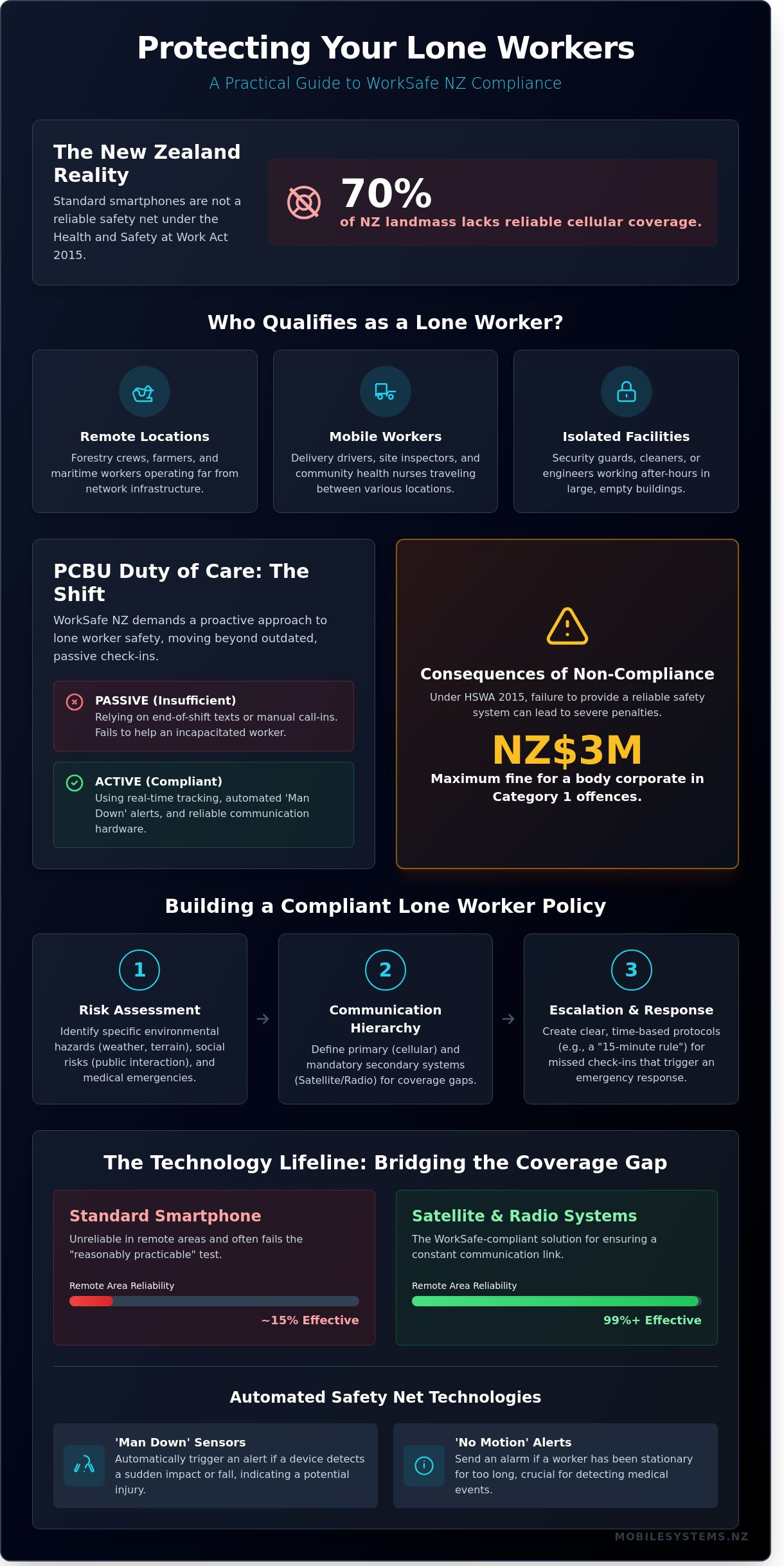
If one of your team members faced an emergency in a cellular dead zone in the Kaimai Ranges today, would your current worksafe nz lone worker policy actually trigger a rescue, or is it just a document gathering dust on a shelf? In New Zealand, roughly 70% of our landmass lacks reliable mobile coverage, which means relying on a standard smartphone for remote safety is a risk that often fails the "reasonably practicable" test under the Health and Safety at Work Act 2015.
It's common to feel frustrated by complex legal jargon while managing the reality of staff working in isolation. You want to ensure your people return home safely every night, but the fear of WorkSafe penalties after an incident can make the compliance process feel like a moving target for many Kiwi business owners.
This guide provides a clear roadmap to building a robust, WorkSafe-compliant lone worker policy that protects your team and meets New Zealand legal standards. We'll break down how to implement reliable communication hardware and structured safety protocols, giving you the peace of mind that comes from knowing your business is fully prepared for the unexpected.
Key Takeaways
- Understand your legal obligations under the HSWA 2015 and the critical role of the PCBU in managing safety for isolated staff.
- Learn how to structure a robust worksafe nz lone worker policy that addresses both environmental hazards and social risks specific to your industry.
- Discover why New Zealand’s unique terrain requires specialized communication tools, such as satellite or radio systems, over standard mobile phones.
- Explore how 'Man Down' and 'No Motion' sensor technologies provide an automated safety net for staff working in high-risk or remote areas.
- Identify the best practices for staff training and regular equipment testing to ensure your safety framework remains effective and compliant.
Understanding Your WorkSafe NZ Lone Worker Obligations
Under the Health and Safety at Work Act (HSWA) 2015, New Zealand businesses have a legal mandate to protect staff who work in isolation. A robust worksafe nz lone worker policy isn't just a compliance checkbox; it's a critical framework for managing the unique risks found in our local industries. When a worker is out of sight or sound of a colleague, the PCBU (Person Conducting a Business or Undertaking) must provide a system that ensures help is accessible during an emergency.
Who Qualifies as a Lone Worker in NZ?
In the New Zealand context, lone working isn't limited to remote wilderness. It applies to any situation where assistance isn't readily available. This includes:
- Staff in remote locations: Forestry crews in the Bay of Plenty, farmers in the Mackenzie Basin, or maritime workers on coastal vessels.
- Mobile workers: Site inspectors, delivery drivers, and community health nurses who travel between locations throughout the day.
- Isolated facility workers: Security guards, cleaners, or maintenance engineers working after 6:00 PM in large manufacturing plants or warehouses.
If your team members operate in environments where communication is limited or help is more than a few minutes away, they fall under these regulations. Identifying these roles is the first step in building an effective worksafe nz lone worker policy.
The PCBU Duty of Care
The PCBU holds the primary responsibility for worker safety. This duty requires you to eliminate risks where possible or minimize them using the "reasonably practicable" standard. In New Zealand's remote sectors, "reasonably practicable" is defined by the available technology and the severity of the risk. Relying on a standard mobile phone in an area with 15% cellular coverage is rarely considered sufficient by WorkSafe inspectors.
There's been a significant shift from passive safety to active monitoring. Passive systems, like a "check-in" text at the end of a shift, don't help a worker who's unconscious at midday. Active monitoring involves real-time location tracking, "man-down" sensors, and heartbeat signals that alert headquarters automatically if a worker stops moving. A tailored assessment often prevents costly mistakes when choosing between satellite, cellular, or radio-based hardware.
The legal consequences of failing to provide a reliable communication lifeline are severe. Under HSWA 2015, Category 1 offences for reckless conduct can result in fines of up to NZ$3 million for a body corporate. Even without an injury, WorkSafe can issue improvement notices if they find your communication systems are inadequate for the environment. Proactive investment in reliable hardware is always more cost-effective than legal defense and reparations. For expert guidance on hardware that meets these standards, you can contact our technical team for a consultation.
Essential Components of a Compliant Lone Worker Policy
A robust WorkSafe NZ lone worker policy must clearly define who is at risk. This includes anyone working out of sight or sound of colleagues, such as field technicians in the Waikato or late-night retail staff in Auckland. Identifying these roles allows you to tailor safety measures to specific environmental and social hazards.
Effective risk assessment goes beyond general site safety. You need to evaluate the likelihood of medical emergencies, vehicle accidents, or aggressive interactions with the public. For workers in remote New Zealand terrain, terrain-specific hazards like rapid weather changes or loss of cellular signal must be documented and mitigated.
The Communication Hierarchy
Reliable communication is the backbone of lone worker safety. Your policy should establish a primary method, usually cellular, and a secondary backup for when the main network fails. In rural areas or deep inside concrete structures, cellular coverage often drops to 0%.
For these "dead zones," your policy must mandate specialized equipment. High-powered Two-Way Radio Systems or satellite communicators ensure the worker is never truly isolated. Clear protocols should dictate when to switch devices to maintain a constant link to the base office.
Escalation and Response Plans
A missed check-in is a critical event. Many New Zealand firms adopt a "15-minute rule" where an overdue check-in immediately triggers a Tier 1 alert. If the worker isn't reached within a further 10 minutes, the protocol escalates to a Tier 2 emergency response.
- Tier 1: Internal contact attempts via all available channels including voice and text.
- Tier 2: Deployment of a nearby staff member or supervisor to the last known GPS location.
- Tier 3: Notification of emergency services or Search and Rescue (SAR) authorities.
Your policy must name the specific roles with the authority to initiate a search. This prevents hesitation during a crisis. Every incident, including "near misses" where a worker was briefly unreachable, must be documented for future WorkSafe reviews to demonstrate active compliance and continuous improvement.
Building a framework that meets these standards takes technical insight into local signal conditions. A tailored assessment of your team's specific working environments often prevents costly compliance gaps.
Risk Assessment: NZ Environmental and Technical Hazards
New Zealand's geography presents unique challenges that standard consumer technology cannot overcome. A robust worksafe nz lone worker policy must account for the fact that 75% of New Zealand's landmass sits 200 metres above sea level. This rugged terrain frequently blocks line-of-sight signals, making standard mobile phones unreliable for emergency response in backcountry or deep valley locations.
Environmental risks aren't limited to terrain. In the Southern Alps or high-country stations, temperatures can drop 10 degrees in under an hour. This causes rapid battery depletion in non-industrial devices, potentially leaving a worker stranded without a way to call for help. Technical risks like device durability are equally critical; a dropped phone in a coastal splash zone or a muddy paddock is often a total failure.
Social risks are a growing concern for lone workers in New Zealand. Those in high-stress environments or dealing with the public face potential physical threats. In these moments, a locked phone screen becomes a significant barrier to help. Reliable safety systems require one-touch activation that works even when the user is under extreme pressure or has limited mobility.
The Myth of 100% Cellular Coverage
Many managers assume that because a worker is in a "covered" area on a map, they're safe. This is a dangerous misconception. While 98.5% of the population lives in cellular areas, less than 50% of New Zealand's landmass has a reliable signal. Identifying cellular blackspots in your specific operational area is a mandatory step for compliance.
"Bars on the phone" don't always mean a reliable emergency link. A weak signal might allow a text to send but fail during a critical voice call or when transmitting GPS coordinates. For teams operating in these gaps, reviewing a Satellite Phones NZ Guide helps identify hardware that bypasses terrestrial limitations entirely.
Industry-Specific Hazard Profiles
Forestry workers deal with high-impact risks and steep, remote topography. In these zones, a device must be rugged enough to survive a 2-metre drop onto rock or immersion in water. Your worksafe nz lone worker policy should specify hardware that meets IP67 or MIL-STD-810G ratings to ensure it functions when an accident occurs.
Agricultural workers face different threats. Approximately 20% of farm fatalities involve vehicles or livestock. Isolation in this sector isn't just about distance; it's the inability to reach a device while pinned or injured. Hands-free triggers and "man-down" sensors are essential features for these environments to ensure an alert is sent even if the worker is unconscious.
Construction sites often suffer from urban isolation and extreme noise. Ambient noise levels frequently exceed 85 decibels, making standard phone ringtones impossible to hear. Safety protocols should mandate devices with high-volume speakers or vibrating alerts. This ensures that check-in pings and emergency broadcasts are acknowledged despite heavy machinery interference.
Bridging the Gap: From Policy to Practical Communication
A WorkSafe NZ lone worker policy remains a paper exercise until it's backed by reliable hardware. Selecting the right medium depends entirely on the environment where your staff operate. Cellular-based Push-to-Talk (PoC) works well in urban centers like Auckland or Christchurch, but it fails in the 25% of New Zealand's landmass that lacks mobile coverage.
For high-country stations or remote forestry blocks, satellite technology is the only viable option. These devices use the Iridium network to provide 100% global coverage, ensuring a distress signal reaches help even from the deepest valley. You can compare different options in our guide on Lone Worker Safety Devices NZ.
'Man Down' and 'No Motion' sensors provide a critical fallback when a worker is incapacitated. These sensors detect a 60-degree tilt or a total lack of movement for a pre-set duration, such as 120 seconds. If the worker doesn't cancel the local alert, the device automatically transmits an emergency signal to your monitoring base. This technology bridges the gap between a policy and an actual rescue when the worker can't physically call for help.
GPS tracking often raises privacy concerns among staff. It's essential to frame this as a safety tool under the Privacy Act 2020. Clear communication ensures workers understand that location data is primarily accessed during an emergency or a missed check-in. This transparency builds trust while maintaining strict compliance with your worksafe nz lone worker policy.
Choosing the Right Hardware for Your Policy
UHF and VHF radios are the standard for team-based isolation in forestry or civil construction. They provide instant communication without monthly cellular fees. For off-grid work where teams are separated by rugged terrain, Satellite Messengers like Garmin or Iridium offer the necessary reach. Explore these in our Portable GPS Solutions collection.
- UHF/VHF Radios: Best for line-of-sight communication within localized teams.
- Satellite Messengers: Essential for workers operating outside the 4G/5G footprint.
- PoC Devices: Ideal for urban workers who need the features of a radio with the range of a mobile network.
Implementing Automated Check-ins
Human error accounts for nearly 40% of false alarms or missed safety beats in manual check-in systems. Automated prompts remove this burden by asking "Are you okay?" at 30, 60, or 120-minute intervals. If the worker doesn't respond to the prompt, the system escalates the alert to a supervisor immediately. Integrating these handheld safety devices with Fleet Tracking Systems creates a unified safety net for both the vehicle and the individual.
A tailored assessment often prevents costly mistakes in hardware selection. Contact Mobile Systems to discuss a communication audit for your remote workers.
Implementing and Reviewing Your Safety Framework
A worksafe nz lone worker policy only provides protection if it's actively managed and integrated into daily operations. Transitioning from a written document to a functional safety culture requires consistent effort. You must ensure that every team member views their safety device as an essential tool, similar to high-vis gear or steel-toed boots.
Effective implementation relies on the hardware performing exactly as expected during a crisis. This means your policy must include strict protocols for equipment care and data review. When communication systems fail in remote New Zealand terrain, the consequences are often severe. Proactive management prevents these technical gaps from becoming safety liabilities.
Training Your Team for Success
Training shouldn't be a one-time event during induction. It needs to be a hands-on process where staff practice using their specific devices in realistic conditions. Conduct mock emergency drills twice a year to ensure workers can activate SOS features instinctively, even when under significant stress or in low-visibility environments.
Establish clear maintenance schedules for all safety hardware. This includes daily battery checks and monthly firmware updates to ensure GPS accuracy remains within required tolerances. A "safety first" culture means empowering workers to delay a job if their communication device isn't fully operational. Prioritising safety over "getting the job done" reduces the risk of unmonitored incidents in the field.
The Mobile Systems Advantage
Mobile Systems provides the technical backbone required to make your worksafe nz lone worker policy a reality. We don't offer generic solutions; we design custom systems specifically for New Zealand’s unique commercial sectors. Whether your team operates in dense forestry, isolated agricultural blocks, or urban utility sites, we ensure your connectivity remains unbreakable.
Our expertise covers the full spectrum of communication technology, from satellite-linked GPS units to robust two-way radio networks. We provide ongoing technical support and mobile servicing to keep your fleet in peak condition. This hands-on approach ensures your business stays compliant with Health and Safety at Work Act 2015 requirements while protecting your most valuable assets.
A tailored assessment often prevents costly mistakes in equipment selection and deployment. Our team evaluates your specific site challenges to recommend the most reliable hardware for your environment. Contact our expert team for a tailored safety assessment to secure your lone workers today.
Securing Your Remote Workforce for Long-Term Compliance
Compliance with the Health and Safety at Work Act 2015 isn't a one-off task. It's an ongoing commitment to your team's welfare in the field. A robust worksafe nz lone worker policy serves as your foundation, but the real protection comes from combining this policy with reliable communication hardware and regular risk assessments.
Mobile Systems provides the technical expertise to bridge the gap between paperwork and practical safety. As specialist UHF, VHF, and Satellite installers, we understand the challenges of New Zealand's varied terrain. Our team offers nationwide NZ support and mobile servicing to keep your fleet connected and compliant with HSWA 2015 standards.
Selecting the right technology prevents costly mistakes and ensures help is available when it's needed most. Request a tailored lone worker safety assessment from Mobile Systems to identify gaps in your current framework. Taking proactive steps today protects your most valuable assets and gives your remote staff the confidence to work safely anywhere in the country.
Frequently Asked Questions
Does WorkSafe NZ require a written lone worker policy?
Yes, while the Health and Safety at Work Act 2014 doesn't explicitly name a specific document, it requires PCBUs to manage risks to health and safety. A documented worksafe nz lone worker policy is the most effective way to prove you've identified risks and implemented controls to protect your staff.
Without a written policy, businesses struggle to demonstrate compliance during a WorkSafe audit or investigation. It ensures every team member understands their safety obligations and the specific emergency procedures they must follow while working alone.
Is a mobile phone considered a sufficient safety device for lone workers?
A standard mobile phone is rarely sufficient for high-risk or remote roles because it relies on cellular coverage and manual operation. In many parts of rural New Zealand, coverage gaps prevent calls or data transmission when an emergency occurs.
Professional safety devices offer dedicated SOS buttons and satellite connectivity. These tools ensure a worker can call for help even if they're out of range or unable to unlock a phone screen during a crisis.
What are the penalties for non-compliance with lone worker regulations?
Under the Health and Safety at Work Act 2014, penalties for non-compliance are severe to encourage strict adherence. Corporations can face fines of up to NZ$3,000,000 for serious breaches that put workers at risk of injury or death.
Individual business owners or officers can be fined up to NZ$600,000 and face up to five years in prison for reckless conduct. These financial and legal consequences highlight why robust safety systems are a critical investment for any New Zealand business.
How often should lone workers check in with their base?
Check-in frequency depends on the specific risk level of the task, ranging from every 30 minutes to every four hours. High-risk activities like working with livestock or heavy machinery require more frequent contact than low-risk office-based tasks.
Your policy should clearly define these intervals based on a thorough risk assessment. Using automated check-in systems reduces the administrative burden on staff and ensures no one forgets to confirm their safety.
What is a 'Man Down' alarm and how does it work?
A 'Man Down' alarm is an automated sensor that detects falls, impacts, or a lack of movement using internal accelerometers. If the device remains horizontal or stationary for a set period, such as 60 seconds, it triggers a local warning.
If the worker doesn't cancel the warning, the device automatically sends an emergency alert with GPS coordinates to a monitoring station or supervisor. This technology is vital for situations where a worker is unconscious and cannot manually call for help.
Can GPS tracking be used for lone worker safety without breaching privacy?
Yes, GPS tracking is legal for safety purposes provided you comply with the Privacy Act 2020. You must inform employees about what data is collected, why it's needed, and how it's stored securely.
Transparency is the key to maintaining trust. Most workers accept tracking when they understand it's a tool to ensure help arrives quickly if they're injured or missing during work hours.
What should I do if a lone worker misses a scheduled check-in?
You must follow a pre-defined escalation plan immediately to ensure the worker's safety isn't compromised. Start by attempting contact via phone or radio, then check their last known GPS location using your monitoring software.
If contact isn't established within a specific timeframe, such as 15 minutes, you should dispatch a colleague or emergency services to their location. Having a clear, written response plan prevents panic and saves precious time during a real emergency.
Does my lone worker policy need to be reviewed annually?
Yes, an annual review of your worksafe nz lone worker policy is a best practice to ensure it remains effective. You should also update the policy whenever you introduce new equipment, change work locations, or hire new staff members.
Regular audits help identify gaps in your current system and allow you to integrate new safety technologies. Mobile Systems Limited can assist with these assessments to ensure your hardware and protocols meet current New Zealand standards.
Related posts

- May 28, 2026
In 2024, New Zealand recorded 70 work-related fatalities, a statistic that underscores the critical importance of protecting staff in isolated...

- May 25, 2026
In a 2025 survey of the New Zealand road freight industry, 62% of respondents cited rising business costs and economic...

- May 17, 2026
Relying on a standard radio in a Zone 0 environment is a critical safety breach that can lead to catastrophic...