
Satellite Internet for Remote Areas NZ: The 2026 Professional Guide
For a business operating in the Southern Alps or the King Country, a standard consumer satellite dish isn't a connectivity strategy; it's a single point of failure. You likely already realize that relying on residential services will not cut it.
For a business operating in the Southern Alps or the King Country, a standard consumer satellite dish isn't a connectivity strategy; it's a single point of failure. You likely already realize that relying on residential-grade hardware often leads to dropped VOIP calls and sync errors in your cloud applications. Securing reliable satellite internet for remote areas nz in 2026 demands a shift from retail convenience to professional-grade resilience.
We understand the frustration of losing a connection during a critical safety check or an expensive operational window. This guide delivers a technical blueprint for choosing and installing hardware that maintains a 99.9% uptime target even in New Zealand's most volatile weather conditions.
You'll learn how to distinguish between high-latency legacy systems and modern low-earth orbit arrays. We also detail the specific mounting protocols and network configurations that Mobile Systems Limited uses to ensure your remote site stays connected to the global head office.
Key Takeaways
- Understand the critical technical differences between LEO and GEO technologies and how latency impacts essential business tools like VOIP and video conferencing.
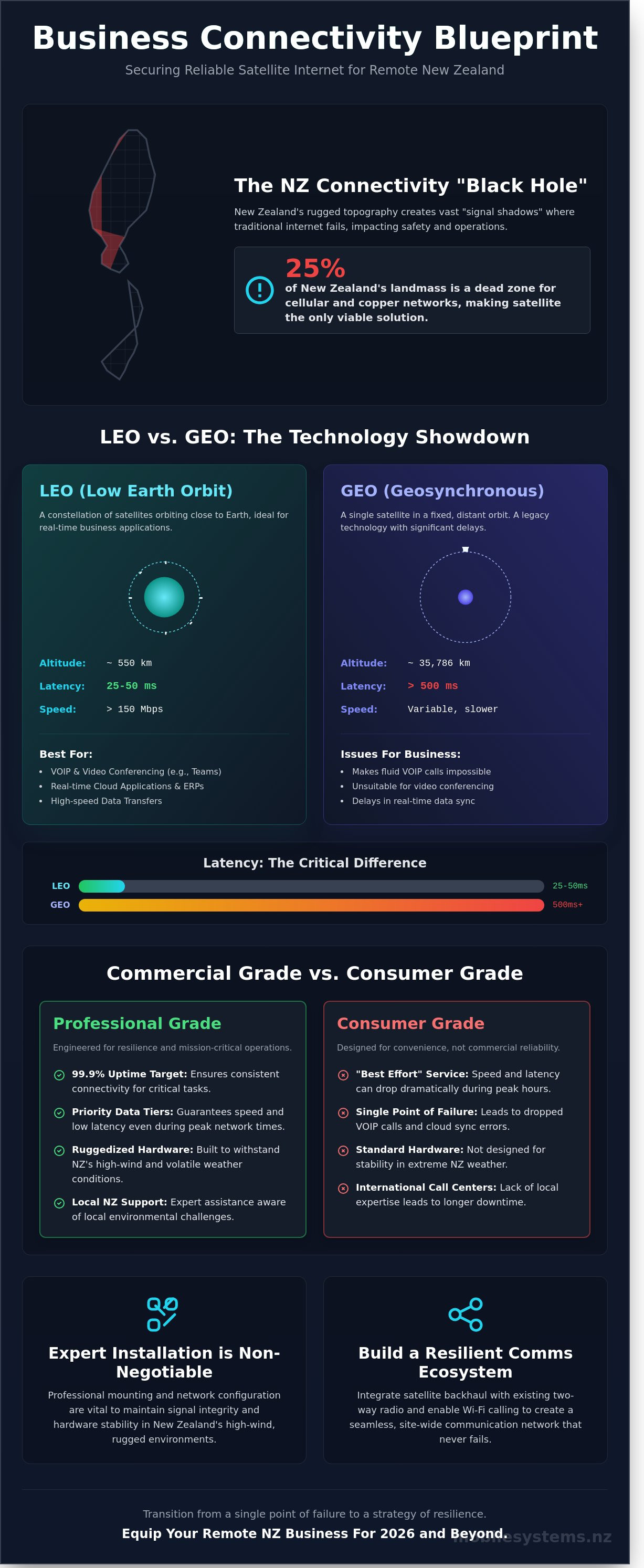
- Discover why satellite internet for remote areas nz is the most reliable connectivity solution for the 25% of New Zealand’s landmass where cellular and copper networks fail.
- Learn why professional mounting and installation are vital for maintaining hardware stability and signal integrity in New Zealand’s high-wind, rugged environments.
- Explore how to integrate satellite backhaul with existing two-way radio systems and Wi-Fi calling to create a resilient, site-wide communication ecosystem.
- Gain practical insights into comparing providers like Starlink Business and Gravity Internet to select a plan that aligns with your specific commercial requirements.
New Zealand's geography is notoriously difficult for traditional telecommunications. While 5G expands in urban centers like Auckland and Christchurch, approximately 25% of the New Zealand landmass remains a "dead zone" for copper and cellular networks. For businesses operating in these regions, understanding satellite internet technology is no longer optional. The landscape has shifted from slow, high-latency Geostationary (GEO) satellites to Low Earth Orbit (LEO) constellations. These LEO systems provide the low-latency speeds required for modern business operations.
To better understand this concept, watch this helpful video:
The shift toward "always-on" connectivity is driven by more than just convenience. Under the Health and Safety at Work Act 2015, New Zealand employers have a legal obligation to ensure the safety of staff in isolated locations. Relying on "emergency-only" devices like PLBs is often insufficient for proactive risk management. High-speed satellite internet for remote areas nz allows for real-time tracking, video check-ins, and instant access to digital safety protocols. This transition ensures that a remote station in the Mackenzie Basin has the same digital safety net as an office in Wellington.
The Remote Connectivity Landscape in New Zealand for 2026
The "Black Hole" Problem: Why NZ Topography Challenges Internet
New Zealand's dramatic terrain creates significant "signal shadows." The Southern Alps and dense native bush blocks in regions like the West Coast effectively block line-of-sight signals from terrestrial towers. Cellular boosters are a popular choice, yet they require an existing base station signal to amplify. If your site is nestled in a deep valley, a booster has nothing to work with. Satellite technology bypasses these physical barriers by communicating directly with overhead constellations. It's the only viable path for achieving 100% coverage across a rugged 268,021 square kilometer territory.
Commercial vs. Consumer Needs in Remote Areas
Modern farm and site management software, such as cloud-based ERPs or real-time stock tracking, requires consistent latency below 50ms. Standard consumer satellite plans often operate on a "best-effort" basis. This means speeds can drop during peak usage times, which disrupts critical business data transfers. Professional-grade hardware and priority data tiers are essential for commercial operations.
Relying on international call centers for troubleshooting leads to unnecessary downtime. Choosing a partner with local New Zealand technical support ensures that remote sites receive expert assistance tailored to the specific environmental conditions of the region. A tailored assessment often prevents costly mistakes. For more information on professional setups, you can contact our team directly.
LEO vs. GEO: Choosing the Right Satellite Technology for Business
Selecting the right architecture for satellite internet for remote areas nz depends on your specific operational requirements. The primary distinction lies in the orbital distance of the satellites. Low Earth Orbit (LEO) constellations sit approximately 550km above the Earth, while Geosynchronous (GEO) satellites maintain a fixed position at 35,786km.
This distance directly dictates latency. LEO systems typically deliver a ping of 25ms to 50ms, which is essential for real-time applications like Microsoft Teams or VOIP. GEO systems suffer from a minimum 500ms delay due to the speed of light, making fluid two-way conversation difficult. When evaluating LEO vs. GEO satellite technology, businesses must weigh this responsiveness against the long-term stability of a fixed-point signal.
The Starlink Revolution (LEO)
Starlink has transformed the landscape by offering speeds often exceeding 150Mbps in rural New Zealand. It's an excellent choice for rapid deployment and high-bandwidth tasks. LEO benefits include:
- Low latency for video conferencing and VOIP.
- Simplified self-installation for mobile teams.
- High download speeds for cloud-based applications.
However, performance can fluctuate. In 2024, some high-density NZ cells experienced peak-hour slowdowns as more users joined the network. The hardware is designed for ease of use but lacks the ruggedization of industrial equipment. For a deeper look at the technical specifications, read our Starlink guide.
Professional VSAT and GEO Solutions
Geosynchronous satellites remain a cornerstone of satellite internet for remote areas nz when dedicated bandwidth is required. Unlike LEO, which requires a handoff between moving satellites every few minutes, GEO dishes point at a single, stationary target. GEO solutions are preferred for:
- Dedicated bandwidth (CIR) for critical telemetry.
- Fixed-point stability for long-term remote base camps.
- High-availability emergency communication hubs.
Weather resilience is a major factor in New Zealand. Heavy rain on the West Coast or in Fiordland can cause "rain fade" in higher frequency bands like Ka-band. During events like Cyclone Gabrielle in 2023, the importance of weather-resilient hardware became clear. Professional VSAT installations often use Ku-band or larger 1.2m reflectors to maintain a 99.9% uptime SLA, even in extreme precipitation.
Strategic decisions should prioritize speed for general office work, but prioritize uptime for critical safety systems. A tailored assessment often prevents costly mistakes when matching technology to your specific terrain and rain profile.
Evaluating Top Satellite Internet Providers in NZ
Choosing the right provider for satellite internet for remote areas nz involves more than comparing download speeds. In 2026, the market is split between high-capacity LEO (Low Earth Orbit) constellations and established local providers who offer specialized terrestrial support. Selecting the wrong tier can lead to significant downtime during peak operational hours.
Starlink Business remains the primary choice for high-bandwidth needs, offering speeds between 40 Mbps and 220 Mbps. For commercial users, the priority data feature ensures that business traffic isn't throttled during peak evening hours when residential usage spikes. Spark Business Satellite provides a different advantage by integrating satellite backhaul into existing corporate SD-WAN networks, allowing for seamless failover between fiber and space-based links.
Local expertise often outweighs raw speed for agricultural and infrastructure sectors. Farmside has operated in the New Zealand rural sector for over 20 years, providing bundled services that combine voice and data. Gravity Internet focuses on flexible plan structures, often used by civil engineering firms that require temporary, high-capacity links for remote project sites without long-term contract lock-ins.
Starlink Business vs. Residential Plans
Many businesses mistakenly deploy residential kits to save on capital expenditure. A standard residential kit costs approximately NZ$599, while the High-Performance Business kit is priced near NZ$4,260. This price gap reflects the hardware's ability to maintain a connection in temperatures exceeding 50°C and its 35 percent wider field of view, which reduces outages caused by minor obstructions.
- Priority Access: Business users receive public routable IP addresses and priority data, ensuring critical ERP and CCTV traffic moves first.
- Ruggedization: The flat high-performance dish is designed for permanent fixed installation and handles extreme NZ alpine weather better than the standard plastic actuators.
- Support SLAs: Business accounts include 24/7 prioritized support, whereas residential users often wait days for ticket responses.
The Role of Local NZ Providers
Local providers like Inspire Net and RBNZ (Radio Beam NZ) solve the "last mile" support gap. When a remote site goes dark at 2:00 AM, a local 0800 number connects you to a technician in New Zealand who understands local geography and weather patterns. These providers often use data shaping to ensure VoIP calls remain clear even when large files are being uploaded to the cloud.
For organizations managing multiple sites, a tailored assessment often prevents costly mistakes in hardware selection. Local providers can often facilitate custom routing and private network tunnels that standard retail satellite internet for remote areas nz cannot support. This level of customization is essential for utility providers and regional councils that must comply with strict data security regulations.
Hardware and Installation: Ensuring Reliability in Rugged Terrain
Deploying satellite internet for remote areas nz requires more than just unboxing a retail kit. In New Zealand's varied topography, the hardware is often the first point of failure if not installed with local conditions in mind. Standard mounts provided in consumer packages aren't designed for the extreme weather common in our rural backcountry.
DIY installations frequently fail during high-wind events. Regions like the Canterbury Plains or the Cook Strait experience gusts exceeding 120km/h. A standard residential mount isn't rated for these loads. Professional mounting ensures the dish remains static; even a three-millimetre shift can cause significant packet loss or complete signal drop-outs. Technical teams use torque-tested brackets and reinforced stays to maintain sub-millimetre alignment during gale-force winds.
Power considerations are equally vital for off-grid sites. Most enterprise satellite terminals draw between 50W and 100W continuously. If you're running on solar, your battery bank must account for New Zealand's winter light levels to prevent system shutdowns at 3:00 AM. Key infrastructure requirements include:
- Battery capacity calculated for 72 hours of autonomy.
- UV-rated conduit to protect cabling from high New Zealand UV indices.
- Rodent-proofing for rural sub-floor entries to prevent cable damage.
Mounting Solutions for Forestry and Construction
Mobile operations in forestry or civil engineering face unique challenges. Custom vehicle mounts are essential for crews moving between sites. Temporary masts must be weighted correctly to prevent swaying. Vibration is a silent killer of connectivity; constant movement in heavy machinery can loosen connectors and misalign phased-array sensors. Many firms now opt for hybrid setups, integrating cellular devices to maintain a heartbeat connection when the primary satellite link is obstructed by dense canopy or terrain.
Protecting Your Infrastructure
Environmental factors in New Zealand are harsh. Protecting your investment in satellite internet for remote areas nz means planning for the Southern Alps' snow-load. Heavy snow can physically bend mounting arms or block the signal if the dish's internal heater isn't configured for peak performance. Coastal sites face salt-spray corrosion, which degrades copper connections within months. Using industrial-grade shielded cabling and weather-sealed connectors is the only way to ensure long-term uptime. High-quality components prevent moisture ingress that leads to short circuits in expensive outdoor units.
A tailored assessment often prevents costly hardware replacements and unnecessary downtime. Request a professional site assessment to ensure your hardware survives the New Zealand elements.
Integrating Satellite into a Full Communication Ecosystem
Satellite connectivity is a transformative tool, but it doesn't solve every operational challenge in isolation. High-performance satellite internet for remote areas nz serves best as the backbone of a broader strategy. While it provides high-speed data, it's not a direct replacement for two-way radios. Radios offer instantaneous, one-to-touch communication that doesn't rely on external infrastructure or satellite alignment, making them essential for site-wide safety and coordination.
Modern remote sites use satellite as a high-capacity backhaul for Wi-Fi calling and Voice over IP (VOIP) systems. This setup allows your team to use standard smartphones for voice calls in areas with zero cellular coverage. By adopting a "Hybrid Approach," businesses combine the data throughput of satellite with the localized reliability of radio and the precision of GPS tracking. This creates a safety net where every team member is reachable and visible on a map, regardless of the terrain.
A tailored assessment often prevents costly connectivity gaps. Without a professional audit, businesses frequently find that their satellite internet for remote areas nz setup works well for email but fails to support real-time safety requirements during peak usage or heavy weather events.
Satellite as a Redundancy Layer
Relying on a single connection point is a significant risk for New Zealand businesses operating in isolated regions. We design systems that include automatic failover. If your primary cellular link drops due to weather or hardware failure, the system instantly switches to satellite. This ensures critical safety communications remain active 24/7. For those requiring handheld mobility beyond the Wi-Fi footprint, our satellite phone guide details how to integrate portable voice units into your emergency protocols.
The Mobile Systems Advantage
Mobile Systems Limited takes a "whole-of-site" approach to communication design. We don't just sell hardware; we engineer ecosystems that withstand the unique environmental pressures of the New Zealand backcountry. Our team provides on-site support and maintenance via our specialized mobile service vehicles, ensuring your gear stays operational in the field. This hands-on support is vital for keeping remote teams connected when local conditions turn challenging.
Building a reliable network requires more than just an out-of-the-box solution. It demands an understanding of how different technologies interact in the New Zealand landscape. Contact our expert team for a custom remote comms audit to ensure your site is fully protected and connected.
Future-Proofing Your Remote Operations
Selecting the right satellite internet for remote areas nz in 2026 involves more than just picking a provider. It requires a strategic balance between LEO speed and the proven reliability of GEO systems within a wider communication ecosystem. Businesses must prioritize hardware that's built for New Zealand's unique topographical challenges to avoid avoidable downtime.
Mobile Systems Limited leverages over 25 years of NZ communication expertise to help you navigate these technical decisions. As authorized dealers for leading brands, we don't just supply equipment; we ensure it's integrated correctly for your specific site requirements. Our fleet of mobile service vehicles provides the on-site support necessary for long-term operational success in even the most isolated regions.
A professional evaluation helps identify potential signal obstructions and hardware needs before you invest. We're here to ensure your remote connectivity remains robust and scalable for years to come. Request a tailored remote communication assessment from our experts to secure your digital infrastructure. It's the most effective way to guarantee your team stays connected when it matters most.
Frequently Asked Questions
Is satellite internet fast enough for Zoom or Teams calls in remote NZ?
Yes, modern Low Earth Orbit (LEO) satellite systems provide the low latency required for stable video conferencing. You'll typically see latency figures between 25ms and 50ms, which is well within the 150ms limit recommended by platforms like Zoom. This technology avoids the frustrating delays found in older satellite systems that made real-time conversation nearly impossible.
For a high-definition video call, you need approximately 3.8 Mbps of upload bandwidth. Modern satellite services in New Zealand consistently deliver upload speeds between 10 Mbps and 30 Mbps. This overhead ensures your call remains clear even if other devices on your network are active at the same time.
What happens to satellite internet during heavy rain or snow?
Heavy precipitation can cause signal attenuation, a phenomenon often called rain fade. While modern phased-array antennas automatically increase power to overcome interference, an extreme downpour exceeding 30mm per hour might cause a 15% to 25% drop in total throughput. It's rare for a connection to drop entirely during standard New Zealand winter weather.
Snow is managed through internal heating elements within the dish hardware. These sensors detect freezing temperatures and melt snow on contact to prevent signal blockage. In alpine regions or the South Island high country, ensuring your dish is mounted away from roof snow-shedding zones is a critical step during installation.
Can I install a satellite internet dish myself on a remote site?
While DIY kits are available, professional installation is recommended for remote business sites to ensure long-term reliability. Professional installers use specialized alignment tools to find the clearest field of view, avoiding even minor obstructions that cause micro-dropouts. We also ensure mounts meet NZS 3604 structural standards to withstand high wind zones.
Self-installed units often suffer from poor cable management or inadequate weatherproofing at entry points. A professional installation includes marine-grade sealants and shielded cabling to protect your hardware from NZ’s high UV levels and salt spray. This level of precision prevents costly hardware failures and service interruptions in isolated areas.
How much does professional satellite internet cost per month in NZ?
Monthly service fees for satellite internet for remote areas nz depend on your required data priority. Standard residential plans currently cost NZ$159 per month, while business-grade plans with public IP addresses start at approximately NZ$426. These business tiers provide priority data, ensuring your speeds remain high during peak usage windows.
You must also factor in the one-time hardware investment. A standard kit costs roughly NZ$599, while high-performance hardware for business or maritime use can reach NZ$4,200. Investing in the higher-spec hardware is often necessary for businesses that cannot afford downtime or those operating in extreme environments.
Is Starlink better than traditional rural broadband providers?
Starlink generally outperforms traditional ADSL or fixed wireless connections in deep rural areas where tower distance is an issue. Most users see download speeds between 100 Mbps and 200 Mbps, which is significantly higher than the 10 Mbps to 20 Mbps typical of aging copper lines. It's a transformative jump in performance for remote Kiwi businesses.
Traditional providers might still be preferable if you're within 5km of a local wireless tower with a clear line of sight. Local WISPs often provide personalized technical support that global satellite companies can't match. However, for those in "black spots" or rugged terrain, satellite is the most reliable high-speed option available in 2026.
Can I use satellite internet for my vehicle while it is moving?
You can use satellite internet while moving if you utilize specific high-performance hardware designed for motion. Standard residential dishes are restricted to stationary use and won't maintain a link while traveling. The Flat High Performance dish is the only model officially supported for in-motion use on NZ roads or coastal waters.
Using this hardware requires a "Mobile Priority" data plan. This plan allows the dish to track satellites while the vehicle changes orientation at speeds up to 100 km/h. It's an essential setup for emergency response vehicles, mobile clinics, or luxury tourism transport operating in areas with zero cellular coverage.
Do I need a special router for satellite internet in a business environment?
Yes, the basic router included in most kits lacks the advanced features required for a professional environment. It doesn't support complex VLAN configurations, robust firewalls, or multi-WAN failover. For business operations, we recommend using an enterprise-grade router like a Peplink or Ubiquiti system to manage your traffic.
A dedicated business router allows you to integrate the satellite feed with other connections, such as a secondary 4G or 5G link. This creates a redundant system where your internet stays online even if one service fails. It also provides better Wi-Fi coverage across large workshops or multi-building remote sites.
What is the difference between latency and speed for satellite users?
Speed refers to how much data you can download per second, while latency is the time it takes for a single packet to travel to the server and back. When using satellite internet for remote areas nz, low latency is what makes the web feel fast. High speed is great for downloading large files, but high latency causes lag.
Older satellites orbited at 35,000km, creating a 600ms delay that made web browsing feel sluggish. Modern LEO satellites orbit at roughly 550km, reducing that delay to under 40ms. This shift means that modern satellite users can now use "snappy" applications like remote desktop, online gaming, and cloud-based accounting software without delay.
Related posts

- May 04, 2026
Research from Frost & Sullivan indicates that fleet tracking technology provides an average 300% return on investment for businesses. You...

- April 26, 2026
According to the 2023 Kantar Workplace Wellbeing Survey, 1 in 5 New Zealanders report feeling lonely or isolated at work,...