
GPS Tracking and Health and Safety: A Comprehensive Guide for NZ Businesses (2026)
Imagine a lone worker in a remote part of the Kaimai Ranges who hasn't checked in for four hours while operating in a known cellular black spot. For many New Zealand business owners, this isn't a hypothetical fear.
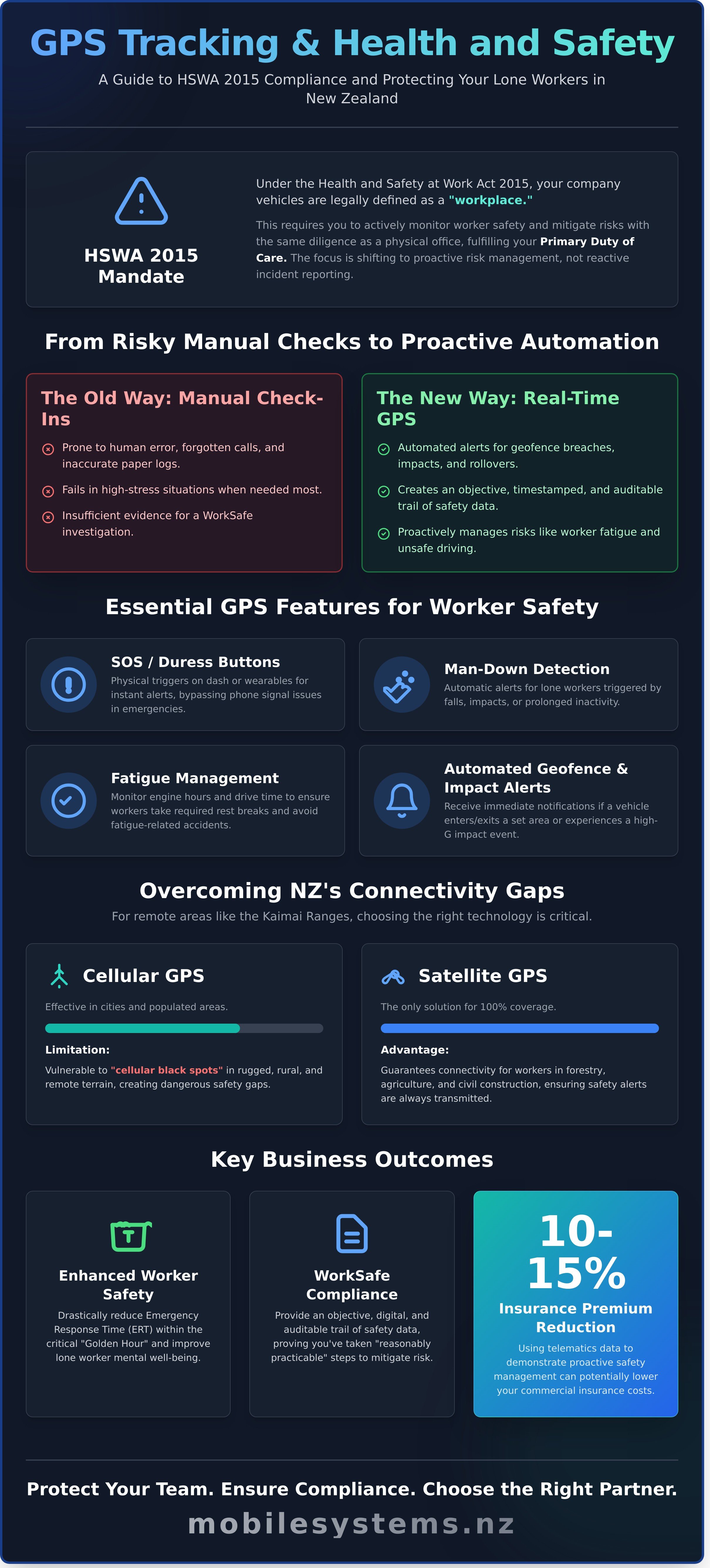
Imagine a lone worker in a remote part of the Kaimai Ranges who hasn't checked in for four hours while operating in a known cellular black spot. For many New Zealand business owners, this isn't a hypothetical fear but a daily operational risk. Integrating GPS tracking and health and safety systems is no longer just about monitoring locations; it's about meeting your primary duty of care under the Health and Safety at Work Act 2015.
You likely agree that manual check-in procedures are prone to human error and often fail when they're needed most. Relying on a "she'll be right" attitude isn't a strategy that satisfies WorkSafe inspectors or protects your team from fatigue and avoidable accidents.
This guide shows you how to build a robust safety framework that provides real-time visibility, even in areas without mobile coverage. You'll learn how to automate maintenance schedules and use telematics data to potentially lower your commercial insurance premiums by 10% to 15%.
We will examine the specific hardware requirements for NZ conditions, explain how to manage driver privacy, and outline the steps to achieve total compliance before your next audit.
Key Takeaways
- Understand your legal obligations under the HSWA 2015, including why New Zealand law classifies company vehicles as workplaces that require active monitoring.
- Identify essential safety features such as SOS duress buttons and Man-Down detection to protect workers in high-risk or isolated environments.
- Learn how to bridge connectivity gaps in New Zealand’s rugged terrain by choosing between cellular and satellite-based communication systems.
- Discover a practical framework for integrating GPS tracking and health and safety into your corporate policy while addressing employee privacy concerns.
- Evaluate the importance of local technical support and professional installation to ensure your safety equipment remains compliant and operational.
Understanding the Role of GPS Tracking in NZ Health and Safety Compliance
The Health and Safety at Work Act (HSWA) 2015 redefined how New Zealand businesses approach risk. Under this legislation, the relationship between GPS tracking and health and safety has evolved from an optional extra to a core compliance requirement. For a Person Conducting a Business or Undertaking (PCBU), the primary duty of care involves ensuring that workers are not exposed to health and safety risks while on the job.
Section 20 of the HSWA 2015 clarifies that a "workplace" includes any place where work is being carried out, specifically including vehicles. Whether your team is driving a delivery van in Auckland or a utility vehicle in the Southern Alps, that vehicle is legally a workplace. This mandate requires managers to monitor conditions and worker safety with the same rigour they would apply to a physical office or factory floor.
Understanding How GPS Tracking Technology Works allows businesses to create an auditable trail of safety data. In the event of a WorkSafe investigation, paper logs are often insufficient. Digital records provide timestamped, objective evidence of vehicle speeds, rest breaks, and location history. This data proves that a business has taken proactive steps to mitigate known risks.
The Legal Framework: HSWA and Your Obligations
The HSWA 2015 requires PCBUs to eliminate risks so far as is "reasonably practicable." If elimination isn't possible, risks must be minimised. For fleet operators, this means monitoring worker fatigue and vehicle behaviour in real time. By 2026, New Zealand regulatory bodies expect a total shift from reactive incident reporting to proactive risk management. You can't wait for an accident to happen before you look at the data.
- Reasonably Practicable Steps: In remote areas with limited cellular coverage, satellite-integrated GPS is often the only way to meet this legal threshold.
- Monitoring Health: GPS systems can track engine hours and drive time, ensuring workers don't exceed safe limits that lead to fatigue.
- Worker Participation: The law encourages involving workers in safety decisions. Sharing GPS data with drivers helps them self-correct and engage with safety protocols.
Why Real-Time Data is Essential for Risk Mitigation
Traditional check-in logs rely on human memory and manual entry, which often fail during high-stress situations. Real-time GPS tracking replaces these manual systems with automated alerts. If a vehicle leaves a designated geofence or experiences a high-impact event, the system notifies management immediately. This automation removes the burden of reporting from the driver during an emergency.
In rural New Zealand, the "Golden Hour" is a critical concept in trauma care. Reducing Emergency Response Time (ERT) by even 15 minutes can be the difference between a minor injury and a fatality. GPS tracking provides exact coordinates to emergency services, bypassing the confusion of vague landmarks or poor mobile reception. This is vital for sectors like forestry, agriculture, and civil construction where workers are often isolated.
The psychological impact on lone workers is equally significant. Knowing that a "man-down" sensor or an SOS button is active provides a sense of security that improves mental well-being. When a business invests in high-quality tracking hardware, it sends a clear message: the safety of the person is more valuable than the efficiency of the route. This trust is a cornerstone of a healthy workplace culture.
To effectively integrate these essential systems into your existing fleet, expert guidance is invaluable. A tailored assessment can prevent costly mistakes and ensure your business meets every WorkSafe requirement. Contact our team today to discuss your specific compliance needs and discover how we can help.
Key GPS Tracking Features for Enhancing Workplace Safety
Modern GPS tracking and health and safety protocols are no longer separate business functions. They operate as a unified system that provides real-time visibility into high-risk environments. In New Zealand, where terrain and weather change rapidly, these features are essential for meeting the standards set by the Health and Safety at Work Act 2015.
The most immediate safety feature is the SOS or Duress button. These physical triggers, located on vehicle dashes or wearable units, allow workers to signal for help in seconds. This bypasses the need to unlock a mobile phone or search for a signal in remote areas. When a worker presses the button, an instant alert reaches the dispatch team with precise GPS coordinates, enabling an immediate emergency response.
Man-Down and No-Motion detection features provide a critical safety net for solo operators. These devices use internal accelerometers to detect sudden vertical drops or a total lack of movement for a pre-set period. If a worker is incapacitated after a fall, the device emits a local audible alarm before automatically sending an emergency signal to headquarters. This ensures help is dispatched even if the worker is unconscious.
Geofencing allows managers to draw digital perimeters around hazardous or restricted zones. You can mark high-voltage areas, unstable cliffs, or chemical storage sites on a digital map. If a tracked vehicle or person crosses these boundaries, the system triggers an instant notification. This proactive approach prevents accidents before they occur by keeping staff away from known dangers.
In-Vehicle Monitoring Systems (IVMS) track driver behaviour by recording speed, harsh braking, and rapid acceleration. When Implementing GPS Tracking into Your Health and Safety Policy, many New Zealand firms see a 25% to 30% reduction in high-risk driving events within the first six months. This data allows for targeted training and fosters a culture of accountability on the road.
The installation of these sophisticated systems is crucial for their reliability, a principle that applies to all in-vehicle electronics, including security and audio. For a look at how specialists handle nationwide mobile installations in the UK, you can visit Safe & Sound Mobile.
Personal Safety Devices for Lone Workers
Wearable GPS units are indispensable in New Zealand’s forestry and agriculture sectors. These rugged devices function in deep bush or high-country stations where standard cellular coverage often fails. They provide a lifeline for staff who spend their days kilometres away from the nearest colleague.
Two-way messaging via satellite-enabled GPS units facilitates regular safety check-ins. Workers can send pre-set "I'm safe" messages at scheduled intervals, which the system logs automatically. Investing in high-quality portable communications ensures that field staff are never truly alone, regardless of their location.
Vehicle-Based Safety and Behaviour Monitoring
Tracking driver behaviour directly reduces the risk of serious road accidents. Impact sensors play a vital role here; they detect the specific G-force of a collision and automatically alert dispatch to the exact crash site. This automation removes the reliance on a potentially injured driver to call for help.
Maintenance scheduling is another often overlooked safety benefit. The system tracks engine hours and mileage to ensure every fleet vehicle remains in safe operating condition. This prevents mechanical failures, such as brake degradation or tyre blowouts, that could lead to workplace injuries. A tailored assessment often prevents costly mistakes and ensures your fleet meets all NZ compliance standards. Contact the expert team at Mobile Systems Limited to discuss your specific safety requirements.
Overcoming Connectivity Gaps: Satellite vs. Cellular GPS Solutions
New Zealand's rugged topography presents a unique challenge for fleet managers. While cellular networks cover 95% of the population, they only reach about 50% of the country's actual landmass. This massive gap leaves workers in remote areas vulnerable when GPS tracking and health and safety systems rely solely on terrestrial towers. Satellite GPS provides a critical safety net by offering 100% geographic coverage, ensuring that a vehicle's position is visible to dispatchers even in deep valleys or dense bush.
Choosing the right hardware requires a clear understanding of the practical trade-offs involved in each technology:
- Cellular Units: These devices are cost-effective, with hardware often priced below NZ$350 and monthly data plans around NZ$20 to NZ$35. They provide near-instant updates, which is vital for real-time traffic navigation in urban centres.
- Satellite Units: These involve a higher investment, with hardware reaching NZ$750 to NZ$1,200 and monthly airtime fees often exceeding NZ$50. However, the reliability they offer in "black spots" is non-negotiable for high-risk remote work.
- Hybrid Systems: These represent the gold standard for New Zealand fleets. They prioritize cellular networks to keep operational costs low but failover to the satellite network the moment a signal is lost.
Hybrid systems ensure that GPS tracking and health and safety data remains continuous, regardless of where the driver travels. This transition happens automatically, removing the need for manual intervention from the driver. A tailored assessment often prevents costly mistakes when selecting between these hardware tiers, especially for fleets that frequently move between city limits and rural back blocks.
When to Choose Cellular-Based Trackers
Urban transport, couriers, and local trades typically find cellular-based trackers sufficient for their daily operations. These industries operate within well-serviced areas like Hamilton, Wellington, or Dunedin where signal dropouts are rare. You can explore a range of cellular devices designed for urban fleet management. These units deliver high-frequency data pings, allowing managers to monitor idling times, harsh braking, and precise arrival windows with minute-by-minute accuracy.
The Necessity of Satellite for Remote NZ Operations
Remote operations in NZ forestry, mining, or conservation demand satellite-grade reliability. The Iridium satellite network is the preferred choice here because its 66 low-earth orbit satellites provide true pole-to-pole coverage. When a driver triggers a duress button in a remote valley, the signal bypasses local infrastructure to reach emergency responders via the orbital network. This level of protection is a key recommendation in the NZ guide to GPS tracking for worker safety, which outlines how businesses can meet their legal obligations under the Health and Safety at Work Act 2015. Satellite units must have an unobstructed view of the sky to maintain a consistent connection with the orbital network.
Latency is another factor to consider with satellite communication. While cellular pings take milliseconds, satellite pings can take between 2 and 5 minutes depending on the selected plan and satellite positioning. This delay is acceptable for safety monitoring and check-ins, but it requires managers to adjust their expectations for real-time tracking. In the context of New Zealand's strict safety regulations, the priority isn't just speed; it's the absolute certainty that an SOS signal will get through when it matters most.
How to Implement GPS Tracking into Your Health and Safety Policy
Implementing GPS tracking and health and safety protocols requires more than just installing a black box under a dashboard. It's a cultural shift that demands clear communication and structured rollout. In New Zealand, the Health and Safety at Work Act 2015 requires businesses to consult with workers on matters that affect them. Skipping this step often leads to resentment and "Big Brother" accusations that can undermine the safety benefits of the technology.
Start with a transparent framework. Explain that the primary goal is driver protection, not micro-management. When drivers understand that the system provides evidence in the event of a non-fault accident or triggers an immediate response during a medical emergency, buy-in increases significantly. Use a phased approach: consult, draft the policy, run a pilot program with a small group of senior drivers, and then roll it out fleet-wide.
- Consultation: Meet with drivers to discuss safety gaps, such as black spots in cellular coverage or high-risk routes.
- Policy Design: Clearly state what data is collected, who sees it, and how it's used for coaching rather than punishment.
- Private Use: Define "Business Use vs. Private Use" clearly. For staff with take-home vehicles, provide a "privacy mode" or a clear cut-off time where tracking ceases to respect their personal time and comply with the Privacy Act 2020.
- SOS Training: Don't assume staff know how to use duress features. Conduct monthly drills to ensure drivers can activate SOS alerts instinctively during high-stress situations.
Drafting a Privacy-First GPS Policy
Your NZ employment contracts should include specific clauses regarding vehicle telematics. These clauses must outline the purpose of collection, such as ensuring lone worker safety or verifying RUC (Road User Charges) accuracy. To maintain trust, limit data access. Only Health and Safety officers or dispatchers should have real-time access to location data. The Office of the Privacy Commissioner’s guidelines emphasize that businesses shouldn't collect more data than necessary. If you're tracking for safety, you don't necessarily need to monitor every stop at a lunch bar.
Integrating GPS with Broader Communication Systems
GPS data tells you where a vehicle is, but it doesn't tell you what's happening inside the cab. For comprehensive protection, GPS should be backed up by two-way radio systems. This synergy is vital in rural New Zealand where cellular signals often fail. If a GPS unit triggers a roll-over alert, a dispatcher can immediately use the radio to check on the driver's condition. This instant voice link provides context that raw data cannot match. A tailored assessment often prevents costly hardware mismatches and ensures your communication tools work as one cohesive unit.
When these systems are integrated, the response time for an emergency can drop by over 40% compared to manual reporting. This is especially critical for forestry or agricultural contractors operating in remote regions like the Bay of Plenty or the Waikato. Ensure your policy includes a "Communication Hierarchy" that dictates when to use the radio versus when to rely on automated GPS alerts. This clarity prevents confusion during a crisis and ensures help arrives exactly where it's needed.
Choosing the Right GPS Tracking Partner for Your NZ Operations
Selecting a technology partner is a critical decision for your fleet's compliance and operational longevity. While offshore software providers often offer lower monthly subscriptions, they frequently lack the boots-on-the-ground support required for New Zealand's rugged conditions. Local providers understand that a signal drop in the Kaimai Range or a hardware failure in a remote South Island logging site requires immediate, physical resolution, not an overseas support ticket.
Mobile Systems Limited goes beyond standard hardware supply by providing bespoke health and safety communication audits. We don't just sell devices; we evaluate how your team interacts with technology in high-risk environments. This includes assessing cellular dead zones and recommending satellite failover options for lone workers. Our audits ensure your GPS tracking and health and safety protocols meet the rigorous standards set by the Health and Safety at Work Act 2015.
Choosing a partner who understands NZ-specific risks is vital. For example, roughly 22% of local fleet incidents occur on unsealed roads or in areas with poor visibility. A provider familiar with these conditions will configure your geofencing and rollover alerts to be more sensitive in high-risk zones. This localized expertise transforms a standard tracking tool into a life-saving asset for your drivers.
The Value of Expert Installation and Servicing
DIY installation is a common mistake that leads to avoidable system failures. A 2023 industry analysis found that 15% of fleet tracking issues stem from poor antenna placement or interference with the vehicle's Engine Control Unit (ECU). Professional installation ensures that devices are securely mounted and calibrated to provide accurate data. This precision is essential for incident reconstruction and insurance claims where meter-perfect location data is required.
Mobile Systems provides comprehensive mobile servicing to keep your fleet operational without requiring you to visit a workshop. Our technicians travel to your site to perform health checks, firmware updates, and hardware migrations. This proactive approach prevents the signal interference often seen in self-installed units. You can learn more about our 30 years of technical experience on our about us page.
Ongoing support is the backbone of a reliable safety system. We offer regular hardware audits to ensure every vehicle in your fleet is communicating correctly with your central dashboard. If a device stops reporting, our team identifies the root cause quickly, whether it's a damaged cable or a localized network outage. This level of service ensures your safety net never has a hole in it.
Taking the Next Step for Team Safety
The transition from a "tracked" fleet to a "safe" fleet involves more than just software. It requires a commitment to using data for coaching and risk mitigation. When you integrate GPS tracking and health and safety into your daily operations, you move from reactive management to a proactive safety culture. This shift often results in a 30% reduction in harsh braking events within the first six months of implementation.
A professional consultation is the most effective way to identify gaps in your current fleet management strategy. We help you navigate the trade-offs between different hardware options and data plans, ensuring you don't pay for features you don't need while securing the ones you do. A tailored assessment often prevents costly mistakes and ensures your technology investment delivers genuine protection for your staff.
Our team is ready to help you build a more resilient and compliant fleet operation. We provide the technical expertise and local support necessary to protect your most valuable assets: your people. Contact our team to discuss your health and safety requirements and secure a safer future for your New Zealand business.
Securing Your Workforce with Intelligent Tracking
Effective GPS tracking and health and safety management requires more than just hardware. It demands a strategic approach that aligns with the Health and Safety at Work Act 2015. By bridging the gap between cellular and satellite networks, your business ensures that workers in remote New Zealand locations are never truly alone. Using Iridium and Tait technology provides the reliable data flow necessary for immediate emergency response.
Mobile Systems Limited offers NZ-wide mobile service and installation to simplify this transition. Our team understands that every operation has unique risks, whether you're managing a local delivery fleet or a remote forestry crew. We focus on practical solutions that improve response times and provide clear audit trails for regulatory compliance.
Choosing a partner with deep technical expertise prevents common implementation errors. It's about creating a culture of safety that staff trust and use daily. We're ready to help you evaluate your current systems and identify where connectivity gaps might be putting your people at risk.
Request a tailored Health and Safety communication audit to ensure your team stays protected across every corner of New Zealand.
Proactive safety measures aren't just a legal requirement, they're the foundation of a sustainable and respected business.
Frequently Asked Questions
Is GPS tracking legal for employees in New Zealand?
Yes, GPS tracking is legal in New Zealand provided you comply with the Privacy Act 2020. You must have a clear business reason for collecting data and inform your staff that the devices are active.
Most NZ businesses include a specific GPS clause in their employment agreements to ensure transparency. This prevents disputes and ensures your use of the technology meets the 12 privacy principles regulated by the Office of the Privacy Commissioner.
How does GPS tracking improve WorkSafe compliance?
GPS tracking and health and safety systems provide objective data to meet your "duty of care" under the Health and Safety at Work Act 2015. These tools automate logbooks and monitor high-risk behaviours like speeding or harsh braking.
This data allows you to identify risks before accidents occur, satisfying WorkSafe requirements for proactive risk management. Having a digital trail of safety audits proves your business takes its 2015 legislative obligations seriously.
Will GPS trackers work in remote areas with no mobile signal?
Standard cellular trackers stop reporting when a vehicle enters a "black spot" with no mobile coverage. For 100% coverage across rural New Zealand, you'll need a hybrid system that switches to the Iridium satellite network.
These dual-mode devices ensure your team stays visible even in the most remote parts of the Southern Alps or North Island backcountry. Data is cached on the device and uploaded the moment the vehicle returns to a coverage area or switches to satellite.
What is the difference between a GPS tracker and an Epirb?
A GPS tracker provides continuous location data and fleet management insights for daily operations. An EPIRB is a "set and forget" emergency beacon designed solely for life-threatening situations in maritime or remote environments.
While many GPS devices include SOS features, they don't replace the 406 MHz distress signal of a dedicated EPIRB or PLB. For workers in extreme isolation, carrying both a tracker for monitoring and a PLB for emergencies is the safest 100% redundancy strategy.
Can I use GPS tracking to monitor driver fatigue?
You can monitor fatigue by tracking continuous drive times and ensuring drivers take mandatory 30-minute breaks every 5.5 hours. Advanced systems integrate with Electronic Logbooks (eWD) to alert managers when a driver nears their legal work-time limit.
This proactive approach helps reduce the 15% of heavy vehicle crashes in New Zealand that are attributed to fatigue. By using GPS tracking and health and safety data, you can schedule jobs more accurately to prevent staff from over-extending themselves.
What happens if a worker presses the SOS button on a GPS device?
Pressing the SOS button sends an immediate high-priority alert via SMS, email, or a monitoring dashboard to your dispatch team. The alert includes the exact NZTM coordinates and a live map link to the worker's location.
If you use a professionally monitored service, a 24/7 response centre follows your specific emergency protocols to coordinate help. This response time is critical in the "golden hour" following a serious incident in a remote location.
How much does a professional GPS tracking system cost in NZ?
Hardware for a professional system typically ranges from NZ$300 to NZ$600 per vehicle depending on the specific features required. Monthly airtime and software subscriptions generally cost between NZ$25 and NZ$55 per unit.
Investing in high-quality hardware reduces long-term maintenance costs and ensures the data remains reliable for legal compliance. A tailored assessment often prevents costly mistakes when choosing between cellular and satellite options.
Do I need to tell my employees I am tracking their vehicles?
Yes, you're legally required to inform employees if you're tracking their vehicles under New Zealand privacy principles. Secret or "covert" tracking is generally prohibited unless you're investigating serious misconduct like theft or fraud.
Clear communication helps build trust and ensures your fleet policy is respected by the whole team. It's best practice to provide a written policy that explains what data is collected, who can see it, and how it's used to improve safety.
Related posts

- April 20, 2026
In 2022, ACC accepted 3,468 new claims for work-related gradual process hearing loss, a figure that underscores the severe risks...

- April 17, 2026
When Cyclone Gabrielle struck in February 2023, more than 400 cellular sites across the North Island failed, proving that standard...

- April 12, 2026
A consumer-grade camera system is often a liability disguised as a bargain for New Zealand enterprises. While DIY kits promise...