
Lone Worker Safety Solutions NZ: The Definitive Guide for 2026
On a cold Tuesday in July 2024, a lone contractor in the Southern Alps realized their standard cellular device was useless during a sudden weather shift. For the 15% of New Zealanders who work in isolated conditions
On a cold Tuesday in July 2024, a lone contractor in the Southern Alps realized their standard cellular device was useless during a sudden weather shift. For the 15% of New Zealanders who work in isolated conditions, this isn't a hypothetical fear but a daily operational risk. Finding the right lone worker safety solutions nz is no longer about ticking boxes for the Health and Safety at Work Act 2015; it's about ensuring every team member returns home safely from our most rugged environments.
You likely already feel the pressure of managing fragmented safety systems that cost too much and offer too little reliability. It's stressful to worry if your current technology will actually hold up when a staff member triggers a distress signal in a remote gully or heavy bush.
This guide provides a clear path to zero-fail communication using New Zealand's most reliable connectivity tools. We'll show you how to blend satellite, cellular, and two-way radio technology into one seamless fleet management system that protects your people and your bottom line.
Key Takeaways
- Understand how New Zealand’s Health and Safety at Work Act (HSWA) applies to isolated staff and why standard mobile phones often fail as primary safety devices in rural terrain.
- Evaluate the "Three Pillars" of connectivity-cellular, satellite, and two-way radio-to select the most reliable lone worker safety solutions nz for your specific operational environment.
- Move beyond manual panic buttons by learning how automated sensors and "man-down" triggers provide a critical safety net when a worker is incapacitated.
- Learn to design a robust safety protocol that replaces ad-hoc check-ins with automated welfare polling and managed escalation procedures.
- Discover why professional system design and bespoke installation are essential for ensuring safety equipment remains resilient in New Zealand’s harshest industrial conditions.
Understanding Lone Worker Safety Solutions and NZ Regulations
A lone worker safety solution is a specialized framework of technology and protocols designed to protect employees who work out of sight or sound of colleagues. In New Zealand’s industrial landscape, this involves more than just a check-in call; it requires a combination of high-grade hardware, real-time monitoring, and clear emergency response plans. Understanding What is a Lone Worker? is the first step for any business owner managing staff in isolation.
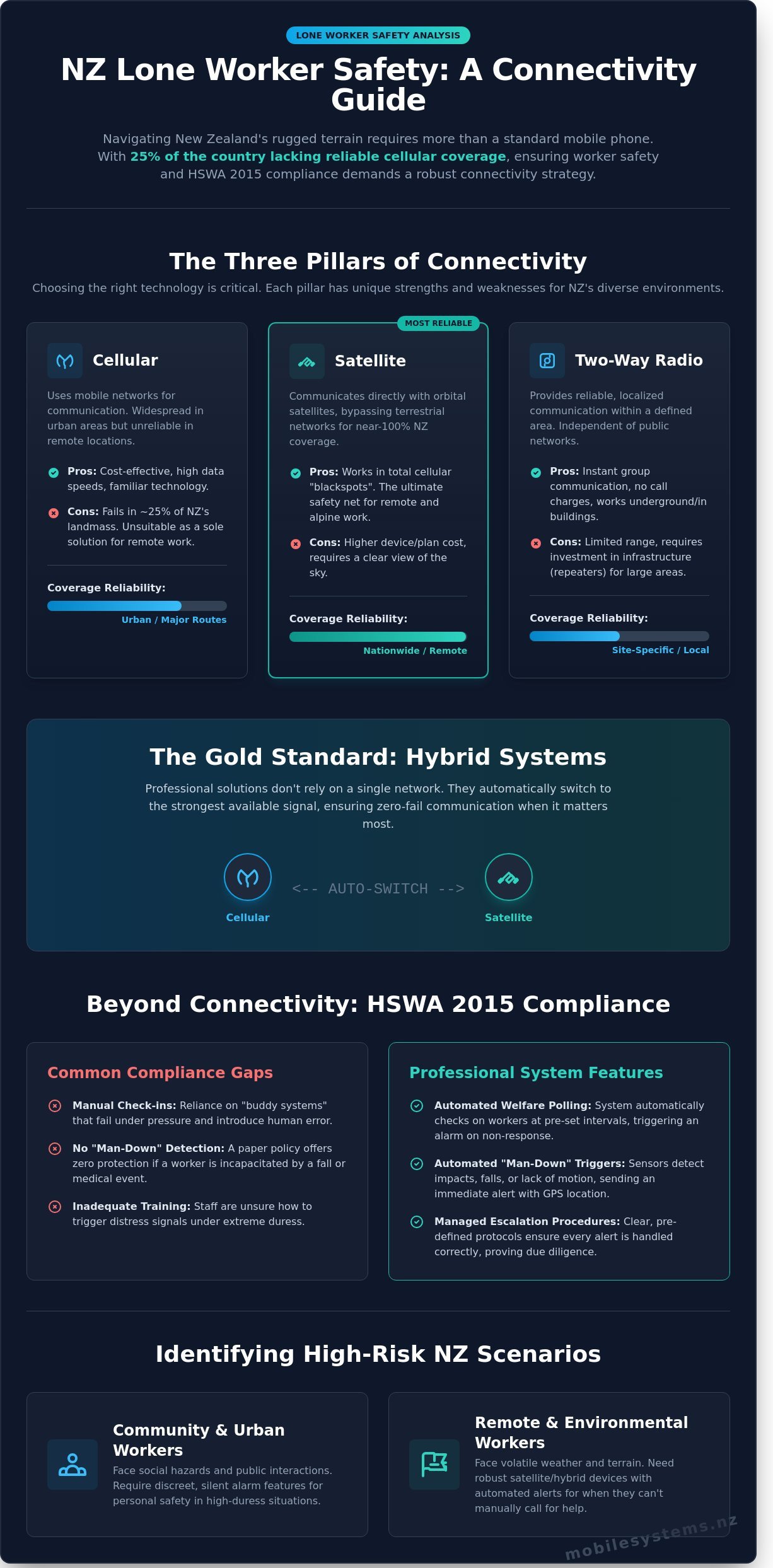
Standard mobile phones frequently fail as primary safety tools because they are not built for the rigors of New Zealand’s geography. Approximately 25 percent of the country’s landmass has no reliable cellular coverage. In regions like the King Country or the Southern Alps, a smartphone often lacks the signal strength to send a basic text. Dedicated lone worker safety solutions nz utilize satellite networks or high-powered radio frequencies to ensure a distress signal reaches help, even in total "blackspots."
The Health and Safety at Work Act 2015 (HSWA) places a legal obligation on employers to protect their staff. This legislation mandates that businesses take all "reasonably practicable" steps to eliminate or minimize risks. Implementing a robust safety system does more than just tick a compliance box. It significantly reduces corporate liability. If an accident occurs, having a documented history of GPS logs and automated alerts proves that the business took active steps to protect its most valuable assets.
The HSWA 2015 Framework for Lone Working
The HSWA 2015 requires PCBUs to identify hazards and implement controls that are effective in real-world conditions. A written lone worker policy is a legal starting point, but it must be supported by reliable hardware to be considered "reasonably practicable." If a worker is injured and cannot reach their phone, a paper-based policy provides zero protection.
Common compliance gaps in New Zealand small-to-medium enterprises often include:
- Reliance on manual "buddy systems" that fail during high-workload periods.
- Lack of coverage in known cellular blackspots.
- No automated "man-down" detection for sudden medical events or falls.
- Inadequate training on how to trigger distress signals under extreme pressure.
A professional system automates these processes, triggering an alarm if a worker fails to check in at a pre-set interval. This removes the "human error" element from safety management and ensures a response is initiated even if the worker is unconscious.
Identifying High-Risk Lone Working Scenarios
Risks in New Zealand are broadly categorized into community-based and remote environments. Community workers in urban centers like Auckland or Christchurch often face social hazards. These include aggressive interactions with the public or working in high-duress environments like mental health facilities or late-night retail. In these cases, discreet "silent alarm" features are vital for staff safety.
Remote workers face extreme environmental volatility. New Zealand’s weather can shift violently, with temperatures in alpine or coastal areas dropping by 10 degrees Celsius in less than 30 minutes. Terrain hazards like slips or dense bush can turn a minor injury into a life-threatening situation if the worker cannot signal for help. By deploying tailored lone worker safety solutions nz, businesses ensure that their team is never truly alone, regardless of how far off the grid they travel.
Connectivity Comparison: Cellular vs. Satellite vs. Two-Way Radio
Selecting the right lone worker safety solutions nz requires a deep understanding of the "Three Pillars" of connectivity. In New Zealand, our unique topography means a one-size-fits-all approach often leaves workers vulnerable. Under the NZ Health and Safety at Work Act 2015, businesses must provide reliable communication channels for staff in isolated roles. Relying on a single network is a common mistake that can lead to compliance failures during an incident.
Hybrid systems are now the gold standard for fleet safety. These systems automatically switch between cellular and satellite networks based on signal strength. This ensures a worker in a rural Northland valley remains as protected as a delivery driver in central Wellington. Determining your specific operational footprint involves mapping "black spots" against your team's daily routes. A gap in coverage is a gap in your safety net.
Cellular and App-Based Solutions
Cellular solutions are ideal for urban trades, community health visits, and metro-based delivery services. These apps leverage existing smartphones to provide GPS tracking and man-down alerts. However, cellular-only strategies have significant limitations in regional New Zealand. Battery drain is a constant issue; running high-frequency GPS pings can deplete a standard phone battery in less than 6 hours. Screen fragility and the presence of dead zones in 25% of New Zealand's landmass make them risky for remote work. You can explore our cellular device range to find ruggedized hardware that mitigates some of these hardware vulnerabilities.
Satellite Messaging for Total NZ Coverage
When workers head into the Southern Alps or deep into the King Country, satellite messaging becomes essential. Networks like Iridium and Garmin bypass terrestrial towers entirely, communicating directly with low-earth-orbit satellites. It's vital to choose two-way messaging over simple "one-way" SOS beacons. Two-way systems allow a worker to describe the nature of their emergency, which can reduce rescue response times by up to 40%. The main trade-offs are a slight latency in message delivery and the requirement for a clear view of the sky. Satellite devices often require a monthly subscription, which should be factored into your NZD budget.
UHF/VHF Radio Integration for Lone Workers
For high-intensity worksites like forestry blocks or large-scale construction, dedicated radio infrastructure remains the most resilient option. Modern handheld two-way radios feature automated safety polling. The system "checks in" with the worker at set intervals; if the worker doesn't respond, an alarm triggers at the base station. This doesn't rely on external telco providers, making it immune to network outages during storms or civil emergencies. Dedicated emergency buttons are tactile and easy to press even when wearing thick gloves or in low-visibility conditions. Radio is a capital-intensive investment but offers zero ongoing airtime costs on private frequencies.
Choosing between these technologies depends on your specific risk profile and geographic reach. A tailored assessment often prevents costly mistakes and ensures your team stays connected when it matters most.
Critical Features of a Professional Safety System
While a basic panic button is better than nothing, professional lone worker safety solutions nz require automated triggers. If a staff member is incapacitated by a medical event or physical assault, they can't always manually call for help. A robust system removes the reliance on human action during a crisis, ensuring help is dispatched even when a worker is unable to move.
High-quality audio capabilities represent another critical layer of protection. Listen-in features allow monitoring staff to assess a situation without alerting an aggressor. This provides vital context, such as hearing a verbal threat or the sound of heavy machinery, which helps emergency services prepare before they arrive on-site. It's an essential tool for de-escalating duress situations safely.
Under the NZ Health and Safety at Work Act 2015, PCBUs must manage risks to workers who operate in isolation. Relying on a manual button alone often fails to meet the "so far as is reasonably practicable" standard when automated technology is readily available. Professional systems provide the data logs and reliable triggers necessary to satisfy these legal obligations.
Man Down and No-Movement Sensors
Modern devices use 3-axis accelerometers to measure velocity, impact, and orientation. These sensors distinguish between a worker jumping off a truck tailgate and a true fall followed by a sudden impact. If the device detects a fall, it initiates a countdown. If the worker's fine, they can cancel the alert within 15 to 30 seconds before it escalates to management or a monitoring centre.
No-movement timers are equally vital for comprehensive safety. If a worker remains still for a set period, such as 3 minutes, the device triggers a pre-alert vibration. This captures scenarios where a worker has collapsed from a medical event without a high-impact fall. Configuring these timers correctly prevents false alarms while ensuring that unconsciousness never goes unnoticed in the field.
GPS Tracking and Geofencing
GPS and GNSS (Global Navigation Satellite Systems) provide the precision needed in New Zealand's challenging geography. In dense bush or deep canyons, standard GPS often struggles to maintain a signal. Deploying lone worker safety solutions nz that utilize GNSS ensures workers are protected because the device connects to multiple satellite networks, including GLONASS and Galileo, for faster and more accurate positioning.
Real-time location intelligence is superior to "last known position" reporting, which might be hours old. Integrating these features with portable GPS units ensures field teams are never truly off the grid. Geofencing adds another layer of security, automatically alerting a supervisor if a worker enters a high-risk zone, such as a remote forestry block or a restricted high-voltage area.
Designing a Lone Worker Protocol for Your NZ Business
Moving from an ad-hoc safety approach to a structured framework is a legal necessity under the Health and Safety at Work Act 2015. Many NZ businesses rely on informal "check-in" texts or phone calls. This method often fails when a manager is in a meeting or a worker's battery dies. A managed system removes human error by using automated polling. This ensures that if a worker doesn't respond to a pre-set prompt, an alert triggers immediately without requiring manual intervention. Effective lone worker safety solutions nz rely on a consistent welfare check schedule. For high-risk roles, such as electricians working on live lines or forestry contractors, a 30-minute polling interval is standard. For lower-risk roles, a two-hour window might suffice. The goal is to create a "heartbeat" for your remote team. If the heartbeat stops, the protocol starts. This transition requires moving away from "call me when you're done" to a system where silence is treated as a potential emergency.
Conducting a Connectivity Audit
New Zealand's geography presents unique challenges for safety technology. While mobile networks cover 98.5% of the population, they only reach about 50% of the landmass. You must map your specific work sites against current Spark, One NZ, and 2degrees coverage maps. Don't assume that a "fringe" signal is enough for safety data. It often isn't. Identify "dead zones" where cellular signals drop out entirely. In these areas, your protocol must mandate satellite-based hardware or high-power digital radio systems. Consulting with an expert helps you avoid over-investing in expensive satellite gear for sites that have reliable 4G or 5G coverage. We often see businesses spend NZ$1,000 per device on satellite tech when a NZ$300 cellular pendant would have provided better indoor penetration.
Self-Monitoring vs. Professional ARC
Deciding who answers the call is the most critical part of your protocol. Internal monitoring involves routing alerts to a supervisor or team leader. This is cost-effective but carries significant risk. If a manager is driving, sleeping, or in a dead zone themselves, the alert goes unanswered. Data from local incidents shows that internal response times can lag by 15 to 25 minutes compared to professional services. A 24/7 Alarm Response Centre (ARC) provides a dedicated team to manage every alert. These professionals follow a strict escalation path tailored to your business. For a "missed check-in," they might call the worker twice. For a "man-down" impact alert, they immediately coordinate with NZ Emergency Services. This level of lone worker safety solutions nz ensures that your staff are never truly alone, regardless of the time or day. Training your team is the final step in the protocol design. If the technology feels like a burden or a tool for micro-management, staff won't use it correctly. Focus training on the "why" of the system. Explain that the "Man Down" sensor isn't there to track their breaks, but to call for help if they're knocked unconscious. When workers understand that the tech is a lifeline rather than a leash, compliance rates typically rise by over 80% within the first month of implementation.
A tailored assessment often prevents costly mistakes when choosing the right safety protocol for your team.
Why Expert Installation and System Design Matter
Safety isn't a commodity that you can simply pull off a retail shelf. Many organizations make the mistake of "buying a box" rather than deploying a comprehensive safety strategy. A standalone device is only as effective as the network and configuration supporting it.
In New Zealand's varied terrain, from the dense bush of the Ureweras to the high-country stations of the South Island, signal reliability varies wildly. Mobile Systems focuses on designing bespoke networks that bridge these gaps. We ensure your lone worker safety solutions nz are fully integrated into your existing operational workflows.
Hardware durability is a non-negotiable factor for NZ industries. We specify equipment that meets IP68 ratings for dust and water immersion. Most of our critical hardware also adheres to MIL-STD-810H standards. This ensures devices survive 1.2-meter drops onto concrete and extreme temperature fluctuations common in our alpine regions.
Local support remains the backbone of a reliable safety system. Relying on offshore help desks during a hardware failure creates unacceptable risks. Our team provides on-site servicing and technical troubleshooting, ensuring your gear is back in the field without delay. This hands-on approach minimizes downtime and maintains the integrity of your safety protocols.
Custom System Design by Mobile Systems
We don't believe in one-size-fits-all configurations. Our engineers integrate lone worker alerts directly into your vehicle-mounted fleet communications. This creates a multi-layered safety net where a worker's handheld device communicates seamlessly with their truck's high-gain antenna system.
We tailor alert parameters to match specific job descriptions. A forestry worker might require a "man-down" tilt sensor set to a 60-second delay, while an urban health visitor might prefer a silent panic trigger. You can learn more about our expertise and history in providing these specialized configurations across New Zealand.
Ongoing Maintenance and Technical Support
Safety hardware requires proactive management to remain effective. Lithium-ion batteries typically see a 20% capacity drop after 500 charge cycles. We implement regular battery health checks and firmware updates to prevent mid-shift failures. This technical oversight ensures that 100% of your devices are ready for an emergency at any given moment.
Our fleet of mobile support vehicles brings this technical expertise directly to your site. Whether you're at a port facility or a remote construction zone, we handle the technical heavy lifting so your team can focus on their jobs. This eliminates the logistical headache of shipping sensitive gear back and forth for routine maintenance.
Effective safety planning starts with an audit of your current environment and risks. A tailored safety assessment from our team helps identify coverage gaps and hardware needs before they become liabilities. Contact our team today to ensure your lone worker safety solutions nz are designed, installed, and maintained by local experts who understand the demands of the New Zealand landscape.
Securing Your Workforce for 2026 and Beyond
Implementing effective lone worker safety solutions nz requires a strategic balance between robust hardware and reliable connectivity. Whether your team operates in urban centers or the most remote corners of the Southern Alps, your system's design must account for the specific blind spots of cellular networks.
A professional setup isn't just about the device; it's about the response protocol. Mobile Systems provides nationwide NZ support and servicing to ensure your UHF, VHF, and Satellite integrations remain operational 24/7. Relying on consumer-grade gear often leads to critical failure when it's needed most.
Choosing the right partner means accessing specialists in remote area connectivity who understand NZ regulations. A tailored assessment often prevents costly mistakes and ensures your business meets its legal obligations under the Health and Safety at Work Act 2015.
Contact Mobile Systems for a tailored lone worker safety assessment
Protecting your team is a long-term investment in your company's most valuable asset.
Frequently Asked Questions
What is the best lone worker device for remote areas in NZ?
Satellite-based devices like the Garmin inReach or Zoleo are the most reliable options for remote New Zealand terrain where cellular coverage is non-existent. These units use the Iridium satellite network to provide 100% coverage across the country. While cellular-based lone worker safety solutions nz work well in urban centers, remote staff need the dedicated SOS and two-way messaging that only satellite technology provides.
Does a mobile app count as a lone worker safety solution under NZ law?
A mobile app can be part of a compliant safety system, but it must be assessed against the Health and Safety at Work Act 2015 requirements for effective communication. Apps are often sufficient for low-risk urban roles. However, for high-risk tasks or areas with spotty reception, WorkSafe NZ guidelines suggest that a dedicated physical device with a one-touch SOS button is a more robust choice.
How much does a lone worker safety system cost in New Zealand?
Hardware costs for professional units typically range from NZ$350 to NZ$850 per device depending on the specific technology used. Monthly monitoring and airtime subscriptions generally cost between NZ$25 and NZ$65 per user. These costs are a fraction of the potential NZ$500,000+ fines businesses face for failing to provide adequate protection for their staff under current safety regulations.
What is the difference between an EPIRB and a lone worker device?
An EPIRB is a one-time emergency beacon designed for life-and-death maritime situations, whereas a lone worker device supports daily operational safety and check-ins. Lone worker units offer features like "man-down" detection and two-way messaging for non-emergencies. Unlike an EPIRB, which alerts the Rescue Coordination Centre NZ (RCCNZ) immediately, these devices are usually managed by private 24/7 monitoring centers.
Can I integrate lone worker features into my existing two-way radios?
Most modern digital two-way radios, including brands like Motorola and Hytera, have built-in "Man Down" and "Lone Worker" functions that can be activated via programming. These features trigger an alarm if the radio remains tilted for more than 30 seconds or if the user doesn't check in. Integrating these features creates cost-effective lone worker safety solutions nz by leveraging your existing hardware investment.
What happens if a lone worker device is triggered by mistake?
Professional devices include a pre-alarm warning period, usually lasting 15 to 30 seconds, which lets the user cancel a false alert before it's transmitted. If the alert goes through, the monitoring center follows a strict escalation protocol, which usually begins with a direct call to the user. This process prevents the unnecessary dispatch of emergency services and avoids the associated costs of false alarms.
How long do the batteries last on satellite-based safety devices?
Battery life for satellite units typically ranges from 75 to 200 hours of active use when set to standard 10-minute tracking intervals. If you use the device primarily for emergency standby, some models can last for several weeks between charges. Mobile Systems Limited recommends that field teams follow a daily charging schedule to ensure the device is always ready for a full shift.
Do I need a subscription for lone worker monitoring services?
You need a subscription to cover the costs of the data connection and the professional 24/7 monitoring team that responds to alerts. These services ensure that every SOS trigger is managed by an expert who follows your company's specific emergency response plan. While some hardware allows for self-monitoring, a professional service is the best way to ensure compliance with NZ safety standards.
Related posts

- June 10, 2026
Did you know that approximately 15% of New Zealanders work in isolated conditions, with many operating entirely outside of reliable...

- May 30, 2026
Could your business withstand a $3 million fine for a health and safety oversight? Under the Health and Safety at...

- May 28, 2026
In 2024, New Zealand recorded 70 work-related fatalities, a statistic that underscores the critical importance of protecting staff in isolated...