
Security Team Radio Communication: The Professional Guide (2026)
What if the communication system protecting your facility is the very thing providing intruders with your team’s exact location and intentions? You likely understand that reliable security team radio communication is the…
What if the communication system protecting your facility is the very thing providing intruders with your team’s exact location and intentions? You likely understand that reliable security team radio communication is the backbone of any professional operation. However, signal blackspots and the threat of eavesdropping remain constant risks in complex New Zealand environments.
It’s a frustrating reality that standard equipment often fails when it's needed most, whether due to interference from neighbouring businesses or hardware that cannot survive a 24/7 shift. This guide provides a comprehensive framework for designing and managing high-reliability radio systems that ensure 100% site coverage and total message privacy.
We will examine the essential transition to AES-256 encrypted digital standards and the impact of 2026 Radio Spectrum Management (RSM) updates on local licensing. You will also learn how to select durable hardware that incorporates quantum-safe security to protect your sensitive operational data from modern threats.
Meta Description: Master security team radio communication in NZ. Learn about AES-256 encryption, 2026 RSM regulations, and hardware for 100% signal coverage across your site.
URL Handle: security-radio-guide-2026
Key Takeaways
- Understand why professional-grade equipment is necessary to reduce incident response times and avoid the common failure points of consumer-grade devices.
- Select the appropriate frequency bands and digital standards to ensure your security team radio communication remains private and free from external interference.
- Evaluate industry-leading hardware and surveillance kits to identify durable solutions that withstand the rigours of 24/7 security operations.
- Navigate New Zealand’s Radio Spectrum Management (RSM) licensing requirements to maintain legal compliance and secure dedicated, interference-free channels.
- Learn to design a future-proof infrastructure using repeaters and integrated systems to eliminate communication blackspots across your entire facility.
The Critical Role of Professional Radio Communication in Security
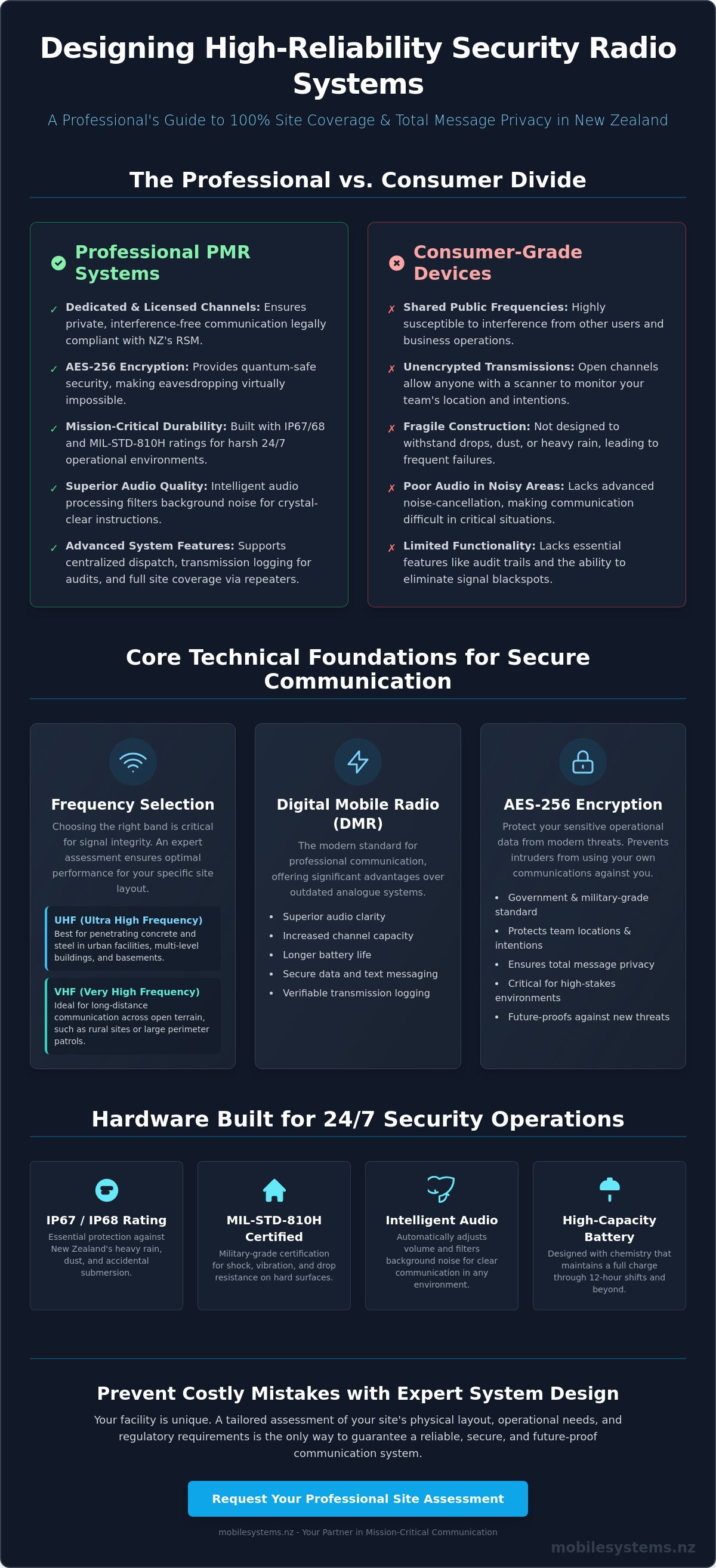
High-stakes security environments require more than basic consumer-grade equipment. Consumer walkie-talkies often fail in professional settings because they operate on shared, unencrypted channels susceptible to interference and eavesdropping. For robust security team radio communication, professionals rely on Professional Mobile Radio (PMR) standards, which provide dedicated bandwidth and superior signal clarity.
Instant push-to-talk (PTT) functionality is the primary advantage of these systems. Unlike mobile phones, which require unlocking and dialing, PTT allows for immediate broadcast to the entire team. This reduces incident response times from minutes to seconds, which is vital during medical emergencies or physical breaches. Rapid coordination ensures that backup arrives before a situation escalates beyond control.
To better understand how professional radio systems solve common security communication issues, watch this helpful video:
Digital systems also help reduce corporate liability. Modern digital mobile radio (DMR) networks can log every transmission, providing a verifiable record of instructions and actions during an incident. This data is essential for post-event reporting and legal compliance in New Zealand. It turns verbal exchanges into a searchable audit trail that supports incident investigations.
Response Speed and Team Coordination
Centralized dispatch allows a single coordinator to manage resource allocation effectively. By monitoring all channels, dispatchers can redirect personnel to where they're needed most without cluttering the main voice lines. The psychological impact of 'radio presence' also serves as a deterrent. When individuals see security staff using professional surveillance cameras and radios, it signals a high level of preparedness that often prevents anti-social behaviour before it starts.
Reliability in Critical Environments
Cellular networks are often the first infrastructure to fail during large-scale emergencies or in high-density crowds. Professional radio systems operate independently of public networks, ensuring connectivity even when mobile towers are overloaded. For 12-hour shifts, these devices require high-capacity batteries and rugged construction that standard consumer electronics cannot match.
- IP67 or IP68 ratings for protection against New Zealand's heavy rain and dust.
- MIL-STD-810H certification for shock and drop resistance on concrete surfaces.
- Intelligent audio processing that filters out wind and background noise.
- Battery chemistry designed to maintain a charge through an entire double shift.
A tailored assessment of your site's physical layout often prevents costly mistakes in hardware selection. Professional security team radio communication is not just about the handheld device; it's about the entire infrastructure that supports it.
Technical Fundamentals: Frequencies, DMR, and Encryption
Selecting the correct frequency band is the first technical decision in designing a robust system. For most New Zealand security operations, Ultra High Frequency (UHF) is the preferred choice. UHF waves are shorter and more effective at penetrating the steel and concrete found in urban facilities or multi-level basements.
In contrast, Very High Frequency (VHF) is better suited for outdoor perimeter patrols or rural sites where signals must travel long distances over open terrain. Effective Spectrum Management ensures these frequencies are utilized without causing interference to other essential services.
The shift to Digital Mobile Radio (DMR) has changed the landscape. The DMR market is expected to grow at a CAGR of over 15% by 2026, largely because digital systems offer features that analogue cannot match. Digital systems use Time Division Multiple Access (TDMA) to split a single 12.5 kHz channel into two independent talk-paths, doubling capacity without additional licensing.
Analogue vs. Digital Systems
Digital systems provide consistent voice clarity up to the very edge of the coverage area. While analogue signals become increasingly static-heavy as a guard moves away from the base station, digital audio remains crisp until the signal is lost entirely. This is achieved through vocoders that filter out background noise, which is vital for security team radio communication in noisy environments.
Digital systems are also more spectrum-efficient, allowing multiple talk-groups to operate on the same frequency without overlapping. This prevents the "dead zone" problems common in concrete basements where analogue signals often fail to resolve clearly.
Privacy and Security Features
Standard analogue transmissions are easily intercepted by anyone with a basic scanner. To protect sensitive operational data, professional security teams now utilize AES-256 encryption. This is the gold standard for secure communication, as recommended by cybersecurity agencies to prevent eavesdropping.
As we move into 2026, manufacturers are also introducing quantum-safe security measures, such as CRYSTALS-Kyber algorithms, to counter advanced decryption threats. This ensures that your security team radio communication remains private even against "harvest now, decrypt later" attacks.
Beyond encryption, digital hardware supports integrated safety protocols. 'Man Down' and 'Lone Worker' alerts use internal sensors to detect if a guard is incapacitated, automatically triggering an emergency broadcast. If a handset is lost or stolen, remote 'stun and kill' features allow administrators to disable the device over the air.
A tailored technical assessment often prevents signal failures and ensures your safety features are correctly configured for your specific risk profile.
Selecting Security Hardware: Handhelds and Surveillance Kits
Hardware selection must align with the specific operational environment. Tier 1 manufacturers like Tait Communications and Hytera provide the reliability required for high-stakes roles. Tait, a New Zealand-founded company, focuses on extreme durability and public safety standards. Hytera leads in digital innovation, offering feature-rich DMR handsets that are highly effective for security team radio communication. Choosing a brand often depends on whether your team needs localized support or specific digital protocols.
Mobile patrol units require vehicle-mounted radios to ensure connectivity during perimeter checks. These units offer significantly higher transmission power than handhelds, ensuring signals reach the base station from the furthest edges of a site. Integrating these with external antennas further improves performance in rural or industrial New Zealand locations where signal attenuation is a common challenge.
Portable Handsets for Foot Patrol
Ergonomics are a critical factor for foot patrols. Radios must be easy to operate while wearing tactical gloves or heavy uniforms. Non-display radios offer a simplified interface that prevents accidental channel changes, whereas display models allow supervisors to monitor caller IDs and system status. High-quality handsets often feature IP67 or IP68 ratings, ensuring they continue to function after exposure to heavy rain or accidental submersion. You can browse professional two-way radio devices to compare different form factors and durability levels.
Covert and Surveillance Accessories
Covert operations require specialized surveillance kits to maintain a low profile. Two-wire kits combine the microphone and PTT button on one lead, while three-wire kits separate them, allowing for more discreet placement under clothing. For high-noise environments like concerts or festivals, bone conduction headsets are an excellent choice. These devices transmit sound through the cheekbones, leaving the ear canal open so guards can maintain full situational awareness.
Accessory choice also extends to overt operations. Selecting the right interface depends on the specific risks of the site:
- Remote Speaker Mics: Best for high-visibility roles where speed of access is paramount.
- Surveillance Earpieces: Necessary for retail or event security where a discreet presence is required.
- Bone Conduction: Ideal for high-decibel environments where hearing protection is also used.
Heavy-duty remote speaker microphones are built to withstand physical impacts and are often easier to trigger in high-stress situations. To find the right fit for your team's specific needs, explore portable communication accessories designed for professional security applications. A mismatched accessory is often the weakest link in an otherwise robust system.
New Zealand Regulatory Compliance and Radio Etiquette
Operating a security firm without a proper licence from Radio Spectrum Management (RSM) introduces significant operational risks. Licence-free bands, such as the 80-channel UHF CB service, are shared by the general public. This lack of exclusivity means your sensitive security team radio communication can be overheard or intentionally jammed by unauthorized users.
Professional systems utilize licensed frequencies to provide a clear, private environment for voice and data traffic that consumer devices cannot access. New Zealand's Health and Safety at Work Act (HSWA) also influences communication requirements. Under this act, businesses have a primary duty of care to provide a safe work environment, which includes reliable methods for staff to summon assistance.
If a guard is injured because they couldn't reach dispatch due to preventable channel interference, the organization may face legal scrutiny. Transitioning to professional-grade hardware programmed to specific RSM-allocated frequencies is a key step in meeting these safety obligations and ensuring team safety.
The Licensing Process in NZ
Securing a licence involves a technical coordination process to ensure your chosen frequency doesn't interfere with existing users in your area. This process is handled in three distinct stages:
- Assessment: You must first determine the power output and frequency band (UHF or VHF) required based on your site's physical footprint and building materials.
- Certification: Applications are submitted through an Approved Radio Certifier (ARC) who calculates the technical parameters before submission to the RSM.
- Compliance: Once the licence is granted, hardware must be professionally programmed to operate strictly within the authorized bandwidth and power limits.
Operational Radio Discipline
Even the most advanced digital system fails if the team lacks discipline. Standardized radio etiquette prevents channel congestion and ensures messages are understood immediately. Security teams should use the NATO phonetic alphabet to spell out names or vehicle plates and incorporate 'Prowords' like 'Roger' or 'Standby' to keep transmissions brief.
These protocols are essential for maintaining clear security team radio communication during high-stress incidents. Common mistakes include 'keying' the microphone before thinking or using informal slang, which wastes airtime and creates confusion. For a deeper look at best practices, read our guide on walkie-talkie etiquette to refine your team’s protocols.
Professional conduct on the airwaves reflects the overall standard of your security operation. Mobile Systems Limited provides expert guidance for securing and maintaining your RSM radio licences to ensure your team remains safe, legal, and connected.
Designing a Future-Proof Security Communication Infrastructure
Designing a long-term security team radio communication strategy requires more than just purchasing handsets. It involves building a resilient network that can adapt to site expansions and technological shifts. Repeaters are the cornerstone of this infrastructure, as they receive and re-transmit signals to bypass physical obstructions and extend coverage across large New Zealand industrial sites or multi-story complexes.
Integration with existing security layers adds significant value to your investment. Modern digital systems allow radios to receive automated alerts from surveillance cameras or building alarm systems. When a perimeter sensor is triggered, the radio network can broadcast a voice alert or text message directly to guards. This creates a unified response environment where information flows seamlessly between different security technologies.
This is particularly effective for remote construction projects, where specialized solutions like Jobcam solar-powered towers can act as the primary detection layer, sending real-time alerts to the security team's handheld radios.
Planning for scalability ensures that adding new users doesn't degrade system performance. A well-designed network accounts for peak traffic and provides enough channel capacity to prevent channel busy signals during emergencies. Regular equipment servicing and firmware updates are also essential. These updates often include critical security patches and performance enhancements that keep the hardware running reliably throughout its operational life.
System Integration and Wide-Area Coverage
IP-linked repeaters allow security teams to maintain connectivity across geographically dispersed locations. By using a standard internet connection, repeaters in different cities can be bridged to create a single, unified talk-group. For remote New Zealand sites where traditional backhaul is unavailable, you might learn more about Starlink for remote site connectivity to facilitate these links.
Bridging radio networks with Push-to-Talk over Cellular (PTToC) applications provides additional flexibility. This allows management personnel to monitor security team radio communication from a smartphone without carrying a dedicated radio. While PTToC isn't a replacement for mission-critical hardware, it serves as a valuable extension for administrative oversight and off-site monitoring.
The Mobile Systems Expert Advantage
Bespoke system design is the most effective way to prevent costly interference issues. Off-the-shelf solutions rarely account for the specific RF environment of a site, which often leads to dead zones and dropped calls. Mobile Systems Limited provides comprehensive design services, ensuring that your antennas, repeaters, and handsets are perfectly matched to your specific operational requirements.
Ongoing performance depends on professional maintenance and expert configuration. We offer on-site support and mobile servicing to ensure your fleet remains in peak condition without requiring you to ship equipment away for extended periods. A tailored assessment often prevents technical failures before they occur. To secure your facility's future, contact our technical team for a site assessment today.
Securing Your Operational Connectivity
Professional security team radio communication is defined by the integration of rugged hardware, digital encryption, and strict regulatory compliance. Transitioning from unsecure analogue systems to DMR standards ensures your voice data remains private. It also keeps coverage consistent across complex New Zealand sites. Adopting these technologies isn't just about hardware; it's about meeting Health and Safety obligations through reliable coordination.
Success depends on selecting equipment that meets high-durability requirements for 24/7 shifts while navigating the specific licensing frameworks of Radio Spectrum Management. Mobile Systems Limited serves as a trusted partner, offering specialist UHF and VHF system design alongside nationwide support and installation. Our team ensures that your infrastructure is built to scale as your operational needs grow.
As official partners for Tait and Hytera, we provide the technical expertise needed to build a future-proof network. Contact Mobile Systems for a tailored security communication assessment to identify the optimal configuration for your site. A robust system ensures your team stays protected and keeps everyone connected when it matters most.
Frequently Asked Questions
What is the best radio frequency for indoor security teams in NZ?
UHF (Ultra High Frequency) is the superior choice for indoor security operations in New Zealand. These shorter waves effectively penetrate common building materials like steel and concrete. While VHF might travel further in open rural areas, it struggles with multipath interference in confined spaces. UHF ensures consistent coverage within multi-level complexes or retail environments.
Do I need a licence to use professional security radios in New Zealand?
Yes, professional operations require a licence from Radio Spectrum Management (RSM). While licence-free PRS channels exist, they're open to the public and prone to significant interference. A private licence grants your business exclusive use of a frequency. This ensures your security team radio communication remains reliable and free from outside chatter.
What is the difference between UHF and VHF for security work?
The primary difference lies in wave propagation and obstacle penetration. UHF waves are shorter and better at bouncing around walls and through floors, making them ideal for urban sites. VHF waves are longer and follow the earth's curvature more effectively. This suits large rural sites or perimeter patrols with clear lines of sight between units.
How can I prevent people from eavesdropping on my security team's radios?
Implementation of digital mobile radio (DMR) with AES-256 encryption is the most effective prevention method. Analogue signals can be intercepted by basic scanners, but encrypted digital transmissions are virtually impossible to decode without the correct key. This level of security is essential for protecting sensitive operational data from unauthorized listeners.
What are the most common radio call signs used by security guards?
Teams typically use alphanumeric structures such as Alpha One or Bravo Two to identify individual guards. Functional call signs like Base, Control, or Mobile are used for dispatchers or vehicle units. Using standardized call signs from the NATO phonetic alphabet ensures clarity and reduces the time spent on each transmission during busy shifts.
How long do the batteries last on professional security handsets?
High-quality professional handsets typically provide between 12 and 18 hours of operation on a single charge. This duration depends on the duty cycle, which is the ratio of time spent transmitting versus receiving or on standby. Digital radios are generally more power-efficient than older analogue models, often lasting through a full 12-hour shift.
Can security radios be integrated with CCTV or alarm systems?
Yes, digital systems can be integrated with surveillance and alarm hardware. Modern DMR radios can receive automated text or voice notifications when an alarm is triggered or when CCTV analytics detect a perimeter breach. This integration allows guards to receive immediate information without relying on a central dispatcher to relay every alert.
What happens if my security radio signal doesn't reach the whole building?
Signal blackspots are usually resolved by installing a repeater system. A repeater receives a weak signal from a handheld radio, amplifies it, and re-transmits it to cover the entire facility. If your building has significant concrete shielding, a distributed antenna system (DAS) might be required to distribute the signal evenly across all floors.
Related posts

- June 13, 2026
In 2024, New Zealand recorded 70 work-related fatalities and more than 209,000 injury claims. These statistics underscore the heavy responsibility...

- June 11, 2026
New Zealand's workplace fatality rate is 1.7 times higher than Australia's, a stark figure that highlights the urgent need for...

- June 10, 2026
Did you know that approximately 15% of New Zealanders work in isolated conditions, with many operating entirely outside of reliable...