
Professional Radios in NZ: The Business Guide to Communication Systems (2026)
If your team loses contact in a remote gully or behind a heavy concrete structure, a consumer-grade walkie-talkie becomes little more than a paperweight. Relying on the wrong professional radios nz has to offer in our challenging terrain isn't just a frustration; it's a significant safety risk for your personnel.
If your team loses contact in a remote gully or behind a heavy concrete structure, a consumer-grade walkie-talkie becomes little more than a paperweight. Relying on the wrong professional radios nz has to offer in our challenging terrain isn't just a frustration; it's a significant safety risk for your personnel.
You likely understand that business-grade hardware must be more robust than retail models, but the technical jargon often creates more questions than answers. It's difficult to distinguish between essential features and unnecessary marketing fluff when you just need a system that works every time.
This guide provides the clarity you need to choose between UHF and VHF systems based on your specific industry requirements. We'll also explain critical regulatory changes, including the Radio Spectrum Management (RSM) fee increases effective July 1, 2026, where standard license fees rise to $190.00.
By the end of this article, you'll have a clear roadmap for implementing a compliant, professional-grade communication infrastructure. We'll cover everything from the 40 percent battery life improvement offered by Digital Mobile Radio to the practical trade-offs of Push-to-Talk over Cellular systems.
Key Takeaways
- Understand the critical distinctions between UHF and VHF frequencies to ensure your communication system effectively penetrates the specific terrain of your worksite.
- Explore the advantages of Digital Mobile Radio (DMR) technology, which offers superior audio clarity and significantly extended battery life for demanding operational shifts.
- Learn how to identify and source "intrinsically safe" hardware required for hazardous environments to maintain strict New Zealand health and safety compliance.
- Gain insights into the 2026 RSM licensing regulations and why a managed frequency is essential for secure, interference-free business operations.
- Discover how professional installation and expert system design for radios nz can eliminate dead zones and extend your reach beyond standard mobile network limits.
Understanding the Radio Landscape in New Zealand: Consumer vs. Professional Systems
In New Zealand, the term "radio" is often applied to two entirely different categories of technology. While consumer Hi-Fi brands like Sangean or Tivoli are excellent for high-fidelity audio in a home office, they serve no purpose in industrial communication. Professional two-way radio technology is built for the specific purpose of mission-critical team coordination and site safety.
These systems are engineered to withstand the rigours of the New Zealand workforce, from the high-moisture environments of West Coast forestry to the dust-heavy conditions of Auckland construction sites. For businesses sourcing radios nz, the priority shifts from audio aesthetics to ruggedness, encryption, and signal reliability where lives may depend on a clear signal.
To better understand the basic interface and operation of these devices, watch this helpful video:
When to Choose Professional Two-Way Radios
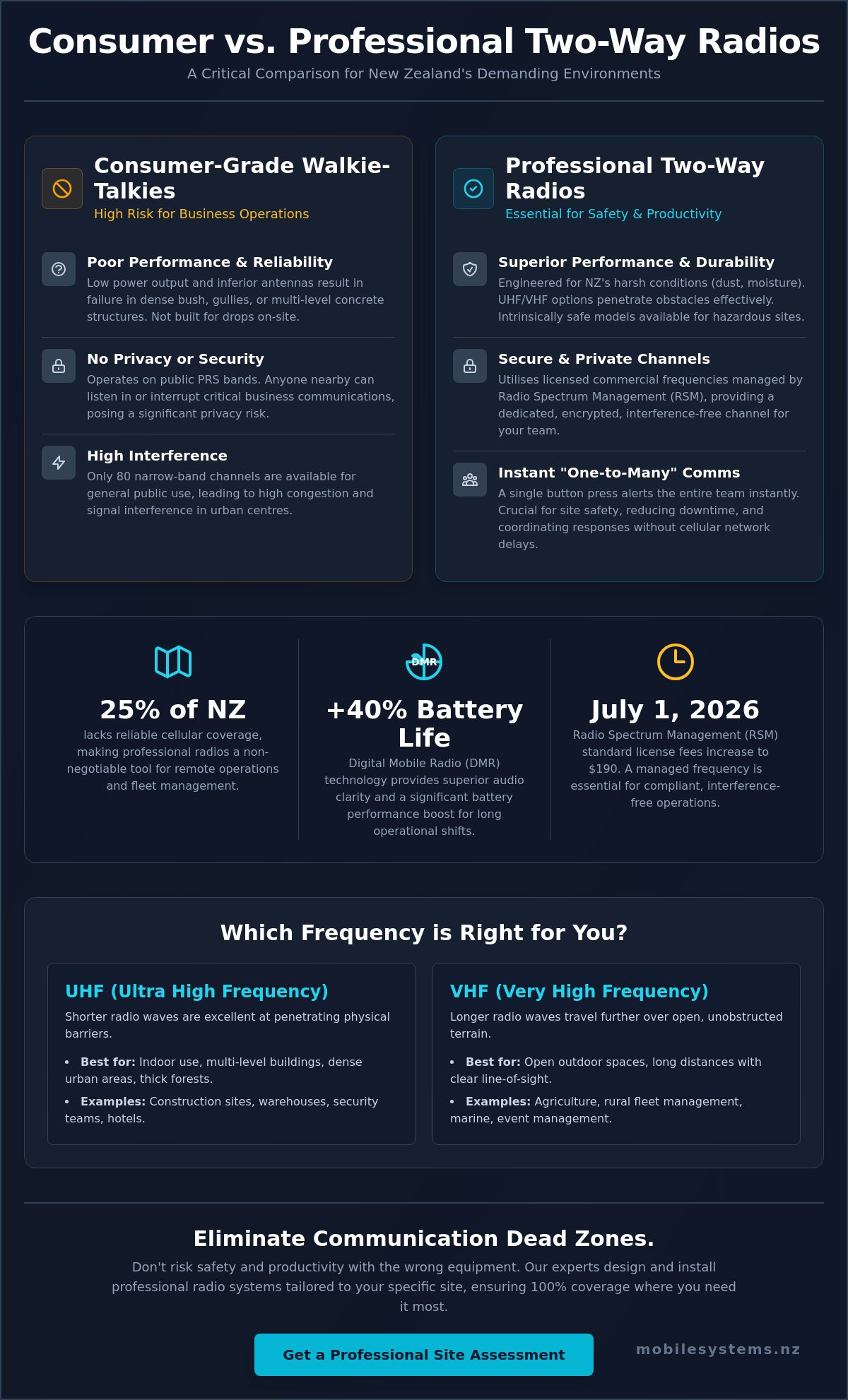
Mobile phone networks are often inadequate for industrial operations. Approximately 25 percent of New Zealand's landmass lacks reliable cellular coverage, making professional two-way radios essential for rural fleet management and remote site work. Unlike a phone call, which requires dialing and waiting for a connection, these systems provide instantaneous "one-to-many" communication.
This speed reduces operational downtime significantly. When a foreman needs to stop work across a 10-hectare site immediately, a single button press alerts everyone on the channel. This immediate response capability is a cornerstone of New Zealand health and safety standards, ensuring that emergency broadcasts aren't delayed by network congestion or signal "dead zones."
The Limitations of Consumer-Grade Walkie-Talkies
Off-the-shelf walkie-talkies found in retail stores typically operate on the Personal Radio Service (PRS) band. While these are useful for casual hikers, they often fail in dense NZ bush or multi-level construction sites due to their low power output and inferior antenna quality. Most consumer units lack the durability to survive a one-meter drop onto concrete, a common occurrence in trade environments.
- Privacy Concerns: PRS channels are public, meaning anyone nearby can listen to or interrupt your business conversations.
- Interference: With only 80 narrow-band channels available for general use, congestion is high in urban centers like Christchurch or Wellington.
- Licensing: Professional systems use licensed commercial frequencies managed by Radio Spectrum Management (RSM), providing a dedicated, interference-free space for your team.
Relying on consumer hardware often leads to hidden costs through frequent replacements and lost productivity. A tailored assessment of your site conditions often prevents these costly mistakes. If you aren't sure which tier of hardware your project requires, you can contact our technical team for a specific recommendation based on your topography.
Key Technologies Powering NZ Business Radios: UHF, VHF, and Digital Standards
Selecting the right frequency is the first technical hurdle for any New Zealand business. The choice between Ultra High Frequency (UHF) and Very High Frequency (VHF) depends entirely on where your team operates. While analog systems were the standard for decades, the industry has moved toward Digital Mobile Radio (DMR) to meet modern demands for data and security.
Properly managing these frequencies requires oversight from Radio Spectrum Management (RSM). This ensures that your professional radios nz setup doesn't interfere with other users or emergency services. Using the wrong equipment for your environment can lead to significant signal loss and operational frustration.
UHF vs. VHF: Which is Right for Your NZ Location?
VHF waves are longer and travel further in open spaces. This makes them ideal for South Island high-country stations, maritime operations, and flat rural plains. If your staff has a clear line of sight across vast distances, VHF provides the most reliable coverage because the signal follows the Earth's curvature more effectively than higher frequencies.
UHF waves are shorter and better at "bouncing" around obstacles and penetrating materials. This makes them the preferred choice for urban centers like Auckland or Wellington, and for indoor use in large warehouses or hotels. UHF signals can penetrate concrete walls and steel frames that would block a VHF signal. A tailored assessment of your site often prevents the mistake of choosing a frequency that can't reach your entire team.
Digital Mobile Radio (DMR) and P25 Standards
The transition to digital standards has changed how businesses use their spectrum. DMR technology uses Time Division Multiple Access (TDMA) to split a single frequency into two "slots." This allows two separate conversations to happen simultaneously on one channel, effectively doubling your capacity without increasing your licensing costs for radios nz.
Digital systems offer several operational advantages over older analog hardware:
- Clarity: Background noise from machinery or wind is filtered out, ensuring voice remains clear even at the edge of the coverage area.
- Battery Life: Digital radios transmit in pulses rather than a continuous stream, which improves battery life by up to 40 percent compared to analog models.
- Security: Advanced digital encryption prevents unauthorized parties from eavesdropping on sensitive business discussions.
- Data Integration: Modern DMR-compatible hardware supports GPS tracking and text messaging, allowing dispatchers to monitor fleet locations in real-time.
For high-security or emergency service applications, P25 standards provide even greater interoperability and robust encryption. Most New Zealand businesses find that a well-designed DMR network offers the perfect balance of performance and cost-effectiveness. These systems ensure that your communication remains private and reliable, regardless of the local terrain.
Selecting the Right Radio System for Your Industry Requirements
New Zealand businesses face diverse environmental challenges that demand specific hardware configurations. A civil contractor in Christchurch requires different technology than a logging crew in the Kaimai Ranges. Selecting the right radios nz involves evaluating durability standards and safety features like "intrinsically safe" (IS) ratings. IS radios are mandatory in environments with explosive gases or dust, such as fuel terminals or chemical processing plants, where a standard battery spark could be catastrophic.
Balancing handheld portables with vehicle-mounted units is another critical decision for fleet managers. While portables offer individual mobility, vehicle units provide higher power output, often 25 watts compared to a handheld's 5 watts. This ensures a stronger signal when traveling between remote sites or operating in the shadow of steep hills. A tailored assessment often prevents the mistake of investing in hardware that lacks the necessary range for your specific topography.
Construction and Civil Engineering
On high-impact sites, hardware must meet strict Ingress Protection (IP) ratings to survive the elements. An IP67 rating ensures the device is dust-tight and can survive immersion in water for 30 minutes, which is vital for New Zealand's unpredictable weather. Noise-cancelling microphones are another essential feature, filtering out the 90+ decibel roar of heavy machinery so instructions remain audible. You can find robust professional walkie-talkie solutions for teams that meet these industrial standards.
Communication in Forestry and Agriculture
Forestry crews often operate in "black spots" where traditional repeaters cannot reach. For these isolated lone workers, modern systems integrate GPS and man-down alarms to satisfy strict health and safety requirements. In extreme backcountry areas, we recommend satellite solutions for remote NZ operations to bridge the gap where terrestrial signals fail. These hybrid systems ensure a lifeline is always available, regardless of how remote the worksite is.
Marine and Transport Fleet Coordination
Managing a regional transport fleet requires wide-area coverage that mobile phones cannot reliably provide. Digital simulcast technology allows multiple towers to transmit on the same frequency, providing seamless roaming for drivers across the North or South Island. For those operating on the water, VHF remains the global standard for ship-to-ship and ship-to-shore safety. For a deeper dive into these requirements, read more in our complete guide to marine communication.
All commercial operations must comply with Radio Spectrum Management (RSM) licensing to avoid interference with other industrial users. Whether you're coordinating log trucks or managing a large-scale marine event, choosing the right hardware and frequency ensures your team stays connected and compliant. Expert system design ensures your investment provides the coverage you need without unnecessary complexity.
Professional Installation and Licensing: Ensuring Compliance and Coverage
Operating the professional radios nz businesses rely on requires more than just high-quality hardware. In New Zealand, the radio spectrum is a finite public resource managed by Radio Spectrum Management (RSM). Most commercial frequencies require a specific license to prevent interference with other users, such as emergency services or neighbouring industrial sites.
As of July 1, 2026, RSM has implemented updated annual license fees. The standard license fee now stands at $190.00, an increase from the previous $150.00 rate. For larger operations using repeaters, the Land Mobile Radio license fee for up to five repeaters is now $800.00. Staying compliant isn't just about paying fees; it's about adhering to the Radiocommunications Regulations Notice 2025, which ensures all equipment meets modern international safety and performance standards.
Professional installation is the only way to maximize antenna performance. A poorly mounted antenna or an incorrectly tuned cable can lead to high Standing Wave Ratio (SWR). This technical failure reflects power back into the radio and can permanently damage the internal circuitry. Mobile Systems manages the entire licensing and installation process, ensuring your hardware is legally compliant and technically optimized from day one.
The Importance of Custom System Design
A "one size fits all" approach often results in frustrating communication dead zones. Our technicians conduct thorough site surveys to analyze how New Zealand's rugged topography or dense urban structures affect signal propagation. We determine the precise placement for repeaters to bridge gaps in coverage, ensuring your team stays connected across the entire worksite. A tailored assessment often prevents costly mistakes and ensures your infrastructure is built for purpose.
Maintaining Your Radio Infrastructure
Radio systems are critical safety infrastructure, yet they are often neglected until a failure occurs. Regular servicing identifies degraded antennas or moisture ingress before they lead to a total system blackout. Staying current with the latest radios nz standards ensures your fleet remains safe and effective during high-pressure operations.
Large fleets also benefit from battery management programs. While digital models offer 40 percent better battery life, cells still degrade over hundreds of charge cycles. Mobile Systems provides on-site support to minimize operational disruptions. If you're ready to secure your business frequency, you can request a compliance audit to verify your current setup meets the latest RSM requirements.
Why Mobile Systems is New Zealand’s Trusted Partner for Radio Solutions
Selecting the right professional radios nz relies on more than just reading a spec sheet. It requires a partner who understands how New Zealand’s specific atmospheric conditions and rugged terrain affect signal propagation. Mobile Systems Limited provides this depth of technical knowledge, moving beyond simple retail to offer comprehensive engineering solutions.
We provide a complete lifecycle for your communication assets. This includes initial frequency planning and RSM license management, hardware supply, professional vehicle installation, and long-term maintenance. This end-to-end approach ensures that your system remains a reliable safety tool rather than a source of operational frustration.
Nationwide Support and Technical Expertise
From our central base in Mount Maunganui, we provide support to every corner of the country. Our mobile support vehicles are equipped to handle on-site diagnostics and repairs, ensuring your downtime is kept to an absolute minimum. Whether you're managing a civil project in Dunedin or a forestry crew in Northland, our technicians can reach you.
We maintain strong partnerships with world-leading brands that have a proven track record in New Zealand. This includes local expertise with Tait products, alongside robust solutions from Hytera and Icom. You can learn more about the Mobile Systems team and our technical background in designing high-stakes networks for reliable radios nz infrastructure.
Get Started with a Professional Assessment
Transitioning from an unreliable or outdated communication setup doesn't have to be complex. We begin with a thorough analysis of your operational area, identifying potential signal obstructions and determining the necessary repeater density. This data-driven approach ensures that your new digital network provides clear coverage where it's needed most.
Our customized quotes provide a clear breakdown of hardware costs and licensing requirements, tailored specifically to your team size and terrain. A tailored assessment often prevents costly mistakes and ensures your infrastructure is compliant with the latest 2026 regulations. Contact our experts today to discuss your business radio requirements and secure your team's safety.
Securing Your Business Communications for the Future
Reliable communication is the backbone of any successful industrial operation in New Zealand. By understanding the technical differences between UHF and VHF, and staying ahead of the 2026 RSM licensing updates, you ensure your team remains connected when it matters most. Transitioning to digital standards provides the voice clarity and the 40 percent battery life improvement necessary for modern workflows.
Mobile Systems Limited serves as an authorized dealer for world-leading brands like Tait and Hytera, specializing in the remote and rugged terrain communication challenges unique to our islands. Our expertise covers everything from initial system design to nationwide installation and ongoing servicing. A tailored assessment often prevents costly mistakes and ensures your infrastructure is optimized for your specific site conditions.
Don't leave your site safety to chance with consumer-grade hardware. You can contact Mobile Systems for a professional radio system assessment to build a robust network of radios nz teams can trust. We look forward to helping you design a communication system that works as hard as your business does.
Frequently Asked Questions
Do I need a license to use a two-way radio in New Zealand?
Yes, most commercial radio systems require a license from Radio Spectrum Management (RSM). As of July 1, 2026, the standard license fee is $190.00 per year. This license grants you a dedicated frequency, ensuring your business communication remains private and free from interference by other users.
What is the difference between UHF and VHF radios for NZ businesses?
UHF is ideal for urban environments and indoor use because its shorter waves penetrate concrete and steel effectively. VHF is better suited for open terrain, agriculture, and marine use where signals need to travel long distances over hills or water. Choosing the right frequency for your radios nz setup depends on your specific location.
Can I use my radio system in areas with no cellphone coverage?
Yes, professional radio systems operate independently of the cellular network. They communicate directly between units or through a private repeater you own. This makes them the primary choice for the 25 percent of New Zealand's landmass that lacks reliable mobile signal, especially in forestry and backcountry areas.
How far can a professional handheld radio transmit?
A standard professional handheld typically transmits between 2 and 5 kilometers in a direct point-to-point configuration. To cover larger sites or regional transport routes, we install repeaters that can extend this range to 50 kilometers or more. The actual distance is always influenced by local topography and obstacles.
What are the benefits of digital (DMR) radios over older analog systems?
Digital Mobile Radio (DMR) offers superior voice clarity by filtering out background industrial noise and wind. It also provides 40 percent better battery life and supports advanced features like GPS tracking and text messaging. Digital systems use encryption to prevent unauthorized people from listening to your business conversations.
How long do the batteries last in professional-grade walkie-talkies?
Most professional batteries are designed to last between 12 and 18 hours on a single charge. Digital technology is significantly more efficient than analog, often extending a radio's runtime to cover a full double shift. We recommend high-capacity lithium-ion batteries for teams working in demanding, long-duration environments.
Is it better to buy or lease a commercial radio system?
Buying is generally better for long-term infrastructure where you want full ownership of the assets. Leasing is a practical choice for short-term projects, such as a six-month construction contract, as it allows you to treat the cost as an operating expense. Both options ensure you have access to professional-grade hardware and support.
Can I integrate my radio system with GPS fleet tracking?
Yes, modern digital radios nz allow for seamless GPS integration. This enables dispatchers to view the real-time location of every radio user on a digital map, which is a vital safety feature for lone workers. It also helps transport managers optimize routes and response times across their entire fleet.
Related posts

- June 24, 2026
Bigger antennas aren't always better. Here's how to actually match your 4x4 UHF radio setup to New Zealand's terrain, and...

- June 23, 2026
Radios don't fail because they're poorly made. They fail because nobody's looking after them. Here's what a real two-way radio...

- June 21, 2026
Mobile Systems Limited's 2026 guide to two-way radios for NZ construction sites covers rugged IP67-rated hardware, UHF vs VHF signal...