
Your Guide to a Cell Phone Signal Booster NZ
Struggling with bad reception? Discover how a legal cell phone signal booster NZ can eliminate dropped calls and slow data in your home, vehicle, or business.
That single bar of reception blinking on your phone screen—we've all been there. It’s a uniquely Kiwi frustration, whether you're out on a rural farm, deep inside a modern city building, or trying to get a signal on the boat. The fix is often a legal cell phone signal booster, a clever bit of kit that grabs a weak signal from outside, gives it a massive boost, and then blankets your indoor space or vehicle with strong, clear coverage. It’s the definitive solution to dropped calls and data speeds that crawl.
Ending the Frustration of Poor Mobile Signal
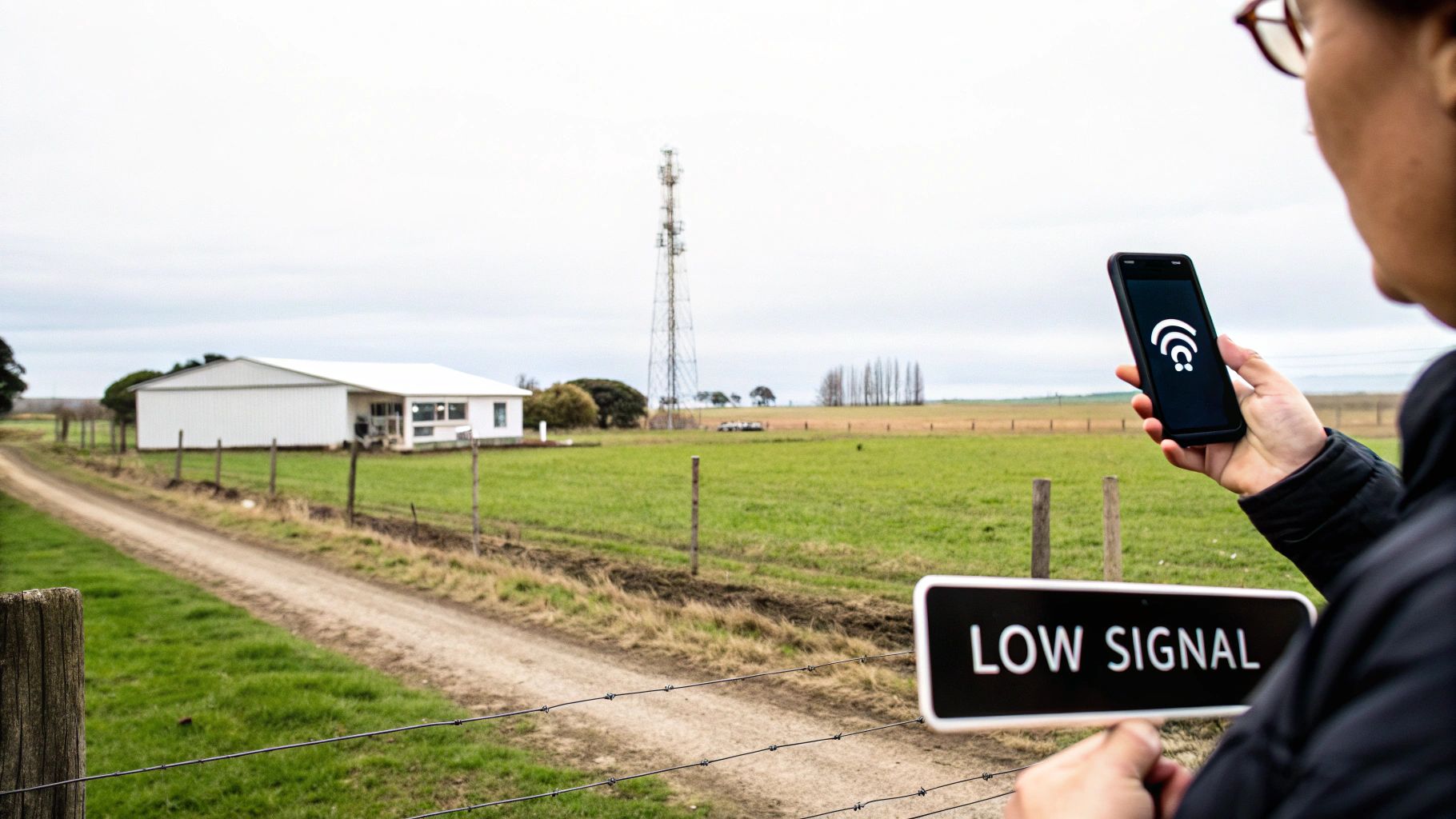
An unreliable mobile connection is far more than just a minor inconvenience. It’s a direct hit to business operations, a risk to personal safety, and a barrier that cuts you off from the digital world. It doesn't matter if you're trying to coordinate a crew on a construction site, keep in touch with family from the bach, or just make a simple, clear call from your home—a weak signal stops you in your tracks.
Think of this guide as your complete roadmap to understanding, choosing, and legally using a cell phone signal booster in NZ. We’re zeroing in on high-quality, fully compliant solutions from specialist suppliers who live and breathe this technology. That’s how you get a system that actually works, safely and effectively.
Identifying Your Signal Problem
Before you can fix the problem, you need to know what’s causing it. Different environments throw up their own unique challenges, but the result is always the same: a patchy, unreliable connection right when you need it most.
To make it clearer, we've put together a quick table that matches common signal headaches with the real-world fix a booster provides.
Common Signal Problems and Their Solutions
| Common Problem | Why It Happens | How a Signal Booster Helps |
|---|---|---|
| Dropped Calls Indoors | Building materials like concrete, steel, and modern Low-E glass are notorious signal killers. | It acts like a bridge, capturing the mobile signal outside and piping a strong, clean version of it inside, completely bypassing the blocking materials. |
| Painfully Slow Mobile Data | The further you are from the nearest cell tower, the weaker the signal gets. It's simple physics. | A booster amplifies that faint, distant signal, which can dramatically improve your data speeds for everything from browsing to streaming. |
| Unreliable Connection in a Vehicle | The metal body of a car or truck creates a 'Faraday cage,' blocking signals. Plus, you’re always moving, which makes holding a connection tricky. | A vehicle-specific antenna grabs signal from all directions, feeding it to an in-cab booster that creates a stable bubble of connectivity while you're on the move. |
| No Signal on a Boat | Being far from shore is one problem; the reflective surface of the water scrambling what little signal is left is another. | A proper marine-grade antenna and a powerful amplifier are designed to lock onto distant land-based towers, giving you reliable coastal communication. |
This guide will walk you through how to tackle every one of these common hurdles. As New Zealand's mobile networks get better and better—the local market is projected to hit USD 4.71 billion by 2030—making sure you can actually access that network is crucial. While the big telcos are investing heavily, a signal booster is often the final, essential piece of the puzzle for bridging coverage gaps in those tricky locations. You can explore more about these trends and the importance of reliable infrastructure here.
How a Signal Booster Creates a Clear Connection
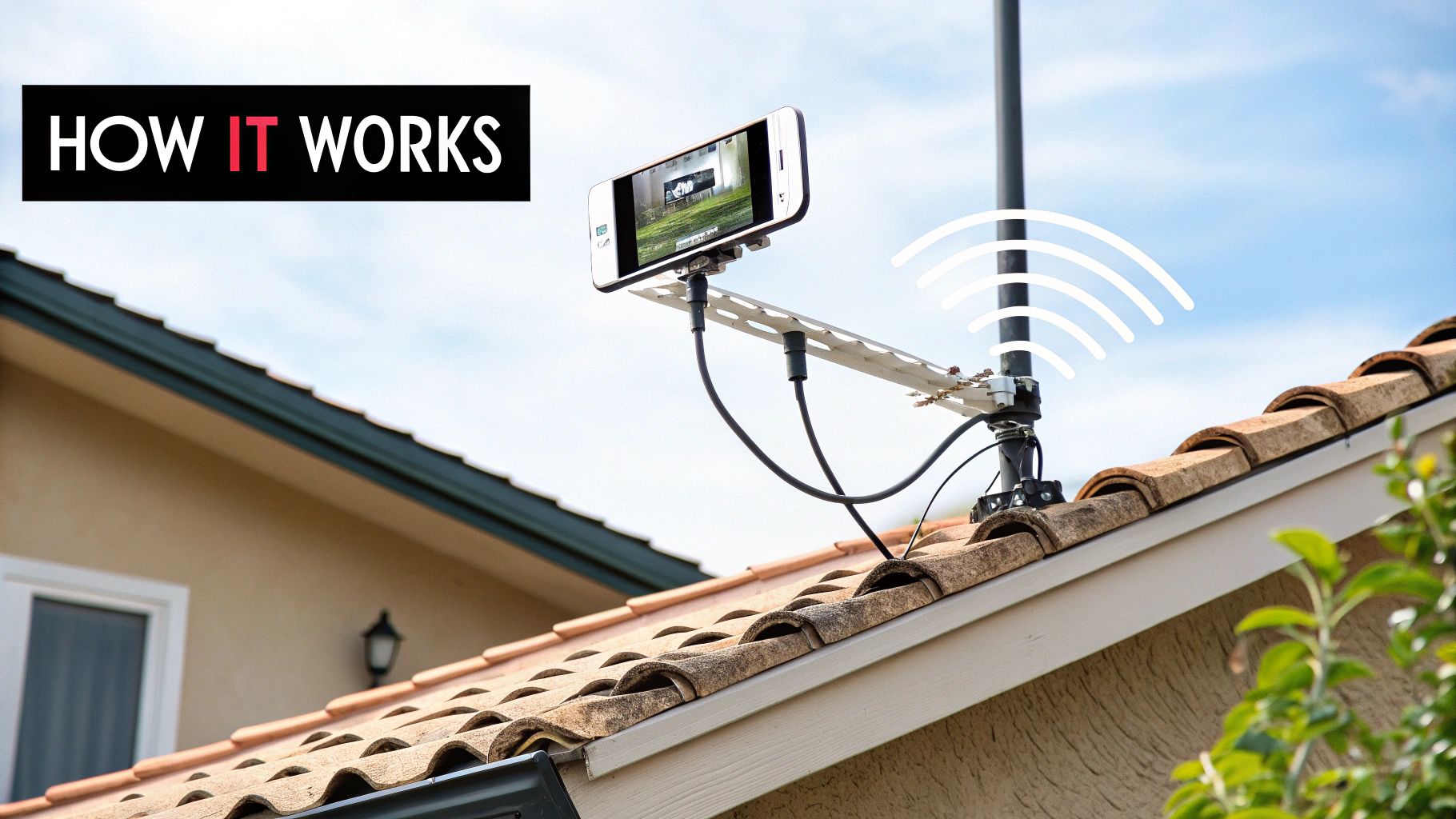
It’s easy to look at a cell phone signal booster and assume it’s some kind of tech wizardry. But what it actually does is surprisingly simple and clever.
Think of it like a sound system for your mobile signal. A weak voice in a big hall is useless, but with a microphone, amplifier, and speaker, that same voice can reach every corner. A signal booster does the exact same thing for mobile reception. It doesn't magically create a signal out of thin air; it just grabs the faint one that's already there and gives it a massive boost.
The Three Core Components
The whole system is a team effort, with three key players working together to turn dropped calls and slow data into a strong, reliable connection.
Let's break down how each part contributes.
-
The Outdoor Antenna (The Microphone): This is where it all starts. Mounted high up on your roof or vehicle, this antenna acts like a high-powered microphone. Its one job is to "listen" for and catch the weak mobile signal coming from the nearest cell tower. Getting this placement right is absolutely CRUCIAL for the whole system to work well.
-
The Amplifier (The Powerhouse): Once that faint signal is caught, it travels down a high-quality, low-loss coaxial cable to the amplifier unit. This is the heart of the system. The amplifier, often a Cel-Fi unit, takes that weak signal, cleans up any noise, and boosts its strength significantly—all without interfering with the wider mobile network.
-
The Indoor Antenna (The Speaker): Finally, that newly powerful signal needs to get to your phone. The indoor antenna is the "speaker" in our analogy. It takes the amplified signal and rebroadcasts it throughout your home, office, or vehicle, creating your own personal hotspot of excellent coverage.
But this isn't just a one-way street. A cell phone signal booster in NZ doesn't just improve what you receive; it also boosts the signal your phone sends back to the tower.
This return journey, or 'uplink amplification', is just as important. It’s what makes sure your texts send instantly, your emails actually upload, and people can hear you clearly on a call. It completes the loop for truly seamless communication.
Ultimately, these three components work in harmony to punch through the physical barriers—like concrete walls or a metal vehicle roof—that block mobile signals. The booster system creates a direct, high-powered bridge between the cell tower and your device.
The result? You go from one frustrating bar to five bars of crystal-clear connectivity. Problem solved.
Navigating the Legal Rules for Signal Boosters in NZ
Before you jump online and start searching for a cell phone signal booster in NZ, it’s absolutely VITAL to get your head around the local laws. New Zealand's radio spectrum isn't a free-for-all; it's a carefully managed public resource. Using the wrong gear can land you in hot water and cause major headaches for everyone around you.
The organisation tasked with keeping our airwaves clean and clear is the Radio Spectrum Management (RSM). Their job is to make sure every wireless device, from your mobile phone to a paramedic's radio, plays nicely together without causing chaos. This is exactly why the legality of signal boosters is such a big deal.
Why Most Boosters You Find Online Are Illegal Here
It’s pretty tempting to browse international auction sites and grab what looks like a bargain booster. The problem is, the vast majority of these devices are completely illegal to switch on in New Zealand.
These uncertified boosters are often cheaply made and essentially "shout" over the mobile networks, creating a massive amount of radio interference. This isn't just a small annoyance; the consequences can be serious, and frankly, dangerous.
- Creating Dead Zones: An illegal booster can easily overpower the signal for your neighbours, creating a brand-new black spot in your community where there wasn't one before.
- Disrupting Emergency Services: Most critically, this interference can cripple the communication networks used by police, fire, and ambulance services. In a life-or-death situation, that's a risk no one can afford to take.
Because the stakes are so high, getting caught operating an uncertified booster can lead to heavy fines and having your equipment confiscated. The responsibility falls squarely on the person using it—that means you could be held liable for any disruption it causes.
Here’s the bottom line: only signal boosters that are officially approved by New Zealand's mobile carriers and comply with RSM rules are legal to use. Getting your gear from a specialist provider is the only way to be certain you're getting a safe, effective, and 100% legal system.
The Authorised Solution: Cel-Fi by Nextivity
So, what’s the right way to boost your signal without breaking the law? The answer is a carrier-approved, smart signal repeater.
In New Zealand, the leading—and fully authorised—brand is Cel-Fi by Nextivity. Cel-Fi systems are intelligent boosters that have gone through rigorous testing and are approved for use by all major NZ mobile networks, including One NZ, 2degrees, and Spark.
Unlike the illegal repeaters, a Cel-Fi unit is designed to cooperate with the local mobile network. It cleverly monitors and adjusts its own power to prevent interference, making sure it boosts your signal without wrecking the network for others. This "network safe" design is precisely why Cel-Fi is the only brand of signal booster widely authorised for use across the country.
When you invest in a Cel-Fi system from a reputable specialist like Mobile Systems, you’re not just buying a box of electronics. You’re getting a fully compliant, powerful, and safe solution that’s guaranteed to work with your provider. It’s the smart way to fix your signal problems for good, without the legal risks or the danger to public safety.
Choosing The Right Booster For Your Environment
Alright, so you understand the tech and the legal side of getting a cell phone signal booster in NZ. Now for the important bit: picking the right one for your specific situation. Choosing the right system isn't about grabbing the biggest, most powerful box off the shelf. It's about matching the gear to the unique challenges of your environment.
Think about it – a booster designed for a ute bouncing along rugged forestry tracks is built completely differently to one meant to cover a large commercial building. Every scenario, from a remote farmhouse to a construction digger, has its own set of signal problems that need a purpose-built solution.
Boosters for Rural Homes and Farm Buildings
The classic challenge for rural New Zealand is twofold: you're miles from the nearest cell tower, and the building itself is working against you. Steel-clad farm sheds, modern homes with iron roofs, and even dense native bush can easily smother what little signal makes it to your property.
For this exact problem, a stationary system like the Cel-Fi GO G41 is the perfect tool. When we pair it with a high-gain directional antenna on the roof, it can lock onto a faint, distant signal and give it a massive boost. This kind of setup is ideal for bringing reliable connectivity to a farmhouse, workshop, or rural bach, turning a useless one-bar connection into something you can actually depend on.
Solutions for Vehicles, Utes and 4WDs
Vehicles are a whole different kettle of fish. They're always moving, meaning the signal strength and direction are constantly in flux. Plus, the metal body of a car or ute acts like a Faraday cage, actively blocking mobile signals from getting inside.
This is where a mobile-specific booster like the Cel-Fi GO G31 shines. These kits use a tough, omni-directional external antenna that pulls in signal from all directions as you drive. A small, low-profile antenna inside then rebroadcasts the boosted signal throughout the cab. This ensures drivers have solid communication for calls and GPS, no matter how far off the beaten track the job takes them.
This simple chart highlights the critical difference between getting a legal, compliant booster versus an illegal one.
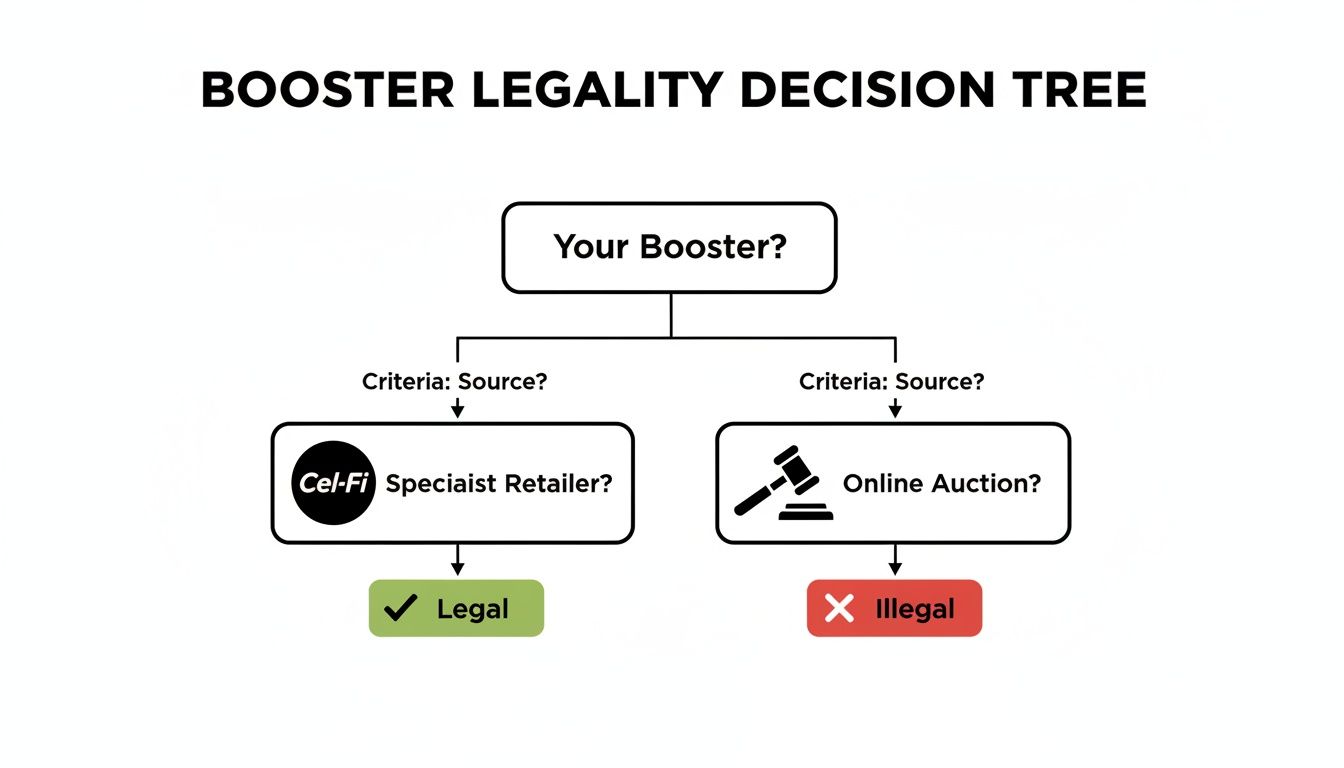
The takeaway is straightforward: buying from a specialist dealer guarantees you get a network-safe, legal Cel-Fi unit. Online auction sites, on the other hand, are often flooded with illegal boosters that can cause serious network interference.
Keeping Heavy Machinery and Marine Vessels Connected
Heavy machinery on construction or forestry sites operates in some of the most punishing environments imaginable, often deep in signal black spots. In the same way, boats and marine vessels have to deal with being a long way from shore and signal interference bouncing off the water.
For these demanding jobs, we use specialised kits. They feature incredibly durable antennas from trusted brands like RFI and Pacific Aerials that are built to handle constant vibration, dust, salt spray, and extreme weather. These robust systems are all about keeping operators connected for safety and operational efficiency, even in the most isolated locations. If you want to dig deeper into the options, you can learn more about the Cel-Fi product range and its various applications.
A professional-grade cell phone signal booster isn't just one device; it's a complete system. The amplifier, the antennas, and the cabling are all carefully chosen to work together, designed to overcome the specific signal challenges you're facing, whether that's in a fixed building or a moving vessel.
Cel-Fi Booster Application Guide
To help you get a quick idea of what system fits where, this table matches common New Zealand scenarios with the recommended Cel-Fi booster. It’s a simple way to see which solution is engineered for your specific challenge.
| Application | Primary Challenge | Recommended System | Key Feature |
|---|---|---|---|
| Rural Home or Bach | Distance from tower and signal-blocking building materials. | Cel-Fi Stationary Kit | High-gain directional antenna to capture weak, distant signals. |
| Ute or Fleet Vehicle | Constant movement and the vehicle's metal body blocking signal. | Cel-Fi Mobile Kit | Omni-directional antenna for 360-degree reception on the move. |
| Commercial Office | Large coverage area and internal walls obstructing signal. | Custom Cel-Fi Solution | Multiple indoor antennas for even coverage across large spaces. |
| Marine Vessel | Distance from land and harsh salt-water environment. | Cel-Fi Marine Kit | Durable, marine-grade antenna designed for coastal use. |
Once you pinpoint your specific need, it becomes clear that there's a professional, legal, and highly effective solution ready to go. The goal is always to choose the right tool for the job, guaranteeing you get a strong, reliable connection exactly where you need it most.
Why Professional Installation Maximises Performance
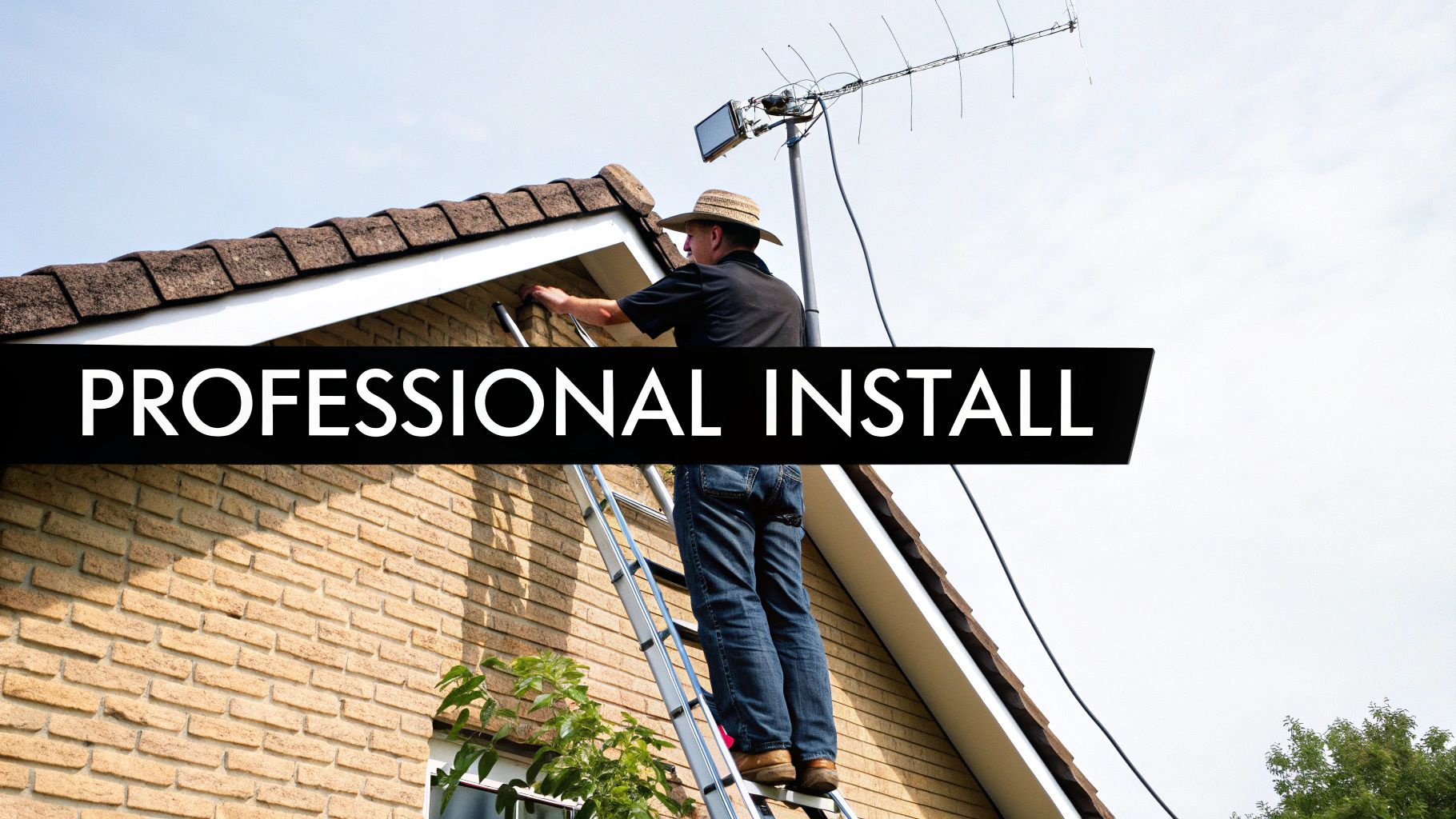
Buying a quality, legal cell phone signal booster in NZ is a great start, but it's only half the story. To truly unlock the system’s full power and get the solid five-bar reception you’re paying for, a professional installation is the only way to go. It’s the difference between a system that sort of works and one that performs brilliantly.
Think of it like this: you wouldn't buy a high-performance engine then just guess where to connect the fuel lines. A signal booster is no different. The precise placement of antennas, the quality of the cabling, and the final setup all require a bit of expertise to squeeze every last drop of performance out of the hardware. A specialist approach makes sure you get the absolute BEST return on your investment.
The Specialist Process: From Start to Finish
At Mobile Systems, we have a proven process designed to deliver solid, long-lasting results. We don't just sell you a box; we provide a complete solution that starts with getting to know your unique environment inside and out.
Our entire process is built on meticulous attention to detail.
-
Comprehensive Site Assessment: The first—and most critical—step is a thorough site survey. We use specialised gear to find the absolute best spot for the outdoor antenna, pinpointing exactly where the signal from the cell tower is strongest and cleanest. This step alone can make a massive difference to the final result.
-
Strategic Component Placement: Next, we figure out the most effective placement for the internal bits and pieces. The amplifier needs a safe, ventilated spot, while the indoor antenna has to be positioned to create the best possible coverage bubble right where you need it most—whether that’s your living room, office, or the cab of your truck.
-
Professional and Discreet Cable Routing: How the signal gets from the roof to the amplifier really matters. We use high-quality, low-loss coaxial cabling and route it professionally to minimise any signal drop-off and ensure a clean, tidy, and weather-resistant installation.
This methodical approach is all about preventing common DIY pitfalls like signal feedback (oscillation), incorrect antenna polarisation, and signal loss from dodgy connections.
Expertise in New Zealand’s Toughest Environments
Our experience goes well beyond typical home installations. We specialise in kitting out assets that operate in New Zealand's most rugged and demanding conditions, where reliable communication is often a matter of safety, not just convenience.
We have heaps of experience installing systems on:
- Commercial Fleet Vehicles: Including utes, trucks, and vans that regularly travel through known black spots.
- Heavy Machinery: For forestry, construction, and agriculture, where vibrations and harsh conditions are just part of the job.
- Marine Vessels: From commercial fishing boats to recreational launches, requiring durable, salt-resistant hardware.
For these challenging jobs, we rely exclusively on trusted, high-performance brands engineered to handle the elements. We use Cel-Fi amplifiers, known for their rock-solid reliability, alongside incredibly durable antennas and mounting hardware from industry leaders like RFI and Pacific Aerials.
Ongoing Support and Peace of Mind
Our service doesn't stop once the installation is done. We provide comprehensive support to make sure your system continues to perform flawlessly. Whether it's a routine check-up or a bit of troubleshooting, our team is here to help. For those interested in the nitty-gritty of stationary units for buildings, our detailed breakdown of the Nextivity Cel-Fi GO G41 Stationary Repeater offers a deeper dive into the technology.
Choosing a professional installation for your cell phone signal booster in NZ means you're investing in reliability, performance, and the peace of mind that comes from knowing the job was done right the first time.
Building Your Complete Communications Toolkit
A powerful, legal cell phone signal booster NZ is a fantastic piece of kit for fixing weak reception, but it's important to see it as one part of a much bigger communications strategy. For anyone operating across New Zealand’s diverse and often challenging landscapes, true connectivity means having the right tool for the right job. A booster is brilliant when there's some signal to work with, but what about when you’re in a genuine black spot?
This is where a layered approach becomes absolutely ESSENTIAL for safety and keeping things running smoothly. A booster can only strengthen what’s already there; it can’t create a signal out of thin air. For those moments when you are completely off the grid, other technologies have to step in and fill that gap.
When There Is ZERO Mobile Signal
Deep in the remote valleys, dense bush, or out on the water where mobile coverage is just a memory, you need a solution that bypasses cell towers altogether. This is where satellite communications come into play.
- Satellite Phones: Devices from providers like Iridium give you genuine global voice and text capability. For teams working in serious isolation, a sat phone isn’t a luxury—it’s a non-negotiable piece of safety equipment, providing a reliable lifeline back to base.
- Satellite Messengers: Something like a Garmin inReach is another brilliant option. It allows for two-way text messaging, location sharing, and critical SOS functions, all running on the Iridium satellite network. It’s a compact and powerful tool for lone workers or adventurers.
These devices ensure that even when you're far beyond the reach of the last cell tower, you’re never truly out of contact. They deliver peace of mind and an essential safety net.
For Instant On-Site Team Coordination
While a booster helps you connect with the outside world, it doesn’t solve the need for instant, on-site chatter between team members. On a noisy construction site, across a sprawling farm, or during a busy event, coordinating a crew requires immediate, push-to-talk reliability.
This is where professional two-way radios (UHF/VHF) are simply unmatched. Offering clear, instantaneous, and private communication channels, they are the backbone of efficient teamwork in demanding environments.
Brands like Tait, Motorola, and Hytera make rugged, dependable radios built for exactly these scenarios. Unlike mobile phones, they don't rely on a public network, ensuring your team stays connected even if the local cell service drops out. They're built for operational efficiency, with no call connection delays or dropped signals within your work area.
To build a truly resilient communications setup, it can also be helpful to know how to effectively forward cell phone calls when a direct signal is unreliable. And for a closer look at how these different technologies stack up, check out our insights on the difference between a cell booster and a WiFi booster in NZ.
By understanding where a signal booster fits alongside satellite phones and two-way radios, you can design a truly comprehensive communications plan that ensures safety and productivity, no matter where you are in New Zealand.
Common Questions About Signal Boosters
Even after seeing the benefits, jumping into the world of cell phone signal boosters in NZ can bring up a few questions. To help you feel confident you're making the right call, we've put together answers to some of the most common queries we get from Kiwis just trying to get a reliable connection.
Think of this as the final piece of the puzzle, giving you the clarity to move forward.
Will a Cel-Fi Signal Booster Work with My NZ Mobile Carrier?
Yes, absolutely. The Cel-Fi GO series boosters we supply are fully approved by all New Zealand carriers and can be set up for One NZ, 2degrees, or Spark.
When you work with a specialist like us, we program the device specifically for your mobile network. This guarantees you get powerful, seamless, and completely legal signal boosting, giving you the best possible performance for your chosen provider.
Can I Install a Cell Phone Signal Booster Myself?
While some of the simpler vehicle kits are designed for a straightforward DIY setup, getting the best result for a home, commercial building, or boat really needs a professional touch. A specialist installation is about much more than just plugging in a few cables.
A professional will:
- Use proper equipment to survey for the best possible signal and find the perfect spot for the roof antenna.
- Run high-quality, low-loss cabling correctly to make sure you don't lose the precious signal you've just captured.
- Position the internal antennas strategically to blanket your indoor area with strong coverage.
Getting it done right from the start avoids common headaches and makes sure you're getting every bit of performance you paid for.
Is a Signal Booster the Same as a Wi-Fi Extender?
That's a great question, but no, they're completely different bits of kit solving two very different problems. A Wi-Fi extender (or booster) simply grabs the internet signal from your router and rebroadcasts it to fill in Wi-Fi dead spots inside your property. It has zero effect on your mobile reception.
In contrast, a cell phone signal booster is all about the mobile network. It captures a weak cellular signal (like 4G or 5G) from the nearest tower, gives it a massive power-up, and then delivers strong, usable mobile reception for calls, texts, and data.
How Much Coverage Can I Expect from a Booster?
The actual coverage area you'll get inside depends on a few things: how strong the signal is outside, which booster model you have, and what your building is made of (concrete and metal roofing are notorious signal killers).
As a general rule, a standard home system can comfortably cover a large room or even a small house.
For bigger homes, workshops, or complex commercial spaces, a specialist can design a solution just for you. This might mean using multiple internal antennas to push a strong, reliable signal exactly where it’s needed, wiping out every last dead zone.
Ready to put your signal problems in the rearview mirror with a powerful, legal, and professionally supported solution? The team at Mobile Systems Limited has the expertise to design and install the perfect cell phone signal booster for your home, vehicle, or business.
Find your complete communication solution at https://mobilesystems.nz
Related posts

- May 24, 2026
Our expert Starlink review NZ looks at speed, pricing, and reliability for business, farm, and maritime use. See if it's...

- May 23, 2026
Approximately 40% of New Zealand's landmass remains outside the reach of traditional mobile networks. For professional teams operating in remote...

- May 14, 2026
A complete guide to Starlink setting up for NZ businesses. Learn pro tips on site survey, mounting, network integration, and...