
Solve Poor Mobile Coverage: Your NZ Guide to Mobile Cell Phone Signal Booster Solutions
Struggling with weak signal in NZ? Learn how a mobile cell phone signal booster transforms connectivity for your vehicles, vessels, and remote teams.
A mobile cell phone signal booster is a legal, carrier-approved device that does one thing incredibly well: it finds a weak external mobile signal, amplifies it, and then rebroadcasts it inside your vehicle, vessel, or worksite. For New Zealand businesses, this transforms a frustrating, one-bar connection into a strong, reliable link for communication and safety.
Is a patchy mobile signal putting your lone workers at risk? Are you seeing expensive project delays stack up because your teams in the field can't be reached? For businesses operating across New Zealand's diverse and often challenging terrain, poor mobile reception is a serious operational liability. A legally compliant mobile cell phone signal booster isn't just a handy gadget—it's mission-critical equipment for productivity and safety.
Dropped Calls and Dead Zones: The Real Cost to Your NZ Business
Across New Zealand's unique landscapes—from dense forestry blocks and remote farms to sprawling construction sites—poor mobile reception is more than an annoyance. It’s a direct threat to safety, productivity, and your bottom line.
If you’re a business owner, operational manager, or Health and Safety leader, you know the daily frustration. Dropped calls with key clients, failed data uploads from the field, and the inability to contact remote teams can bring operations to a grinding halt. This communication breakdown hits hard, especially in industries where real-time coordination is everything.
Operational Pain Points Across New Zealand Industries:
- Agriculture & Horticulture: Coordinating teams across vast properties and ensuring lone worker safety during planting or harvest.
- Construction: Managing machinery, logistics, and on-site teams where cell coverage is often non-existent on new sites.
- Emergency & Disaster Response: Maintaining critical communication links when existing infrastructure is damaged or overloaded.
- Forestry: Ensuring the safety of harvesting crews working deep in remote blocks, far from reliable signal.
- Manufacturing & Processing: Coordinating logistics and staff across large, signal-blocking concrete and steel structures.
- Maritime, Marine & Fishing: Staying connected for safety, weather updates, and operational logistics once offshore.
- Transport, Logistics & Fleet: Tracking vehicles, updating drivers with new instructions, and confirming deliveries in real-time.
- Lone Workers & Remote Field Teams: A reliable signal is their primary lifeline, essential for regular check-ins and emergency support, fulfilling your obligations under the Health and Safety at Work Act 2015.
When an urgent instruction can't get through or a lone worker can't check in, the consequences can be severe. This is the problem a professional-grade mobile cell phone signal booster is engineered to solve. It captures even a faint, unusable signal from the nearest cell tower, powerfully amplifies it, and rebroadcasts a strong, usable signal right where you need it—inside your ute, truck, heavy machinery, or vessel.
How a Mobile Signal Booster Actually Works
A mobile signal booster doesn't create a signal out of thin air. Instead, it acts like a powerful megaphone system, taking a weak, unusable signal and making it strong and clear.
The entire system relies on three core components working together to capture, amplify, and rebroadcast a mobile signal. This is the key to keeping your teams connected in even the most challenging corners of New Zealand.
The Three Key Components
Every professional-grade mobile signal booster system is built around three distinct pieces of hardware, each with a critical job.
-
The External Antenna: This is the ‘catcher’. Mounted on the outside of your vehicle or vessel, its sole job is to find and lock onto the faintest available mobile signal from the nearest cell tower. The quality of this antenna is critical for performance, especially in rugged NZ terrain.
-
The Amplifier (or Booster): This is the engine of the system. It takes the weak signal captured by the external antenna and powerfully boosts its strength, often by up to 100dB, making it strong enough for reliable calls, texts, and mobile data.
-
The Internal Antenna: This is the ‘broadcaster’. Placed inside your vehicle's cab or workspace, it takes that newly amplified signal and distributes it, creating a localised zone of strong, reliable coverage for any mobile device in the immediate area.
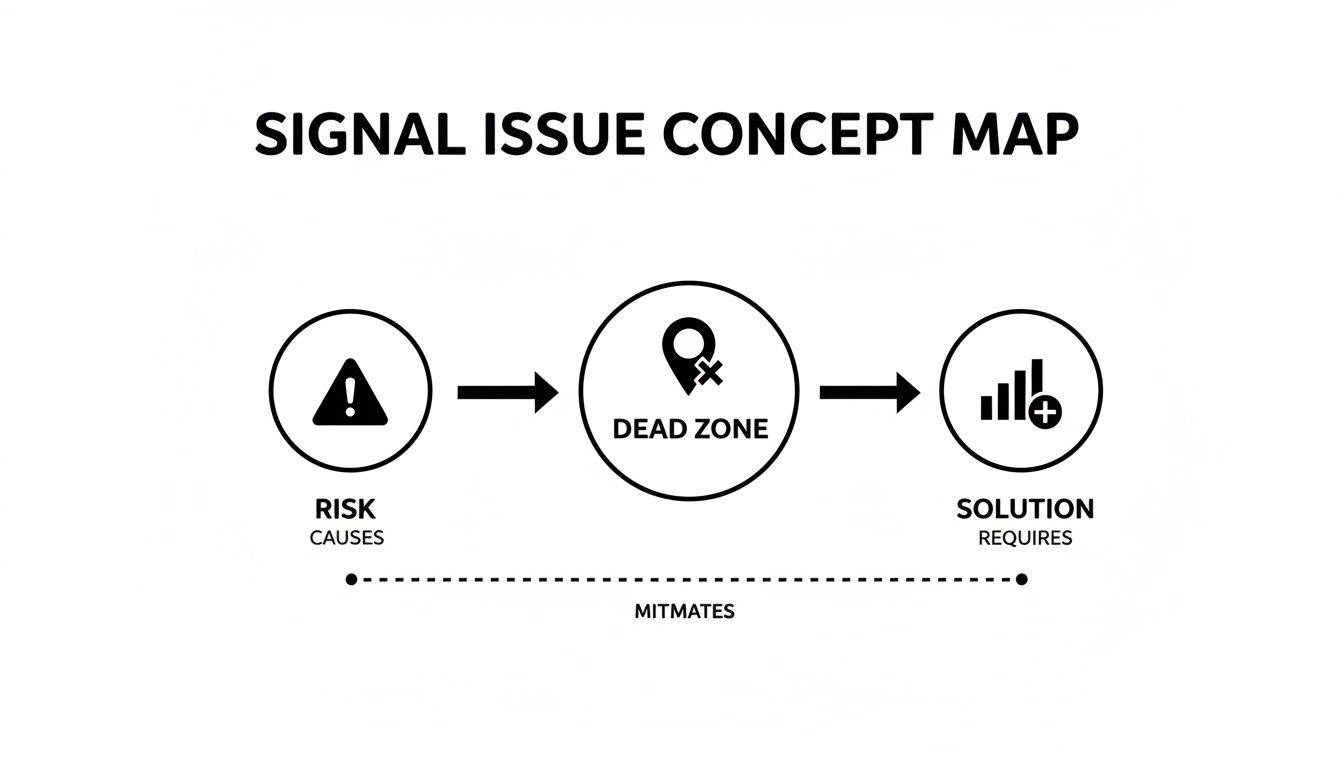
This diagram shows how a signal dead zone is transformed from an operational risk into a solved problem.
NZ Compliance: Why Legal Boosters Are Non-Negotiable
Here in New Zealand, you cannot simply install any signal booster. The rules set by Radio Spectrum Management (RSM) are strict for a critical reason: public safety. An unapproved or poorly installed booster can create serious interference on the mobile network, potentially blocking crucial communications, including calls to emergency services like 111.
All mobile boosters must be approved by the mobile network operators (Spark, One NZ, 2degrees). Currently, only Cel-Fi models are certified for use in New Zealand. This isn't just red tape; it's a safeguard against real-world incidents where illegal boosters have compromised public safety. You can read the official guidelines for mobile boosters in New Zealand on the RSM website.
Why Compliance is Mission-Critical: Using an uncertified mobile cell phone signal booster risks heavy fines and can interfere with public safety networks. At Mobile Systems, we exclusively supply and install Cel-Fi systems. They are the only legally compliant and carrier-approved boosters in New Zealand, ensuring your solution is both effective and responsible.
Choosing the Right Signal Booster for Your Fleet
Selecting the right mobile signal booster isn't a one-size-fits-all task. The best equipment for a long-haul truck crossing the Desert Road is fundamentally different from what a fishing vessel needs off the coast. The right choice depends on your vehicle type, the terrain you cover, and your operational needs.
In-Vehicle Boosters for Utes, Trucks, and Heavy Machinery
This is the most common solution for New Zealand businesses. Designed for a single vehicle, these kits are perfect for sales reps, field service technicians, and operators of heavy machinery like diggers, graders, and harvesters. A standard in-vehicle setup includes an external antenna, the Cel-Fi amplifier unit, and a small internal antenna that creates a bubble of strong signal inside the cab.
- Key Features: Compact design, powered directly by the vehicle’s 12V system, and powerful signal gain up to 100dB to dramatically improve call quality and data speeds.
- Operational Advantages: Ensures drivers and operators are always reachable. They can access digital job sheets, stream data, and use GPS navigation without dropouts in fringe coverage areas.
- Safety Improvements: Guarantees a reliable communication link for lone workers, meeting Health and Safety obligations.
Rugged Marine Boosters for Commercial Vessels
New Zealand’s maritime environment is harsh. Salt spray, constant moisture, and heavy vibration will destroy standard electronics. A dedicated marine signal booster is essential for any commercial or recreational vessel. These systems use specialised antennas and components engineered to withstand marine conditions, with corrosion-resistant materials like fibreglass and stainless steel ensuring reliability miles offshore.
- Key Features: IP-rated for water and dust ingress, corrosion-resistant antennas, and ruggedised components to withstand shock and vibration.
- Operational Advantages: Maintains a vital link to shore for weather updates, logistics, and client communication.
- Safety Improvements: Ensures reliable communication with Coastguard and other vessels in an emergency.
Industry-Specific Solutions: Getting It Right
A generic approach to communication falls short in the real world. At Mobile Systems, we provide end-to-end support tailored to your industry, including programming, professional installation, servicing, and coverage mapping.
- Construction: Your key challenges are rugged terrain, signal-blocking materials, and the need for absolute reliability. A professionally installed Cel-Fi GO in each vehicle and machine ensures site managers and operators are always connected, improving safety and reducing downtime. High IP ratings are essential for dusty, wet environments.
- Forestry: Lone worker safety is paramount. We equip heavy machinery with ruggedised boosters and high-gain antennas to maintain communication deep within forestry blocks, ensuring your team meets its WorkSafe NZ obligations for workers who operate alone.
- Transport & Logistics: For nationwide fleets, consistency is key. We provide scalable solutions with standardised hardware across all vehicles. This ensures every driver has the same reliable communication tool for real-time updates, route changes, and proof-of-delivery uploads, which is a cornerstone of effective fleet management best practices.
- Maritime & Fishing: We understand the demands of the marine environment. Our marine-specific installations use salt-resistant antennas and waterproofed connections to guarantee reliable communication for safety, weather, and operations, even when you're far from shore.
Insider Knowledge: Avoiding Common Mistakes
With over 20 years of field experience, we've seen what works and what doesn't. Here are some common mistakes New Zealand businesses make and how Mobile Systems helps you avoid them:
- Mistake 1: Choosing the Wrong Antenna. Many businesses underestimate the importance of the external antenna. A cheap, low-gain antenna will cripple the performance of the best booster.
The MSL Solution: We assess your specific operating environment—whether it's open country, hilly terrain, or offshore—and m
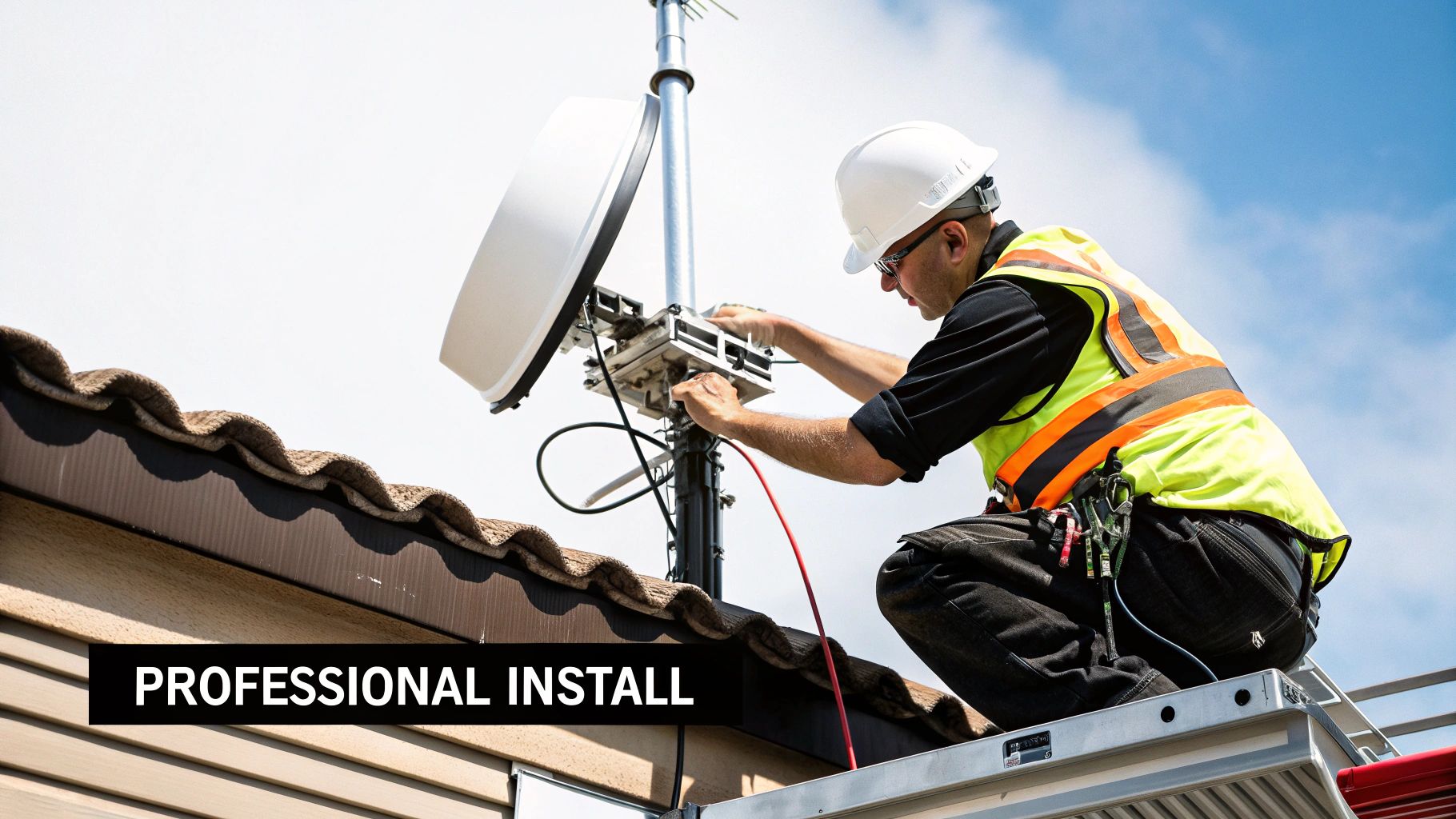
- Mistake 2: DIY Installation. Incorrect antenna placement is the number one cause of poor performance. If the internal and external antennas are too close, the system creates feedback and shuts down, leaving you with no signal boost at all.
The MSL Solution: Our technicians are experts in antenna placement. We use diagnostic tools to find the optimal location on your vehicle or vessel, guaranteeing maximum performance and preventing system oscillation.
- Mistake 3: Neglecting Battery and Power Management. In a commercial fleet, inconsistent power supply or poor wiring can lead to system failures, especially in high-vibration environments like heavy machinery.
The MSL Solution: Our professional installation includes secure, direct-to-power wiring that ensures a reliable power source, protecting your investment and guaranteeing the system is always ready when you need it.
NZ Compliance, Safety, and Operational Considerations
For a commercial operation, a communication system must be more than just functional; it has to be safe, compliant, and reliable.
- Critical Communications & Lone Worker Safety: For lone workers, a reliable signal is a critical control measure under the Health and Safety at Work Act 2015. A legal booster ensures they can call for help in an emergency.
- Durability (IP Ratings): New Zealand work environments are tough. Equipment must be rated to withstand dust, water, vibration, and shock. We recommend devices with appropriate IP (Ingress Protection) ratings for your industry.
- RSM Licensing: While Cel-Fi boosters are legal, their use is subject to conditions. We handle the compliance details to ensure your system is fully compliant with RSM regulations.
- Acoustic Safety: In loud environments like construction sites or processing plants, we can pair your communication system with hearing protection headsets to ensure clear audio without compromising worker safety.
Recommended Solutions for New Zealand Businesses
We guide you to the right tools for the job, focusing on equipment proven to perform in New Zealand conditions. Our solutions are built around trusted, industry-leading brands.
- PoC (Push-to-Talk over Cellular) Radios: For team-based communication over the cellular network, devices like the Hytera P50 or Motorola TLK110 offer nationwide coverage.
- UHF/VHF Two-Way Radios: For localised, off-grid communication, we recommend robust radios from brands like Tait, Motorola, Hytera, Icom, and GME.
- Satellite Devices: When you're completely off the grid, we provide solutions from Starlink, Iridium, and Inmarsat to ensure you're never out of reach.
- Mobile Phone Signal Boosters: For amplifying existing cellular signal, we exclusively use Cel-Fi products, the only legal and carrier-approved boosters in New Zealand.
- GPS Tracking & Lone Worker Solutions: We integrate these systems to provide a complete safety and fleet management solution.
Why Choose Mobile Systems Limited?
Choosing a communications partner is a decision based on trust. You need a team that understands the demands of your industry and is committed to your long-term success.
Mobile Systems Limited is a 100% NZ-owned company based in Mount Maunganui, and we have been serving New Zealand businesses for nearly two decades. We are not just a supplier; we are your hands-on communications partner.
Our commitment to you is built on:
- NZ-Specific Expertise: We have years of practical, on-the-ground experience solving communication challenges in local industries like forestry, construction, transport, and marine.
- Mobile On-Site Support Fleet: Our technicians come to you. We provide expert installation, programming, and servicing at your worksite, depot, or marina, minimising disruption to your operations.
- Custom Coverage & Licensing Support: We handle the technical details, from planning a solution that fits your exact needs to managing RSM licensing, ensuring your system is compliant from day one.
- Long-Term Reliability and Aftercare: Our relationship doesn’t end with the sale. We provide ongoing support and servicing to ensure your investment continues to perform for years to come.
We deliver confidence. We provide the assurance that when a critical call needs to be made, it will get through. Every time.
Get Expert Guidance for Your Business
Ready to eliminate dropped calls and signal dead zones for good? Don't leave your team's safety and productivity to chance. The expert team at Mobile Systems Limited is here with practical advice and proven solutions tailored for your New Zealand business.
Request a quote, ask for a demo, or simply get personalised device recommendations from a team that understands your challenges. Our goal is to provide a helpful, solutions-focused path to better communication.
Speak to a communications specialist today and discover how a compliant mobile signal booster can transform your operations.
FAQ: Your Questions Answered
Are mobile signal boosters legal in New Zealand?
Yes, but ONLY carrier-approved devices are legal. In New Zealand, this means Cel-Fi products, which are approved for use on the Spark, One NZ, and 2degrees networks. Using uncertified boosters from overseas can cause significant network interference and is illegal.
Will a booster work if there is absolutely no signal?
No. A mobile cell phone signal booster amplifies an existing signal. It needs at least a faint, weak signal outside to work with. If you are in a true black spot with zero signal, you will need an alternative technology like a satellite phone or Starlink.
How much coverage will I get inside my vehicle?
This depends on the strength of the external signal. In a fringe coverage area (e.g., one bar outside), a professionally installed booster will typically provide strong, reliable coverage throughout the entire cab of a truck, ute, or machine.
Can you outfit our entire fleet?
Absolutely. We specialise in scalable fleet-wide solutions. Our team works with you to create a standardised, professional installation plan for all your vehicles, ensuring consistent performance and reliability across your entire operation. We come to your site to minimise operational downtime.
What industries do you serve?
We work with a wide range of New Zealand industries, including agriculture, construction, emergency services, forestry, manufacturing, marine, transport and logistics, security, and tourism. Any business that operates in areas with challenging mobile coverage can benefit from our solutions.
Related posts

- July 04, 2026
Most 3G-era phone boosters stopped doing their job when NZ's 3G networks switched off in March 2026. Here's what actually...

- May 24, 2026
Our expert Starlink review NZ looks at speed, pricing, and reliability for business, farm, and maritime use. See if it's...

- May 23, 2026
Approximately 40% of New Zealand's landmass remains outside the reach of traditional mobile networks. For professional teams operating in remote...