
Satellite Phone Plans NZ: The 2026 Guide to Remote Connectivity
What if the most expensive part of your emergency communication strategy isn't the hardware, but the monthly fee you pay for a dial tone you never use? It's a common frustration for New Zealand business owners.
What if the most expensive part of your emergency communication strategy isn't the hardware, but the monthly fee you pay for a dial tone you never use? It's a common frustration for New Zealand business owners who find themselves paying upwards of NZ$1,200 annually per handset just for the peace of mind that it might work during a cyclone or in a remote forestry block.
You're right to be wary of standard contracts that don't account for the seasonal nature of remote work. Selecting the right satellite phone plans nz shouldn't feel like a gamble between high fixed costs and the fear of a connection failure when a staff member's safety is on the line.
This guide provides a clear framework to help you choose a reliable, cost-effective solution that fits your specific operational footprint. We'll examine the technical differences between LEO and GEO networks in the NZ bush and provide a transparent breakdown of total ownership costs to ensure your fleet stays connected without the hidden financial sting.
Key Takeaways
- Understand how New Zealand’s unique topography leaves 40% of the landmass without cellular coverage and why satellite technology is essential for remote safety.
- Compare the performance of Iridium’s global LEO satellites against Inmarsat’s geostationary network to determine which provides the most reliable connection for your specific location.
- Navigate the financial landscape of satellite phone plans nz by identifying the trade-offs between flexible prepaid vouchers and high-usage monthly contracts.
- Select hardware tailored to your industry, ensuring equipment used in sectors like forestry or logging meets the durability standards required for New Zealand’s rugged environments.
- Discover why investing in a managed communication system with local technical support provides greater long-term value than purchasing unconfigured standalone devices.
The Reality of Remote Connectivity in New Zealand
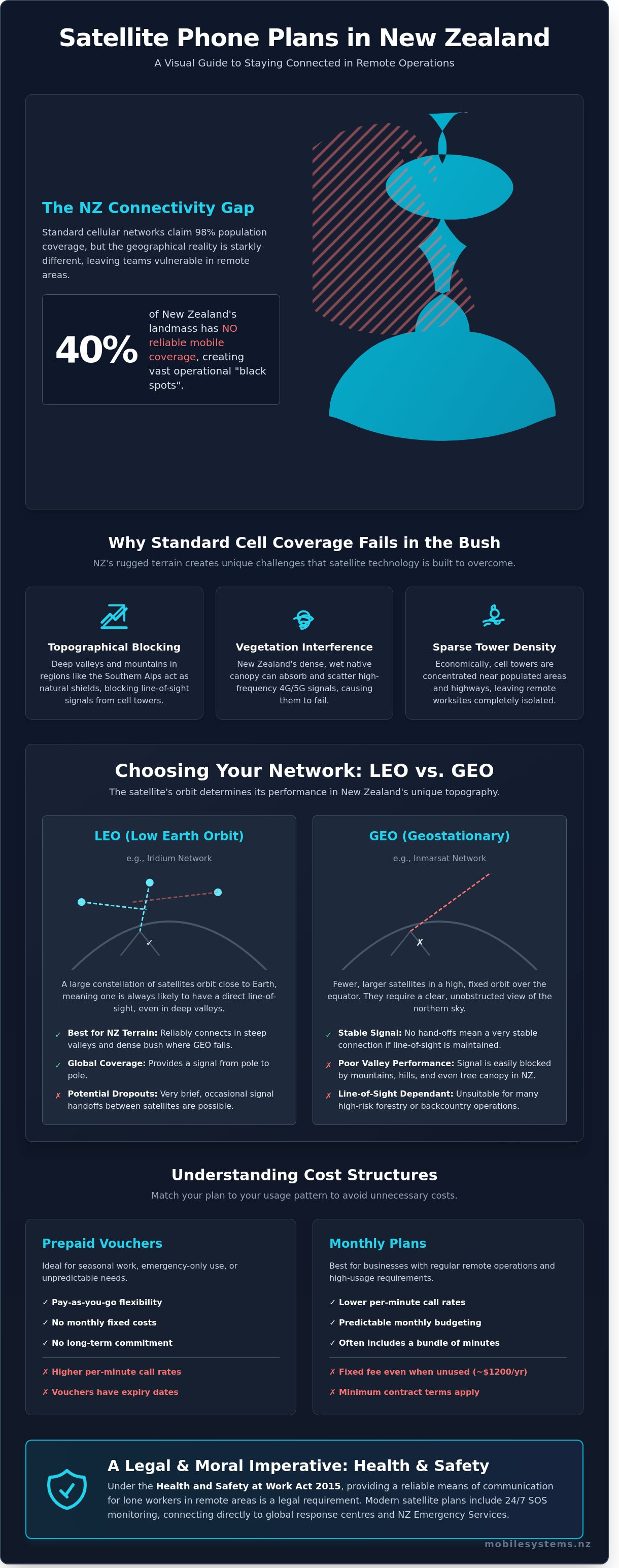
New Zealand's geography is famously rugged, but this beauty presents significant hurdles for digital communication. While mobile carriers claim to reach 98% of the population, the geographic reality is different. Approximately 40% of the New Zealand landmass has no reliable mobile coverage, leaving vast areas of the South Island and central North Island in total "black spots."
For businesses operating in forestry, agriculture, or tourism, satellite phone plans nz have transitioned from being a luxury emergency tool to a core operational requirement. Relying on consumer-grade cellular networks in the backcountry often leads to expensive delays and unnecessary risks. Professional satellite connectivity ensures your team stays reachable regardless of the terrain.
To better understand the current landscape of satellite technology, watch this helpful video:
c
Choosing the right plan requires understanding the underlying hardware. You'll generally choose between two network types: Low Earth Orbit (LEO) and Geostationary (GEO). If you're wondering What is a satellite phone? and how these networks differ, it's about the altitude and position of the satellites. LEO networks like Iridium use a constellation of satellites that orbit close to Earth, providing better coverage in steep NZ valleys compared to GEO satellites that sit fixed over the equator.
Why Standard Cell Coverage Fails in the NZ Bush
Standard cellular signals rely on line-of-sight between your device and a terrestrial tower. In the Southern Alps or the dense bush of the West Coast, "signal shadowing" occurs. This happens when physical obstacles like mountains or heavy wet canopy block the high-frequency waves used by 4G and 5G networks.
- Topographical Blocking: Deep valleys in regions like rural Otago act as natural shields, rendering cell towers useless just a few kilometers away.
- Vegetation Interference: NZ's dense native evergreen canopy can attenuate signals, especially in high-moisture conditions.
- Tower Density: Economic factors mean towers are concentrated near highways, leaving high-country stations and remote worksites isolated.
Relying on "one more bar" of signal is a dangerous gamble. In a crisis, a fluctuating cellular connection often fails exactly when the load on the network increases or weather conditions deteriorate.
The Role of Satellite in NZ Health and Safety
Under the New Zealand Health and Safety at Work Act 2015, PCBU (Persons Conducting a Business or Undertaking) must manage risks to lone workers. If your staff work in areas without mobile reception, providing a reliable means of communication isn't optional; it's a legal requirement. Satellite plans provide the necessary "fail-safe" for these environments.
Modern satellite phone plans nz often include 24/7 SOS monitoring features. When a worker triggers an emergency alert, it doesn't just send a text to a manager. It alerts a dedicated global response center that coordinates with local NZ Emergency Services. This level of redundancy is vital for high-risk industries where every minute matters during a medical event or mechanical failure.
A tailored assessment of your team's typical coordinates often prevents costly mistakes in network selection. Ensuring your plan matches your specific geographic footprint is the first step toward true operational resilience.
Comparing NZ Satellite Networks: Iridium vs. Inmarsat vs. Starlink
Selecting the right network is the most critical decision when evaluating satellite phone plans nz. The choice isn't just about the monthly cost. It's about how the signal interacts with New Zealand's unique topography. Iridium and Inmarsat have been the industry leaders for decades, while Starlink is currently shifting the market with high-speed data and upcoming smartphone integration.
Each system uses a different orbital physics model. This impacts signal acquisition time, call stability, and how the device performs when you're standing at the bottom of a steep ravine or under heavy bush canopy.
Iridium: The Gold Standard for NZ Land Operations
Iridium operates a constellation of 66 Low Earth Orbit (LEO) satellites. These move across the sky constantly. This movement is a massive advantage in the Southern Alps or deep West Coast valleys. If a mountain blocks your signal, you simply wait a few minutes for the next satellite to pass overhead and establish a link.
- Hardware: The Iridium 9555 and Iridium Extreme are the primary choices for NZ land-based professionals.
- Plan Structure: Most users choose between a year-round monthly plan or seasonal options. Monthly access fees for satellite phone plans nz on the Iridium network typically start around NZ$90 to NZ$115.
- Performance: It's the only network providing 100% global coverage, making it the reliable choice for remote forestry and high-country farming.
Inmarsat: Reliability for the NZ Marine Sector
Inmarsat relies on geostationary satellites parked 35,786km above the equator. For those on the open water in the Hauraki Gulf or the Cook Strait, this provides a very stable connection. You don't have to wait for a satellite to rise because the satellite stays in a fixed position relative to your boat.
The IsatPhone 2 is the flagship handset for this network. It offers excellent battery life and clear voice quality. However, because the satellites are positioned over the equator, users in deep southern valleys might struggle to connect if a mountain range sits directly to their north, blocking the line of sight.
Technical Trade-offs and Safety
Latency is significantly lower on LEO networks like Iridium and Starlink compared to geostationary systems. While Starlink and SpaceX are making progress with direct-to-cell messaging, they don't yet replace the dedicated voice reliability of an Iridium handset for emergency communication in New Zealand.
- Iridium: Superior for bush, steep mountains, and high-mobility land use.
- Inmarsat: Excellent for maritime and open-sky coastal environments.
- Starlink: Best for high-bandwidth data but currently lacks the rugged, dedicated voice hardware of its competitors.
Selecting the wrong hardware for your specific region can lead to dropped calls or failed connections during critical moments. If you're unsure which network covers your specific work site, a tailored assessment often prevents costly mistakes.
Understanding Cost Structures: Monthly Plans vs. Prepaid
Selecting the right satellite phone plans nz involves more than comparing monthly fees. Initial setup often includes activation charges between NZ$50 and NZ$150. You must also account for New Zealand specific costs like the Telecommunications Development Levy, which providers pass on as part of their regulatory compliance.
A major advancement in modern plans is the inclusion of a standard NZ mobile number. Historically, satellite users relied on complex international prefixes that were expensive for others to call. A local +64 number allows your team or family to call your satellite device at standard domestic rates. This feature is particularly valuable for forestry crews and remote contractors who need to remain accessible to clients without incurring massive toll charges for the caller.
- Activation Fees: One-off costs to provision the SIM card on the network.
- NZ Government Levies: Small monthly charges applied to all telecommunications services in New Zealand.
- Standard NZ Numbers: Simplifies inbound calling and reduces costs for your home office.
Prepaid vs. Postpaid: Which Saves You More?
Prepaid vouchers are the preferred choice for seasonal hunters or occasional trampers. A 50-minute voucher might cost approximately NZ$130 with a 30-day validity. However, the break-even point for moving to a monthly subscription is typically four months of active use per year. If you spend more than 120 days in the field, a monthly plan usually offers a lower total cost of ownership.
Commercial operators should consider the risk of credit expiry. If a prepaid balance isn't topped up, you may lose the remaining minutes and the associated phone number. To mitigate this during quiet periods, some providers offer a seasonal suspension feature. For a small fee of around NZ$15 per month, you can keep the service active without paying for a full airtime package.
Smartphone Satellite Add-ons
The collaboration between One NZ and SpaceX has introduced satellite texting capabilities to standard smartphones. This is a significant step forward for casual users, but it has limitations compared to dedicated hardware. Smartphones generally lack the high-gain antennas and ruggedised housing necessary for reliable communication in the Southern Alps or deep bush.
Reliability is why emergency responders and government agencies continue to invest in the Public Safety Network infrastructure. For professionals who require a mix of everyday utility and emergency backup, hybrid cellular devices provide a practical solution. These units transition between terrestrial towers and satellite networks to ensure you stay connected regardless of your proximity to a cell site.
A tailored assessment of your expected usage often prevents costly mistakes. Choosing a plan based on your specific 12-month activity cycle ensures you don't pay for airtime you won't use or run out of credit when it matters most.
Selecting the Right Plan for Your Industry
Selecting the right satellite phone plans nz requires a deep understanding of your specific work environment. A plan that works for a solo tramper won't meet the safety standards of a commercial logging crew or a remote station manager. Hardware and airtime must be matched to the physical risks of the location.
For forestry and logging, hardware durability is the priority. These environments require devices that can survive 2-metre drops and heavy rain. We recommend LEO (Low Earth Orbit) networks for these teams. These satellites provide better signal penetration in deep valleys and under heavy canopy compared to older geostationary systems.
Agriculture and station management require wide-area coverage across thousands of hectares. Workers often encounter cellular blackspots during daily operations. Vehicle-mounted units are the standard choice here. They use high-gain external antennas to maintain a signal lock while driving through rugged terrain, ensuring help is always a button-press away.
Tourism and guiding professionals typically prioritize lightweight messaging over voice. Plans that focus on SMS and SOS-centric data are highly cost-effective for these groups. These allow guides to provide daily check-ins and weather updates without the high cost of satellite voice minutes.
Land-Based Commercial Operations
Integrating satellite with two-way radio systems provides a complete safety net for land-based teams. This hybrid approach allows for free team chatter via radio while using satellite as the emergency backhaul. It's a strategic way to manage monthly overheads while maintaining 100% site coverage.
- Fixed-mount vehicle kits are preferred by fleet managers to ensure phones are always charged and ready.
- External antennas significantly reduce dropped calls in mountainous terrain.
- Satellite data bursts allow for remote asset tracking of vehicles and heavy machinery in areas without cellular reception.
Marine and Coastal Connectivity
Marine connectivity follows different rules than land-based operations. While VHF is the priority for ship-to-ship and coastal communication, its range is limited. Once you cross the 85-nautical-mile limit, satellite becomes your only reliable link to NZ Search and Rescue and land-based support.
Hardware for marine use must be rated for salt-spray and high-vibration environments. Standard handheld units often fail when exposed to the elements on a deck. Dedicated marine terminals or IP67-rated handsets are the safer choice for offshore work. Choosing the right satellite phone plans nz for marine use ensures you have the data capacity for updated GRIB weather files and emergency voice calls.
A tailored assessment often prevents costly mistakes when choosing your hardware and airtime. Contact our team for a customized connectivity audit for your business.
Why Professional Hardware and Local Support Matter
Selecting the right hardware is just as critical as choosing the correct satellite phone plans nz. For many operators, there is a fundamental difference between simply buying a handheld device and investing in a communication system. A standalone handset might work in a clear field, but it often fails inside a vehicle or under heavy forest canopy without the right peripherals.
Mobile Systems brings over 25 years of expertise in designing communication solutions specifically for New Zealand's challenging topography. From the deep valleys of Fiordland to the remote forestry blocks of the Central Plateau, local conditions require hardware that is ruggedized and optimized for the Southern Hemisphere's satellite footprints.
Having a local base in Mount Maunganui provides New Zealand businesses with a tangible advantage. If a device fails or needs a firmware update before a major project, you aren't dealing with an overseas call center. You have access to technicians who understand the local RF environment and can provide immediate troubleshooting or replacement units.
Custom Installation and Antenna Optimization
Vehicle-mounted satellite kits require professional installation to ensure reliability. A common DIY mistake involves poor cable routing or placing antennas too close to other electronic interference. This often results in a 30% to 40% reduction in signal strength, leading to dropped calls when you need them most.
- External antennas provide a clear line of sight to the satellite constellation, even while the vehicle is moving.
- Mobile Systems operates specialized support vehicles to provide on-site servicing and installation across the North Island.
- Professional shielding prevents interference from high-powered vehicle electronics and GPS units.
Next Steps: Getting a Tailored Assessment
Generic satellite phone plans nz often lead to businesses overpaying for data they never use or facing throttled speeds during emergencies. A fleet audit ensures your hardware and airtime are perfectly matched to your operational footprint.
Before the summer peak or winter storm season begins, it's vital to verify your equipment's readiness. You can contact Mobile Systems for a comprehensive assessment of your current hardware and airtime requirements. Testing your gear now prevents critical failures when you're outside of cellular range.
Securing Your Remote Connectivity for 2026 and Beyond
Reliable communication in New Zealand's backcountry isn't just a convenience; it's a critical safety requirement for 2026. Choosing the right satellite phone plans nz involves balancing the global reach of Iridium with the high-bandwidth capabilities of newer constellations. Selecting a plan without understanding your specific data overhead often leads to unexpected expenses that can quickly exceed your initial budget.
Mobile Systems Limited serves as an authorized dealer for the world's leading satellite networks, providing the local expertise needed to navigate these complex options. Our technical team specializes in ruggedized vehicle-mounted installations that withstand the most demanding local environments. We ensure your hardware is configured correctly before you head into the field, backed by NZ-based support that understands our unique geography and regulatory standards.
A tailored assessment often prevents costly mistakes and ensures your team remains reachable regardless of cellular coverage gaps. To find a solution that fits your specific industry needs, request a tailored satellite connectivity assessment from our specialists today.
Properly configured remote technology gives you the confidence to operate anywhere in Aotearoa with total peace of mind.
Frequently Asked Questions
Do satellite phones work everywhere in New Zealand?
Yes, satellite phones provide 100% coverage across New Zealand's entire landmass and territorial waters. You only need a clear line of sight to the sky to establish a connection. While deep limestone gorges or extremely dense bush can occasionally obstruct signals, the Iridium network's 66 low-earth orbit satellites ensure a connection is usually available within minutes even in the Southern Alps.
Can I use my existing smartphone for satellite calls in NZ?
You can't use a standard smartphone for voice calls via satellite without additional hardware. Devices like the Iridium GO! act as a mobile hotspot, allowing your iPhone or Android to make calls through a dedicated app. While iPhone 14 and newer models include basic emergency messaging, comprehensive satellite phone plans nz require a dedicated handset or hotspot for reliable voice and data communication.
What is the average monthly cost of a satellite phone plan in NZ?
Standard monthly access fees typically range from NZ$85 to NZ$135 depending on the included minutes. Most business users find that a mid-tier plan with 50 inclusive minutes provides the best balance for safety and daily check-ins. Prepaid options are also available, starting at approximately NZ$150 for a 30-day voucher with limited minutes for short-term projects.
Is there a difference between Iridium and Inmarsat coverage in the South Island?
Iridium offers superior performance in the Southern Alps because its satellites move across the sky. Inmarsat relies on geostationary satellites positioned above the equator. In deep South Island valleys, a fixed satellite at a 35-degree angle is often blocked by terrain, whereas Iridium's 66 satellites eventually pass directly overhead to provide a window for communication.
Can I keep my existing NZ mobile number on a satellite plan?
You can't port a standard Spark, One NZ, or 2degrees mobile number directly to a satellite network. Satellite handsets use specific international prefixes, such as +8816 for Iridium. However, you can opt for a "Local Number" add-on for roughly NZ$20 per month, which gives you a terrestrial New Zealand number that forwards calls directly to your satellite device.
Do satellite phone plans include data for internet browsing?
Basic handheld satellite phone plans nz include data, but speeds are limited to 2.4kbps, which is only suitable for short text emails or basic weather updates. Standard web browsing is impossible at these speeds. For functional internet, you'll need a broadband terminal like an Iridium Certus 100, where data speeds reach 88kbps and plans often start at NZ$160 per month.
What happens if I trigger the SOS button on my satellite plan?
Pressing the SOS button sends your precise GPS coordinates and a distress message to a 24/7 global monitoring center. In New Zealand, this alert is immediately coordinated with the Rescue Coordination Centre (RCCNZ) in Wellington. They manage 100% of land-based and maritime search and rescue operations, deploying local helicopters or ground teams as required by the situation.
Are there seasonal satellite plans for people who only work in summer?
Yes, many providers offer flexible plans with a minimum term of just 1 to 3 months. This is a common choice for forestry contractors or DOC seasonal workers who only require connectivity from October through March. You can often move your plan to a dormant mode for approximately NZ$15 per month to keep the SIM card active during the winter off-season.
Related posts

- July 04, 2026
Most 3G-era phone boosters stopped doing their job when NZ's 3G networks switched off in March 2026. Here's what actually...

- May 24, 2026
Our expert Starlink review NZ looks at speed, pricing, and reliability for business, farm, and maritime use. See if it's...

- May 23, 2026
Approximately 40% of New Zealand's landmass remains outside the reach of traditional mobile networks. For professional teams operating in remote...