
The Complete Guide to Handheld Radio in NZ: Choosing Professional Solutions
Last June, a forestry crew in the Bay of Plenty found their consumer-grade radios failing exactly when a safety alert needed to be broadcast across a 200-hectare block. It's a common story for businesses to rely on.
Last June, a forestry crew in the Bay of Plenty found their consumer-grade radios failing exactly when a safety alert needed to be broadcast across a 200-hectare block. It's a common story for businesses relying on a handheld radio nz setup that isn't built for our unique topography or heavy rainfall. When your team's safety and productivity depend on a signal, a "near enough" solution usually ends in a costly communication blackout.
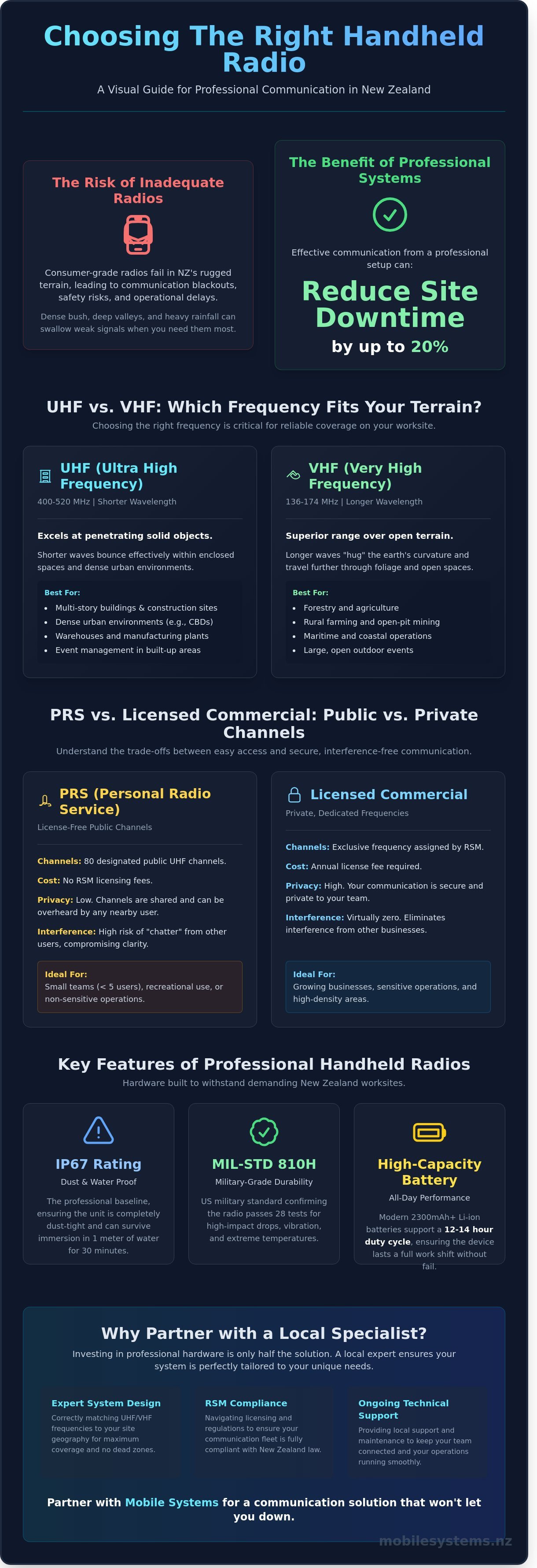
You likely already know that New Zealand's dense bush and rugged hills can swallow a standard radio signal in seconds. Maintaining reliable contact shouldn't feel like a gamble, especially when effective communication can reduce site downtime by up to 20%. You need hardware that's as tough as the environment it works in and a system that won't let you down when the weather turns.
This guide will show you how to choose professional radio solutions that offer crystal-clear audio and years of durability. We'll explain the differences between license-free PRS units and high-power digital systems, while ensuring your setup remains fully compliant with Radio Spectrum Management (RSM) regulations. From understanding IP67 ratings to navigating licensing, you'll gain the clarity needed to make a smart investment for your business.
Key Takeaways
- Understand the critical role of Radio Spectrum Management (RSM) and how to navigate licensing to ensure your communication fleet remains compliant with New Zealand law.
- Identify essential hardware standards like IP67 and MIL-STD ratings to ensure your handheld radio nz can withstand the demanding environmental conditions of local worksites.
- Learn how to match specific radio technologies to your industry requirements to improve operational efficiency and meet Health and Safety (OSH) communication obligations.
- Discover why professional-grade equipment outperforms "cheap" overseas imports and how high-capacity battery technology supports full 12-hour shifts.
- See why partnering with a local specialist like Mobile Systems ensures expert system design and ongoing technical support for your business communication needs.
Table of Contents
- Understanding Handheld Radio Technology in New Zealand
- Key Features of Professional Handheld Radios
- Industry-Specific Solutions for NZ Businesses
- Licensing, Compliance, and Essential Accessories
- Why Partner with Mobile Systems for Your Communication Fleet?
Understanding Hanheld Radio Technology in New Zealand
A handheld radio serves as a critical lifeline for teams operating where cellular signals disappear. In the New Zealand context, these devices provide instantaneous communication that doesn't rely on local cell towers. This makes a professional handheld radio nz solution essential for sectors like forestry, civil construction, and event management. Understanding the underlying two-way radio technology is the first step in selecting a tool that won't fail when it's needed most.
Radio Spectrum Management (RSM) governs all wireless frequencies across the country. They ensure that different users, from maritime services to private businesses, don't interfere with one another. While consumer-grade units are available at retail stores, they typically lack the durability required for New Zealand's harsh conditions. Professional units often feature IP67 or IP68 ratings, meaning they can survive immersion in water for 30 minutes, a standard requirement for outdoor work in the 2,000mm annual rainfall of the Waikato or West Coast.
Range is primarily governed by "line of sight" physics. While a radio might be advertised with a 20-kilometre range, New Zealand's volcanic plateaus and deep valleys frequently obstruct signals. In real-world NZ conditions, a standard 5-watt professional handheld usually covers 3 to 5 kilometres in mixed terrain. For commercial environments, the difference between a NZ$150 consumer unit and a NZ$600 professional model often comes down to receiver sensitivity and the ability to filter out background noise on busy sites.
PRS vs. Licensed Commercial Radios
The Personal Radio Service (PRS) is the most common entry point for users in New Zealand. It operates on 80 designated channels within the UHF band and is "license-free," meaning you don't need to pay RSM for an individual frequency. It's an excellent choice for small teams or recreational users. However, because these channels are public, you'll often hear "chatter" from other nearby users, which can compromise privacy and operational efficiency.
When a business grows beyond five users or handles sensitive information, moving to a dedicated commercial license is the standard recommendation. A private frequency, managed by Mobile Systems Limited through the RSM framework, eliminates interference. This exclusive access ensures that your team's communication remains secure and clear, even in high-density areas like the Christchurch CBD or Tauranga Port where hundreds of users may be competing for airwaves.
UHF vs. VHF: Which is Right for Your Terrain?
Ultra High Frequency (UHF) operates between 400 and 520 MHz. These shorter waves excel at penetrating solid objects like concrete, steel, and wood. If your work site is a multi-story building or a dense urban environment, UHF is the correct choice. It's the standard for 90% of indoor commercial applications in New Zealand because the waves bounce effectively within enclosed spaces.
Very High Frequency (VHF) operates between 136 and 174 MHz. These longer waves have a superior ability to "hug" the earth and travel through dense foliage. For rural farming, open-pit mining, or forestry operations in the central North Island, VHF provides significantly better range than UHF. Choosing the wrong frequency for your specific geography is a common mistake that often leads to dead zones and communication blackouts across a site. A professional handheld radio nz assessment ensures your equipment matches your specific location.
Key Features of Professional Handheld Radios
Selecting a high-performance handheld radio nz requires looking beyond basic communication. Business-grade equipment must withstand the harsh environmental demands of New Zealand's primary industries, from forestry to maritime logistics. Reliability in these sectors isn't just a convenience; it's a fundamental requirement for operational safety.
Durability is measured by two primary benchmarks: IP ratings and MIL-STD certifications. An IP67 rating is the professional baseline, ensuring the unit is completely dust-tight and can survive immersion in one meter of water for 30 minutes. For rugged terrain, look for MIL-STD 810H. This US military standard confirms the radio has passed 28 different tests, including high-impact drops, vibration, and extreme temperature shifts common in the Southern Alps.
Battery technology has shifted entirely toward high-capacity Lithium-ion (Li-ion) packs. A standard 2300mAh battery now supports a 12 to 14-hour duty cycle, assuming a 5-5-90 usage pattern. This ensures the device lasts through a full double shift or an extended emergency response. Unlike older nickel-based batteries, Li-ion units don't suffer from "memory effect," meaning they can be charged at any time without degrading the total capacity.
Clear communication in high-noise environments depends on digital signal processing (DSP). Professional radios utilize noise-cancelling microphones that actively filter out background machinery, wind, or engine roar. This technology ensures that only the human voice is transmitted, which is vital for safety on construction sites where ambient noise levels frequently exceed 85 decibels.
Safety features like Lone Worker and Man Down are now essential for compliance with New Zealand health and safety legislation. The Man Down feature uses an internal accelerometer to detect if a radio is tilted at an unusual angle or remains motionless for a set period. If the user doesn't respond to a warning tone, the radio automatically sends an emergency alert to the base station or other units.
Digital (DMR) vs. Analogue Systems
Analogue systems remain the traditional standard because they're simple to operate. However, they're prone to static and signal degradation as the user moves toward the edge of the coverage area. Most NZ businesses are now migrating to Digital Mobile Radio (DMR) for superior performance.
Digital systems provide consistent audio quality across the entire range. They also offer 20% better battery efficiency because the transmitter isn't running constantly during a call. Because DMR uses TDMA technology, a single 12.5kHz channel can support two independent conversations simultaneously. All professional digital hardware must comply with the technical standards set by Radio Spectrum Management (RSM) to ensure interference-free operation.
Build Quality and Ergonomics
Commercial-grade radios feature a reinforced polycarbonate housing over a die-cast aluminium chassis. This construction is significantly more resilient than the thin plastic shells found on consumer-grade walkie-talkies. The weight of a professional unit usually indicates a robust internal heat sink, which is necessary for the radio to transmit at full power without overheating.
Ergonomics play a vital role in daily usability. Buttons should be large and spaced widely enough to allow operation while wearing heavy work gloves. Tactile feedback, such as a physical "click" when a button is pressed, is better than silent touchscreens in cold or wet conditions. For outdoor operations, transflective screens are necessary to remain readable under the high UV levels of the New Zealand sun.
Selecting the right hardware involves balancing these technical specifications against your specific operational environment. A tailored assessment from Mobile Systems often prevents costly mistakes when upgrading your fleet.
Industry-Specific Solutions for NZ Businesses
Every sector in New Zealand faces distinct environmental and operational challenges. Selecting the right handheld radio nz depends on balancing hardware durability with specific frequency requirements. Under the Health and Safety at Work Act 2015, reliable communication is a legal necessity for risk management.
Compliance begins with understanding New Zealand's Radio Spectrum Management guidelines. This ensures your fleet operates on legal, interference-free frequencies. Using uncoordinated channels can lead to signal overlaps that compromise site safety during critical maneuvers.
Modern handhelds often act as extensions of vehicle-mounted systems. For workers moving between a truck and the field, cross-band repeating allows a portable unit to leverage the higher power of a vehicle's mobile radio. This ensures the team stays connected even when they are several kilometers from their transport.
Incorporating GPS tracking into these units provides a critical safety layer. In the event of an accident, dispatchers can pinpoint a worker's exact coordinates. This data is vital for "Man Down" or "Lone Worker" protocols where every second counts during a rescue operation.
Construction and Civil Engineering
Construction sites are punishing environments where dust, mud, and vibration are constant. Handhelds used here must meet IP67 or IP68 ratings for water and dust ingress. This prevents internal circuitry failure when a unit is dropped in a puddle or exposed to concrete dust.
Coordination on large-scale civil projects requires multi-channel setups. This allows crane operators, traffic control, and site foremen to have dedicated channels while maintaining a priority "All Call" function. We recommend rugged brands like Tait or GME for their proven shock-resistance on NZ work sites.
Forestry and Rural Operations
The steep valleys and dense canopy of New Zealand's backcountry demand VHF technology. VHF signals wrap around terrain more effectively than UHF, making them the standard for logging and farming. High-gain antennas are often added to handheld units to squeeze out extra range in "black spot" areas.
For ultra-remote operations, we integrate handheld radios with satellite backup systems. This ensures that if a worker moves beyond the reach of the local repeater, they can still trigger an emergency alert. Relying on consumer-grade gear in these environments is a common mistake that increases operational risk.
Security, Events, and Hospitality
In the security and hospitality sectors, communication must be instantaneous but subtle. Staff often use earpieces and headsets to keep messages private from the public. This is essential for managing crowd control or discreetly handling intoxicated patrons at large venues.
- Battery Life: High-capacity 2000mAh+ batteries are required for 12-hour shifts or multi-day festivals.
- Group Calling: Allows specific teams, such as medical or logistics, to talk privately without cluttering the main security channel.
- Rapid Response: Dedicated emergency buttons can bypass all other traffic to alert the entire team to a breach or medical incident.
Choosing the correct hardware involves more than comparing spec sheets. A tailored assessment of your specific site topography and team structure often prevents costly mistakes. This ensures your investment meets both NZ safety standards and your daily operational needs.
Licensing, Compliance, and Essential Accessories
Operating a professional handheld radio nz involves more than just unboxing a device and pressing a button. New Zealand airwaves are a finite resource managed strictly by Radio Spectrum Management (RSM). Every business transmission must occur on a designated frequency to prevent interference with critical infrastructure, such as emergency services or aviation. Failing to comply with these regulations isn't just a technical oversight; it's a legal risk that can lead to significant penalties.
NZ Radio Licensing Explained
Most commercial operations require a specific land mobile license. You'll need to work with an Approved Radio Certifier (ARC) to secure a frequency allocation that fits your geographic area. Annual license fees typically start at NZ$150 per frequency, depending on the location and power output. Using unapproved frequencies can result in fines under the Radiocommunications Act 1989, reaching up to NZ$200,000 for companies. Mobile Systems simplifies this by managing the entire RSM application process for you. We ensure your fleet stays compliant and your annual renewals are handled without administrative delays.
Must-Have Accessories for Handheld Radios
- Remote Speaker Microphones: These allow staff to communicate without unhooking the radio from their belt or vest. This is essential for high-movement roles in construction or logistics where quick access saves time.
- Multi-Unit Chargers: For fleets of six or more devices, a multi-charger saves desk space and ensures batteries are conditioned correctly for a full 12-hour shift. They also provide a central "home" for the fleet, reducing the chance of lost units.
- Heavy-Duty Carry Cases: Field data shows that 40% of radio repairs involve cracked screens or snapped antennas. A rugged leather or nylon case acts as a cheap insurance policy against drop damage and general wear.
- High-Capacity Batteries: If your team works 10 to 14 hour days, standard batteries may fail. Upgrading to a 2900mAh Li-ion battery ensures the handheld radio nz remains operational until the job is done.
Common Mistakes in Radio Procurement
Buying cheap, unbranded radios from overseas websites is the most frequent error we see. These devices often lack the AS/NZS 4768 compliance stickers required for legal use in New Zealand. They're frequently programmed to frequencies that overlap with local fire or police bands, creating a safety hazard. Price-driven decisions often ignore the total cost of ownership. A cheap radio that fails after 12 months costs more than a professional Motorola or Kenwood unit that lasts seven years. You're not just buying a tool; you're buying a communication guarantee.
Skipping a professional coverage test is another costly oversight. You shouldn't commit to a fleet purchase based on a theoretical range. Environmental factors like steel-reinforced concrete or local topography can reduce signal strength by 60% or more. Testing your specific site ensures the hardware you buy actually performs when your team needs it most. We've seen businesses spend thousands on hardware only to find it won't penetrate a basement or a thick forest canopy. A simple field test prevents this waste.
Ensuring your fleet is legal and functional requires expert oversight. A tailored assessment often prevents costly mistakes and keeps your business compliant with RSM standards.
Why Partner with Mobile Systems for Your Communication Fleet?
Selecting the right handheld radio nz solution involves more than just picking a model from a catalogue. Since 1998, Mobile Systems has worked with New Zealand enterprises to bridge the gap between off-the-shelf hardware and functional, site-specific communication networks. We understand that a radio is a tool for safety and efficiency, not just an electronic device.
Our team operates from a dedicated technical hub in Mount Maunganui. This local presence means we understand the unique RF challenges posed by New Zealand's varied topography, from dense forestry blocks to steel-heavy industrial sites. We don't just ship boxes; we provide the engineering backbone that ensures your team remains connected when cellular networks fail. Having local support means you won't wait weeks for overseas shipping or generic call centre advice.
- On-site Technical Assistance: Our technicians travel across the Bay of Plenty and nationwide to provide hardware integration and troubleshooting.
- Preventing Costly Errors: Statistics show that roughly 30% of businesses overspend on features they don't need or purchase hardware incompatible with their existing frequencies. A tailored assessment identifies these risks early.
- Frequency Management: We handle the complexities of Radio Spectrum Management (RSM) licensing to ensure your fleet operates legally and without interference.
- Rapid Turnaround: Because we maintain local stock and a physical workshop, repairs and reconfigurations happen in days, not months.
Our Professional Approach
Reliability starts with a comprehensive site survey. We evaluate signal penetration and dead zones before recommending a single device. This data-driven method is why we partner with industry leaders like Tait, Icom, and GME. Tait, a New Zealand success story based in Christchurch, offers ruggedness that survives the harshest 2026 work environments, while Icom provides the digital clarity essential for emergency services.
Our commitment extends beyond the initial sale. We provide support structures for critical infrastructure clients, ensuring that your handheld radio nz fleet maintains 99.9% uptime. We focus on clarity and durability because we know that in high-risk industries like civil engineering or port logistics, communication is a primary safety requirement. We don't use marketing fluff; we use technical specifications that meet NZ standards.
Get Started with a Specialist Consultation
Every industry has distinct requirements. A forestry crew needs different durability standards than a retail security team. We provide customized quotes that reflect your specific operational scale and budget. You can contact our team to schedule a full fleet evaluation and discuss your long-term communication goals. This prevents the common mistake of buying consumer-grade gear for industrial applications.
Our ongoing support ensures your system scales as your business grows. Whether you're adding five units or fifty, we maintain your frequency records and hardware configurations to make expansion seamless. By partnering with specialists, you ensure your investment in communication technology delivers measurable returns in safety and productivity. We help you avoid the NZ$2,000 mistakes that come from poor hardware selection by getting the architecture right the first time.
Future-Proofing Your Business Communication
Selecting the right handheld radio nz solution is about more than just hardware; it's about ensuring your team stays connected when it matters most. Professional communication requires a balance of rugged hardware, correct RSM licensing, and reliable local support. High-quality digital radios from brands like Tait and Icom provide the durability needed for New Zealand's demanding terrain and weather conditions.
Mobile Systems Limited is a 100% NZ-owned and operated specialist with over 25 years of industry experience. As an authorized dealer for Tait, Icom, and GME, we provide on-site technical support that offshore retailers can't match. We manage the complexities of RSM licensing and compliance so your business avoids interference issues and legal risks.
A tailored assessment often prevents the mistake of investing in equipment that isn't fit for purpose. Contact Mobile Systems for a Tailored Radio Assessment to discuss your fleet requirements with our technical team today. We're ready to help you build a more resilient and efficient communication network.
Frequently Asked Questions
Do I need a license to use a handheld radio in NZ?
You don't need an individual license if you use a handheld radio NZ on the 80-channel UHF Personal Radio Service (PRS) band. This is a class license managed by Radio Spectrum Management (RSM) that allows public access for work or play. If you require private frequencies for a business, you'll need to apply for a specific commercial license which carries an annual fee.
What is the real-world range of a 5-watt handheld radio?
A 5-watt radio typically provides a range of 1km to 3km in dense New Zealand bush or urban environments with heavy obstructions. If you have a clear line of sight from a hilltop, that distance can extend to 20km or more. Physics dictates that VHF and UHF signals travel in straight lines, so terrain is always the biggest factor in performance.
Can I use Australian UHF radios in New Zealand?
Yes, you can use Australian UHF radios here because both countries share the same AS/NZS 4365:2011 standard for the 80-channel PRS band. These units operate on the 476.425 to 477.4125 MHz frequency range. Using radios from the United States, such as FRS or GMRS models, is illegal in New Zealand and can interfere with vital local services.
How long do professional handheld radio batteries usually last?
Professional batteries usually last between 10 and 14 hours when following a standard 5-5-90 duty cycle. This cycle assumes you spend 5% of the time transmitting, 5% receiving, and 90% on standby. High-capacity 2,500mAh Lithium-Ion batteries can often push this runtime to 20 hours, ensuring the device stays active through a full double shift.
Are all handheld radios waterproof?
Not all radios are waterproof, and many entry-level models only provide basic protection against light rain. To ensure your device survives a drop into water, look for an IP67 or IP68 rating. An IP67 rating means the radio can withstand being submerged in 1 metre of water for 30 minutes, which is essential for marine or high-country use.
What is the difference between a walkie-talkie and a two-way radio?
The main difference lies in the build quality and the intended user. People use the term walkie-talkie for consumer-grade devices sold in retail toy or camping stores. Professional two-way radios feature die-cast aluminium chassis and meet MIL-STD-810G ruggedness standards. These commercial units offer better audio clarity and are designed for 10 years of daily use.
Can digital radios talk to analogue radios?
Digital radios can't communicate directly with analogue units while in digital mode. However, most professional digital handhelds are "dual-mode," meaning they can be programmed to operate on analogue channels. This allows you to migrate your fleet to digital technology gradually without losing contact with your existing analogue equipment during the transition.
Why is my radio getting interference from other users?
Interference occurs because the 80 PRS channels are shared public resources, and someone else is likely transmitting on your frequency nearby. You can solve this by using CTCSS or DCS sub-tones, which act as a digital lock on your speaker. While this doesn't stop others from using the channel, it ensures you only hear your own team's transmissions.
Related posts

- July 04, 2026
Most 3G-era phone boosters stopped doing their job when NZ's 3G networks switched off in March 2026. Here's what actually...

- May 24, 2026
Our expert Starlink review NZ looks at speed, pricing, and reliability for business, farm, and maritime use. See if it's...

- May 23, 2026
Approximately 40% of New Zealand's landmass remains outside the reach of traditional mobile networks. For professional teams operating in remote...