
How to Extend Two-Way Radio Range: A Professional Guide for NZ Businesses
That "50km range" sticker on your radio box is a laboratory fantasy that will fail the moment you enter New Zealand’s rugged backcountry. It's a common frustration for site managers who find their team's safety compromised by dead zones.
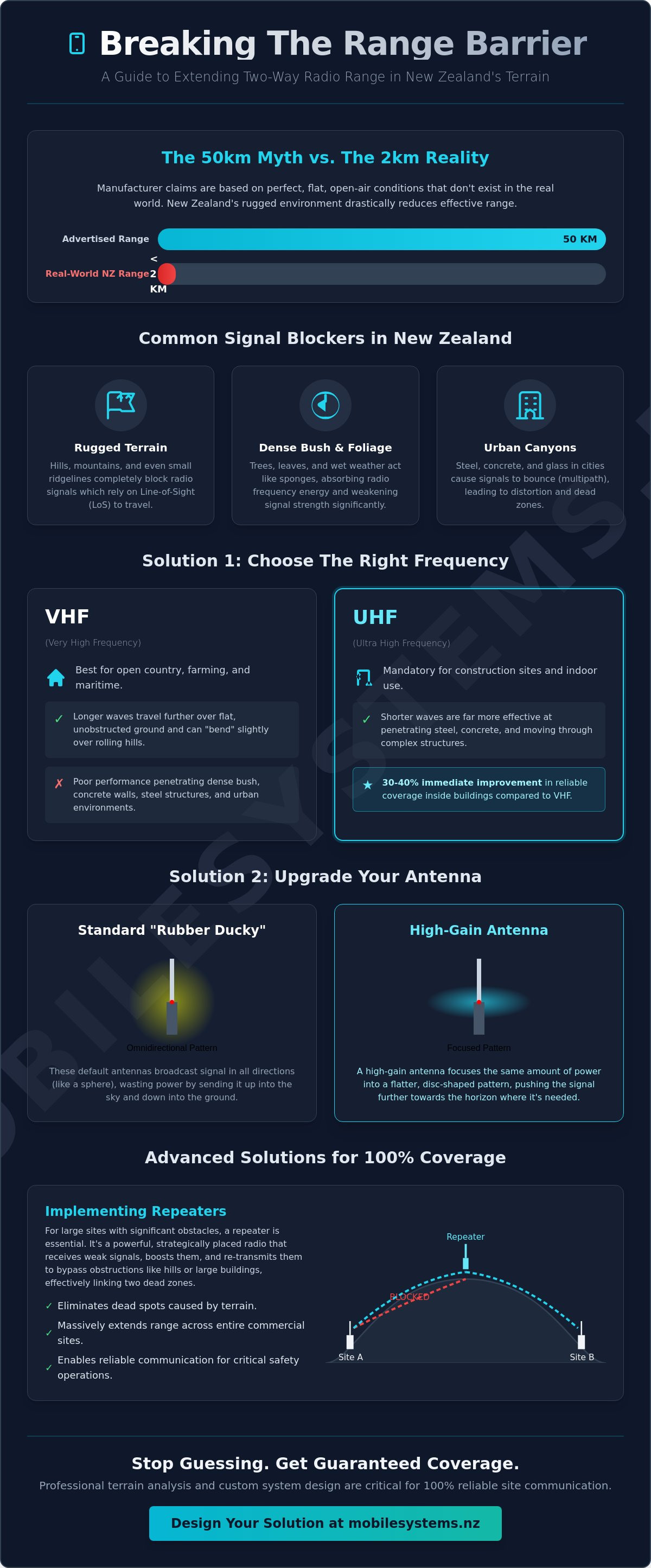
That "50km range" sticker on your radio box is a laboratory fantasy that will fail the moment you enter New Zealand’s rugged backcountry. It's a common frustration for site managers who find their team's safety compromised by dead zones, where real-world testing often shows handheld-to-handheld range dropping to less than 2 kilometres in dense bush. You understand that clear communication isn't just a convenience; it's a critical safety requirement for high-risk sites.
If you're struggling with dropped signals, learning how to extend two way radio range involves more than just buying a bigger battery. This guide provides a technical roadmap to overcoming New Zealand's challenging terrain through hardware upgrades and strategic infrastructure. We'll show you how to achieve 100% site coverage without falling for misleading marketing claims.
We'll explore the specific ROI of installing repeaters versus upgrading to high-gain antennas. You'll also learn how to navigate RSM licensing requirements to ensure your expanded network remains compliant and interference-free.
Key Takeaways
- Learn how to navigate New Zealand’s rugged geography by selecting the correct frequency bands and understanding the principles of Line-of-Sight communication.
- Discover how to extend two way radio range by replacing standard "rubber ducky" antennas with high-gain hardware designed to focus radiated power.
- Master practical field techniques, such as the "Height is Might" rule and proper vertical radio posture, to improve signal clarity and range instantly.
- Evaluate the role of repeaters and digital linking (DMR) in bypassing terrain obstacles to provide reliable communication across wide-area commercial sites.
- Understand why professional terrain analysis and custom coverage mapping are essential for designing a system that meets strict business requirements.
Understanding the Factors That Limit Two-Way Radio Range
Most New Zealand businesses find that the "out of the box" performance of their communication gear rarely matches the optimistic claims on the packaging. While a manufacturer might advertise a 10-kilometre range, real-world results in a Kiwi context often drop to 2 kilometres or less. This discrepancy occurs because advertised specs are based on ideal, unobstructed conditions that don't exist in our local environment.
Knowing Factors that affect the range of a two-way radio is the first step in learning how to extend two way radio range effectively. Radio waves primarily operate on a Line-of-Sight (LoS) principle. If you can't physically see the other person, there's a high probability that something is degrading your signal quality.
To better understand this concept, watch this helpful video:
The Impact of New Zealand Terrain on Signal Propagation
New Zealand's geography presents unique challenges for radio users. Dense native bush and rugged hills act as massive sponges for high-frequency signals. In rural areas, a single ridge line can completely sever a connection between two high-quality handheld units.
In cities like Auckland or Christchurch, "urban canyons" created by glass and steel towers cause multipath interference. This happens when the signal bounces off multiple surfaces, arriving at the receiver at slightly different times. This leads to the "picket fencing" sound often heard when moving while talking.
- Absorption: Dense foliage and wet weather significantly reduce signal strength.
- Reflection: Metal structures in industrial zones can bounce signals in unpredictable directions.
- Diffraction: Lower frequency signals can sometimes "bend" over a hill, but this is limited.
UHF vs VHF: Choosing the Right Band for Your Environment
Selecting the wrong frequency band is the primary reason for poor performance in professional settings. Selecting the correct hardware from a professional two-way radio collection ensures the physics of the signal match your specific site requirements.
VHF (Very High Frequency) is the standard for open farmland, maritime use, and aviation. The longer waves can travel further over flat ground and have better diffraction over rolling hills. However, they're easily blocked by the thick concrete walls of a modern warehouse or office block.
UHF (Ultra High Frequency) uses shorter waves that excel at penetrating steel and concrete. This makes UHF the mandatory choice for construction sites, indoor security, and retail environments. If your team is struggling with "dead spots" inside a building, switching from VHF to UHF often provides an immediate 30% to 40% improvement in reliable coverage without changing any other variables.
Upgrading Your Antenna and Hardware for Maximum Gain
The antenna is the most critical component in determining how your radio performs in the field. Many businesses rely on the factory-standard "rubber ducky" antenna, which is often a compromise between durability and performance. These short, flexible antennas frequently have negative gain, meaning they actually radiate less power than the radio is capable of producing.
To understand how to extend two way radio range, you must understand antenna gain, measured in dBi. Gain doesn't create more power; it focuses the existing power. A high-gain antenna reshapes the signal from a broad sphere into a flatter, more concentrated disc, pushing the energy further toward the horizon where your team is actually working.
While New Zealand has specific licensing rules, referencing the FCC guide to Personal Radio Services provides a useful technical baseline for how different frequencies and hardware configurations influence coverage. Beyond gain, you must monitor the Standing Wave Ratio (SWR). A high SWR indicates that power is reflecting back into the radio instead of radiating outward, which can lead to hardware failure and a 40% reduction in effective range.
Cable quality is another area where signal is frequently lost. In fixed or vehicle installations, using thin, low-grade cabling can result in a loss of 3dB or more over just a few metres. This effectively cuts your transmit power in half before it even reaches the antenna. Using high-quality, shielded cables like LMR-400 for permanent installs is a standard professional requirement in NZ.
Selecting High-Gain Antennas for Handheld and Mobile Units
Choosing the right antenna involves balancing portability with performance. A 1/4 wave "stubby" antenna is convenient for belt-worn use, but it significantly limits distance. Moving to a 1/2 wave whip antenna can provide an immediate boost in clarity and distance, often adding 1 to 2 kilometres of coverage in open terrain.
- Whip Antennas: These offer the best gain for handhelds but require careful handling to avoid snapping in rugged environments.
- Vehicle Mounting: For mobile units, the centre of the roof is the optimal position. The metal roof acts as a ground plane, reflecting the signal upward and outward.
- Professional Selection: Accessing professional-grade antennas ensures your hardware is tuned specifically for the frequencies used in New Zealand.
Power Supply and Battery Health
Transmit reach is directly tied to the voltage your battery can provide. As a battery depletes, the voltage drops, and the radio's power amplifier can't maintain its maximum wattage. This leads to a "fading" effect where a staff member can hear clearly but can't be heard by others as their shift progresses.
Modern Li-Ion batteries are preferred over older NiMH types because they maintain a flatter discharge curve. They provide consistent 7.4V power for a longer duration before the performance drops off sharply. In high-demand NZ industries like forestry or construction, batteries should be tested and replaced every 18 to 24 months to ensure they still hold at least 80% of their original capacity.
Regular maintenance cycles prevent subtle signal degradation that occurs over time. A tailored assessment of your current fleet often prevents costly communication gaps during critical operations.
Practical Techniques to Improve Range in the Field
Success with wireless communication often depends on how the user interacts with their environment. Understanding how to extend two way radio range doesn't always require expensive hardware upgrades. Often, it's about mastering basic physics and operator habits that directly impact signal propagation.
Radio waves used by New Zealand businesses typically operate on a line-of-sight basis. The "Height is Might" rule is the most effective field tactic. Elevating your position by just 2 or 3 metres can increase your effective coverage area by up to 15% in rugged environments like the King Country or the Southern Alps. This small change helps the signal clear local obstructions and reach the nearest repeater or receiver.
Correct radio posture is another critical factor. Many operators mistakenly hold their radio horizontally or at a steep angle. Because most land mobile antennas are vertically polarized, holding the device at a 45-degree angle can cause a signal loss of 3dB. This loss effectively cuts your transmitter's perceived power in half. Always keep the antenna pointing straight up toward the sky for maximum efficiency.
- Use external remote speaker microphones to keep the radio unit higher on your body.
- Avoid standing near large metal structures, shipping containers, or power transformers.
- Identify and move away from local sources of electromagnetic interference, such as poorly shielded LED light bars or electric fences.
Optimal Positioning for Handheld Users
Your physical location relative to your equipment is vital. Moving just 5 metres away from a concrete wall or a piece of heavy machinery can significantly reduce signal attenuation. It's also important to be aware of "Body Shielding." Human tissue is highly effective at absorbing radio frequency energy. If you hold a radio tight against your chest, your body can block up to 50% of the signal in that direction.
In marginal areas, search for "Hot Spots." These are small zones where signals may reflect off nearby hills or buildings to create a usable path. If you hear static, move a few paces in different directions. In many NZ work sites, a "Hot Spot" is often found near open doorways or on the side of a building facing the known repeater location.
Vehicle Installation Best Practices
For mobile setups, the vehicle itself acts as part of the antenna system. Centring the antenna on a flat metal roof is the gold standard. This provides a consistent ground plane, which reflects the signal and creates a balanced 360-degree radiation pattern. Mounting an antenna on a bull bar or a wing mirror often results in a directional signal that struggles to reach 40% of its potential range in certain headings.
Ensuring a solid chassis ground is essential for reducing electrical noise. A poor connection to the vehicle frame can introduce alternator whine that masks weak incoming signals. For those interested in the science behind these signals, you can explore how radio waves work to understand the interaction between antennas and metal surfaces. Proper installation by a professional ensures your fleet achieves the best possible results on the road.
Implementing Repeaters and Digital Linking for Wide-Area Coverage
If you're looking for how to extend two way radio range across vast distances or rugged terrain, repeaters are the primary solution. A repeater acts as a relay station, receiving a weak signal from a handheld unit and re-transmitting it at a much higher power level. This process effectively bypasses physical obstacles that would otherwise block a direct line-of-sight signal.
New Zealand's geography often creates "shadow zones" where hills or dense bush prevent communication. By placing a repeater on a high-elevation site, you can create a wide-area coverage umbrella. This setup allows teams on opposite sides of a mountain range to communicate as if they were standing in the same field.
The Role of Repeaters in Commercial Networks
Standard repeaters function by receiving on one frequency and transmitting on another. This duplex operation requires a specialized antenna system to prevent interference. For remote backcountry operations in the South Island or central North Island, solar-powered repeaters provide a self-sustaining solution where grid power is unavailable. These units are built to withstand New Zealand's harsh alpine environments.
Operating a high-power repeater requires a license from Radio Spectrum Management (RSM). These licenses ensure your frequency doesn't interfere with other local businesses. Most commercial repeaters in NZ operate at 25 to 50 watts, providing a massive boost compared to the 5-watt limit of most portable radios. Using professional-grade equipment ensures your network remains compliant and reliable.
Digital Radio (DMR) and Range Extension
Digital Mobile Radio (DMR) handles signal degradation differently than traditional analog systems. While analog audio becomes increasingly filled with static as you reach the edge of its range, DMR uses digital error correction to keep audio clear. This technology fills in the gaps of a weak signal, ensuring the receiving party hears a crisp voice even when the signal strength is low.
Many New Zealand businesses follow Tait Communications standards for professional DMR because of their reliability in critical environments. However, users must understand the "Cliff Effect." Unlike analog's gradual fade, a digital signal remains perfect until it hits a specific threshold, then it drops out completely. This predictable performance helps teams define clear operational boundaries for their staff.
To achieve coverage across multiple regions, we utilize IP-Linking. This technology connects different repeater sites via the internet, allowing a worker in Auckland to talk to a colleague in Christchurch instantly. For large forestry or farm blocks, Simulcast systems provide seamless roaming. Workers can move between different repeater zones without ever having to manually change channels on their devices.
A tailored assessment often prevents costly mistakes when choosing between analog and digital infrastructure for your specific site.
Designing a Professional Communication System with Mobile Systems
Generic, off-the-shelf radio kits often fail to meet the rigorous demands of New Zealand commercial operations. While a consumer-grade unit might work in an open paddock, the dense bush of the Urewera or the steel-heavy environments of Auckland construction sites require a more robust approach. Relying on basic hardware without understanding the physics of propagation is the most common reason businesses struggle with how to extend two way radio range effectively.
Mobile Systems provides professional radio coverage maps and detailed terrain analysis to eliminate guesswork. We use specialized software to model how signal interacts with New Zealand's unique topography. This data-driven approach ensures that repeaters and antennas are placed with mathematical precision, providing reliable coverage where it's needed most.
- Forestry Operations: Custom engineering for high-gain antennas and ruggedized units that survive 100km/h winds and heavy rain.
- Emergency Services: Redundant power systems and cross-band links to ensure communication stays live during critical incidents.
- Remote Infrastructure: Solar-powered repeater stations for sites where grid power is unavailable.
Maintaining peak performance requires more than just a good setup. Our team offers ongoing mobile servicing across the country. We come to your site to test signal strength and hardware integrity, ensuring your system continues to meet Health and Safety at Work Act 2015 requirements for worker safety in isolated areas.
Tailored Assessments to Prevent Costly Mistakes
Mobile Systems evaluates your specific site challenges before a single piece of equipment is purchased. We look at electromagnetic interference from nearby machinery and physical obstructions that block line-of-sight. Choosing the right frequency band and hardware from the start is vital. A tailored assessment often prevents costly mistakes, such as investing in VHF systems when UHF would perform better in your specific built environment.
Contact Mobile Systems for Expert Advice
Our comprehensive installation and servicing solutions cover everything from initial design to long-term maintenance. If your current setup isn't delivering the clarity you need, it's time for a professional system audit. We'll identify bottlenecks and provide a clear roadmap on how to extend two way radio range for your specific fleet.
Don't leave your team's safety and operational efficiency to chance. Contact our team today to discuss a customized communication strategy that works for your business.
Securing Reliable Coverage Across New Zealand's Challenging Terrain
Maximising your network's reach requires a strategic combination of high-gain hardware and smart infrastructure. Whether you're upgrading antennas or deploying digital repeaters, understanding the technical limitations of your environment is the first step toward better connectivity. It's essential to account for the specific geographical barriers that define the New Zealand landscape.
Learning how to extend two way radio range isn't just about increasing power; it's about precision engineering for local conditions. As an authorised Tait and Hytera dealer, Mobile Systems Limited provides the technical expertise needed to overcome dead zones and signal interference. We understand how to navigate the complexities of NZ-specific terrain challenges to keep your teams connected.
Our team operates nationwide with dedicated on-site mobile support vehicles to ensure your system performs under pressure. A tailored assessment often prevents costly mistakes and ensures your communication system meets rigorous industry standards. This proactive approach helps you avoid the common pitfalls of off-the-shelf solutions that fail in the field.
Contact Mobile Systems for a professional range assessment to discuss your specific site requirements. Investing in a robust communication network provides the long-term reliability your business needs to stay productive and safe.
Frequently Asked Questions
How much does a repeater actually increase radio range?
A repeater can increase your communication distance from 5km to over 50km by utilizing high-altitude sites. It's the most effective method for businesses asking how to extend two way radio range across large geographic areas like the Bay of Plenty or Waikato.
By receiving and re-broadcasting signals from a peak or tall building, the repeater overcomes the limitations of the earth's curvature. This setup turns weak, obstructed signals into clear transmissions across entire regions.
Can I use a cellular booster to extend my two-way radio range?
You can't use a cellular booster for two-way radios because they operate on entirely different frequency bands. Cellular boosters target 700MHz to 2600MHz, while most NZ business radios operate between 136MHz and 470MHz.
Using the wrong equipment won't provide any signal improvement. For radio systems, you need a dedicated bi-directional amplifier or a repeater system designed for your specific licensed frequency.
Is it legal to use a high-gain antenna on my handheld radio in NZ?
It's legal to use high-gain antennas in New Zealand provided your equipment stays within the Effective Radiated Power (ERP) limits specified in your RSM license. Most handheld high-gain antennas fall within these 5-watt limits.
Exceeding these parameters can cause interference with other licensed users. If you're unsure about your current license conditions, a professional audit can ensure your fleet remains compliant with Radio Spectrum Management standards.
Does increasing the wattage of my radio always improve the range?
Increasing wattage doesn't always improve range significantly. Doubling your power from 5 watts to 10 watts typically only yields a 15% to 20% increase in distance. Physics dictates that antenna height is a much more critical factor than raw power.
Higher wattage also drains batteries faster and increases the risk of heat damage to the radio. Most professional users find that optimizing antenna placement provides a better return on investment than simply boosting power.
What is the best radio frequency for long-distance communication in the bush?
VHF (Very High Frequency) is the superior choice for long-distance communication in the NZ bush and rugged terrain. These waves have longer lengths that allow them to diffract over hills and through dense foliage more effectively than UHF signals.
Most forestry and rural businesses rely on the 136-174 MHz band for this reason. UHF is better suited for urban environments where signals need to penetrate concrete walls and steel structures.
How do I know if my radio antenna is tuned correctly?
You can confirm your antenna is tuned correctly by measuring the Standing Wave Ratio (SWR) with a specialized meter. A reading below 1.5:1 indicates that the antenna is efficiently converting power into radio waves.
If the ratio exceeds 2.0:1, your radio's internal components could suffer damage over time. Regular testing is vital because vibration, moisture, and physical wear can shift an antenna out of its optimal tuning range.
Can weather conditions like heavy rain affect my radio signal?
Heavy rain and high humidity can reduce signal strength, especially for UHF systems. Water droplets absorb and scatter radio energy in a process called atmospheric attenuation. This is why signals often feel "shorter" during winter storms.
While VHF is less affected, extreme weather events on the West Coast or in alpine regions can still see a 10% reduction in effective range. Using high-quality, weather-sealed connectors helps prevent moisture from entering the cable and causing further signal loss.
What is the difference between a simplex and a duplex system for range?
Simplex systems communicate directly between two radios on a single frequency, which limits range to the immediate line of sight. This is the standard "walkie-talkie" mode used for short-range site work.
Duplex systems use a repeater to receive on one frequency and transmit on another simultaneously. This setup is the primary way businesses understand how to extend two way radio range across entire cities or mountain ranges by using a central relay point.
Related posts

- June 12, 2026
Relying on a cellular signal in the Southern Alps or the dense King Country bush is a calculated risk that...

- June 06, 2026
Did you know that 98.6% of radio licenses in New Zealand are subject to a fee increase starting July 1,...

- May 17, 2026
Read our 2026 NZ guide. DMR vs P25: Which Digital Radio Standard is Right for Your Business? Compare features to...