
Two-Way Radio Rental Prices: A 2026 Guide for NZ Businesses
In November 2024, a Waikato-based civil engineering firm discovered that their two way radio rental prices increased by 40% once freight and licensing fees were finally invoiced. These hidden costs often turn a seemingly affordable equipment hire into a significant project overspend.
In November 2024, a Waikato-based civil engineering firm discovered that their two way radio rental prices increased by 40% once freight and licensing fees were finally invoiced. These hidden costs often turn a seemingly affordable equipment hire into a significant project overspend.
You likely agree that clear communication is the backbone of site safety, but it's frustrating when hardware fails in rugged New Zealand terrain. Finding the balance between cost-effective gear and high-performance digital systems shouldn't feel like a guessing game.
This guide provides a definitive breakdown of hire costs and technology trade-offs for 2026. We'll help you navigate the differences between analogue and digital systems while ensuring your fleet meets current health and safety standards.
We examine long-term leasing options and the specific NZD costs associated with Radio Spectrum Management (RSM) compliance. You'll gain the clarity needed to build an accurate budget for your next major contract.
Key Takeaways
- Understand how fleet scale and volume-based discounts directly influence standard market rates for handheld units across New Zealand.
- Compare the cost-effectiveness of short-term hire for events against long-term leasing models tailored for the construction and transport sectors.
- Evaluate the technical trade-offs between entry-level analogue and high-performance digital systems to optimize your two way radio rental prices.
- Identify potential "hidden" expenses, such as Radio Spectrum Management (RSM) licensing fees and logistics costs for remote NZ locations.
- Discover how localized expertise and nationwide on-site support from Mobile Systems Limited ensure your communication fleet remains reliable in any environment.
Factors Influencing Two-Way Radio Rental Prices in New Zealand
Understanding two way radio rental prices in New Zealand requires looking at several variables beyond just the daily rate. While basic handheld units might start at lower price points for short events, commercial-grade solutions involve technical overhead and specialized equipment. Two-way radio technology has evolved into sophisticated digital systems that require precise configuration to ensure clear communication across rugged NZ terrain. To better understand how these rental services operate in a commercial context, watch this helpful video:
Standard NZ rental market rates vary based on the hardware's sophistication. Professional-grade units from manufacturers like Tait or Hytera command a premium because they offer superior signal clarity and mechanical durability compared to consumer-grade alternatives. The rental duration also plays a critical role; daily rates are the highest, while long-term project-based rentals can reduce the daily cost by more than 50% for terms exceeding 90 days.
Hardware Grade and Durability
The environment where you'll use the equipment dictates the necessary hardware grade. For instance, forestry operations or construction sites require IP67 or IP68 waterproof ratings to survive the 2,000mm+ annual rainfall common in regions like Fiordland or the West Coast. These ruggedized units cost more to maintain and replace, which is reflected in the rental price. Hazardous environments like fuel depots or chemical processing plants require Intrinsically Safe (IS) radios. These units are engineered to prevent sparks that could ignite flammable atmospheres, often making them 40% to 60% more expensive to rent than standard models. Additionally, choosing high-capacity batteries for 12-hour shifts instead of standard 8-hour cells will influence the total package price.
Quantity and Fleet Management
Scaling a fleet from 5 units to 50 units changes the pricing structure significantly. While the total invoice increases, the price per unit often drops by 15% to 25% due to volume-based discounts. Large-scale deployments require different logistics, such as multi-bank chargers that can power six units simultaneously, which simplifies on-site management. Setting up a large fleet involves technical labor before the hardware leaves the warehouse. Fleet programming is a one-off technical requirement for custom frequencies, ensuring all units communicate securely without interference from other local users. This process involves aligning digital IDs and channel maps across every device in the rental pool to ensure seamless operation. A tailored assessment
Short-Term Hire vs. Long-Term Leasing: Which Is More Cost-Effective?
Choosing between short-term hire and long-term leasing depends on your project duration and operational stability. While short-term hire offers flexibility for temporary needs, long-term leasing often provides a more stable financial path for established NZ businesses with ongoing communication requirements.
Short-Term Rental Scenarios
Short-term hire is the standard choice for events, festivals, and week-long infrastructure projects. These rentals provide immediate access to communication without a heavy upfront investment. You'll find that two way radio rental prices are typically higher for 1-3 day periods because they account for the logistics of cleaning, testing, and rapid courier delivery.
These "ready-to-go" kits are essential for immediate deployment. Each unit arrives programmed, labeled, and fully charged, so your team can start communicating the moment they arrive on site. You can view our handheld radio collection to see the hardware available for these high-rotation roles.
Long-Term Commercial Leasing
For the construction, forestry, and transport sectors, long-term leasing is almost always more cost-effective. Leasing reduces the total cost of ownership over 12 to 36 months. It shifts the financial burden from a large capital outlay to a manageable monthly fee, which helps significantly with cash flow management.
One major advantage of leasing is the "evergreen" fleet model. Most professional agreements include regular hardware upgrades, ensuring your team isn't left with outdated or failing technology. Additionally, leasing often covers the complexities of Radio licensing in New Zealand, which is a critical factor in the total two way radio rental prices you'll pay over time.
Leasing is also beneficial for tax purposes. In New Zealand, lease payments are generally treated as an Operating Expenditure (OpEx). This allows businesses to deduct the full cost of the lease as a business expense, rather than depreciating a purchased asset as Capital Expenditure (CapEx) over several years. This treatment keeps the equipment off the balance sheet while maintaining modern standards.
A professional lease agreement includes comprehensive maintenance and support that isn't typically available with a standard purchase. This includes:
- Regular firmware updates to maintain security and feature sets.
- Battery health checks and automatic replacements every 18-24 months.
- Rapid repair or replacement of faulty hardware to ensure zero downtime.
- Ongoing frequency management to prevent interference from other local users.
A tailored assessment often prevents costly mistakes when choosing between hire and lease options. Contact our team to discuss which model fits your current project timeline.
Analogue vs. Digital: How Technology Choices Impact Your Hire Costs
The underlying technology of your fleet is the most significant factor in determining two way radio rental prices. While the industry has largely shifted to digital standards, analogue equipment remains available for specific use cases. Understanding the technical requirements of your site prevents overspending on features you won't use or under-equipping your team with unreliable tools. All radio operations in New Zealand must comply with the standards set by Radio Spectrum Management. This ensures your hired equipment operates on legal frequencies, avoiding interference with emergency services or other commercial operators.
The Analogue Entry Point
Analogue radios represent the price floor for the New Zealand rental market. These units are best suited for simple, line-of-sight communication where high-fidelity audio isn't a priority. You'll often find these used in event management or small-scale construction where the distance between users is minimal. The price gap between basic analogue and entry-level digital units typically ranges from NZ$5 to NZ$15 per unit per week. However, analogue is becoming less common for professional industrial sites. It lacks the noise-cancelling capabilities required in high-decibel environments and doesn't support the safety features mandatory on modern worksites.
Digital and Advanced Features
Digital Mobile Radio (DMR) technology offers 30% to 50% better battery life than analogue counterparts. This efficiency reduces the need for spare batteries, which can lower your total hire cost over long projects. Digital units also provide clearer audio at the edge of the coverage area, ensuring messages aren't lost in static. Safety features like "Man Down" and "Lone Worker" sensors often attract a rental premium. These sensors detect lack of movement or horizontal positioning, automatically triggering an alert to the base station. For fleet managers, Explore GPS and portable communications integration allows for real-time location tracking. This feature is essential for logistics and large-scale infrastructure projects where coordinator visibility is critical for safety.
Trunked Systems and Terrain Matching
Wide-area coverage across multiple New Zealand sites requires trunked radio systems. These systems use a pool of frequencies to manage high volumes of users, but they involve higher rental costs due to the required repeater infrastructure. Two way radio rental prices for trunked systems often include a subscription fee for access to the network. The physical environment also dictates the hardware choice:
- VHF (Very High Frequency): Best for bush, forestry, and rural environments where signals need to bend over hills.
- UHF (Ultra High Frequency): Preferred for urban environments as the shorter waves penetrate concrete and steel more effectively.
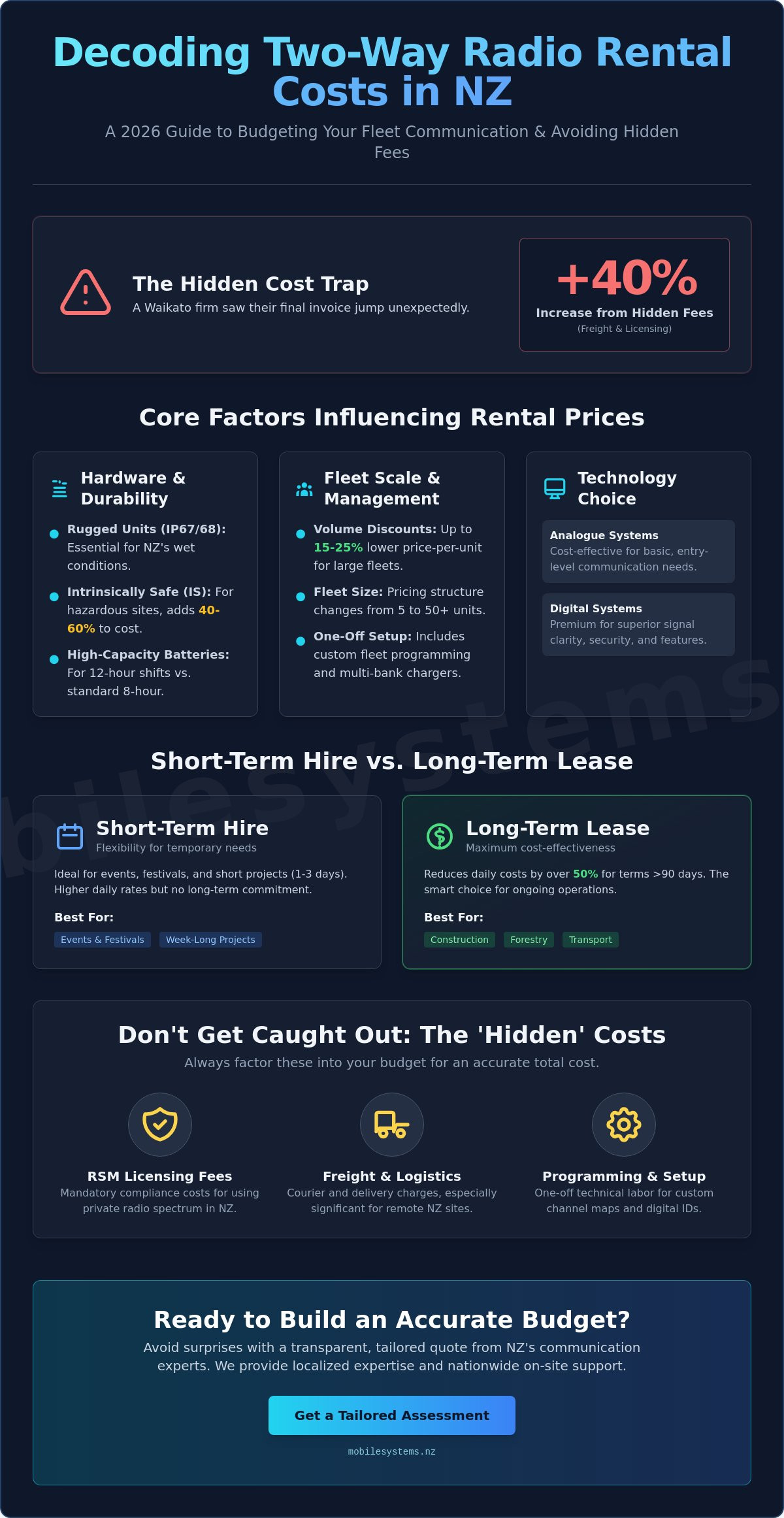
Understanding the 'Hidden' Costs of Radio Rental
When you calculate two way radio rental prices, looking only at the daily or weekly rate leads to budget overruns. The headline figure covers the hardware, but several operational variables impact the final invoice. New Zealand businesses must account for regulatory compliance, logistics, and the specific peripheral gear required for their environment.
Logistics often represent a significant portion of the total cost. Getting a fleet of 50 radios to a remote site in the Southern Alps or a construction zone in Northland involves more than simple postage. High-value electronics require tracked, insured transit. If you're operating on a tight schedule, the cost of urgent courier services for last-minute additions can quickly escalate.
Licensing and Frequency Coordination
The Radio Spectrum Management (RSM) governs how airwaves are used in New Zealand. You have two primary options for your rental fleet. The 80-channel Citizen Band (CB) is free to use but it's often crowded; this leads to interference and dropped messages in high-traffic areas like Auckland or Christchurch. For secure, clear communication, private licensed frequencies are necessary.
- Interference Mitigation: Mobile Systems manages the licensing process to ensure your fleet operates on a dedicated frequency.
- Compliance: We handle the technical coordination with RSM so your business stays within legal boundaries.
- Cost: Private frequency licensing typically costs a small annual fee per unit.
Accessories and Peripherals
The environment dictates the accessories you'll need. A standard handheld unit works for basic site walk-throughs, but specialized roles require specific gear. Audio accessories are a primary driver of two way radio rental prices because many items are treated as consumables for hygiene reasons. You wouldn't want to wear an earpiece used by a stranger the week before.
If your project involves heavy machinery or high-noise environments, you'll need remote speaker mics or heavy-duty noise-cancelling headsets. Additionally, if your handheld fleet needs to integrate with vehicles, adding vehicle-mounted units increases the complexity and cost of the rental package. For more information on hardware options, you can browse our two-way radio collections.
Loss and damage waivers (LDW) are another critical consideration. While modern digital radios are built to military standards, accidental breakage happens on busy job sites. An LDW protects your business from the full replacement cost of a unit, which can exceed NZ$1,000 for high-end models. It's a small upfront fee that prevents a massive unexpected expense later.
A tailored assessment often prevents costly mistakes. If you're unsure which accessories or licensing options suit your project, contact our technical team for a detailed quote.
Why Mobile Systems is the Preferred Choice for NZ Fleet Communications
Selecting the right hardware involves more than just comparing two way radio rental prices on a spreadsheet. Mobile Systems Limited focuses on the technical variables that ensure a signal reaches its destination, whether in a deep Waikato valley or a high-rise construction site in Auckland. We design systems specifically for New Zealand's unique topography and regulatory environment.
Our approach eliminates the "dead zones" that often plague generic rental setups. By prioritizing signal integrity and hardware durability, we help businesses avoid the indirect costs of communication failures. When you partner with us, you're investing in a managed service that includes:
- Custom Frequency Management: We handle the Radio Spectrum Management (RSM) licensing to ensure your channels are legal and interference-free.
- Ruggedized Equipment: Our fleet consists of professional-grade UHF and VHF units built for the dust, rain, and vibration of NZ worksites.
- Pre-Configured Programming: Radios arrive ready for immediate use, programmed to your specific site requirements or existing fleet.
- Scalable Solutions: We easily adjust your unit count as project demands change, ensuring you only pay for what you need.
Because we understand that local conditions dictate performance, we don't offer one-size-fits-all packages. A tailored assessment ensures that the two way radio rental prices you pay translate into 100% site coverage and operational safety.
Expert Design and Installation
We focus on the "why" behind every system recommendation. If your team operates in a multi-level basement, a standard handheld won't suffice; you'll likely need a repeater system. Our team has decades of experience supporting the transport, construction, and emergency services sectors across the North and South Islands. We ensure that every piece of equipment, from antennas to mounting brackets, meets industry standards for safety and reliability. Contact our team for a custom quote to see how we can optimize your fleet.
Local Knowledge, Local Support
Mobile Systems is a Mount Maunganui-based company, but our reach extends across all of New Zealand. We don't just ship boxes and hope for the best. Our mobile support vehicles allow us to provide on-site assistance and technical troubleshooting when projects require it. This local presence means we handle hardware replacements and technical adjustments rapidly, minimizing downtime for your crew.
Working with a local expert ensures your communication strategy aligns with New Zealand's specific radio standards. We've seen many businesses struggle with imported gear that doesn't comply with local laws or fails in our coastal environments. A tailored assessment often prevents these costly mistakes. Contact us today to discuss your fleet requirements and secure a reliable communication backbone for your next project.
Optimising Your Fleet Communication Strategy
Selecting the right communication tools requires balancing upfront costs against long term operational efficiency. Whether you're coordinating a short term event or managing a multi year construction project, understanding two way radio rental prices ensures you stay within budget while maintaining site safety. Choosing digital systems like Tait or Hytera often provides better clarity and range, though the final cost depends on your specific frequency needs and hardware requirements.
Mobile Systems simplifies this process by handling the technical complexities on your behalf. Our team provides full RSM licensing support and frequency management, ensuring your fleet remains compliant with New Zealand regulations. With our fleet of NZ based technical support vehicles, we provide on site assistance whenever it's required, reducing downtime and keeping your team connected across any terrain.
A tailored assessment often prevents costly mistakes and ensures you don't pay for features your business doesn't need. Request a tailored rental quote for your business to see how our expertise can support your 2026 goals. We're ready to help you build a reliable, professional radio network that scales with your operations.
Frequently Asked Questions
How much does it cost to rent a two-way radio for one day in NZ?
Daily rates for professional radio hire in New Zealand typically range from NZ$15 to NZ$45 per unit depending on the model and quantity. Short-term rentals for events often carry a minimum hire fee or delivery charge. Total two way radio rental prices are influenced by the choice between basic handhelds and high-tier digital models with GPS or emergency features.
Do I need a license to rent and use a professional two-way radio?
You don't need to hold an individual license because Mobile Systems provides equipment pre-configured to operate under our commercial managed spectrum licenses. In New Zealand, Radio Spectrum Management (RSM) requires specific frequencies for high-power professional use to prevent interference. By renting, you bypass the NZ$150 annual fees and administrative burden of maintaining your own private frequency license.
What is the difference between hiring analogue and digital radios?
Digital radios offer approximately 40 percent better battery life and significantly clearer audio compared to older analogue technology. While analogue units are still used for basic short-range communication, digital DMR (Digital Mobile Radio) standards provide superior noise cancellation in loud environments like construction sites. Digital systems also allow for private calling and text messaging features that analogue cannot support.
Can I rent radios for use in remote areas with no cell coverage?
Yes, professional two-way radios operate independently of cellular networks, making them the primary safety tool for remote NZ locations. These devices use direct point-to-point radio waves to communicate, which is essential for forestry, back-country trekking, or rural infrastructure projects. For extended range in deep valleys or over hills, we can provide portable repeaters to bridge communication gaps.
Are accessories like earpieces included in the rental price?
Standard rental packages usually include the radio body, a high-capacity battery, an antenna, and a belt clip. Specialized accessories like acoustic tube earpieces, remote speaker microphones, or heavy-duty headsets are typically available as add-on items for a small daily fee. Hygiene requirements mean that earpieces are often sold as a low-cost consumable or sanitized strictly according to NZ health standards.
What happens if a rented radio is damaged or lost on-site?
Clients are responsible for the replacement cost of lost equipment or the repair costs for damage beyond normal wear and tear. We recommend checking if your business insurance covers hired-in equipment, as a professional Tier 1 digital radio can cost over NZ$800 to replace. Mobile Systems provides a clear schedule of equipment values at the start of the hire period to ensure full transparency.
Does Mobile Systems offer long-term leasing for commercial fleets?
We provide flexible long-term leasing options for 12, 24, or 36 month terms to help businesses manage their cash flow. Leasing allows you to access the latest Motorola or Kenwood technology without a large upfront capital investment. This approach ensures your fleet remains under warranty and includes regular maintenance, which is a tax-efficient way to manage two way radio rental prices over several years.
How long does the battery last on a rented professional radio?
A modern digital radio battery typically lasts between 12 and 18 hours on a single charge based on a standard 5-5-90 duty cycle. This cycle assumes the user spends 5 percent of the time transmitting, 5 percent receiving, and 90 percent on standby. For 24 hour operations or double shifts, we provide spare batteries and multi-unit rapid chargers to ensure your team stays connected without downtime.
Related posts

- June 27, 2026
Searching "commercial radio suppliers NZ" turns up broadcasting licences before real hardware. Here's how to cut through that, and what's...

- June 17, 2026
Did you know that fines for an expired Road User Charges (RUC) license in New Zealand can exceed $1,000 per...

- June 07, 2026
A single wiring error in a modern vehicle's digital bus system can lead to repair costs of up to NZ$4,500....