
Two-Way Radios for Schools in NZ: The Complete Safety & Communication Guide (2026)
Discover how to select the best two way radios for schools nz. Ensure 100% campus coverage, emergency coordination, and MoE safety compliance for your staff.
Discover how to select the best two way radios for schools nz. Ensure 100% campus coverage, emergency coordination, and MoE safety compliance for your staff.
Can your school’s current communication system reach a duty teacher in a concrete gymnasium or a remote basement during a sudden emergency lockdown? You likely understand that reliable communication is the backbone of student safety, yet many New Zealand schools struggle with fragile consumer-grade equipment that fails when it matters most.
Selecting the right two way radios for schools nz is about more than just talking; it's about building a robust safety infrastructure. We'll show you how to implement a professional system that eliminates dead spots, withstands daily playground use, and ensures full compliance with the Health and Safety at Work Act 2015.
This guide explores professional-grade hardware options and the critical shift toward digital clarity. You'll also learn how to navigate the July 2026 licensing fee updates and MoE safety guidelines to ensure your campus remains secure, connected, and fully compliant.
Key Takeaways
- Learn why professional radio systems outperform mobile phones during critical school lockdowns by avoiding network congestion and dead spots.
- Understand the technical superiority of UHF technology for penetrating concrete school buildings to ensure 100% campus-wide coverage.
- Discover how specialized features like emergency "All-Call" buttons and discreet earpieces protect staff and maintain student privacy.
- Navigate the 2026 licensing requirements and Health and Safety standards for two way radios for schools nz to keep your system legal and reliable.
- Find out how a professional site assessment and coverage test can prevent costly hardware mistakes when designing your school's communication network.
Why New Zealand Schools are Prioritising Dedicated Two-Way Radio Systems
School safety is no longer just about locked doors; it's about the speed of your response. Many New Zealand educational facilities are moving away from consumer-grade electronics in favour of professional infrastructure. Relying on two way radios for schools nz ensures that your staff can communicate instantly without the lag or reliability issues common with other devices.
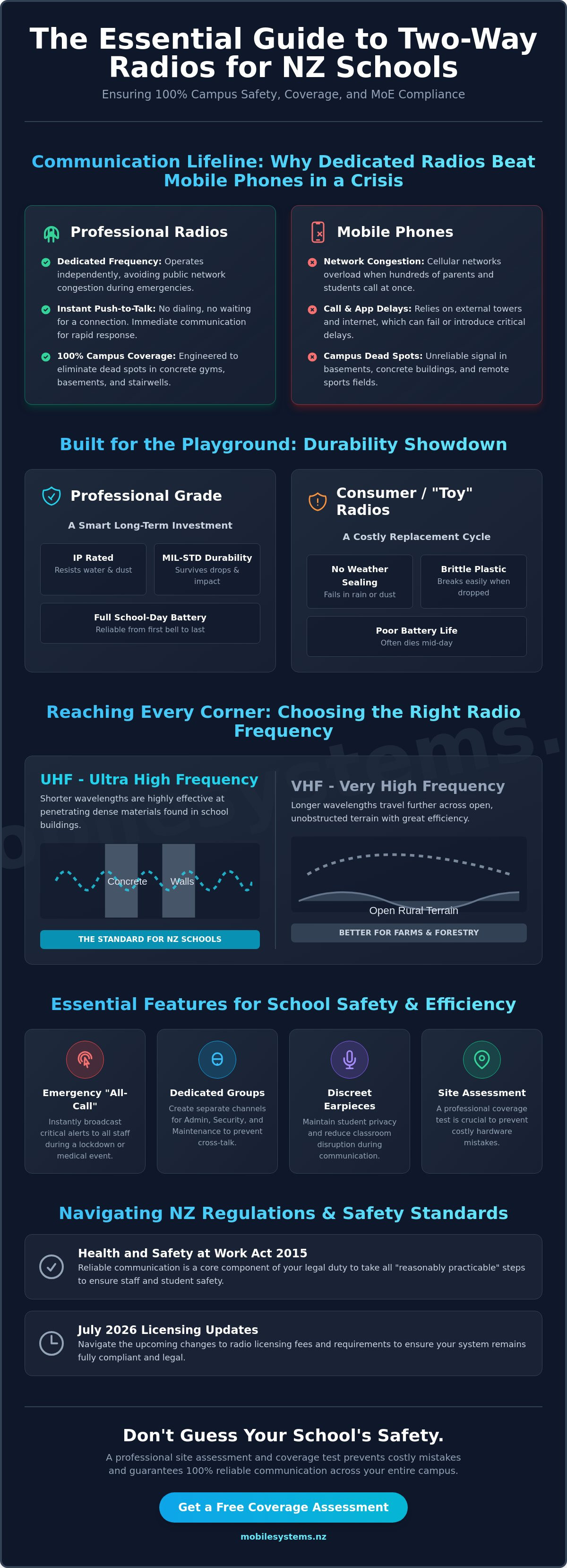
Mobile phones often fail when they're needed most. During a major emergency or a school-wide lockdown, local cellular networks frequently become congested as hundreds of students and parents attempt to make calls simultaneously. A dedicated radio system operates on its own frequency, providing a clear line of communication that doesn't rely on external towers or internet connectivity. Cell towers fail. Radios don't.
To better understand how these systems empower educational environments, watch this guide:
The Health and Safety at Work Act 2015 mandates that schools take all "reasonably practicable" steps to ensure the safety of staff and students. Reliable communication is a core component of this legal duty. By providing staff with commercial radios, you ensure they can call for immediate medical help or security assistance from any corner of the campus.
Operational efficiency also improves when you move away from a "one-channel" approach. Modern systems allow for dedicated groups, such as:
- Administration: For coordinating daily logistics and visitor arrivals.
- Maintenance and Grounds: For managing facility repairs without interrupting teaching staff.
- Security and Duty Teachers: For rapid response to playground incidents or gate monitoring.
Beyond the Classroom: Real-World School Applications
Effective communication extends to the edges of your school grounds. Coordinating large-scale sporting events or school trips becomes significantly safer when teachers can talk across a field instantly. Managing pick-up and drop-off zones also becomes more efficient, reducing traffic congestion and keeping students safe near moving vehicles. For assemblies or large outdoor events, integrating Portable PA systems ensures that instructions reach every student and parent clearly.
The Durability Factor: Education vs. Consumer Grade
Many schools initially buy "toy" radios from big-box retailers, but these units rarely survive a full term. They lack the battery life for a full school day and break easily when dropped on asphalt. Professional hardware is built to a different standard. Understanding the fundamentals of Two-way radio technology helps school leaders see why commercial units are a better long-term investment.
Commercial radios feature high IP-ratings for water and dust resistance, along with MIL-STD durability. This means they'll keep working after being dropped by a duty teacher or caught in a sudden downpour. While the initial cost is higher, the total cost of ownership is lower because you aren't replacing broken handsets every few months. A tailored assessment from an expert usually prevents these costly hardware mistakes.
Understanding the Technical Requirements for School-Wide Coverage
While UHF is designed to penetrate solid structures like concrete school blocks, VHF is better suited for long-distance communication across open, rural terrain. Choosing the wrong frequency is the most common reason school systems fail to reach staff in critical areas like basements or internal stairwells.
UHF (Ultra High Frequency) is the standard choice for most New Zealand campuses. Its shorter wavelengths are highly effective at navigating through the dense materials found in modern school architecture. If your staff needs to communicate from inside a classroom to a duty teacher across the quad, UHF provides the reliable signal penetration required to bypass brick and steel.
VHF (Very High Frequency) remains a viable option for rural schools with expansive outdoor grounds and few large buildings. Because VHF signals travel further over flat, open land, they're ideal for schools with massive sports fields or forestry blocks. However, for the average urban or suburban school, VHF often struggles to reach through internal walls.
Even with the right frequency, large campuses or multi-storey buildings can suffer from "dead zones." Repeaters solve this by receiving a signal and re-transmitting it at higher power. Installing a repeater ensures 100% coverage in notoriously difficult spots like gymnasiums, performing arts centres, or underground car parks. A tailored coverage assessment often identifies these gaps before they become safety risks.
PRS vs. Licensed Frequencies: Making the Safe Choice
Many schools mistakenly use PRS (Personal Radio Service) channels, which are public and license-free. During a crisis, these channels quickly become congested with chatter from nearby construction sites or truck drivers. This interference can block emergency transmissions when every second counts.
A private, licensed frequency from Radio Spectrum Management (RSM) provides your school with a "dedicated lane." This prevents outside interference and ensures your security remains intact. Licensed digital radios also offer basic encryption, meaning people outside the school can't eavesdrop on sensitive conversations regarding student welfare or staff movements.
Digital vs. Analog: The 2026 Standard
Digital Mobile Radio (DMR) has become the professional standard for educational environments. Unlike older analog systems that get "fuzzy" as you move further away, digital radios maintain clear audio quality right to the edge of their range. They also feature digital noise cancellation, which filters out the background roar of a noisy playground or a windy sports field.
Battery life is another significant advantage of digital technology. Because digital units only transmit for half the time (using TDMA technology), they consume less power. This ensures your handheld radios last through the full school day and any after-school events without needing a mid-day charge. For a deeper look at this technology, you can read our guide on DMR and digital radio systems.
Key Radio Features for Staff: From Duty Teachers to Emergency Response
Modern two way radios for schools nz offer specialized safety features that go far beyond simple push-to-talk functionality. For senior leadership and emergency response teams, these tools provide a level of control and oversight that consumer devices cannot match. Understanding these features ensures you select hardware that actually supports your staff's daily workflows.
The Emergency "All-Call" button is perhaps the most critical feature for any New Zealand school. With a single press, a staff member can override all other radio traffic on every channel. This ensures that an urgent alert, such as a medical emergency on the sports field or a security breach, is heard by everyone simultaneously. It eliminates the need to switch channels manually during a high-stress event.
Privacy is equally important in an educational setting. Using radio earpieces and headsets allows staff to communicate discreetly about sensitive student matters or behavioral incidents. This prevents students or visitors from overhearing confidential information, maintaining a professional environment while ensuring the right people stay informed.
Safety for non-teaching staff shouldn't be overlooked. Lone Worker and Man Down alerts are essential for groundskeepers or caretakers who often work alone in remote parts of the campus or after hours. If a radio remains tilted at an unusual angle or hasn't been used for a set period, it can automatically trigger an alarm to the main office, providing a vital safety net for isolated employees.
Emergency Lockdown Integration
During a crisis, a "silent lockdown" protocol is often the safest approach. Two-way radios allow the front office to transmit instructions directly to teachers' earpieces without making a sound in the classroom. This keeps students calm while providing staff with real-time updates. Integrating these radios with existing PA systems allows for a dual-layered alert approach, ensuring no corner of the school is left in the dark. Hearing a calm, authoritative voice via a radio can also significantly reduce the psychological stress felt by staff in isolated areas during a drill or real event.
Accessories that Improve Daily Functionality
The right accessories turn a good radio into a seamless tool. Multi-unit chargers are a practical necessity for the staff room, allowing all handsets to be centralized and charged overnight in one footprint. For teachers on yard duty, Remote Speaker Microphones (RSMs) are a popular choice. These small units clip to a jacket or shoulder, allowing the teacher to listen and talk without having to unclip the radio from their belt. This hands-free operation is particularly useful when managing groups of students or equipment. A tailored assessment of your staff's specific roles will help determine which accessories are most beneficial for your campus.
Navigating NZ Regulations and Radio Licensing for Schools
Managing the airwaves in New Zealand is the responsibility of Radio Spectrum Management (RSM). For two way radios for schools nz, a private license is the only way to guarantee a clear, interference-free channel that won't be interrupted by nearby commercial activity or local construction crews.
Budgeting for these systems requires awareness of upcoming regulatory changes. Effective July 1, 2026, the standard annual fee for a radio license in New Zealand will increase to $190.00. This fee applies to 98.6% of all radio licenses, including the vast majority of those used by educational facilities.
For larger campuses using more complex networks, the costs change slightly. A Land Mobile Radio License for up to five repeaters will be $800.00 annually, while networks with more than five repeaters will cost $1,800.00 per year. These fees ensure your school has a protected frequency that others cannot legally use.
Importing cheap, unrestricted radios from overseas is a common and risky mistake. Brands like Baofeng or Wouxun are often prohibited for general use in New Zealand because they can interfere with emergency services. Using non-approved equipment can lead to significant fines and puts your school's compliance at risk.
Health and Safety Compliance in the NZ Context
The Ministry of Education (MoE) emphasizes the need for reliable communication during critical incidents. "Type Approved" equipment ensures your hardware meets New Zealand's technical standards and won't fail during a high-stakes response. This is a key part of meeting your obligations under the Health and Safety at Work Act 2015.
Maintaining radio logs is another practical step for incident reporting. If an emergency occurs, having a record of communication can be vital for post-incident reviews. Professional digital systems can even automate some of this data, providing a clear timeline of events for school board reports or health and safety audits.
Managing the Licensing Process
Attempting to navigate RSM applications alone often leads to frequency interference with neighbouring businesses. A professional assessment ensures your assigned frequency is clean and won't clash with others in your local area. This prevents the "crosstalk" that often plagues cheaper, unmanaged systems.
Mobile Systems simplifies this by handling all RSM paperwork on behalf of our partner schools. We manage the technical details of the application, ensuring your system remains legal and your coverage stays clear. If you're unsure about your current licensing status, contact us for a regulatory audit to ensure your school remains fully compliant.
Designing and Implementing a Professional Radio Solution with Mobile Systems
Implementing a communication system for a school requires more than just unboxing handsets. At Mobile Systems, we take a consultative approach to ensure your investment in two way radios for schools nz provides reliable coverage from the front gate to the furthest sports field.
Our process begins with site-specific coverage testing. We use professional diagnostic tools to map your campus and identify signal obstacles. This allows us to design a custom system that accounts for your school’s unique topography, whether you're dealing with multi-level concrete blocks or a sprawling rural site.
Technology is only effective if your staff knows how to use it. We provide comprehensive training to ensure every teacher and administrator feels confident operating the equipment during a high-pressure incident. If a unit requires maintenance, our mobile service vehicles can often perform on-site repairs or servicing, minimising downtime for your safety network.
Tailored Assessments for NZ Schools
Many schools find that "one size fits all" radio packs from retail stores fail because they lack the power to penetrate modern building materials. These consumer units often lead to frustrating dead spots in gyms or internal corridors. A tailored assessment often prevents costly mistakes by ensuring total coverage before you commit to a purchase.
By identifying signal gaps early, we can recommend the right hardware to match your specific needs. For example, an entry-level professional radio like the Hytera BD-612 at $559.00 NZD might suit a small primary school, while a larger secondary college might require the advanced features of the Hytera HP682. This proactive approach ensures your school doesn't waste budget on equipment that isn't fit for purpose.
Next Steps: Securing Your Campus
The first step toward a safer campus is auditing your current communication gaps. Whether you're upgrading an old analog fleet or starting from scratch, professional guidance ensures your system meets both MoE guidelines and the 2026 licensing requirements managed by Radio Spectrum Management.
We invite school leaders to see the difference commercial-grade hardware makes. You can contact the Mobile Systems team for a full campus audit or to request a practical demonstration of the latest walkie talkies currently available in New Zealand.
Securing Your School’s Future with Reliable Communication
Ensuring the safety of students and staff requires a communication system that works the first time, every time. Transitioning to professional-grade two way radios for schools nz eliminates the dangerous unpredictability of dead spots and network congestion. By choosing digital technology over consumer-grade alternatives, your campus gains a dedicated safety infrastructure that meets modern health and safety standards.
Mobile Systems provides the technical expertise needed to navigate complex RSM licensing requirements and the 2026 fee updates. As specialists in Tait and Hytera commercial radio systems, we offer NZ-wide onsite support through our fleet of mobile service vehicles. We don't just sell equipment; we partner with you to maintain a secure environment through custom design, staff training, and ongoing maintenance.
Take the first step toward a more resilient campus. You can Request a Professional Campus Communication Audit to identify your specific needs and ensure total coverage. Investing in the right technology today provides peace of mind for your entire school community tomorrow.
Frequently Asked Questions
Do we need a licence to use two-way radios in our school?
While you can technically use public PRS channels, schools require a private license from Radio Spectrum Management (RSM) for secure, interference-free communication. A private license ensures your emergency transmissions aren't blocked by outside users, which is a critical requirement for student safety. We manage the licensing process to ensure your frequency is protected and legal.
Can we use our existing radios with a new digital system?
It's possible if your existing radios are compatible with Digital Mobile Radio (DMR) standards. Many modern digital units can operate in "mixed mode," allowing them to communicate with older analog handsets during a transition period. However, you won't access the full benefits of digital clarity or enhanced battery life until your entire fleet is upgraded.
How many channels does a typical primary or secondary school need?
Most New Zealand schools operate effectively with four to six channels. This typically includes dedicated lines for senior leadership, duty teachers, grounds maintenance, and a priority channel for emergency response. Separating these groups prevents non-urgent chatter from interrupting staff who are managing student incidents or playground duty.
What is the range of a commercial handheld radio on a standard NZ campus?
A professional handheld radio generally covers 1 to 2 kilometres in a built-up school environment. Range varies based on building materials and topography; however, two way radios for schools nz are specifically selected to maintain signal through dense concrete. For very large campuses or multi-site schools, we can install repeaters to extend this range further.
Are two-way radios better than mobile phones for school lockdowns?
Radios are superior because they provide instant, one-to-many communication without the risk of cellular network congestion. In a lockdown, teachers don't have time to dial numbers or wait for a signal; they need immediate voice contact. A radio system remains operational even if local cell towers are overloaded by worried parents making calls.
How long do the batteries typically last on a professional school radio?
Professional digital batteries are designed to last 12 to 18 hours on a single charge. This ensures the devices remain active through the full school day, after-school sports, and evening parent-teacher interviews. Unlike consumer electronics, these batteries are built for thousands of charge cycles before they need replacement.
Can we integrate our radio system with our school PA system?
Yes, you can bridge your radio network with your existing public address system. This allows staff to trigger school-wide announcements or lockdown alerts directly from their handheld radio, saving critical seconds during an incident. This integration ensures that your emergency protocols are heard in every classroom and outdoor area simultaneously.
What happens if we have "dead spots" in our concrete school buildings?
Dead spots are usually resolved by installing a repeater or a distributed antenna system. We conduct site-specific testing to locate these gaps and ensure your signal reaches every classroom, basement, and gymnasium on campus. A tailored assessment prevents the frustration of losing contact in critical areas during a drill or real emergency.
Related posts

- June 19, 2026
Fall detection, no-motion sensors, and GPS - here's exactly how a man down alarm knows something's wrong, and how the...

- June 13, 2026
In 2024, New Zealand recorded 70 work-related fatalities and more than 209,000 injury claims. These statistics underscore the heavy responsibility...

- June 11, 2026
New Zealand's workplace fatality rate is 1.7 times higher than Australia's, a stark figure that highlights the urgent need for...